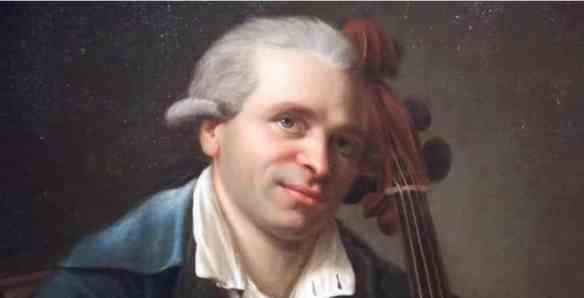
Jean-Louis Duport, cellist and composer – portrait by Remi-Fursy Descarsin
Sonata no.1 for piano and cello in F major Op.5/1 (1796, Beethoven aged 25)
Dedication Friedrich Wilhelm II, King of Prussia
Duration 25′
Listen
Background and Critical Reception
Before Beethoven, the cello was an instrument with its roots in accompaniment. The first edition of Bach’s solo suites was yet to appear. Some composers, notably Vivaldi and Boccherini, brought the instrument forward in wonderful solo concertos, and wrote sonatas with harpsichord for private use. However neither Haydn nor Mozart wrote for the instrument in a singular capacity. Haydn’s piano trios assign the cello faithfully to the bass line, while the string quartets of both composers rarely elevated its profile. Notable exceptions occur in Mozart’s last three quartets, written for Friedrich Wilhelm II, King of Prussia.
Five years after Mozart’s death, Beethoven paid a visit to the King’s court in Berlin, where two cellist brothers were working – Jean-Pierre and Jean-Louis Duport. To honour the occasion Beethoven composed a pair of substantial sonatas published as Op.5 and explicitly stated to be ‘for piano with cello’. It is thought the younger Duport, Jean-Louis, gave the premiere of both Op.5 works, with Beethoven himself taking on the challenges of the piano part.
The composer’s aim was to unite the two instruments in the way Mozart had done through his sonatas for piano and violin, though as Steven Isserlis notes in his writing for Hyperion, Op.5 no.1 is more like a concerto for the two. In his foreword for the thoroughly engaging book Beethoven’s Cello, by Marc D. Moskovitz and R. Larry Todd, Isserlis describes how Beethoven was ‘rattling the cage of classicism’ with these two works.
The book proceeds with a forensic but wholly accessible look at this piece and its innovations, not to mention its instinctive and joyful writing for the instruments. ‘For the first time ever, the cello and piano, collaborating as equals, begin the conversation together, in unison’. The dotted-note style is ‘a patent reference to the royal dedicatee, the Prussian monarch’, leading to an Allegro that has ‘an abrupt about-face…a playfully buoyant piano theme’.
The Allegro is the main body of the work, and is complemented by a Rondo third movement where, as the book explains, Beethoven ‘again stretched his musical canvas’, broadening the structure of a typical Rondo (where three different ideas appear in the order ABACABA) to incorporate yet more melodic ideas.
Thoughts
This is one of the most original statements in Beethoven’s music so far. As he did in the Op.1 piano trios, Beethoven is using a relatively new form to broaden his means of musical expression, this time using a form completely untouched by Haydn and Mozart. Here he has the freedom to set his own rules as well as expand the previous ones.
The shock of the new runs through this piece. Beethoven appears to have been intoxicated by the freedom of writing for the cello in a solo capacity, and for such a distinguished dedicatee. He takes risks, leaving no stone unturned while exploring the relationship between the two instruments. At his disposal are many memorable tunes, worked with daring twists and turns through far ranging harmonies and textures.
You can sense the composer literally rubbing his hands as he presents both the Duport brother and himself a fiendish but ultimately surmountable set of musical posers.
The introduction of Op.5 no.1 would have raised a few eyebrows at the first performance, and still does when you consider, as Steven Isserlis noted, that ‘Beethoven was practically inventing the medium as he wrote’. The slow introduction establishes the partnership and a genial atmosphere. It is fully realised in a substantial and joyous Allegro where cello and piano trade thoughts and literally bounce off each other, bursting with enthusiasm.
Looking at the timings for the movements suggests an imbalance, with a first movement of a quarter of an hour (including the introduction) and a second movement of 7 minutes, but there is no suggestion of this at all in listening to the work. The third movement is bright and lively, with one of those tunes you end up whistling in the street after a concert, and there are more opportunities for both instrumentalists to demonstrate their skill in the king’s presence. Beethoven moves them to distant keys towards the end, playing with his audience as he anticipates the final straight.
This is wonderful music, giving its listener both then and today the fullest possible sense of discovery. Piano and cello form a true partnership, with Beethoven once again showing his ability for true innovation. This is another form transformed – with many more to come!
Recordings used and Spotify playlist
Steven Isserlis (cello), Robert Levin (fortepiano) (Hyperion) Heinrich Schiff (cello), Till Fellner (piano) (Philips) Miklós Perenyi (cello), András Schiff (piano) (ECM) Mstislav Rostropovich (cello), Sviatoslav Richter (piano) (Decca) Pierre Fournier (cello), Wilhelm Kempff (piano) (DG)
The playlist below contains a handful of recordings of this piece, from notable duos such as Mstislav Rostropovich and Sviatoslav Richter, Heinrich Schiff and Till Felner. Miklós Perenyi and András Schiff and Pierre Fournier and Wilhelm Kempff. All those listed are brilliant partnerships, compelling from first moment to last – especially Perenyi and Schiff. Yet the one I return to most often is the partnership between fortepianist Robert Levin and cellist Steven Isserlis, playing the music as though it was written yesterday in an account of spontaneity and joy.
The below playlist includes all the recordings mentioned above save Isserlis and Levin – to hear clips from this you can visit the Hyperion website
You can chart the Arcana Beethoven playlist as it grows, with one recommended version of each piece we listen to. Catch up here!
Also written in 1796 Haydn – Mass in C major, Hob.XXII:9 Missa in tempore belli (‘Mass in Time of War’)
Next upSonata for piano and cello in G minor Op.5/2
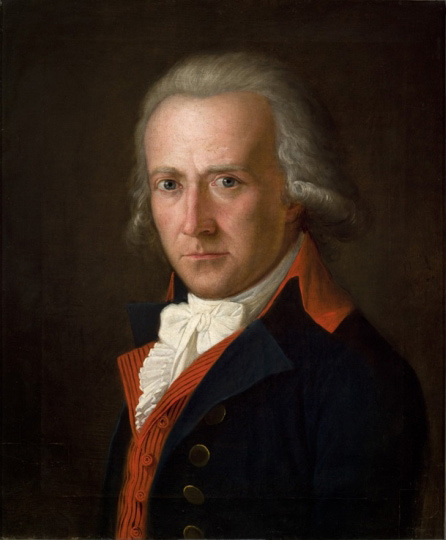
Friedrich von Matthison – portrait by Ferdinand Hartmann
Opferlied Hess 145 for voice and piano (1796, Beethoven aged 25)
Dedication not known
Text Friedrich von Matthisson
Duration 3′
Listen
Background and Critical Reception
This is our second encounter with a text Beethoven was to set four, maybe even five times in the course of his life – and it is his second setting in a year, following the version tagged as WoO 121. The poet Friedrich von Matthisson has also featured previously in his output – through the cornerstone song Adelaide – but now the Opferlied (‘Song of Sacrifice’) appears in a setting for lower voice and piano. As the Unheard Beethoven site points out, it would be finally completed to the composer’s satisfaction when properly published as Op.121b in 1824.
The text stayed with him from now until the end of his life – and again we refer to Unheard Beethoven for noting that it runs hand-in-hand with Ode an die Freude, the Ode to Joy, as a text the composer was mildly obsessed with.
Thoughts
This setting of the Opferlied pairs singer and pianist closely – the right hand of the keyboard shadowing the melody almost throughout. The tempo is slow but the song seems to end a bit too soon, perhaps reflecting its unpublished status.
As with the first version there are strong hymn-like moments in Beethoven’s writing, the singer transported by his text.
Recordings used
Paul Armin Edelmann (baritone), Bernadette Bartos (piano) (Naxos)
Seemingly the only available recording of this version of Opferlied, the performance has a nice poise in the hands of Paul Armin Edelmann and Bernadette Bartos.
Spotify link
You can chart the Arcana Beethoven playlist as it grows, with one recommended version of each piece we listen to. Catch up here!
Also written in 1796 Boieldieu – Duet no.2 in B flat major for harp and piano
Next upSonata for piano and cello in F major Op.5/1
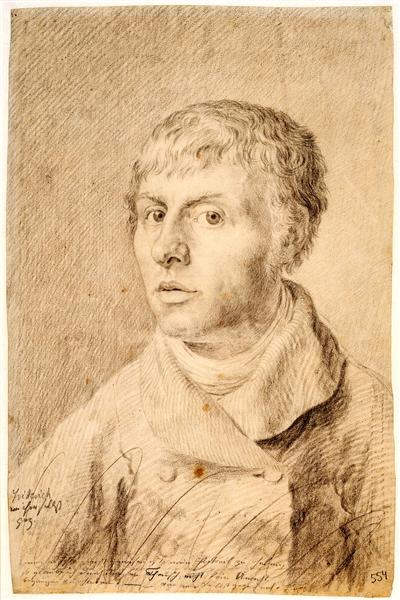
Self-portrait as a young man by Caspar David Friedrich (1800)
Piano Sonata no.20 in G major Op.49/2 for piano (1795-6, Beethoven aged 25)
1 Allegro ma non troppo
2 Tempo di Minuetto
Dedication unknown
Duration 8′
Listen
Background and Critical Reception
One of Beethoven’s shortest piano sonatas, this miniature jewel in G major is an early work in spite of its Op.49 publication. It was published alongside an equally compact work in G minor but is thought to have been written during Beethoven’s visit to Prague in 1796, one of the few times he ventured away from Vienna.
Angela Hewitt, writing in the booklet notes for her Hyperion recording, describes that ‘after a straightforward, no-fuss Allegro, ma no troppo (a study for playing triplets), Beethoven gives us a beautiful movement in the tempo of a minuet, an example of a dance that figured prominently in his music. He must have liked this theme because he used it again in the third movement of his Septet in E flat major Op.20 (1799)’.
Thoughts
The first movement of G major sonata is almost certainly the first complete sonata movement a piano student will encounter – such was the way for me. And yet despite its supposed technical ease it has a poise to rival the most charming works of Mozart and Haydn.
Beethoven writes with a relatively light touch, a few crunchy chords aside, and the tunes are attractively delivered and then developed. A call to arms from the first chord is answered by more delicate thoughts, and this to and fro forms the basis of the first movement. The second movement has its roots more obviously in the dance, and begins with a true earworm that deserved its place at the heart of the wonderful Septet – still to come in our listening. This slightly cheeky tune returns at regular intervals, as though checking we haven’t forgotten about it, before signing off with a thoughtful full stop.
Recordings used and Spotify links
Emil Gilels (Deutsche Grammophon) Alfred Brendel (Philips) András Schiff (ECM) Angela Hewitt (Hyperion) Paul Badura-Skoda (Arcana) Stephen Kovacevich (EMI) Igor Levit (Sony Classical) Ronald Brautigam (BIS)
There are many thoroughly enjoyable versions of this piece. In picking out a few, I would commend Ronald Brautigam for the freshness of his fortepiano phrasing, even though the recorded sound is a little roomy at times. As András Schiff points out in his notes for ECM, there are no dynamic markings for the sonata, so the performer has to interpret them. His own recording is also quite reverberant, with a clipped delivery turning the second movement theme into a real dance movement. Angela Hewitt takes a smoother approach to Op.49/2, beautifully pointed and phrased, with lovely balance between the hands. Emil Gilels has a more regal approach but is completely captivating in his account.
The playlist below accommodates all the versions described above except that by Angela Hewitt:
You can hear clips of Hewitt’s recording at the Hyperion website
You can chart the Arcana Beethoven playlist as it grows, with one recommended version of each piece we listen to. Catch up here!
Also written in 1796 Clementi 3 Piano Sonatas Op.35 .
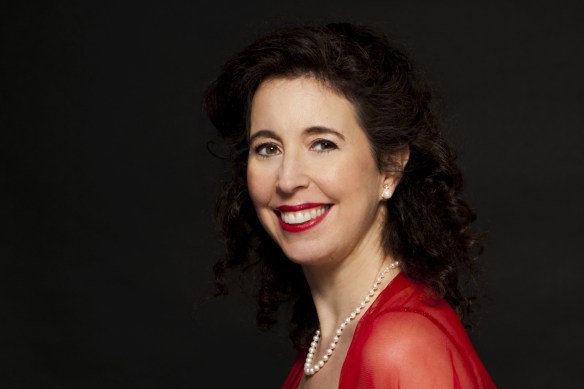
When Arcana spoke with Angela Hewitt, we were just a few weeks into lockdown. Since then, she has been able to complete her recorded cycle of all 32 Beethoven Piano Sonatas for Hyperion, concluding with two of the titans – the Hammerklavier, Op.106, and the final sonata, Op.111, both of which are due for release next year. She gave generously of her time so that we could discuss Beethoven’s works for piano.
For her recordings, Angela wrote all the notes accompanying the sonatas. “I put a lot of time and effort into those”, she says. “I enjoy it, and it’s important for me to know all those things, and there are so many interesting details. I try to make them notes that everyone can read, so that they’re not too technical. With so many notes that you read they can be boring, and you have no idea what people are talking about. I like to situate it within the life of the composer, what’s going on and how the music relates to it.”
The Hyperion cycle was carefully planned, placing a well-known sonata such as the Moonlight alongside others equally deserving, to give them more exposure. “I did that for two reasons”, she says. “One was because I thought it was more interesting than doing the groups together, like the three Op.10s or the three Op.31s and the last three, like everybody else has done, and because when I started the project there were some sonatas I had to learn. In the earlier records I put the ones I had played a lot, in my youth or up until then anyway. That’s partly why it worked out that way, but each record makes for a very interesting recital.”
When recording a new set of sonatas, does the pianist have to some extent ignore the recorded history around the pieces, and go with what they feel themselves musically? “Yes – very, very, very much so!” she says emphatically. “Especially with the famous sonatas but also with the others, there is so much taken for granted ‘because that’s how it goes’. When you look at the score it’s not at all how it goes, and not at all what Beethoven wrote. There are so many examples you could take, but one that comes to mind is the beginning of Op.10/3, with absolutely no crescendo before you get up to the ‘A’. That’s just one tiny thing, you really have to look at the score. I really enjoyed that aspect of it, and I am also determined to learn the Hammerklavier without going to listen to how every Tom, Dick or Harry plays it, because actually I don’t know the piece that well. It will be rather exciting to learn such a piece just looking at the score and learning it from what Beethoven left us.”
She was influenced in this way of thinking by other performances she had seen. “When I heard the early music people like Roger Norrington, and his Beethoven cycle back in 1987-88 at the Queen Elizabeth Hall, I remember all those concerts vividly to this day. It completely changed my way of looking at Beethoven. Up until then of course I enjoyed it, but I didn’t quite get it. You hear a lot of the interpretations, and I was living in France up until 1985, and people used to say ‘Oh, C’est Olympien’ – it’s Olympian when anybody played it, you know, and I just thought it was incredibly boring!”
The orchestral concerts turned Hewitt’s thinking around. “I never really got it, but then I heard Norrington and John Eliot Gardiner do it and I thought ‘Wow, that’s what it’s about!’, with the excitement in it and not dragging those slow tempos. It was just an eyeopener and I remember going home after those concerts, going to the Beethoven sonatas that I already played, and applying that and thinking, ‘Now I realise what I have to do here. Not just with Beethoven but Mozart as well, but Beethoven especially. That was a huge stimulus to me and one where I took the best of what I heard and applied it to how I felt. It really gave me a different way of looking at them.”
I share my own experiences of ‘getting’ a composer, which can often begin with a quest to try and understand the music, waiting for the penny to drop. “I also think it’s very important when you approach Beethoven to go from Baroque training rather than when you go back to him from being a Romantic pianist specialising in Chopin, Liszt or Rachmaninov. That’s totally the wrong direction. When you look at his music as coming out of the Baroque and early Classical it completely makes sense. You have all the training in counterpoint and harmony, and his own love of Bach, having played The Well Tempered Clavier. When you look at his music horizontally like that and clean it up, you pay attention to articulation and get the fingering to match that. Beethoven was the first to use the pedal, and use it to great effect, but not just to apply it systematically. If you get that right it really makes a big difference.”
We agree about the importance of silence in Beethoven’s music, too. “You hear that in Op.7, in that slow movement – that’s one of the best examples of how expressive a silence could be. My music teacher said he was very good at that, and used to circle the rests on the score as expressive, you know? That’s something that is very hard to teach, because either a student feels it or they don’t, really. You can fill that silence with expression but it’s not an easy thing to do unless you feel it. Beethoven was a master of that, and yes, that Op.7 is a beautiful example.”
She notes the physical demands of playing Beethoven’s music. “After Bach I find him the most demanding of composers. People might say that Beethoven wrote stuff that is a lot more technically demanding than Bach, but in Bach you cannot cheat and it demands so much musical intelligence. You have to put everything in there yourself, you know. Bach is the hardest to bring off really well I think, but the problem with Beethoven is that the more you give to it the more you get back, the more you see what’s there and the more difficult it becomes, in a way! It’s quite easy to bash your way through the Pathétique sonata, but if you really want to play it well then that takes an incredible amount of work.”
Hewitt often pairs the two composers in concert. “Often, I will give Bach / Beethoven recitals, with a substantial Bach partita or suite in each half along with a Beethoven sonata. Those are always incredibly exhausting and demanding programmes, probably much more than people realise. I worked hard at the Beethoven Waldstein sonata and came to it quite late, because when I was young, I couldn’t stand everybody banging away at it, it just sounded so dreadful! When I got to it just a few years ago I could see what was in it and really enjoyed playing it. I don’t think it’s his greatest sonata but it is a wonderful performance piece when you can bring it off. If you look at every detail in it then it and want to play it well it is very difficult. I do find he is extremely demanding on the interpretative level but on many levels, not just technically to manage the notes which is often hard enough, but to make sense of it and find the right mood and colour.”
Does she get the sense of the enormous amount of Beethoven’s personality is in the music? “Of course. It’s totally different from Bach. Of course Bach’s personality is there, and there is great joy in his sense of the dance which is in every note he wrote. Beethoven really, when you play all the sonatas you realise what a personal document it is, what a personal confession. They tell of his whole life, because they start in his early years and go almost right to the end. What I wanted to say about that too is that the more you open up yourself playing Beethoven, and I almost mean physically when you’re playing, you have to think that you’re opening up your body and letting it in. The more you do that the more you see the incredible immensity of what he was saying, and also I think the diversity. He wrote music of such great tenderness too. We think of Beethoven as being ‘crash bang wallop’ most of the time, which he is at times, and you take something like the Emperor concerto where he is both. You take the piano writing after those opening flourishes, it’s marked dolce – which is gentle – which a lot of people don’t really do. A lot of that concerto is marked pianissimo as well, even in the brilliant movements. He had an immense tenderness, and the opening of the fourth concerto is an obvious example. Sometimes I think that’s lacking in interpretation.”
We share a great love of the three sonatas Op.31. “They are all fantastic, aren’t they? I learnt the Op.31/3 first, and recorded it some time ago, in about 1988. It’s a wonderful piece, the Hunt. I must play that piece again, once I’ve learned the Hammerklavier I will go back and play the ones I haven’t played for a while. Then there is the Tempest, which I left until the year before I recorded it. I adore that piece, it is one of my favourites to perform, and the slow movement is so gorgeous. It’s unique among the sonatas, it is very declamatory, and it speaks in a different way to the others. Who knows about the title, but it does have something very special about it. Then the G major, which I never understood when I was young. I looked at this thing and thought, ‘What the hell is that’, you know?! Then after doing some work now I understand it. A musician friend asked me the other day to learn that slow movement again, so I could play it again. It’s very operatic and very, very difficult to do. It has to be very poised, and you have to be the orchestra too! That’s another thing in Beethoven – that you have to be not just the pianist but a really good conductor and orchestra too, because so much of this music you can hear the orchestra in it. I tell students that in masterclasses, I get them to play and then conduct, to sort out the timing. You have to be a pianist, a conductor, a singer, an orchestral player even!”
Hewitt has also recorded the sonatas for piano and cello, with Daniel Müller-Schott as her partner. “They are fantastic pieces too. The A major, Op.69, I played when I was living in Paris in my early twenties, with chums at the conservatoire. It is the most wonderful piece. I’m making my way through the violin sonatas as well; I’ve done four or five. I want to finish those eventually; I think it’s good for pianists to know those works as well.”
Of the Beethoven works that don’t feature the piano, Hewitt has her favourites. “The symphonies I adore, they are all fantastic. The Second Symphony has always been a favourite. There is some surprising stuff in the songs. I’ve done many of them, in the last year at my festival, and accompanied Anne Sofie von Otter and Anu Komsi. There is some amazing stuff in the songs. I found out the other day when I was writing the booklet notes for my variations disc on Hyperion that there are some 150 folksong arrangements, even Auld Lang Syne! I didn’t realise that.”
Her disc of the Variations was released on Hyperion in September, and she is keen to expand on the pieces. “Everyone talks about the Diabelli Variations, but the Eroica Variations has been one of my big pieces since 1990, when I first played it at the Beethoven festival in San Francisco. I also did the Piano Concerto no.4 with Sir Roger Norrington that year. The Eroica Variations are on the new disc, and there are some of the variations that are very amusing, too. I did the God Save The King and Rule Britannia ones as well, which were a hoot, and I did two Paisiello ones which were easy but charming, pieces that pianists can really work on and improve their way of playing. I also did the beautiful Variations in F major Op.34 which I did as a teenager. It’s great to capture the character of each variation and then to make a whole out of it. It’s a very important work and shouldn’t be put aside as a piece of lesser importance. It’s important to know how to play the variation sets well.”
The C minor variations, from my own concert experience, can be eye-popping too. “They are terrific really, and of course it’s a Baroque theme, with a chaconne rhythm and everything. When Beethoven heard them live, he said, ‘Who wrote that?’, and someone said, ‘You did!’, and he said, ‘What an ass I was in those days’, or something like that! It’s a terrific piece and makes a great impression. What an imagination he had, and what a sense of overall architecture. That is a really important thing when you are playing Beethoven, you need this sense of overall architecture, of where you’re going. It’s not enough just to play the notes well, you have to make a shape out of the whole thing. You see that especially in the later sonatas but also in the early ones. It was an interesting experience for me learning the Op.111 sonata last year. Like the Waldstein sonata it was a piece I had heard a lot in competitions as a kid, and I thought I never wanted to play it. Now of course I have had incredibly moving experiences playing it. I’ve only played it twice live, once as part of my festival in the beautiful church in Perugia. In something like the second movement variations you really have to find an overall shape, and in Op.109 too, which is very difficult to bring off. I found that very hard.”
She learned the shorter Bagatelles much earlier in life, “when I was a kid, at my first recital when I was nine! There is a Rondo in G major too which I used to play, but I haven’t played them for many years. The concertos of course I have played, and the Triple Concerto too. I have conducted nos.2 and 4 from the keyboard, with the Britten Sinfonia, which was wonderful – to get it just exactly how you wanted it. I’d like at some point to do the others like that. If you do have an extraordinary conductor that’s wonderful, but there are some things in the Emperor concerto where you would like some extra elasticity sometimes, and that isn’t really possible unless you’re conducting it yourself.”
Her interpretations usually draw positive reactions. “Orchestras have played those pieces so much that they are so familiar with them, and if you put in something different, really looking at the score and what is there, then you notice a point at which they sit up and think. I think it’s still possible to get incredible excitement out of playing a piece that is so well known from the musicians themselves.”
Away from Beethoven, Hewitt has an unexpected connection with Manfred Mann, who she met while travelling. “I was going up to Helsingborg to play the Goldberg Variations in a festival”, she begins, “so I flew to Copenhagen. I got on the train to Helsingborg and it was the rush hour. I had to run to get on the train and found the first-class compartment, and there was just one seat left. I got on just as they were closing the doors, and shoved myself into the seat and collapsed, you know. I noticed there was a man sitting across from me with this rather eccentric looking hat on, and he looked a bit eccentric. I thought he looked harmless! So, I pulled my laptop out and started typing away, and then at Malmo everybody got off except for a few of us. He stayed on, and he asked if the train was going on. I moved over to the table adjacent to us because there was more room, and I took a phone call. Then, at one point, I can’t remember how we started talking, but his opening line was, ‘Do you always work on your laptop with such good posture?!’”
She laughs. “Well, I used to be a dancer, so we got on to how I play piano, and he said, ‘I play a bit of keyboard’, and then he started asking me questions about fingering, if you’re playing an E flat major scale very quickly what would be your best fingering to jump up and back. So, then I guess I said I was going up to play the Goldberg Variations, and he said he listened to the Art of Fugue all the time and has an LP of it. Then he said, ‘Are you travelling all alone?’ I had to go to a hotel in Helsingborg, but it was close enough so that I didn’t need to walk, and I said, ‘Do you know which direction I should go?’ He said, ‘I’ll take you there’. He couldn’t believe I was travelling all alone with all my luggage. We said goodbye, and then the next day I went out to practice, and when I came back into the hotel, there he was in the hotel lobby! He was handing me a letter, which I read, and then through the letter he put his real name, which is Manfred. Through the letter I realised who he was, and there was an e-mail address, so I wrote to him and said ‘You should have told me! Anyway, I’m going to practice the Goldberg tonight, in a hall, if you’d like to come, I’ll play it for you. He and his friend couldn’t get a ticket as it was sold out, which was why he had written to me. I gave him a private performance of the Goldberg Variations, which blew him away, and at the end he said. ‘I used to think I was a keyboard player!’ He has written to me several times since then.”
Perhaps inevitably, talk turns to the dreadful mishap Hewitt suffered back in February, when her beloved Fazioli piano was dropped during a house move. She appears to have dealt with this incident with the same poise with which she walks out onto the stage at the beginning of her concerts. “As I wrote somewhere, I had three nightmare days where the press of the whole world was after me. it was absolutely incredible – I couldn’t believe it. I put something on Facebook because I had to put something about my plans and made sure I had written it really well so that if it was reused, I didn’t mind if the whole world saw. Then the next day the Guardian was phoning my agency and trying to find out who the firm was. There were only 4-5 people who knew who the moving firm was, and that’s been their whole life – I didn’t want to shame them, because it was a very unfortunate accident. It just ballooned, it was the top story under the Coronavirus – and then CNN called! I was marooned in Italy which was a good thing because it was isolated, so I couldn’t go into a studio. I had no peace for three days; I was completely exhausted! I couldn’t go speaking about it on television though, I didn’t want to say anything else. It was really a lesson in how the media works these days, and how careful you have to be with what gets out there. On the other side however, you could say it was terrific publicity which you couldn’t buy! In the early days I was walking around, and people stopped me and said they were so sorry about my piano. The press loves a story, that’s for sure, but I’m still so glad I didn’t give any of those interviews. I think a lot of people would, just to be on CNN – but one has to preserve one’s dignity, you know what I mean!”
You can listen to excerpts from Angela Hewitt’s Beethoven discs on the Hyperion websitehere – and for more information on the pianist herself visit her websitehere
Celebrated pianist Cyprien Katsaris is on the phone to Arcana from Paris. We are to talk about the music of Beethoven, which he has celebrated with the release of a fascinating new box set, exploring a number of different corners of the composer’s piano output. Not for him a disc of sonatas – this includes some of Beethoven’s earliest and latest works, plus familiar utterances in unexpected guises, for instance Saint-Saëns’ and Musorgsky in arrangements of movements from the string quartets.
Cyprien is an extremely generous interviewee, and our chat is punctuated by musical examples given on the piano of his Paris apartment. He is also incredibly good-humoured and engaging. We begin the interview by discussing his first experiences of Beethoven’s music, which on the way reveal important aspects of his upbringing.
“We used to live in French Cameroon in the 1950s”, he says, “and I was raised there because my family emigrated from Cyprus. My parents were among the few people who had an LP collection, and I remember very well my first Beethoven listening was the Pastoral symphony and the Ninth, because they had those LPs. This could explain why I went into recording the transcriptions by Liszt of the nine Beethoven symphonies in the 1980s for Teldec, because since I was a kid I loved that music. I was always wondering if it was possible to enjoy this music with my own fingers on the piano, so you can guess the shock when I found out about those transcriptions, which were published by the French publisher Durand.”
He is a natural storyteller who draws some unexpected parallels. “As you might also guess, when you like something and you can’t get it, you want it more. It’s like having a girlfriend who is very beautiful, but when I walk down the street and I see another woman I want her even more because I know that I cannot get her. When I say this to my girlfriend she laughs, you know?! The same thing happened with the Pastoral symphony, and that could be the explanation for my very strong attraction towards transcriptions. I always try in my life to keep a balance in my concert programmes and recordings between normal, standard repertoire and forgotten pieces or transcriptions.”
His contribution to Beethoven’s anniversary is A Chronological Odyssey, a set of six CDs available on his own Piano 21 label. “The idea came to me in April last year, because I was wondering what to do for the 250th anniversary. Doing the 32 sonatas again did not seem like a good idea. There are so many, and I was told there are more than 70 versions. The idea was to do this chronological odyssey, mixing standard repertoire and transcriptions, and I also had a photocopy of the Kreutzer Sonata arranged for piano. I have had that for several years, and received it from a musicologist at the Beethoven-Haus in Bonn. He told me that the second movement was arranged by Carl Czerny. Nobody knows who did the other two movements, maybe Czerny and maybe someone else, and I was wondering if I should record it. That was the perfect combination, and the Spring Sonata too. They sound so nice on the piano. I only found out then that the Mozart and Beethoven sonatas, and the cello sonatas, are not written for violin and piano, but for piano with violin.”
We turn to Beethoven’s output of sonatas for solo piano. “As you know there are not 32 sonatas but 35”, he tells me, “because you have to include the first three ones that Beethoven wrote, known as the Electoral sonatas. I also wanted to include a rarity, the 2 Preludes in all 12 major keys. There is also the small Ritterballet, a commission from Count Waldstein. On the day of the premiere the Count said to the audience that he was the composer! It’s crazy. There is a piano transcription by Beethoven himself.”
Katsaris does also include some well-known works, such as the Moonlight and Appassionata sonatas. “I made a selection of eight sonatas in addition to the youth sonatas, and I tried to be careful about the combination of personal ideas and the information written by Beethoven himself on the score, considering that the pianos now are different to his years. For example, in the last movement of the Appassionata Sonata, it says Allegro ma non troppo, and almost all the big names who recorded or played it played it too fast! This is not what Beethoven wants. Of course it is a temptation to do that, but it’s not what he wrote!” By way of illustration he sings the theme. “These little details are important, in order to respect the wishes of the composer.”
A good deal of detective work has resulted in the unearthing of some unusual arrangements. “I have spent all those years – I’m 69 now – and I have been in libraries, specialist shops of antique scores, and sometimes you are lucky and sometimes not so lucky. Saint-Saëns, by the way, his anniversary is next year. He died in 1921, on 16 December – the exact anniversary of when Beethoven is supposed to have been born. I had invitations for a Beethoven recital in Bonn in May and September, where I was going to play the Symphony no.9 in a two-piano version with my good friend Etsuko Hirose. She lives in Paris, and won the Martha Argerich competition. We were going to play the Symphony no.9 together, and then I have an invitation on 16 December into the Beethoven Haus with several musicians playing a piece each. I hope the confinement t will allow us to do this. Saint-Saëns arranged for piano three movements from string quartets, and Musorgsky two movements from the last quartet, Op.135. It’s quite fascinating, and also the Wagner transcription of the Symphony no.9. It’s not as good as the Liszt version, but Wagner discovered the music of Beethoven when he was 18 years old, and he claimed that Beethoven and Shakespeare were visiting him in his dreams. He copied the Fifth and Ninth symphonies entirely, and transcribed the Fifth, so I wanted to include that transcription. It also allowed me to cover all the scores in my collection. Some of them I was not even aware of!”
There were more arrangements to come. “I found out about Louis Winkler, who made these great transcriptions of the Spring Sonata and some other pieces, and as I explained in the booklet, he did a lot and transcribed so many things! There was also Franz Kullak who transcribed the last movement of the Violin Concerto. It’s all very fascinating, and the idea was to have a chronological order from the very first transcription when Beethoven was 11 or 12 years old, up to the very last one. I didn’t even know that Beethoven wrote the short canons which he used to call a musical joke, which is very interesting and funny!”
He recounts his thoughts on Beethoven’s first work. “The very first piece is based on a march by Dressler. They didn’t find out where this march comes from, and I remember a German musicologist told me 25 years or so ago in Berlin that we pianists only play 2% of everything which has been published for the piano in the 19th century. Anyway, this piece is variations by a kid, and it could be considered in the beginning a little bit boring. I decided to change the tempi of the variations to make it a little bit more interesting, but this is not of course the only way to perform this piece. You can stay in the same tempo, like the theme. My argument is that when you consider Beethoven was a great improviser, like Mozart, Chopin, Bach or Liszt, the problem of composing music is that you have just one version put down in writing. For example, Chopin, when he played the same piece again, would change tempi, dynamics, the notes, even – we found several versions.”
The same applies here. “When you look at Beethoven maybe I am maybe the first pianist who recorded the four versions of that famous theme of the last movement of the Eroica Symphony. He wrote it first as a dance, part of a group of dances for orchestra with piano arrangements, and then he used it again as the last number of his ballet The Creatures of Prometheus. Then he uses it again in the last movement of the Eroica Symphony, and his Eroica Variations Op.35. It shows that sometimes they have these different ideas about a theme. We know he was a great improviser, and from the writings of Carl Czerny that he played quite fast and full of fire. I think that allows some freedom, especially in the Variations, and especially those that could become a little bit boring if you don’t add something a little bit more spicy. Of course Beethoven was a kid, and his teacher probably told him to keep the same tempo, but I think there is a probability that if Beethoven played that piece as an adult he would play it in a different way to when he was under the guidance of that teacher. What a pity we didn’t have recordings earlier!”
Cyprien also includes the Fantasy, published as Op.77 in Beethoven’s output. “What a difficult piece!” he exclaims. “This is a perfect example of what could have been an improvisation of Beethoven, right? It is a very interesting piece, and not often performed unfortunately. I don’t know if that is because it’s difficult. Is it because when a pianist wants to include the music of Beethoven in a program it’s always sonatas, and sometimes variations, and almost nothing else? I found out that some colleagues don’t even know about the existence of this piece. It’s a pity because it’s a great piece, and it’s interesting to have an overview between the first sonata and the last one.”
He has a special place for the last of Beethoven’s 32 sonatas, published as Op.111. “The last sonata is of course this great masterpiece. It’s all written in the booklet to the release, but it is expressing so much of what were the feelings and philosophy of Beethoven. With the Fantasy, you have at the end this strange theme which could be an embryo of the Ninth Symphony and the Ode To Joy theme. The same thing happened with Mozart. We are going to release the complete concertos in a few months, live recordings made in Salzburg, and one theme he used in his Piano Concerto no.8 in C major K246, and this theme he uses again a little bit differently in a later concerto, also in C major, and again in his last C major concerto, no.25. It’s so interesting to find out about all these connections. I remember about 15 years ago I made a CD devoted to the family of Mozart, the father and his son. I recorded one of the three sonatas of Leopold Mozart, which is a strange situation because he was a violinist but has not left any violin pieces! I found in his Piano Sonata in C major that the second movement contains some elements which are obviously used again by Mozart the son when he wrote the divine slow movement of the Piano Concerto no.21. This means that he remembered the slow movement of his father’s sonata.”
Katsaris is on something of a roll. “When I met your former prime minister Tony Blair at a dinner, I went to the piano of my friends and I improvised. First, I played the British national anthem, and then I improvised on the Warsaw Concerto, and Rule Britannia, and I asked him how many times did you meet the Queen in those Tuesday meetings? He could not remember because he did not write it down. But you know that Beethoven wrote variations on God Save The King and Rule Britannia, don’t you? On one of my CDs called Album d’un voyager, I recorded a piece, a set of variations on Rule Britannia composed and published in London something like 200 years ago by a French composer called Latour. He was established in London, and that was in my collection of old scores. Many people were writing fantasies, potpourris and variations on old tunes from Wales, England and Scotland.”
Our time is sadly up – which gives me time for one last question, on how Cyprien has reacted to lockdown conditions. “I am practising continuously”, he says with characteristic enthusiasm, “even without the confinement. I practise every day of the year. Life is too short and I have too many scores to still learn before I pass away! I have decided I will not pass away for several decades more. I practise every day except for the day of the concert. If you have a nice dinner in the evening you will spoil it by having a dinner before, so I always do not play on the day of the concert itself. The confinement here does not concern me at all.”
Beethoven: A Chronological Odyssey is a 6D anthology of the composer played by Cyprien Katsaris, and released by Piano 21. You can listen to the collection on the Spotfy link below, and you can explore purchase options at the Presto website

 Arcana.fm