Listening to Beethoven #26 – Prüfung des Küssens


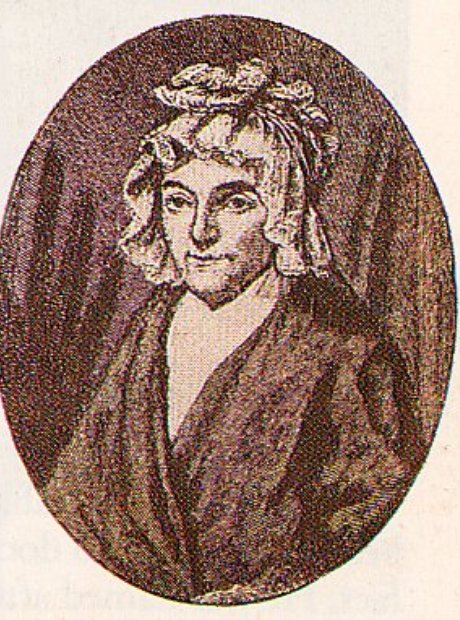
An image of Beethoven’s mother, Maria Magdalena Keverich

Prüfung des Küssens (“Meine weise Mutter spricht”) WoO 89 for bass voice and orchestra (1790-2, Beethoven aged 21)

Dedication Joseph Lux
Text Giorgio Federico Ghedini
Duration 5’30”

Listen

Background and Critical Reception

Beethoven wrote two arias for the bass Joseph Lux, a popular singer in Bonn known for his comic sensibilities. Little is known of the exact composition date beyond the years 1791-92, and it is also thought the works were not performed in Bonn.

A vocal part from the first aria, Prüfung des Küssens, survives from Beethoven’s time in Vienna, which suggests it was to be published – but again there is no evidence of performance. Ernst Herttrich, writing in the booklet notes for DG’s complete edition, notes that Beethoven offered both arias to a publisher in 1822, evidence that he still held them in high regard.

Thoughts

A lightly playful, slightly syncopated introduction brings in our bass singer – with what could easily be an excerpt from a much larger stage work. Beethoven’s writing is impish, slightly cheeky, and although the words are relatively nonsensical the character of Joseph Lux comes through.

The singer dominates, with occasional probing from the orchestra – and the vocal line encourages the character to take liberties with the tempo, to bring humour to the text and to stamp their personality on the aria. The orchestral writing offers plenty of room for this, and the false ending – the aria finishing but then restarting – only adds to the comic potential.

Recordings used

Kevin Greenlaw, Turku Philharmonic Orchestra / Leif Segerstam (Naxos)

Thomas Hampson, Concentus Musicus Wien / Nikolaus Harnoncourt (Warner Classics)

Thomas Hampson is more convincing as a comic baritone in his account, taking a few more liberties with Beethoven’s tempo than Kevin Greenlaw – who is nonetheless a fine performer himself. The newer Naxos recording is more sympathetic in its sound.

Spotify links

Kevin Greenlaw, Turku Philharmonic Orchestra / Leif Segerstam

Thomas Hampson, Concentus Musicus Wien / Nikolaus Harnoncourt

You can chart the Arcana Beethoven playlist as it grows, with one recommended version of each piece we listen to. Catch up here!

Also written in 1792 Cimarosa – Il Matrimonio Segreto

Next up Mit Mädeln sich vertragen

Listening to Beethoven #25 – Romance cantabile in E minor


18th century engraving of Bonn (unknown artist)

Romance cantabile in E minor WoO 207 (1786-7, Beethoven aged 16)

Dedication not known
Duration 5′

Listen

Background and Critical Reception

We step back briefly for an encounter with a fragment dating from slightly earlier in the teenage Beethoven’s Bonn years. The Romance cantabile seems to have been written as the slow movement to a concerto – or more likely a Sinfonia concertante for several instruments and orchestra. Its relatively unusual instrumentation suggests it could have been with the Westerholt-Gysenberg family of Bonn in mind, as Beethoven wrote his substantial Trio for Flute, Bassoon and Piano around that time.

After the main theme there is a second section, but it is incomplete and peters out after a short while.

Thoughts

The Romance cantabile is a rather charming piece, though it is laced with melancholy. The elegiac tones of the orchestral introduction are soon given a brighter edge from the piano soloist, who enjoys a little more amiable dialogue with the flute before the serious theme returns.

Beethoven would revisit the key of E minor for a concerto slow movement much later in his career, for the Piano Concerto no.4 .

Recordings used

Patrick Gallois (flute), Pascal Gallois (bassoon), Philharmonia Orchestra / Myung-Whun Chung (piano) (DG)

Johanna Haniková (piano), Czech Chamber Philharmonic Orchestra, Pardubice / Marek Štilec (Naxos)

The Philharmonia strings give a luxurious cushion to the version on DG, which is a relatively glossy account from Patrick and Pascal Gallois, conducted by Myung-Whun Chung, who is also the piano soloist. The Naxos recording is smaller scale and a little more intimate as a result.

Spotify links

Patrick Gallois, Pascal Gallois, Philharmonia Orchestra / Myung-Whun Chung

Johanna Haniková, Czech Chamber Philharmonic Orchestra, Pardubice / Marek Štilec

You can chart the Arcana Beethoven playlist as it grows, with one recommended version of each piece we listen to. Catch up here!

Also written in 1787 Haydn 6 String Quartets Op.50 (‘Prussian’)

Next up Prüfung des Küssens

Listening to Beethoven #24 – 6 Variations on a Swiss Song WoO54


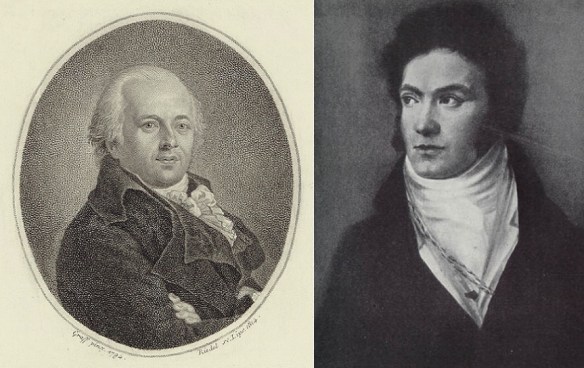
Swiss and German folksong collector Johann Friedrich Reichardt (left, picture by
Carl Traugott Riedel) and the young Ludwig van Beethoven

6 Variations on a Swiss Song WoO 64 for piano (1790-92, Beethoven aged 21)

Dedication not known
Duration 3′

Listen

What’s the theme like?

The theme is a 17th-century Swiss song, Dursli and Babeli – which appears in the collections of old Swiss and German folk tunes, made by composers such as Reichardt, Herder and Müller. It is a simple but catchy tune that bears a resemblance to a hymn that followed a century or so later, This joyful Eastertide. The tune was a favourite of Goethe, who is said to have described it as ‘a charming story of peasant love’.

Background and Critical Reception

Very little is written about these variations. The short note for Cécile Ousset’s recording declares the variations ‘do not go any further than mere charm’. Meanwhile Barry Cooper, writing in his guide for the DG complete Beethoven edition, describes the variations as ‘relatively simple an unadventurous’.

It seems these variations are popular student pieces, the standard suitable for developing pianists and markedly different from the Righini variations we heard very recently.

Thoughts

The source material does at least ensure a memorable melody for the short series of variations, which feel more like a set of unfinished doodles. The hymn-like main theme slips into the minor key for a little while, its second variation given a sideways glance by the composer as he does so. There is a nice bit of humour here at times, but the piece does ultimately feel lightweight, more of a student exercise.

Recordings used

Cécile Ousset (Eloquence), Mikhail Pletnev (DG); Cyprien Katsaris (Piano 21)

Three fine recordings – but again it is Ousset who emerges with a greater poise, and less of a tendency to indulge than Pletnev. Ronald Brautigam takes a typically quick tempo in his sprightly version.

Spotify links

Mikhail Pletnev

Cécile Ousset

Ronald Brautigam


Also written in 1792 Hummel Piano Trio no.1 in E flat major Op.12

Next up Prüfung des Küssens

Listening to Beethoven #23 – Ritterballet WoO 1 (piano version)


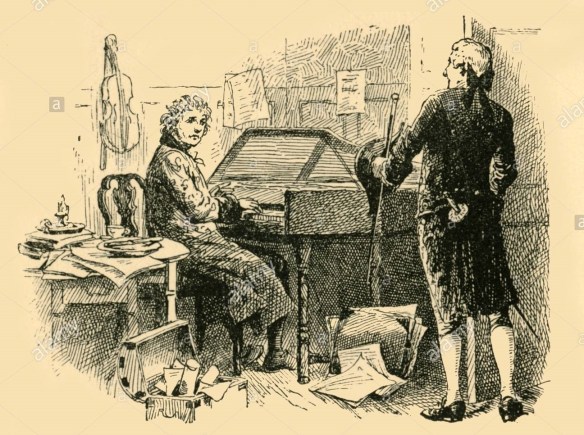
Beethoven and Count von Waldstein. Artist unknown, Alamy stock photo

Dedication Count Waldstein
Duration 13′

1. March
2. Deutscher Gedsang: Allegro moderato
3. Jagdlied: Allegretto
4. Romanze: Andantino
5. Kriegslied: Allegro assai con brio
6. Trinklied: Allegro con brio – Trio
7. Deutscher Tanz: Walzer
8. Coda: Allegro vivace

Listen

Background and Critical Reception

We have already examined (and enjoyed) Beethoven’s Ritterballet in its orchestral form. It is the piece he was prepared to ‘hand over’ to Count Waldstein… but it is clear that the composer thought highly enough of the piece to transcribe it himself for solo piano. Beethoven retains the same format and order as the orchestral version, and the arrangement appears to be a completely faithful one.

Thoughts

Perhaps inevitably the piano version of Ritterballet loses a little of its colour, though the March does benefit from firmer rhythmic impetus. The German Song retains its charm and memorability, but does lose a little of its dance-like poise when transferred to the keyboard.

Recordings used

Cyprien Katsaris (Piano 21)

Cyprien Katsaris clearly enjoys the Ritterballet, and its abundance of good tunes. He can’t resist the chance to make the opening March flourish, with a lively left hand part, and his ‘war’ scene is suitably dramatic too.

Spotify links

Cyprien Katsaris (Piano 21)

Also written in 1791 Mozart La clemenza di Tito

Next up 6 Variations on A Swiss Song WoO 64

Listening to Beethoven #22 – 24 Variations on ‘Venni amore’ WoO 65

Vincenzo Righini (left) and the young Beethoven (unattributed picture)
Dedication Countess of Hatzfeld
Duration 23′

Listen

Background and Critical Reception

Beethoven’s second set of variations for the keyboard is very different from the first. The Dressler Variations, his first published work, were effectively testing the water to see what the young composer could come up with. This set of 24 variations is a different animal entirely. Alexander Thayer‘s biography of Beethoven tells the story of its genesis:

‘Kapellmeister Vincenzo Righini, a colleague of Sterkel in the service of the Elector of Mainz, had published Dodeci Ariette, one of which, Vieni (venni) Amore was a melody with five vocal variations, to the same accompaniment. Beethoven, taking this melody as his theme, had composed, dedicated to the Countess of Hatzfeld and published 24 variations for the pianoforte upon it. Some of these were very difficult, and Sterkel now expressed his doubts if the author himself could play them.’

He could indeed – and ‘went on with a number of others no less difficult, all to the great surprise of the listeners’. Harold Truscott is impressed. Writing in The Beethoven Companion, he declares the work ‘has a strong claim to be considered Beethoven’s earliest masterpiece’. He goes further, noting anticipations of Brahms’s variation technique, and a fade out of ‘imaginative power which would not be out of place in mature Beethoven and which also anticipates one of Schumann’s favourite coda devices’.

Thoughts

Truscott is right. This piece takes Beethoven’s writing for piano up several levels, both technically and emotionally. Righini’s them has basic outlines, which are perfect for the variation treatment – and Beethoven wastes no time in getting to work with his interpretations on the theme, picking up momentum quickly.

The sheer variety of his variations are dazzling – the trills of the fourth variation, the triplet figures of the fifth and the free, almost improvised nature of the eighth. There is plenty of humour here too, Beethoven enjoying the chromatic ninth variation, but darkening the mood considerably with two minor key variations. The first (no.12 is mysterious and uncertain; the second powers through the octaves.

The fascinating drama continues, with every variation raising the question in the listener’s mind as to what might be next! In no.14 Beethoven plays around with the tempo and mood, almost as though the composer is scratching his head as he considers his next move. In no.15, an emphatic volley of notes, we find out. Towards the end the drama heightens again, with the impish no.20, the big octaves of no.21 and the flowing no.22. The profound thoughts of the 23rd are blown out of the water by an almost violent final variation, but despite the virtuosity and drama, Beethoven opts for a quiet and thoughtful coda which is all the more meaningful and leaves the listener lost in thought.

This set of variations is a fascinating and totally absorbing journey, with thrills, spills and unexpected turns on its route. Beethoven’s unpredictable streak has truly arrived.

Recordings used

Ronald Brautigam (BIS), Cécile Ousset (Eloquence), Mikhail Pletnev (DG)

Three excellent recordings – though Mikhail Pletnev’s is a little more mannered with a clipped delivery of the main theme and some interesting ideas of playing around with the tempo of the music. Most are in line with Beethoven’s thoughts – but even he is not quite as impressive as Cécile Ousset, who delivers a compelling performance of virtuosity and thoughtful insight. The quiet passages of her playing will have you leaning in towards the speaker.

Meanwhile Ronald Brautigam is typically incisive with his fortepiano version, and the flicks he achieves on the second variation are really well done, but he is a bit breathless at times, finishing almost two minutes clear of the others.

Spotify links

Ronald Brautigam

Cécile Ousset

Mikhail Pletnev

Also written in 1791 Mozart Clarinet Concerto in A major K622

Next up Ritterballet WoO 1 (piano version)