Peanuts comic strip, drawn by Charles M. Schulz (c)PNTS
Punschlied WoO 110 for voice, choir and piano (1790-92, Beethoven aged 21)
Dedication not known
Text Anonymous
Duration ’50”
Listen
Background and Critical Reception
This is another example of Beethoven setting a ‘Gesellschaftslied’ – a public form of the song, but in this case thought to be for private consumption. It is another drinking song, setting its anonymous text with a similar structure to the previous Trinklied.
A florid piano introduction brings in the singer, who encourages each of his friends to drink the punch as it goes round the room. The choral response is emphatic: ‘Wir trinken alle hocherfreut, so lang uns Punsch die Kumme beut’ (‘We’ll surely stay a merry bunch, as long as our cups stay full of punch!’)
Thoughts
This is a good complement to the Trinklied – and is pretty much the next gulp from the flagon, with high spirits and good cheer! For a second time Beethoven reads his room well, leading the festivities with music of celebration.
Recordings used
Hermann Prey (baritone), Heinrich Schütz-Kreis Berlin, Leonard Hokanson (piano)
Peter Schreier (tenor), Gisela Franke (piano)
Once again Hermann Prey is on fine form, with sprightly piano playing from Leonard Hokanson and a fulsome choir. They eclipse Peter Schreier’s slightly higher version, which lacks a choir and cuts out the piano introduction.
Spotify links
Hermann Prey, Heinrich Schütz-Kreis Berlin, Leonard Hokanson
Peanuts comic strip, drawn by Charles M. Schulz (c)PNTS
Trinklied WoO 109 for voice, choir and piano (1790-92, Beethoven aged 21)
Dedication not known
Text Anonymous
Duration 1’30”
Listen
Background and Critical Reception
In her essay on Beethoven as a song composer for Deutsche Grammophon’s Beethoven: The New Complete Edition, Helga Lühning notes how ‘there was no period during his creative life where he did not explore the field of vocal music and write for the human voice’.
She writes how Lieder was the prime form of expression, but that Beethoven also turned to the ‘Gesellschaftslied’, the public form of the song. A typical example of the form would be for a soloist to sing the verse and a choir to respond with a chorus.
The Trinklied is the first of one of these settings, a drinking song with an anonymous text encouraging ‘Erhebt das Glas mit froher Hand und trinkt euch heitren Mut’ (‘Raise your glass with a glad hand and drink your hearty courage’)
Thoughts
A playful piano introduction trips down the stairs before a lusty bellow from the bass encourages everyone in the room to raise their glasses. Beethoven has the measure of the crowd, with everyone included in the enthusiastic response! Then it’s no doubt straight on to the next song…and drink…
Recordings used
Hermann Prey (baritone), Heinrich Schütz-Kreis Berlin, Leonard Hokanson (piano)
Peter Schreier (tenor), Gisela Franke (piano)
Hermann Prey is in very good voice here, and the choir respond with full bodied tones. Peter Schreier’s tenor version, set a good deal higher in pitch, is a little more chaste, and there is no choir to back him up. That said, his brighter tone rings out clearly.
Spotify links
Hermann Prey, Heinrich Schütz-Kreis Berlin, Leonard Hokanson
Peter Schreier, Gisela Franke
Also written in 1792 Haydn 150 Scottish Songs, Hob.XXXIa:1–150
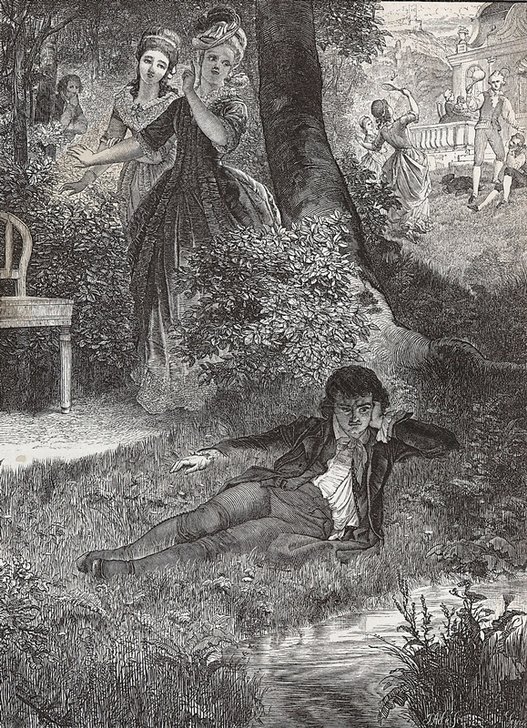
Beethoven and Jeannette d’Honrath (Bonn 1785: the young Beethoven at the house of Hofrätin Helene von Breuning; first love for Jeannette d’Honrath, later Greth by marriage).
Woodcut, 1865, after drawing by Wilhelm Lindenschmit (1829-1895).
Scena ed aria ‘Primo amore’ for soprano voice and orchestra (1790-2, Beethoven aged 21)
Dedication not known
Text Anonymous
Duration 15′
Listen
Background and Critical Reception
Primo amore is a passionate aria for soprano and orchestra, a single unbroken scene of a quarter of an hour. It was not published until 1888 – and initially it was thought to have been written in Vienna while Beethoven was studying with Salieri. However more recent, forensic analysis of the autograph score dates it to 1790-92, late on in his time at Bonn.
The aria sets an anonymous text on the subject of early love, and given its emotion surprisingly little is written about it by scholars of the composer. The focus is thought to have been soprano Magdalena Willmann, a daughter of Beethoven’s neighbour in Bonn, who had an unusually low range – or even Jeanette d’Honrath, described by the Bonn physician Franz Gerhard Wegeler as ‘a beautiful, vivacious blonde, of good upbringing and friendly character’.
Writing about the aria in the booklet notes for her recent disc of Beethoven vocal music, soprano Chen Reiss describes how Primo amore ‘displays a startlingly mature way of looking at love’s complexities, with its disjointed structure, inner turmoil and restlessness. The music – both instrumental and vocal – is strange, almost brutal in comparison with that of his contemporaries’.
Thoughts
The text for Primo amore is matched by Beethoven’s lovelorn music. ‘Primo amore, piacer del ciel! Penetrasti il mio cor’ (‘First love, joy of heaven, you penetrated my heart’). The soprano sings with long notes, often well above the accompaniment of a smallish orchestra. As the aria progresses so the mood becomes more fraught, the orchestra less controlled – and the lasting impact of this first love is laid bare.
Beethoven asks his soprano to cover a lot of ground, with lower notes in the opening pages but much greater heights later on. The writing feels very instinctive, the composer responding keenly to the text with music of broad phrases and great feeling. In the process he echoes some of the soprano writing in the Cantata on the death of Joseph II. Here, as in that piece, the singer is almost completely dominant – and the piece leaves a lasting impression.
Recordings used
Chen Reiss (soprano), Academy of Ancient Music / Richard Egarr (Onyx Classics) Reetta Haavisto (soprano), Turku Philharmonic Orchestra / Leif Segerstam (Naxos)
Chen Reiss is a fervent devotee of Beethoven’s music for voice and it shows as she completely inhabits the loss and sorrow of the writing. Her beautiful tone soars effortlessly above the well-matched phrasing of the Academy of Ancient Music, who bustle along into the aria’s second section.
Reetta Haavisto, in another new recording for Naxos, sings in a much broader view of Primo amore, complete with expansive introduction from the Turku Philharmonic Orchestra under Leif Segerstam. Her voice has a creamy tone and is beautifully controlled.
Both sopranos hit the highest notes of the aria with some aplomb and manage the demanding range of Beethoven’s vocal writing impressively.
Spotify links
Reetta Haavisto, Turku Philharmonic Orchestra / Leif Segerstam
Chen Reiss, Academy of Ancient Music / Richard Egarr
You can chart the Arcana Beethoven playlist as it grows, with one recommended version of each piece we listen to. Catch up here!
Also written in 1792 Cimarosa – Il Matrimonio Segreto
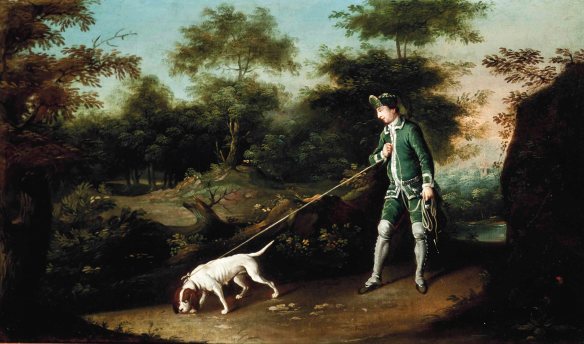
Gentleman walking a hound in a wooded landscape (Unknown, German school, late 18th century
Flute Sonata in B flat major Anh.4 (1790-92, Beethoven aged 21)
Dedication unknown
Duration 25′
Listen
Background and Critical Reception
This substantial four-movement work was found amongst Beethoven’s papers after his death, and was not published until 1906. Despite its location, there are a number of doubts over the authorship of the piece – which appears not to have been in Beethoven’s own handwriting, according to biographer Alexander Thayer.
Barry Cooper, writing in the ‘Rarities’ booklet accompanying DG’s New Complete Edition of Beethoven, makes several useful points. He notes a ‘few awkward moments that could betray inexperience’, and says ‘its authenticity cannot yet be excluded completely, if it is a very early work’. Yet in the other corner there are ‘far fewer articulation markings than in even Beethoven’s earliest known works’, and the scribe ‘was also the composer’, which for Cooper offers the final proof that Beethoven was ultimately not involved.
If it was indeed Beethoven who wrote this work it is thought it would date between 1790 and 1792 – which would plausibly make the dedicatee the flautist son of the Westerholt-Gysenberg family, who Beethoven had included as part of his equally substantial Trio for Flute, Bassoon and Piano a few years earlier.
Thoughts
This substantial piece is quite hyperactive in its first few minutes, when it feels like there are too many notes, but the mood is bright and positive. The music gradually settles, passing through quite an adventurous development section where the dynamic changes, from quite a pastoral mood which then darkens as Beethoven shifts into the minor key.
The second movement, a Polacca, sets out on a strident path, in the same key of B flat major. Both instruments are close together, complementing each other’s melodic movements. The theme is a bit more rustic but the polonaise attributes are not obvious.
The slow movement brings the music to rest, and offers a change of scenery in E flat major. The final movement finds the players close again for a bright theme on which the players then expand with four variations. Even the minor key variation, the third, doesn’t really cloud the sunny exterior too much. By Beethoven’s standards so far it does feel like a relatively standard theme and variations, but they end with a flourish and a relatively restful coda.
Recordings used
Michel Debost (flute), Christian Ivaldi (piano) (Warner Classics) Emmanuel Pahud (flute), Eric Le Sage (piano) (Auvidis Valois) Severino Gazzelloni (flute), Bruno Canino (piano) (DG)
A trio of excellent performances here, each of which serves the sonata very well. The top choice by a whisker would be the ever-stylish Emmanuel Pahud and Eric Le Sage, though Severino Gazzelloni and Bruno Canino run them close with their close-knit partnership, which is particularly beautiful in the slow movement.
Spotify links
Michel Debost, Christian Ivaldi
Emmanuel Pahud, Eric Le Sage
Severino Gazzelloni, Bruno Canino
You can chart the Arcana Beethoven playlist as it grows, with one recommended version of each piece we listen to. Catch up here!
Also written in 1792 Haydn Symphony no.98 in B flat major
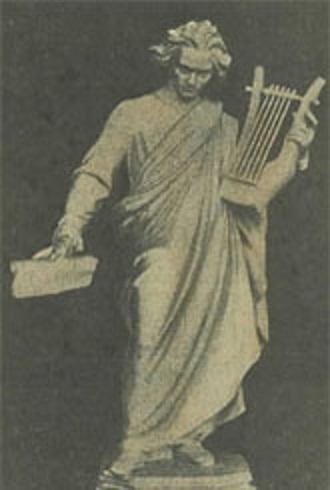
Beethoven with lyre and scroll, alluding to god Apollo (1838-1842)
Reproduction of an old photography of Bläser’s draft, around 1920 (Beethoven-Haus Bonn, photo documentation Stephan Ley, Volume VIII, No. 78)
2 Sonatinas for Piano Anh.5 (1790-92, Beethoven aged 21)
Dedication unknown
Duration 4′ and 5′
Sonatina in G major Anh.5 no.1
1 Moderato
2 Romanze
Sonatina in F major Anh.5 no.2
1 Allegro assai
2 Rondo
Listen
Background and Critical Reception
These two works, of tiny dimensions, are attributed to Beethoven with a suspected year of composition between 1790 and 1792. The unusual numbering of Anh.5 comes from the 1955 catalogue of Beethoven works put together by Georg Kinsky and Hans Halm. ‘Anh’ is an abbreviation for ‘Anhang’, the German word for ‘appendix’, indicating that Beethoven’s authorship remains in doubt.
Were the pieces genuine they would fall towards the end of Beethoven’s time in Bonn. Both works are in two movements, and are mostly suitable for beginners.
Thoughts
Regardless of whether Beethoven wrote these pieces or not, they are a good deal of fun – and one (the F major work) contains a proper earworm.
The G major’s Moderato first movement flows easily on the ear, with a polite theme – and the Romanze, more obviously childlike, is equally easy to listen to.
The F major work appears to be in a bit of a hurry in its first movement, with a few lightly mischievous touches to its phrasing. It is in the second movement, a Rondo, where the earworm appears – and again there are a few mischievous touches round the end. With the emphasis almost entirely on that single tune it is well set in the inner ear by the end!
Recordings used
Tobias Koch (DG) Ronald Brautigam (BIS)
Brautigam’s fortepiano can sound a little clinical with a harsher edge applied in the Romanze, but he gives charming accounts of both Sonatinas. Tobias Koch is also charming in his versions.
Spotify links
Tobias Koch
Ronald Brautigam
You can chart the Arcana Beethoven playlist as it grows, with one recommended version of each piece we listen to. Catch up here!