
Listening to Beethoven #11 – Piano Quartet in C major WoO 36/3

How Bonn looked around the year 1790. Artist unknown
Piano Quartet in C major WoO 36/3 for piano, violin, viola and cello (1785, Beethoven aged 14)

Dedication Thought to be Elector Maximilian Friedrich
Duration 17′

Listen

Background and Critical Reception

There is a good deal of speculation that Beethoven played and improvised in front of Mozart when he journeyed from Bonn to Vienna in 1786. Reports on what actually happened – and indeed if the two composers met at all – are sketchy. Misha Donat, in his booklet notes to one of the recordings used here, says that ‘if, as we may assume, he (Beethoven) also showed him some of his compositions, they would almost certainly have included a set of three Piano Quartets, completed some two years earlier’.

These first examples of Beethoven chamber music set out in a musical idiom not used until now. This is surely a deliberate move by the 14-year-old composer, given the pressure he would have endured in either the string quartet or piano trio. Haydn and Mozart had made giant steps in those forms; the piano quartet – piano, violin, viola and cello – was untried, and it seems these early works even predate the two masterpieces offered by Mozart later the same year.

When published by Artaria, the works were re-ordered – but our listening reverts to Beethoven’s original plan, beginning with the C major work. When they were published – after Beethoven’s death – Lewis Lockwood notes they ‘so surprised even knowledgeable observers, including Ferdinand Ries, that they doubted Beethoven had written them at all, let alone at age fourteen’.

Beethoven thought highly enough of the first work in C major to recycle some of its themes in his Piano Sonata in F minor Op.2/1. Lockwood notes the work to be ‘clearly modelled on Mozart’s C major Violin Sonata, K296. You can decide for yourself here:

Thoughts

There is an attractive hustle and bustle about the C major Piano Quartet right from the start. Its first theme of the first movement (marked Allegro vivace – fast and lively) is a simple one, drawing the Mozart comparisons with its reliance on the notes of the ‘home’ C major chord. The piano has all the dressing, the strings content to provide accompanying roles as they might in a concert. The second theme is more lyrical but continues the piano’s dominance.

For the second movement we retreat to a slow tempo and close-knit scoring, the strings providing rich harmonic support to the piano’s melody. Soon the sweet tone of the violin takes the lead, bringing tenderness to the central section before all three strings enjoy reacquainting us with the first theme, Beethoven’s scoring nicely balanced at this point.

The third movement finale has a resolute quality. Led by the piano with a bright theme, it busies itself with developing that idea and introducing a fresh second theme, played on the piano over pizzicato (plucked) strings. The theme passes to violin – some of its most attractive music – before ending in a whirl of positivity.

Positive is definitely the word to describe this Piano Quartet, for it is a breezy first outing into chamber music for Beethoven. Even though he appears to be using Mozart as a model, there is more than enough evidence that he is at ease in this form, with an individual voice about to emerge.

Recordings used and Spotify links

Christoph Eschenbach (piano), Members of the Amadeus Quartet (Deutsche Grammophon) – tracks 7 to 9:

Anthony Goldstone (piano), Cummings String Trio (Meridian) – tracks 1 to 3:

New Zealand Piano Quartet (Naxos) – tracks 1 to 3:

Christoph Eschenbach and the Amadeus Quartet fly out of the traps in the first movement. The piano sound is a little ‘clangy’ at times, possibly due to the age of the recording, but this is a performance with plenty of energy.

The Goldstone / Cummings version goes off at quite a lick too. It has a thoughtful and considered slow movement, really nicely performed, while the third movement bustles along.

Finally the New Zealand Piano Quartet give a nicely nuanced performance on Naxos, with the best recording of the three sampled versions. Their interpretation is light on its feet.

You can chart the Arcana Beethoven playlist as it grows, with one recommended version of each piece we listen to. Catch up here!

Also written in 1785 Mozart Piano Concertos nos. 20 & 21

Next up Piano Quartet in E flat major WoO 36/1

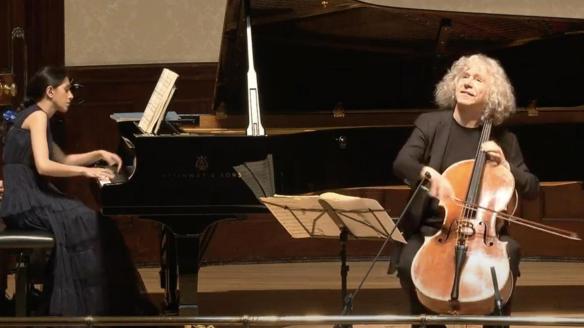
In concert – Steven Isserlis & Mishka Rushdie Momen @ Wigmore Hall

It must have been extremely special for Steven Isserlis to be playing the music of three of his favourite composers at the Wigmore Hall on this day – even more so as the date fell on the birthday of one of them, Robert Schumann.

He is one of the cellist’s greatest musical loves, and the sense persists that Isserlis is still discovering more things that make it so. One of Schumann’s many strengths is the versatility of his music, meaning pieces such as the 3 Romances Op.94, originally written for oboe and piano and given to his wife Clara as a Christmas present in 1849, can easily be performed with violin or, indeed, the cello.

Schumann’s birthday was marked by a performance of unaffected romantic beauty from Isserlis and pianist Mishka Rushdie Momen, very much on an equal footing playing the composer’s first instrument. The pair caught the doleful and slightly inquiring nature of the first romance beautifully, while the surge of feeling in the central music of the second was a strong cumulative wave. The third, its theme given in a darker shade, was briefly introspective in its unison phrases but then more overtly passionate.

Before Schumann came another ‘birthday’ composer. Beethoven’s 250th is not likely to receive quite so much live coverage as it would have done in a year without a pandemic, but what it lacks in quantity it will surely make up for in quality. The Sonata for piano and cello no.1 in F major, the first of a pair published as the composer’s Op.5, is the ideal concert opener. It begins in slight trepidation of what it is about to discover, but then, on establishing what is effectively a new form of writing for the cello and piano together, throws itself headlong into the rapids.

The Allegro that comes after that first sense of discovery was joyous indeed, with lovely dialogue in play between the two protagonists. Isserlis smiled frequently, as though revelling in the combination of favourite music and venue once again, while Momen’s clear phrasing dovetailed neatly with the cello’s, owning some of the really tricky right hand runs with fearless accuracy.

The second movement had a terrific burst of energy, the sun breaking through at every possible opportunity when its catchy theme made several reappearances. The pair also gave a nice air of mystery when Beethoven suddenly departed from ‘home’ and ended up in a number of seemingly unrelated tonal centres, before reassuring us with the warmth of the home key once again.

As he introduced his favourite 20th century cello sonata, there was a sense of Isserlis’ heart almost bursting with the chance to play music live again. He described his discovery of Fauré’s late music as ‘being outside a door but then passing through and wondering why on earth I had been outside’, before the pair played the Cello Sonata no.1 in D minor Op.108, the first of two such works from the Frenchman.

This was a very fine performance indeed, Isserlis and Momen watchful and urgent at the start, its music wracked with uncertainty but nonetheless pushing forward with great conviction. The Andante slow movement began lost in thought, the bell-like toll of the piano matched by Isserlis’ rich legato tone, before reaching heights of passion that the final movement also delivered, the performers now glorying in the major key and Fauré’s bursts of sunshine, the strong resolve of the first movement bringing its ultimate reward.

The pair finished with a profound account of Isserlis’ own transcription of a Bach chorale prelude, Ich ruf’ zu dir, Herr Jesu Christ, in which – as the cellist noted – Bach says it all.

Listening to Beethoven #10 – Piano Concerto in E flat major


Beethoven, aged 13. This portrait in oils is said to be the earliest authenticated likeness of Beethoven – but Beethoven-Haus Bonn disputes this description, claiming it to be an unknown youth painted in the early 19th century.

Piano Concerto in E flat major WoO 4(1783-4, Beethoven aged 13)

Dedication not known
Duration 24′

Listen

Background and Critical Reception

Daniel Heartz tells the story of Beethoven’s first foray into the world of the concerto. Barely a teenager, ‘it was appropriate to the young composer’s status as a virtuoso of the keyboard that he should try his hand at writing a piano concerto.’

The work was incomplete however, with the orchestral part left unfinished beyond its two-piano reduction. The trip to Holland mentioned in the previous article on the Rondo in C major looks to have been the driving force behind this composition, for Heartz says that ‘Beethoven may have performed it in a concert at The Hague for which he was paid a large sum as a pianist, and at which Carl Stamitz also appeared as a viola soloist.’

As Jan Swafford notes, the work begins with a ‘flavour of hunting call-cum-march’, an ‘abiding topic in his future concerto first movements’. He calls it a ‘lively and eclectic piece that showed off his virtuosity’, while in his booklet notes to the DG complete Beethoven edition Barry Cooper notes its proximity in style to J.C. Bach rather than Mozart.

Thoughts

In Ronald Brautigam’s recording – where he made the orchestral arrangement – the horns are prominent in the opening salvo, which is reasonable to expect given the key of E flat major which will suit them. Then the piano takes over with an upbeat theme and some florid passagework. The music is fluently written, and follows the rules relatively closely in moving to the keys expected in the course of its development – B flat major, G minor, closely ‘related’ to the home key. The music is both charming and virtuosic.

For the slow movement Beethoven revisits a Larghetto direction (slow but not as slow as the ‘adagio’ tempo marking’) and writes music of an appealing delicacy and charm – undemanding but giving the soloist room to spread their wings a little.

For the finale Beethoven uses a Rondo form (presenting three themes in the sequence A – B – A – C – A – B – A) – a form he used for the last movement of each of his five published piano concertos. Despite the rigorous structure it again sounds very natural and the ‘A’ theme – which you hear from the start – is lightly playful, suggesting a less formal dance. The grace and charm of the third movement has a nice complement in the shape of a rustic ‘C’ theme where we briefly flirt with the minor key and the melody becomes more decorative. Only the ending is a bit strange, with a sudden cut-off point.

Recordings used

Ronald Brautigam (piano), Norrköpping Symphony Orchestra / Andrew Parrott (BIS)
Orchestra of Opera North / Howard Shelley (piano) (Chandos)

Ronald Brautigam gives a fine performance of the concerto, with attentive accompaniment from Andrew Parrott and the Norrköpping Symphony Orchestra. Howard Shelley’s version has a softer orchestration for the first theme of the piece which works really nicely. His playing follows suit, proving particularly effective in the second movement where his affection for Beethoven’s early work is clear.

Spotify links

Ronald Brautigam, Norrköping Symphony Orchestra / Andrew Parrott (tracks 1-3 of the link below)

Orchestra of Opera North / Howard Shelley (piano) (the fourth disc of an album containing all the Beethoven works for piano and orchestra)

You can chart the Arcana Beethoven playlist as it grows, with one recommended version of each piece we listen to. Catch up here!

Also written in 1783 Abel 6 Symphonies Op.17

Next up Piano Concerto in E flat major WoO 4

Listening to Beethoven #9 – Rondo in C major


Beethoven statuette – plaster cast by Gebrüder Micheli based on an original by Gustav Adolf Landgrebe (Beethoven-Haus, Bonn)

Rondo in C major WoO 48 for piano (1783, Beethoven aged 12)

Dedication not known
Duration 2’40

Listen

Background and Critical Reception

March 1783 saw a tragic time for the Beethoven family, as a younger brother to Ludwig, Franz Georg van Beethoven, died at the age of two. This precipitated a family visit from Rotterdam of the dead child’s sister, Maria Magdalena, who arranged for a return visit from Beethoven and the opportunity to perform new works.

With the three Electoral sonatas on the table Beethoven was really hitting his stride with writing for the piano, and with a first concerto just around the corner he produced another short Rondo for solo piano. Its exact composition date is not known, only that Beethoven was ‘around 12’.

Daniel Heartz describes the Rondo as having a ‘catchy and quite folk-like theme’. He says that ‘the model is clearly the second and last movement of Mozart’s Violin and Piano Sonata in G major K301’. Explaining in detail, he declares ‘The correspondence is evident not only in the theme but also in the way it is treated to rapid alternation of major and minor forms. Beyond looking up to Mozart as a legendary performer, Beethoven obviously took him as a model for composition. You can compare for yourself here:

Thoughts

Daniel Heartz’s observation is a fascinating one, and on listening it rings true. The purity of Beethoven’s theme is closely aligned to Mozart’s, though there is a slight glint in the eye at times, especially with one or two of its harmonic shifts. The use of C major is also in line with one of Mozart’s most popular piano sonatas.

Again, this is very surefooted music for a 12-year-old boy to be writing!

Recordings used

Mikhail Pletnev (DG); Jenő Jandó (Naxos), Ronald Brautigam (BIS)

Jenő Jandó takes the ‘Allegretto’ tempo marking more to heart with a slower reading which initially sounds quite pedestrian but makes sense when it has settled down. Ronald Brautigam goes for a very similar approach, adding a little more mystery to the middle section. Mikhail Pletnev is quite light hearted, and affectionate at the end – but his tempo choice is much faster than Beethoven indicates.

Spotify links

Mikhail Pletnev

Jenő Jandó

Ronald Brautigam

You can chart the Arcana Beethoven playlist as it grows, with one recommended version of each piece we listen to. Catch up here!

Also written in 1783 Paisiello La passione di Gesù Cristo

Next up Piano Concerto in E flat major WoO 4

Listening to Beethoven #8 – An einen Säugling


A Peanuts strip drawn by Charles M. Schulz (c)PNTS

An einen Säugling WoO 108 (“Noch weisst du nicht, wes Kind du bist”) for voice and piano (1783, Beethoven aged 12)

Dedication not known
Text Johann von Dohring
Duration 3’20”

Listen

Background and Critical Reception

There are very few words written on Beethoven’s second song, a duet for two upper range female voices. It comprises four verses by Johann von Doring, with a piano introduction and postlude.

For Lewis Lockwood, the three-minute song ‘shows a slight touch of originality in its brief major-minor mixture, but reflects the pretty, homely sentimentality of the contemporary German ‘lied’ (song).’

Thoughts

An airy piano introduction leads to some rather beautiful harmonies in this song. Both singers are close together in pitch, occasionally uniting in unison but rarely further than a third apart.

The harmonic language is very straightforward – this is a song ‘to an infant’ so that is not a surprise! – but the elaboration of the piano part in between verses is attractive.

Recordings used

There are only two versions immediately available on Spotify. The Heinrich Schütz Kreis, Berlin deliver a chaste reading of the song with pianist Leonard Hokanson, but get to the right level of innocence with pure harmonies.

That said, the version on the DG complete edition, from single voices Karen Wierzba and Natalie Pérez, is really nicely done. The pair have more vibrato, but their unison and harmony singing is ideal, the roomy recording works nicely and pianist Jean-Pierre Armengaud adds some sensitive touches.

Spotify links

Heinrich Schütz Kreis & Leonard Hokanson:

Karen Wierzba, Natalie Pérez and Jean-Pierre Armengaud:

Also written in 1783 Dittersdorf Six Symphonies after Ovid’s Metamorphoses

Next up Rondo in C major