Listening to Beethoven #7 – Piano Sonata in D major (‘Electoral’ no.3)


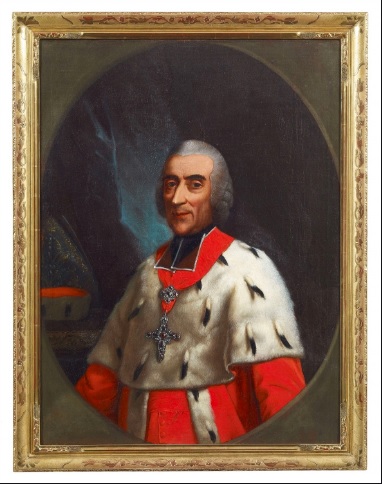
Portrait of Maximilian Friedrich von Königsegg-Rothenfels, Archbishop-Elector of Cologne. Portrait by Georg Oswald May

Piano Sonata in D major WoO 47/3 ‘Electoral’ for piano (1783, Beethoven aged 12)

Dedication Maximilian Friedrich, Elector of Cologne
Duration 14’00

Listen

Background and Critical Reception

The third of the Electoral sonatas is, for Jan Swafford, the strongest of the set. For him, it ‘suggests Haydn at his most vivacious. Its jolly outer movements frame the most striking formal idea of the sonatas, a minuet followed by six variations…’ and it finds Beethoven in D major, ‘bright and ebullient’.

Pondering the forms further, he says, ‘It is hard to tell whether his departures from standard forms are imaginative or naive. Only in the D major does he begin to grapple with the sophisticated discipline of sustaining an idea’.

At this point it is worth restating that this is music written by a 12-year old, one of his first public statements – and certainly one of the first opportunities for teacher Christian Kneefe to show off the work of his pupil.

Thoughts

As Swafford says, the brightness of this music is striking, right from the airy, genial first theme. This is music you would listen to in order to feel right with the world, to take the weight off a difficult day. With rippling textures in the left hand, Beethoven writes a fluid first movement.

The Menuett and variations is the star though, an attractive triple-time dance supported by the left hand which is clearly the ‘feet’ of the operation. The variations include a glittering right hand (4) then some gentle syncopation (5) before an attractive couplet in thirds (6).

The third movement is similarly bright, more closely related to the fourth variation of the Menuett in its rapid movement for the right hand – which helps keep the music on its natural high level. Beethoven will give us more of these natural highs in D major – this is simply the first!

Recordings used

Jörg Demus, as used on the DG complete edition, is given a very roomy backdrop in Vienna to work with. As a result his recording, made in 1969, does show its age in spite of some lovely playing. In part because of that the preference is for Jenő Jandó on Naxos, who also gives the music a nice amount of room. Beethoven’s work is closely aligned to Haydn in his hands. Ronald Brautigam, meanwhile, adds all repeats in an account that lasts 17 minutes, bringing forward Beethoven’s potential for the longer form. His virtuosity and musicality really bring these pieces to life.

Spotify links

The playlist below is for all three Electoral Sonatas, and includes the recordings discussed above:

You can chart the Arcana Beethoven playlist as it grows, with one recommended version of each piece we listen to. Catch up here!

Also written in 1783 Michael Haydn Symphony in E-flat major .

Next up An einen Säugling

Listening to Beethoven #6 – Piano Sonata in F minor (‘Electoral’ no.2)


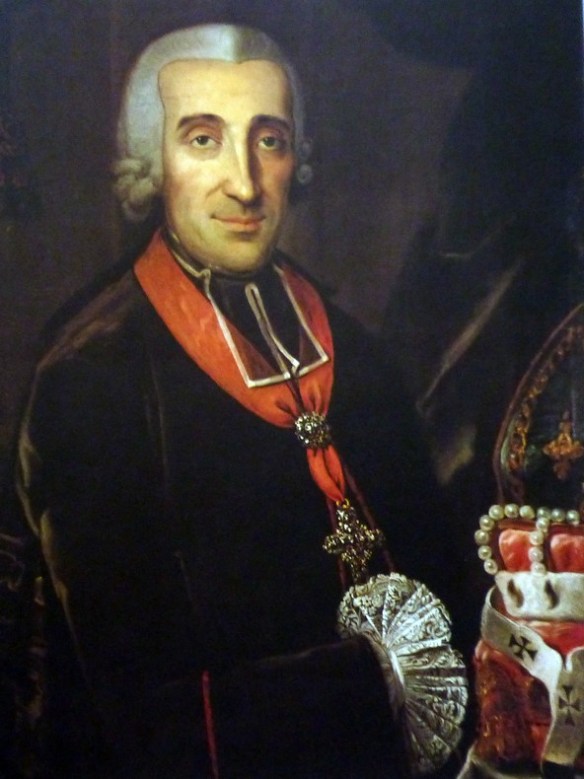
Portrait of Maximilian Friedrich von Königsegg-Rothenfels, Archbishop-Elector of Cologne. Artist unknown

Piano Sonata in F minor WoO 47/2 ‘Electoral’ for piano (1783, Beethoven aged 12)

Dedication Maximilian Friedrich, Elector of Cologne
Duration 11’20

Listen

Background and Critical Reception

The three Electoral sonatas divide opinion among Beethoven scholars. While you can read largely complimentary thoughts in the background to no.1 – as appraised yesterday – Lewis Lockwood‘s biography decides that the three works are ‘short, undeveloped and crowded with stereotyped figures. He does however go on to concede that ‘still, these three little works show that the barely adolescent Beethoven could spin coherent phrases and short paragraphs as capably as many an adult professional.’

Charles Rosen‘s observation that Beethoven’s three Electoral Sonatas ‘start clearly from Haydn’s work of the late 1760s’ appears to have greatest traction with the second work in F minor. This key was important to Beethoven’s contemporary, and accounts for two of his most profound works – the Symphony no.49 (‘La Passione’) and the Variations in F minor for piano.

Beethoven too made use of F minor for important works, and it was a relatively brave choice to use it early on in his career as here. For Barry Cooper, writing in the complete edition as released on Deutsche Grammophon, this second sonata is ‘the most strongly emotional in the set, with powerful gestures that anticipate some of Beethoven’s later minor-key sonatas such as the Pathétique and the Moonlight.’

Thoughts

The first movement starts deep in thought, but Beethoven snaps out of that mood with a flash the music suddenly tearing forward. However it doesn’t completely throw off the mood of the sombre opening, which leaves its striking mark and brings to mind the writing of C.P.E. Bach in the process – not to mention the aforementioned La passione symphony from Haydn.

In spite of this the slow movement is the emotional heart of this sonata – and it is probably the most meaningful music we have heard so far. Time really does slow as Beethoven’s thoughts unfurl, a method with which we will become increasingly familiar as time moves on. Here it feels like we have a private audience with him as the music becomes more freeform.

The third movement, marked Presto, throws off the shackles, with a heavily ornamented melody which must be tricky to play. It means the music retains some tension despite its much quicker delivery.

Recordings used

There is a terrific account of this piece from Emil Gilels, whose playing gets to the heart of the emotion in the second movement but also catches the devil-may-care freedom of the third. Jenő Jandó also gives a fine performance, if slightly trailing in the wake of the Russian.

Spotify links

The playlist below is for all three Electoral Sonatas, and includes the two recordings discussed above – Emil Gilels and Jenő Jandó:

You can chart the Arcana Beethoven playlist as it grows, with one recommended version of each piece we listen to. Catch up here!

Also written in 1783 Mozart Mass in C minor, K427 (the Great Mass) .

Next up Piano Sonata in D major, ‘Electoral’

Listening to Beethoven #5 – Piano Sonata in E flat major (‘Electoral’ no.1)


Portrait of Maximilian Friedrich von Königsegg-Rothenfels, Archbishop-Elector of Cologne, by Johann Heinrich Fischer

Piano Sonata in E flat major WoO 47/1 ‘Electoral’ for piano (1783, Beethoven aged 12)

Dedication Maximilian Friedrich, Elector of Cologne
Duration 11’10

Background and Critical Reception

With the world of keyboard composition starting to turn to the piano from the harpsichord, the 12-year-old Beethoven was already plotting his own innovations. Christian Kneefe, his teacher, was encouraging him to compose and was conceding the piano was the best method of his expression. So it was that on 14 October 1783 a set of three piano sonatas were published, dedicated to Maximilian Friedrich, Elector of Cologne – whose residence was in Bonn.

Each of the sonatas is in three movements, and unlike the previous year’s Dressler variations there are plenty of markings to indicate how they should be performed. Jan Swafford notes how the young composer went a little too far in this regard, over-directing his performer in some instances – but that his treatment of the rules of sonata form, used for the vast majority of these multi-movement works, was impeccable.

Thus the melodic themes and their development unfolded as they ‘should’ – but that didn’t stop Beethoven from experimenting a little. Pianist Cyprien Katsaris asserted in an interview with Arcana that ‘there are not 32 sonatas but 35 as you have to include the first three ones that Beethoven wrote’. That gives an indication of how he views the quality of the three pieces.

For musicologist Charles Rosen ‘the sonatas…start clearly from Haydn’s work of the late 1760: we tend to forget that Beethoven’s early musical education antedated any knowledge (in Bonn at least) of the works of Haydn and Mozart in the fully developed classical style – the works by which they are best known. Bonn was less advanced than Vienna.

The first of the three sonatas is in E flat major, a key Beethoven used a great deal – and a key Haydn used in a number of his piano sonatas. Swafford describes the opening movement as ‘stately, aristocratic, fashionably gallant and a little pompous: its tone may have been a tribute to the Elector.’

Thoughts

As Swafford says, this is quite a step forward for Beethoven. A bright, march-like theme brings in the sonata’s first movement. It is quite polite but there is the airy quality of an earlier Haydn sonata. Exchanges between the parts are lively, though there is a feeling that Beethoven is doing things by the book, trying his hand at an existing form. A brief excursion to C minor brings grittier music around the three-minute mark, before the first theme returns in regular fashion.

The second movement is marked Andante (at a walking pace) – and the left hand really is out for a stroll. This movement in B flat major has simple but effective outlines. As it moves on the music becomes more expressive, the right hand rising much further up the register, before the initial music returns.

Similarly the third movement, a Rondo, has very simple outlines – Beethoven was 12 after all! – but the surety of direction is there again. Once again he develops his ideas with an animated section into C minor, but this comes to quite an abrupt halt so that the main theme can return

Recordings used

Recordings of the Electoral Sonatas are few and far between. Emil Gilels is the starriest name at this stage, and he plays the first sonata thoughtfully – though may be a touch slow for some tastes in his choice of tempi. Jenő Jandó is articulate, with nicely shaped melodies and clarity. Cyprien Katsaris’ recording is the most recent, and is quite roomy. He lends a certain grandeur to the piece which it benefits from.

Spotify links

The playlist below includes the recordings discussed above – Emil Gilels, Jenő Jandó and Cyprien Katsaris:

You can chart the Arcana Beethoven playlist as it grows, with one recommended version of each piece we listen to. Catch up here!

Also written in 1783 Mozart Symphony no.36 in C major K425 ‘Linz’ .

Next up Piano Sonata in F minor, ‘Electoral’

Listening to Beethoven #4 – Rondo in A major


The sitting Ludwig van Beethoven or draft for a Beethoven monument (Friedrich von Amerling – Washed pen drawing, mid-19th century (Beethoven-Haus Bonn, NE 209)

Rondo in A major WoO 49 for piano (1783, Beethoven aged 12)

Dedication not known
Duration 2’30

Listen

Background and Critical Reception

Very little is known of this short Rondo – and even its date of composition appears to be in doubt, at least from its appearance on a DG anthology played by Mikhail Pletnev. In his writing about the set, Barry Cooper places it around Beethoven’s output at the age of 12 – and its stylistic features would seem to confirm that.

Thoughts

The Rondo sounds like a study piece, with its polite theme – but as time goes on it turns out to be a bit of an earworm, especially when repeated and developed as the Rondo form demands.

With a classic Rondo form of A-B-A-C-A (each letter referring to the appearance of a theme) the ‘A’ section is the polite one. ‘B’ is more flowing, the music shifting to C major, then ‘C’ throws off the shackles a bit more before sliding rather provocatively back to ‘A’ – a subtle but eye catching chromatic movement. There will be many more to come in Beethoven!

Recordings used

Mikhail Pletnev (DG); Jenő Jandó (Naxos), Ronald Brautigam (BIS)

All three performances are good. Pletnev is slightly more ‘pointy’ in his delivery, and that works well with the theme. Jenő Jandó goes with the flow nicely. Ronald Brautigam’s version appears on volume 13 of his traversal of the complete Beethoven piano works. This performance, with various other Rondos and short pieces, is on the fortepiano and is slightly lower in pitch, in keeping with pianos of Beethoven’s time. He gives it plenty of character.

Spotify links

Mikhail Pletnev

Jenő Jandó

Ronald Brautigam

You can chart the Arcana Beethoven playlist as it grows, with one recommended version of each piece we listen to. Catch up here!

Also written in 1783 Clementi 3 Sonatas for piano Op.9. You can read a little more about Clementi on Arcana here

Next up Piano Sonata in E flat major, ‘Electoral’

Listening to Beethoven #3 – Fugue for organ in D major


The organ of the Minorite Church in Bonn, which Beethoven played at the age of 12. Photograph from 1905, in the collection of the Beethoven-Haus Bonn

Fugue in D major WoO 31 for organ (1783, Beethoven aged 12)

Dedication not known
Duration 2’15

Listen

Background and Critical Reception

Although Beethoven regularly played the organ in his years at the Bonn court, he wrote virtually no organ music – and what survives is certainly not well known. The DG notes for their complete Beethoven edition describe it as a ‘rather modest two-voice fugue in D, written at the age of 11 or 12’ – and that’s it.

Thoughts

Yes it may be modest – and in the end it is relatively unmemorable – but there is something very impressive about the sure-footed way this fugue goes about its business. The thematic entries are textbook, Beethoven following the rules when it comes to writing a fugue, but the arrival at the big held note on the pedals towards the end feels inevitable – as does the conclusion.

Recordings used

Simon Preston (DG), Janette Fishell (Naxos)

Whereas Simon Preston’s version keeps moving it has quite a remote tone, recorded at more of a distance. Janette Fishell (Naxos) gives the fugue a warmer registration on the organ and brings it to life more. The final cadence feels more impressive in her hands.

Spotify links

Simon Preston

Janette Fishell

You can chart the Arcana Beethoven playlist as it grows, with one recommended version of each piece we listen to. Catch up here!

Also written in 1782 AlbrechtsbergerMass in D major Albrechtsberger was Beethoven’s teacher for a while, and you can read about him here

Next up Rondo in A major