RSNO Friday Night Club – Beethoven’s Choral Symphony

The RSNO’s Friday Night Club is proving to be a popular series – and tonight’s instalment looks set to provide just the tonic needed to start the weekend. Conducted by Peter Oundjian, the orchestra return to Beethoven in a concert given at their home venue, the Glasgow Royal Concert Hall, in 2016.

The vocal soloists are soprano Marita Sølberg, mezzo-soprano Renata Pokupić, tenor Ben Johnson and bass-baritone Stephan Loges, with the RSNO Chorus joining for the exultant choral finale.

You can watch the on the orchestra’s website here, or join on Facebook here

Routes to Beethoven – 1770: Music in the year of Beethoven’s birth

by Ben Hogwood

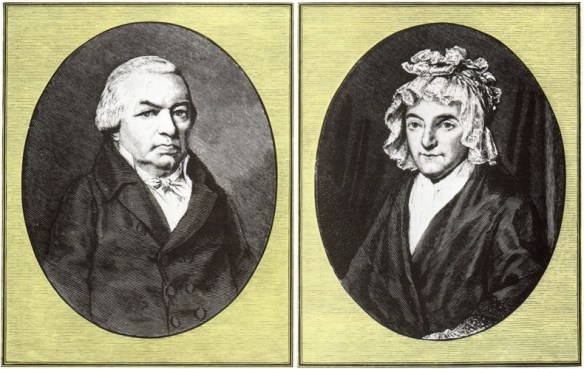
Picture: Beethoven’s parents, Johann van Beethoven and Maria Magdalena Keverich

The last listening exercise before diving into the music of Beethoven is to explore the music being made in the year of his birth, to try and get an idea of the temperature in Western classical music.

For Mozart, opera was key – even at the age of 14. His year began with a trip to Italy, organised by father Leopold with the aim of securing a big stage commission. That was duly achieved in Milan, at the flagship Teatro Regio Ducal (below). In December this prestigious venue became the setting for the premiere of Mozart’s first opera, Mitridate, re di Ponto. An ambitious three-act work, it has some eyecatching arias for the leading cast, virtuoso writing that established Mozart as a composer of real intent and secured a number of standing ovations at the premiere.

With the commission for Mitridate secured in January the Mozarts toured Italy for much of 1770, where Wolfgang found the time to take his symphonic canon into double figures. Don’t forget, he was still barely a teenager!

Haydn, meanwhile, an established composer in his late thirties, was beginning to flex his symphonic muscles. His Sturm und Drang period was just under way, and the innovations he would make in nearly every musical genre were beginning to take shape. 1770 was a relatively quiet year for his output, however. The symphony he completed, no.43 in E flat major, is known as the Mercure for no obvious reason. It is perhaps a more ‘polite’ piece than the minor key examples around it, but that should not be seen as a derogatory observation – it has the typical Haydn poise, guile and wit.

In London, Johann Christian Bach (Bach’s eleventh and youngest son) was impressing with his symphonies and piano concertos, and Hummel published a set of six as Op.6 in 1770. Daniel Heartz writes of how no.5 was a favourite with the public, to judge by the number of reprinting, but that the sixth in the series is impressive, with a ‘fiery middle movement’.

Meanwhile the fifth Bach son, Carl Philipp Emanuel, was adding to his enormous output too. Exact dates are harder to find for his works, though the first version of the Passion According to St Mark can definitely be said to have been completed in 1770.

Meanwhile Gluck, one of the most prominent operatic composers of the day, was occupied with the Viennese premiere of Paride ed Elena. When compared with his stage successes Orfeo ed Euridice or Iphigenie en Tauride, it has not performed well historically. Little is written about its premiere or reception, save for the relative lack of a convincing plot in the opera itself, but listening to it reveals some beautiful writing for soprano and castrato, and a Chaconne that becomes increasingly daring as it proceeds. It has been cited in a number of articles such as this one that Paride ed Elena marks a change in opera from singing to storytelling.

Elsewhere Boccherini was making a name as a prolific composer of works for strings, the most since Vivaldi – and secured for himself a prestigious role as cellist and composer to the royal court in Madrid. He would write more than 15 cello concertos and much chamber music besides.

What of the music of Bonn, where Beethoven was born in 1770? Well not much is known – or at least, not within easy reach in books or on the internet! It would be intriguing to know what was played at his baptism in St. Remigius on 17 December. Listen to the playlist below though and you will get an idea of the music circulating in what appears to have been a transitional year in European music. In many ways it was the calm before the storm.

Listen

The music of 1770 is collected in a Spotify playlist below:


Routes to Beethoven – Clementi

by Ben Hogwood

“Clementi plays well, with regard to right-hand technique. His speciality is passages in thirds. Otherwise he hasn’t a trace of feeling, or taste, in a word, he is a mere mechanic.”

This withering assessment of the virtuoso 18th century pianist Muzio Clementi came from none other than Mozart, who had engaged in a keyboard competition with the Roman composer at the request of Haydn on Christmas Eve in 1781. Mozart was writing to his father Leopold, as Daniel Heartz reports the duo in his superb book Mozart, Haydn and early Beethoven. Perhaps not surprisingly Haydn, who organised the duel, was more independent in his views, describing a set of Clementi’s Piano Sonatas as ‘very beautiful’ a year or so later.

Clementi was a nimble-fingered virtuoso. Born in Italy but settling in London, he is not mentioned a great deal in books of the time. Heartz reports a number of lukewarm reactions to his symphonies in England, though again this is not surprising given he was being compared with the visiting Haydn.

It was then in the field of piano music where Clementi really made his mark, and not just as a musician but as a publisher too. Beethoven recognised his influence in both disciplines, recommending his music for the use of piano students. Jan Swafford writes of how Beethoven and Clementi finally cemented a friendship in 1807. “As a pioneering composer for the piano, he had been a formative influence on the young Beethoven, because Clementi was among the best available models for how to write idiomatically for the instrument. Now retired from performing, Clementi lived in England and prowled the continent looking for music to publish and customers for his pianos.” He made several visits to Vienna. After an initial misunderstanding in Vienna in 1804, the pair struck a publishing deal and a friendship on a subsequent visit three years later.

Charles Rosen, writing in The Classical Style, recognises his influence. “In his (Beethoven’s) youthful works, the imitation of his two great precursors is largely exterior: in technique and even in spirit, he is at the beginning of his career often closer to Hummel, Weber, and to the later works of Clementi than to Haydn and Mozart.”

Harold Truscott, writing in The Beethoven Companion about Beethoven’s piano music, goes further. “I think it is true that Beethoven absorbed so much of this music of Clementi and Dussek that many times themes crop up in his work which go right back to themes in their work and that it seems probable he was unconscious of any origin; they had become part of him. We should be careful to distinguish between such unconscious connections and real influence, although the mere fact that these themes penetrated so deeply into his musical make-up seems to show that they had a great impact upon him.”

He observes many characteristics in the make-up of Beethoven’s themes and their treatment that have their common points with equivalent Clementi works. Looking at the Op.2 sonatas in particular, Truscott says, “Throughout his career the essentials of Beethoven’s piano writing changed little from what is displayed in these three sonatas. It was the writing of a virtuoso, using the basic techniques of Clementi and Dussek, but gradually developing their potential in his own way to meet new expressive demands as they arose.”

We will encounter the Op.2 sonatas early on in the Beethoven listening project…but for now we can enjoy Clementi’s own writing, when at its best is full of dramatic contrast, taking minimal melodic material and growing it substantially. The Sonata in G minor is perhaps the best example of his craft, and showing these qualities with the reminder that its date of composition, 1795, is before all of Beethoven’s early published work. It is included in the Spotify playlist below.

About the F minor work, also included in the playlist, Anselm Gerhard writes in his booklet notes how “the whirl of the final movement proclaims the definitive end of music’s historical dependence on traditional dance forms: here purely instrumental music reveals its determination to stand on its own two feet. It was not long before this idea was put into practice by Beethoven”, he continues, “albeit using completely different, characteristically revolutionary means: by consistently dramatising his music, he set out to transfer the prestige of the age’s most celebrated literary genre to instrumental music, and in the highly charged atmosphere of works like the Op.26 and Tempest sonatas, the medium’s new artistic ambitions were plain for all to hear.”

There is humour in Clementi’s thought process too, nowhere more so than in the brilliant pastiche of the Preludes in the style of Haydn and Mozart. Beginning the playlist is the Piano Concerto in C major, and there are two symphonies that illustrate how the composer’s prowess was not as stilted as some might have claimed. They may of course have seen him as a rival.

Clementi’s standing proves him to be more than that – and his influence on Beethoven will become clear in due course.

Routes to Beethoven – Mozart

by Ben Hogwood

It has often been speculated that Beethoven met Mozart in Vienna when he was 17. What a meeting that would have been, with a musician and composer at the peak of his powers and the man seen by many as his successor-in-waiting.

There were many contacts to link the two – not least Archduke Maximilian, elector and archbishop of Cologne. Mozart enjoyed good relations with him, and Beethoven was sent out with his strong recommendation. However not much is known about the outcome of their proposed meeting, nor even if it took place at all, given the conflicting tales afterwards. Yet what cannot be doubted is that the music of Mozart exerted a considerable influence on Beethoven for years – more so even than Haydn.

In his biography of the composer Lewis Lockwood writes of how Beethoven played Mozart piano concertos with the orchestra in Bonn. Beethoven’s good friend Reicha recounts of how, ‘after hearing an aria from Mozart’s Idomeneo (Electra’s passionate D minor aria), he talked of nothing else day and night for weeks thereafter.’ He also treasured Mozart’s Piano Concerto no.20, written in the same key, and wrote two cadenzas for it to be performed by his student Ferdinand Ries.

Lockwood goes on to examine the 14-year old Beethoven’s prodigious Piano Quartets, found after his death and posthumously published. So accomplished was the writing in these pieces that contemporaries doubted if Beethoven could have written them at all, but an autograph score survives to confirm their authenticity.

Lockwood notes them as ‘the first and clearest examples of the teenage Beethoven’s dependence on Mozart. They mark the beginning of a relationship to Mozart that remained a steady anchor for Beethoven over the next ten years as he moved into his first artistic maturity. Just as Mozart himself had once told his father that he was ‘soaked in music’ so Beethoven was soaked in Mozart. His invention of new ideas sometimes began with his asking himself if what he was writing was his own, or something he might have heard or seen in a work by Mozart, or partly both.

Several sources note that Beethoven copied out two of Mozart’s string quartets when the time came for his first forays into the form. Both form part of the set of six dedicated to Haydn – in G major (K387) and A major (K464), and the latter became a model for the fifth of the set published as Beethoven’s Op.18. He was also deeply impressed and affected by the otherworldly way in which Mozart begins another ‘Haydn’ quartet, the one known as the Dissonance in C major, K465. The introduction to this work is remarkable, removed almost completely from tonality and – at the time – regarded as deeply unattractive. Beethoven took it on board, however, and imitated it twice in subsequent slow introductions, the string quartets Op.18/6 and Op.59/3.

In his early work Beethoven used a number of titles and forms common to Mozart. A Serenade, a Quintet for piano and wind instruments, and he built several pieces of variations on Mozart themes. Some of Mozart’s forays into C minor – often seen as a ‘tragic’ key – are precedents for Beethoven’s own thoughts. The Piano Concerto no.24 is an especially vivid example, its mood and musical arguments emulated in Beethoven’s Piano Concerto no.3.

As I mentioned, Beethoven had to check a theme he had written was not a Mozart original, so concerned was he about marking his own path. As Lewis Lockwood writes, ‘Nothing could be more revealing of his anxiety about Mozart, his musical god and artistic father, whose music he knew and heard in his mind so well and clearly that he must have felt he had to work his way through the Mozartian landscape to find his own voice.’

The playlist includes all the works mentioned above and closes with Mozart’s crowning orchestral glory – the final Symphony no.41 in C major, known as the Jupiter:

Next we’ll briefly examine Beethoven’s relationship with the music of Clementi, one of the piano-playing stars of the time…and then it’s a look at the music of 1770, Beethoven’s birth year!

Igor Levit plays the Adagio from Beethoven’s Pathétique Sonata

As part of the celebrations for the 250th anniversary of Beethoven’s birth, Igor Levit has recorded the 32 piano sonatas, a highly acclaimed set released on Sony Classical late last year.

They are sure to form an integral part of our listening as Arcana navigates Beethoven’s complete output, but for now you can enjoy the timeless Adagio from the Piano Sonata no.8 in C minor, known as the Pathétique, which Sony have released today: