Routes to Beethoven – Joseph Haydn

by Ben Hogwood

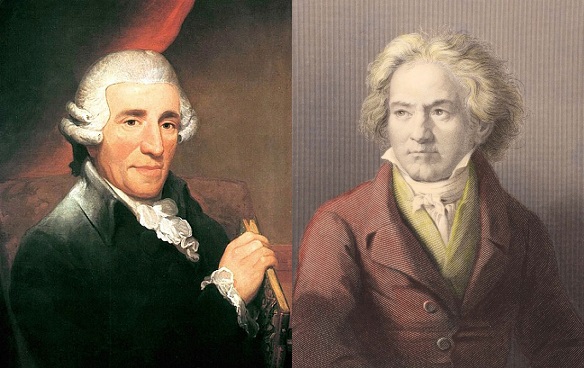
November, 1792. The 21-year old Beethoven was planning to leave his home town of Bonn for Vienna, and he left with a ringing endorsement from Count Waldstein, his most important patron. Mozart had died the previous year at the age of thirty-five, and Waldstein sensed the stage was clear. “Dear Beethoven!”, he wrote. “You are going to Vienna in fulfillment of a wish that has long been frustrated. Mozart’s genius is still in mourning and weeps for the death of its pupil. It found a refuge with the inexhaustible Haydn but no occupation; through him it wishes to form a union with another. With the help of unceasing diligence you will receive the spirit of Mozart from the hands of Haydn.”

This was of course rather fanciful. To suggest Haydn as a channel for Mozart’s inspiration did the older composer – now sixty and in the prime of his musical life – little recognition. Haydn was aware of Beethoven, the younger composer having sent him his ambitious choral Cantata on the Death of Emperor Joseph II – and was willing to take him on. Thus Beethoven left Bonn in early November 1792 and travelled for ten days until arriving in Vienna.

All appeared to be going well for him there, but when Haydn sent a letter to Elector Maximilian dated just over a year later he included a clutch of works that Beethoven had already written in Bonn. Most were sadly lost – including an Oboe Concerto – but an Octet-Partita for wind ensemble has survived. The covering letter expressed the conviction that ‘On the basis of these pieces, expert and amateur alike must admit that Beethoven in time will attain the rank of one of the greatest musical artists in Europe, and I shall be proud to call myself his teacher. I only wish that he might remain with me for some time yet.’

The reply was curt, since Maximilian was receiving music he had already seen – and could not see any discernible progress to finance Beethoven further. As Lewis Lockwood points out in his Beethoven biography, Haydn’s priorities as a composer were stacked up. He had made a pioneering and highly successful visit to London in 1792, and a sequel was on the cards, for which he would need new string quartets and symphonies. Beethoven, too, given his ability and individuality, was not to be the perfect match. Lockwood talks of ‘the same stubborn personal resistance’…which ‘seems to have troubled his relationship to Haydn, though here it was mingled with reverence for authentic genius.’

With Haydn’s focus abroad, Beethoven looked elsewhere for his teaching and found counterpoint studies with Johann Schenk. Haydn returned to London and the brief relationship was at an end. Before he left Vienna, however, he was privy to Beethoven’s Op.1 – three trios for piano, violin and cello – and Op.2, a set of three piano sonatas dedicated to Haydn.

The trios contained a problem, in the explosive form of the third piece in C minor. Haydn advised withholding this from publication, calculating the impact on the Viennese audience might damage Beethoven’s reputation. It was, as Michael Steinberg in The Beethoven Quartet Companion points out, ‘a surprising attitude from a composer who was himself so bold. An observer went further, noting ‘a kind of apprehension, because he realised that he had struck out on a path for himself of which Haydn did not approve.

Jan Swafford holds the conviction that Beethoven took far more from Haydn than he himself declared at the time. ‘There is no record of what transpired in their lessons’, he writes. But it can be said that at least by his Op.2 Piano Sonatas, composed in 1794-5, Beethoven was showing the fruits of his studies in a startlingly mature way. After his months with Haydn, Beethoven emerged a far more sophisticated composer. To mention only one issue: Before Haydn, Beethoven had a shaky idea of proportion, might write an introduction to an aria that was a quarter of its length. After he finished the lessons with Haydn, he had one of the most refined senses of proportion of any composer – a sense of it, in other words, at the level of Haydn.’

Haydn’s influence on Beethoven can be gauged at this stage by listening to some of the works he was writing while teaching the younger composer. The three string quartets published as Op.74 are a case in point. The slow movement of no.3 in G minor finds the sort of spaciousness we became accustomed to from Beethoven in his equivalent slow movements. Meanwhile in the slow movement of no.1 in C major Haydn goes on all sorts of unusual tonal routes, seeming to travel far from home but only so he can show his dexterity as a composer, bringing the music ‘home’ with a single, deft switch. Beethoven was to acquire that quality too.

The Piano Sonatas offer some clues, too. The playful opening of the Sonata in C major has a wit Beethoven was only too keen to take forward. So too the grand gestures of the Sonata in E flat major, a key that was to assume great importance for Beethoven over the years. Haydn’s Masses were well known to Beethoven too, and the Nelson Mass – closely associated with Nelson’s victory over Napoleon – cast quite an influence on the younger composer’s Mass in C major.

The later symphonies acquire a dramatic instinct which must have appealed to Beethoven too. Like C.P.E. Bach, who we have already heard from, Haydn had a Sturm und Drang period that marked his music forever, and the last twelve symphonies, written for use in London, are even more vivid in their stories. The introduction to the relatively unsung Symphony no.98 in B flat major has a dark edge, and these works, now laden with timpani, have more emotive and dynamic contrasts, straining at the leash of the conventions of form and harmony. The final, London symphony – no.104 in D major – demonstrates best of all how far Haydn had taken the form. Its dramatic slow introduction reaching towards the 19th century and beyond, while the slightly rustic finale is brilliantly written.

There is much speculation on how Beethoven and Haydn’s relationship developed, if it did at all, beyond that of a prodigious pupil and a seasoned master of his craft in his early sixties. Certainly a healthy mutual respect existed, Haydn spotting the gifts Beethoven had in abundance, while Beethoven himself found his early works bearing clear influence of Haydn even more than Mozart. We will explore those in greater depth, as Beethoven takes on the forms of symphony, string quartet, piano trio and piano sonata and bears them into the 19th century.

You can listen to selections from Haydn’s enormous output, including the works discussed above, on the playlist below:


2020 Beethoven: The Story So Far

As you may well know, Arcana is undertaking a Beethoven listening project this year, in celebration of the 250th year since his birth.

We are approaching Beethoven by way of composers and teachers that had an influence on his output – J.S. Bach, son C.P.E., Handel and teachers Albrechtsberger and Salieri. We have also had a quick look at the Mannheim school of composers who helped the forms of the symphony and sonata to spread their wings.

We will shortly hear from Haydn and Mozart, then a quick look at Clementi – who Beethoven held in very high regard – before a guide to the music of 1770, the year of Beethoven’s birth. Then – finally – we will start on the music of Beethoven himself.

Arcana have several exciting interviews in the bag to help us with our discovery of Beethoven. Pianist Angela Hewitt has given some pearls of wisdom on the Piano Sonatas, while this morning Cyprien Katsaris held court as he talked of his upcoming Beethoven Odyssey. Many discoveries were made! We will also hear from cellist Steven Isserlis, who has offered his thoughts on the Cello Sonatas.

It has been a relatively slow start – but expect the tempo to rise considerably over the coming months! Meanwhile here are clips from one of Hewitt’s discs for Hyperion on the Piano Sonatas, including the wonderful opening pages of the Pastoral:

Routes to Beethoven – The Teachers: Salieri & Albrechtsberger

by Ben Hogwood
Picture (left to right): Johann Georg Albrechtsberger, Beethoven, Antonio Salieri

In which we briefly explore the music and influence of two of Beethoven’s teachers. In their entry on the composer, The Grove Dictionary of Music and Musicians talk of how the composer initially struggled to find an appropriate teacher. “In his dissatisfaction Beethoven went to another master, Albrechtsberger, a distinguished authority on contrapuntal and sacred music who had been court organist for twenty years”, reads the article. “Beethoven’s lessons with this able teacher continued for an indefinitely recorded period that was more than a year.”

Albrechtsberger was a well respected composer but his music has rather fallen by the wayside. His best-known composition is an unusual one, a Concerto for Jew’s Harp and Orchestra. Once heard, the sound of this unusual instrument is certainly not forgotten, its friendly buzz either appealing or infuriating – a marmite instrument for sure! As you may well hear from the String Quartet included on the Spotify playlist below, Albrechtsberger’s output was extremely accomplished – but not always with especially distinctive material.

Grove then talks of how, from “about 1793 to 1794 he put himself under another specialist, Antonio Salieri, court Kapellmeister, who had for many years been director of the Opera and was himself a flourishing operatic composer.” Beethoven’s aim here was to get a greater understanding of the musical aptitudes required for the stage. As Grove points out, that may seem a bit odd for a composer looking to excel in the supposedly more rigid forms of the symphony and the sonata. Yet Beethoven built on the essence of musical drama, studying with Salieri until 1802 and maintaining strong links with him after that.

Listening to some of Salieri’s large canon of music reveals a composer capable of turning his music into a drama. The Sinfonia in Pantomima, written for Armida, gives an idea of his dramatic instincts, changing mood quite abruptly. It also acknowledges the influence of Gluck in the operatic world at the time. The Overture to Daliso e Dalmino has a rush of violins, uses timpani freely and generates quite a head of steam, which surely would have appealed to his pupil. Likewise the terrific cut and thrust to the Overture to Les Danaides, with flurries of violins.

Again, we will have to wait until the Beethoven listening starts in earnest to gauge the influence of Salieri in particular. Yet the signs are – with Ludwig a dedicated pupil – he will have absorbed important elements from both these teachers. Now to see what Haydn and Mozart could impart!

You can listen to the music of Albrechtsberger and Salieri on the playlist below:

You may also wish to try an acclaimed recent release from Christophe Rousset and Les Talens Lyriques, a thrilling account of Salieri’s opera Les Horaces, written seven years before Beethoven came to call:

Routes to Beethoven – The Mannheim School

by Ben Hogwood
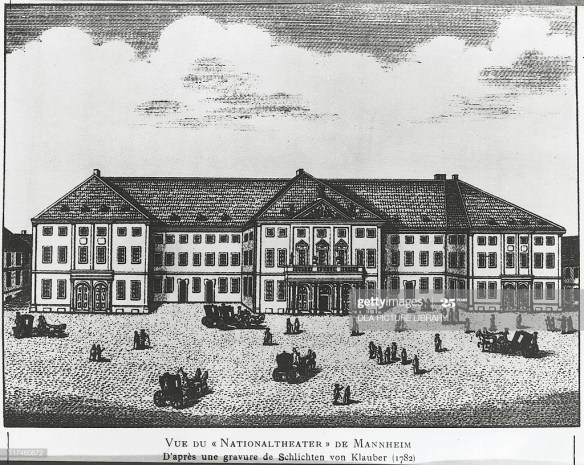
Picture: Mannheim National Theatre, 18th century (Schlichten & Klauber)

As we move towards the music of Beethoven we have so far encountered the music of three great masters – J.S.Bach, C.P.E. Bach and Handel. While all three exerted some sort of influence on Beethoven’s music, it is arguably the music of C.P.E. that was to prove the most far-reaching and original.

C.P.E.’s music went in hand with the Sturm und Drang approach, composers encouraged to bare their souls more explicitly in their music rather than (or as well as) sticking to more conventional rules.

The court orchestra of Mannheim was a hotbed for composers employing the Sturm und Drang in the mid-18th century. Its high level of musicianship was noted by Leopold Mozart and son Wolfgang, who made a prominent visit to Mannheim in 1777.

In his fantastically readable and comprehensive history Music In European Capitals – The Galant Style 1720-1780, Daniel Heartz takes up the story. He tells of how the city was incredibly well-placed for musical entertainment. Much of this took place in the palace, built from 1720 and containing the Knights’ Hall or Rittersaal, which became “the site of the orchestral academies for which Mannheim’s court music was to become most famous”. From 1742 the palace (below, depicted in 1725 by J.C. Froimon) was equipped with an opera house installed in its eastern wing, and a huge number of musicians in its employment.

One of those musicians was Johann Stamitz, described by English music historian Charles Burney as ‘the late celebrated Stamitz, from whose fire and genius the present style of Sinfonia, so full of great effects, of light and shade, was in considerable degree derived’. The ‘light and shade’ of which Burney speaks corresponds with the Sturm und Drang.

Stamitz worked at the court in Mannheim from 1743, but his fame soon spread, and Heartz writes of ‘the performance of a symphony by him with horns, trumpets, and timpani to open the Concert Spirituel in Paris in 1751’. This led to a prolonged period of work in the French capital, though soon Johann returned to Mannheim where he died in 1757, succeeded by his pupil Christian Cannabich.

The playlist below includes a number of Mannheim composers, headed by Johann Stamitz and his son Carl. Johann’s Sinfonia pastorale in D major begins the selection, quoting extensively from a Bohemian Christmas carol. Heartz writes of how ‘Stamitz’s fame rests principally on the handful of symphonies…attributed to his last four years…without equal in the 1750s’.

From there son Carl takes up the baton with the well-loved Clarinet Concerto no.3. Listening to this bright piece, brilliantly played by Sabine Meyer, gives an illustration of the positive energy Stamitz used throughout his music. The Cello Concerto in G major, later in the selection, is even more substantial, an assured piece that has a deeply soulful slow movement.

Cannabich himself wrote a large number of symphonies. Heartz writes of how his Symphony no.22, included here, contains crescendos – the idea of music changing in volume now a completely accepted one by scholars and audiences. It also includes oboes and horns in the scoring, signs that the orchestra was beginning to expand.

Mozart, however, was not impressed for a good while – until a later Cannabich symphony passed his ears in Munich in 1780. Now the story was different. ‘I assure you, if you had heard it yourself it would have pleased and moved you as much as it did me, and if you had not known ahead of time, you would not have believed that it was by Cannabich. Come soon then and hear the orchestra and admire it!’

Other prominent composers in the Mannheim court were Franz Xaver Richter, whose Symphony in B flat major appears on the playlist, as well as Franz Ignaz Beck and Ignaz Fränzl.

Did they influence Beethoven’s way of thinking in any way? We shall find out in due course. In the meantime, listen below:

Next up

Routes to Beethoven moves on to a quick look at the music of two of his teachers, Anton Albrechtsberger and Antonio Salieri.

Sound of Mind 10 – Sounds of Spring

If you’ve been indoors for over a week now, the chances are you’ll be climbing the walls!

Happily there are reasons to be cheerful just around the corner – not least the imminent arrival of spring.

Classical music composers have always taken to spring in their music, from Vivaldi through to Stravinsky. This playlist celebrates their portrayals of the season, through works including Vivaldi’s The Four Seasons, Schumann‘s Spring Symphony, Beethoven, Sibelius and finally Britten.

Have a listen and harness the positive energy our composers can provide!


Ben Hogwood