Wigmore Mondays – Nicola Benedetti & Alexei Grynyuk in late sonatas by Beethoven & Brahms

nicola-benedetti
Nicola Benedetti (violin, above), Alexei Grynyuk (piano, below)

Wigmore Hall, London

Monday, 29 February 2016

Audio (open in a new window)

http://www.bbc.co.uk/programmes/b071cl1c

Available until 29 March

alexei-grynyuk

What’s the music?

Beethoven – Violin Sonata in G major, Op.96 (1812) (28 minutes)

Brahms – Violin Sonata no.2 in A major, Op.100 (1886) (23 minutes)

Spotify

Nicola Benedetti and Alexei Grynyuk have not yet recorded this music, but other versions can be accessed via the playlist below, in case you can’t get to the broadcast:

About the music

Beethoven’s tenth and last published violin sonata sits on its own in his output, a decade after than the composer’s previous work in the form. It is dedicated to the same ‘Archduke’ (Rudolph of Austria) for whom Beethoven wrote his famous B flat major piano trio, also published in 1812. Beethoven supposedly wrote it in a slightly easier style, as the violinist Pierre Rode – who was performing the piece with the Archduke playing piano – was not as skilful as he once was. The G major piece makes allowances, then – but not in a way that you would ever know from listening! It is unusually tranquil, and has instances of the timeless music Beethoven was to find in the slower movements of his late works.

There are no such concessions to technical ability from Brahms, who wrote the second of his three violin sonatas while on holiday by Lake Thun, Switzerland. This is however a relatively late work, and although Brahms has found and established his style the piece still carries some of the pressures of writing for Joseph Joachim. Its lyrical and tuneful nature have helped make it one of the composer’s most popular pieces of chamber music – and like the Beethoven it has a largely sunny outlook.

Performance verdict

A nice combination of two violin sonatas that seemed ideally suited to a bright Spring lunchtime – and how refreshing to hear young artists such as Benedetti and Grynyuk take on two later works like this.

The Beethoven was lovely, performed in a spirit of enjoyment where the violin and piano really were equals. Benedetti’s tone, slightly sweet, was ideal, while Grynyuk proved a very sensitive pianist, with some lightly brushed contributions that made sense of Beethoven’s unusual contentment.

The same mood infused the Brahms sonata, though here there was a greater sense of purpose, as the first movement, having begun relatively slowly, surged through to a much more animated development section. The finale was also notable for revealing some of the shadows that became a greater part of Brahms’s late works – but overall the feeling was one of positivity, celebrating the composer’s good spirits and warm lyricism in this work.

What should I listen out for?

Beethoven

1:58 – as the piece begins there is an immediate feeling of contentment, and although the opening idea is quite innocuous it is distinctive, with its use of the trill ornament. The piano introduces an airy second theme at 3:10, which the violin soon takes up. The mood is summery, and even a bit drowsy. The first section is repeated again at 4:40. Beethoven then develops his ideas fluently before we hear the main tune once again at 8:31, shared this time by the violin and piano. The balmy warmth continues until the end.

13:12 – the second movement is slow, marked Adagio espressivo, and has that kind of heavenly timelessness often found in later period Beethoven. It has a spacious introduction from the piano and is if anything even more relaxed than the first movement. It operates at a similar tempo and mood to the slow movement from the Emperor piano concerto. From around 14:35 the violin lines become quiet and bare, Benedetti using little vibrato, but the warmth does not take long to return.

19: 19 – the third movement, a Scherzo, is short, and if you blink you’ll miss it! Its first idea is once again light of touch, and though there is a heavier trio section it is not at all long before the minor key asserts itself again.

21:48 – the final movement also has a light touch, with a Haydn simplicity, and is particularly rich in the lower register and strong in the continuous, lower runs. The slower music is a delight, still airy and relatively carefree. There is then a quicker, invigorating run to the end.

Brahms

32:37 – one of Brahms’s most celebrated tunes opens this piece, a lovely outpouring of good feeling. It is quite slow and quiet to begin with but grows into a full blooded interpretation as the theme is developed further. There is greater affection here than in much of Brahms’s output.

42:07 – this is definitely the lighter side of Brahms, with a tender slow movement that segues into a more jaunty Scherzo section (43:32), marked by tumbling triplets in the piano part. The slow movement music follows again at a safe distance (44:38) – and then once again the scherzo music trips along (46:43), this time with plucking from the violin.

49:28 – in the last movement we get the warmth of the violin’s lower register, taking the ‘grazioso’ marking in to account. There are though some shadows that the listener might sense occasionally, the odd harmonic turn towards the dark side that never lasts too long but is there nonetheless.

Encore

54:35 – a substantial encore from Benedetti and Grynyuk, and a very different mood in the exotic and intense Myth no.3 by Polish composer Szymanowski.

Further listening

At the bottom of the playlist you will find some further suggestions for violin and piano in the form of sonatas by Schumann – Brahms’ friend, of course – with his Violin Sonata no.1 – and César Franck, whose own Violin Sonata shares the same key and mood as Brahms’s Second. Finally some shorter pieces by Schumann for solo instrument and piano – the joyous Adagio and Allegro and the 5 Pieces in Folk Style, arranged here for cello and piano. Each will put you in a good mood!

Meanwhile if the Szymanowski appeals, Nicola Benedetti has recorded his Violin Concerto no.1:

Wigmore Mondays – Alec Frank-Gemmill & Alasdair Beatson: John Casken world premiere

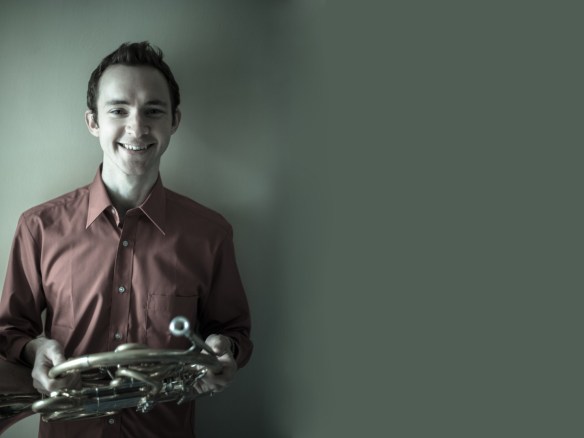
Horn player Alec-Frank Gemill and pianist Alasdair Beatson give the world premiere of a new work by John Casken at the Wigmore Hall

alec-frank-gemmillWigmore Hall, London, 1 February 2016

written by Ben Hogwood

Audio (open in a new window) – available until 3 March

http://www.bbc.co.uk/programmes/b06yrgk5

What’s the music?

James MacMillan – Motet V from ‘Since it was the day of Preparation’ (for solo horn) (2010-11) (8 minutes)

Beethoven – Horn Sonata in F major Op. 17 (1800) (16 minutes)

John Casken – Serpents of Wisdom (world première, 2015) (12 minutes)

Schumann – Adagio and Allegro in A flat major Op. 70 (1849) (9 minutes)

Spotify

Unfortunately neither the MacMillan nor the Casken pieces are available to stream at present. However you can hear the Beethoven and Schumann on the link here:

About the music

There is a pleasing amount of recent music written for the solo horn – and Alec-Frank Gemmill begins this concert with an extract from a much larger work by Sir James MacMillan. Since it was the day of Preparation… is a large, 70-minute piece using texts from St John’s Gospel – but within it are sections for solo instruments from the ensemble, using the sort of structure a composer like Benjamin Britten would have employed. A substantial one of these, for solo horn, is heard here.

John Casken wrote Serpents of Wisdom for this concert and these players, and was inspired by the imagery of a serpent primarily through the poem Celtic Cross by Norman MacCaig. As he wrote he was taken through the idea of a musical representation of the coils of brass that make up the horn. Through the piece he uses some unusual effects such as natural harmonics, which make the horn sound out of tune but are intended.

Beethoven wrote one of the very first sonatas for horn and piano, a three-movement construction that he started – and finished – the day before giving it in concert with the horn player known as Giovanni Punto. Meanwhile Schumann’s only work for horn and piano, the Adagio and Allegro, was written for a member of the Dresden Court Orchestra. It has been a little unfairly taken on by viola and cello players, and is more commonly heard in that version. Reverting to horn and piano enables us to hear why the theme for the Allegro works so well in its original form.

Performance verdict

A pleasant change for a Monday lunchtime from the Wigmore Hall – the first horn recital they have programmed at such a time for years. It was made all the better by the choice of a world premiere, and by the artistry of Alec Frank-Gemmill and Alasdair Beatson, an exciting duo fully justifying their billing as young musicians well worth experiencing live.

Frank-Gemmill is a really excellent player, and took on the Casken with impressive belief and skill. While clearly not an easy piece to play it made a powerful impression – equally so in the piano part, where Beatson had to work hard with some tricky passage work. Although inspired by the coils of brass, Casken’s piece often felt to me as though it was craggy in outline, and while its impression was largely gruff and unforgiving, there were some surprisingly tender asides.

The MacMillan was a striking piece, clearly in homage to Britten – and reminiscent of some of his writing for Dennis Brain – but also showing how it is possible to write quietly for the horn without losing any expression. Frank-Gemmill managed the low notes brilliantly here.

The Beethoven and Schumann were much more conventional but equally enjoyable. Beethoven writes for the horn without any inhibitions and there was plenty of gusto in the outer movements of this performance. The Schumann is a glorious piece, a true musical evocation of happiness, though this account did not completely lift itself off the printed page. No matter, for the new pieces had already left a lasting imprint – and an encore, Glazunov’s Rêverie, made for a lovely finish.

What should I listen out for?

MacMillan

1:41 – MacMillan’s piece has a soft and reverential opening which gives the piece a tonality and also a very low main note, which makes a lovely sound on the horn.

The melody has the appearance of plainchant, and gradually it grows in breadth and confidence. Then around 7:20 the music takes a confrontational approach, whooping excitedly and going all the way up to a remarkably high note at 8:04 – before its relatively calm finish.

Beethoven

11:58 – a brief yet quite understated fanfare from the horn begins the work – and it receives ample support from the more graceful piano theme behind it. A thoughtful second theme is heard at 12:55 before the first section of the first movement is repeated at 14’29. After a short development we hear the main tune once again at 18:15, and the second theme – now in the same key as the main one – at 18:59.

21:04 – a slower movement that begins with a soft and slightly sad air – but it doesn’t last long, as essentially it serves as a long introduction to the final movement, beginning at…

22:30 – quite an angular main tune for this movement, which proceeds in high spirits. The main theme comes back again, signs off brilliantly around 27:27

Casken

29:39 – a brisk start, energetic too. The first of the ‘natural’ notes is heard at 30:13 – you can hear it is out of tune but it is meant to be. The slower music at 30:44 is brooding and paints a relatively austere picture. As the music gets quieter the horn turns to the mute.

There is then an extended piece of writing with impressive energy and stature from the horn, which is required to perform a number of very difficult tasks, usually in cahoots with the piano, which itself has a jagged outline to its music. A slower section runs around 38:30, but then the piece gathers itself for a big finish at 40:15.

Schumann

42:42 – a slow and romantic Adagio, led by the horn, which is largely graceful but has some tricky high notes. This leads into the exuberant Allegro at 46:59. This has a tricky theme with a wide range.

Encore

53:19 – as a soft-hearted encore the pair play the Rêverie in D flat major by Glazunov, which is a warm piece, even when it reaches the depths at 54:55. (4 minutes)

Further listening

This very fine disc from Richard Watkins, on the NMC label, brings together writing for horn from a number of highly respected modern composers, among them Gerald Barry, Peter Maxwell Davies, Robin Holloway, Colin Matthews, David Matthews, Mark Anthony Turnage and Huw Watkins. You can listen here:

Wigmore Mondays – Armida Quartet play Mozart and Beethoven

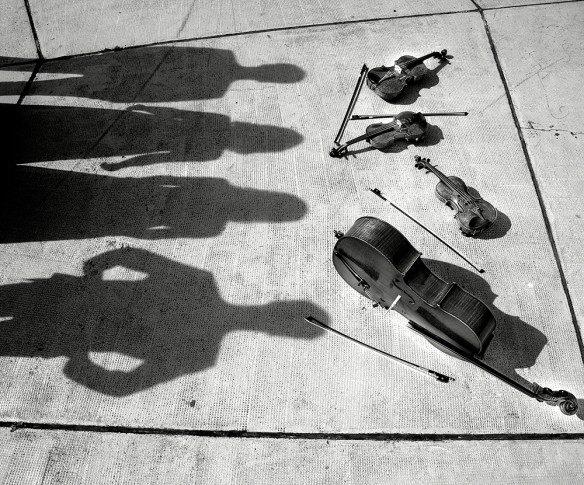
The Armida Quartet play string quartets by the teenage Mozart and Beethoven – his first quartet for Count Razumovsky of Prussia

armida-quartetPhoto: Felix Broede

Wigmore Hall, London, 25 January 2016

written by Ben Hogwood

Audio (open in a new window) – available until 24 February

http://www.bbc.co.uk/programmes/b06xwtbp

What’s the music?

Mozart – String Quartet in G major, K80 (1770) (10 minutes)

Beethoven – String Quartet in F major, Op.59/1 (Razumovsky) (1806) (39 minutes)

Spotify

If you cannot hear the broadcast then this attached playlist has all the repertoire in the concert. The Armida Quartet have recorded a disc of Mozart but not this particular piece – so the Hagen Quartet version is included here, along with the Tokyo String Quartet in the first Razumovsky:

https://open.spotify.com/user/arcana.fm/playlist/726X8dueQnIBJOflr9jeIt

About the music

What were you doing when you were 14? I daresay you hadn’t completed a String Quartet lasting 20 minutes by then! The teenage Wolfgang Amadeus Mozart had managed that – he had also completed ten symphonies and numerous other works – and was about to witness the premiere of his first opera, Mitridate, in Italy with his father Leopold.

This string quartet was written on the road, between Milan and Parma – an early ‘tour album’, you could say! – and initially sat in three movements to conform with Italian taste. Later the composer added a fourth to suit German audiences. All were completed under the watchful eye of his father.

Beethoven dedicated three of his ‘middle period’ string quartets to Count Razumovsky, the Russian ambassador in Vienna at the time and a musical patron. At his request Beethoven included a Russian theme in each work, and in the first quartet it can be heard at the beginning of the last movement.

With these three quartets Beethoven noticeably expanded the form, no longer the intimate salon experience of Mozart but now a medium for the communication of extremely personal thoughts and big structures. The three works are big, each around 35-40 minutes in length, and they push the boundaries of string quartet writing so that on occasion the four instruments sound at least double the size. This one, Op.59/1 in F major, is the longest of the three and is notable for its profound slow movement (one of only two pieces marked mesto (sad) by the composer) and for the fun and games in its second movement Scherzo.

Performance verdict

The Armida Quartet are BBC Radio 3 New Generation artists, and on the strength of their Beethoven performance in particular they clearly have a very bright future.

This was excellent quartet playing, incredibly well balanced and full of vitality. Their sense of enjoyment in the second movement of the Beethoven was infectious, and throughout their quiet playing in particular was something to treasure, enabling them to reach the very sombre depths of the slow movement but also the dynamic contrasts used by Beethoven elsewhere. The outer movements contrasted nicely with this, being vibrant and humourous on occasion, and always revelling in the composer’s tuneful invention.

The Mozart was very stylish, possibly a little too rich in the first movement as the quartet recaptured the Italian style. The main emotion here was one of surprise at the composer’s sheer prowess – this is a remarkable work for someone the age of 14 to have turned out – but on occasion.

The quartet decided not to employ the repeats marked in each movement, effectively halving the length of the piece with the Beethoven in mind. A shame, perhaps, but not a decision that stopped us from sitting in awe of the adolescent’s genius!

Interestingly the quartet changed their seating arrangements during the concert. For the Mozart the violinists faced each other, with viola and cello in between, while for the Beethoven the cello and second violin swapped for a more conventional arrangement.

What should I listen out for?

Mozart

1:32 – the first of Mozart’s quartets is quite top heavy in structure, and it is the first movement that has a lot of the emotional and musical content, lasting nearly twice as long as any of the others. It starts with such elegance you would never know it was the work of a fledgling composer. There is assured writing for the four instruments, often divided into pairs in the part writing.

5:17 – a lively second movement, the four instruments playing in unison initially then moving apart.

7:33 – Mozart writes a graceful minuet for the third movement, one with a light spring in its step.

9:27 – the finale brings with it more open textured, bright writing for the quartet

Beethoven

13:40 – the piece starts quietly, the cello theme immediately evident before being passed to the violin. At 15:03 we hear the other main theme of the quartet, different in character – the music feeling more ‘established’ by this point. At 16:06 we hear the cello’s theme again, but now Beethoven moves this through a development section, chopping and changing it – before bringing it back for a recap at 19:40. By now the music feels increasingly restless, and continues to pass through a number of different forms and keys, until the quartet state the theme in fall, and the music falls away a little to the end, seemingly content.

23:44 – the ‘Scherzo’, traditionally the movement where composers show their witty side. Beethoven certainly does that here, picking a tune that can be cheeky or quite aggressive by turns. It starts sheepishly, but Beethoven varies the volume a lot in this movement, passing from very quiet to loud, often in a way that might make you jump!

The music then moves into the minor key for a contrasting ‘trio’ section, beginning at 30:00, but by 31:14 is back in the major key and playing with different volume levels again! Snippets of the main tune and other phrases are passed around until the soft finish at 32:16…though even this has a sting in the tail!

32:48 – the slow movement begins – and with it one of Beethoven’s saddest themes, heard on the first violin. While fragile at the start the music gains intensity and sounds rather tortured at times. At 37:48 we hear the sad music again, though it is higher and weightless in its new guise. Then Beethoven takes us through a section developing the tune, with a pensive and very intimate dialogue between the four instruments. This profound passage of play comes out of the doldrums and into…

46:05 – the last movement, based on a Russian folk tune – and immediately positive with the cello’s rendition of it. Beethoven structures this as a Rondo – a form that means the tune comes back repeatedly, with differing sections in between. Then at 51:31 we hear the tune very slowly, setting up a quick drive to the finish from 52:03.

Encore

54:09 – as an encore the quartet play Contrapunctus IV from J.S. Bach’s The Art of Fugue. The violin begins, then the second violin joins, then the viola and then the cello – all in a perfectly calculated example of how a fugue works with four parts. (3 minutes)

Further listening


New Year Feature – The Sound of Silence

sound-of-silence

First of all, happy new year! I hope 2016 is good for you, and that Arcana can at least play some part in bringing you some musical treats and writing that you will hopefully enjoy.

It may seem an odd thing for a music site to talk about, but I’m going to kick off the New Year by promoting the virtue of silence.

Silence is good on so many levels. It allows the full formation of thoughts, provides a necessary break from the frenetic activity of day-to-day life, and – for me at least – it cleanses the mind over a holiday period such as Christmas, after which the joy of music can be appreciated more than ever. Not that I made an active bid for freedom from music this time around, but stepping away from it for a bit was incredibly useful.

Pop songwriters and classical composers have used silence to their advantage on many occasions. One use of silence I often think of is incredibly minute but works an absolute treat, where King Crimson go for the jugular half way through 21st Century Schizoid Man:

Perhaps the most famous classical example is John Cage in the sound-free 4’33” – which, depending on your view, is a work of genius or flawed publicity stunt. I would definitely tend towards the former, because if you ‘listen’ to 4’33” (after the pretty loud introduction!) each performance is different – because all manner of tiny micro-sounds make themselves known in your environment:

The use of silence goes much further back of course. Can you imagine the works of Beethoven without the use of silence? How on earth would the start of the Fifth Symphony sound without it…

…or the beginning of the second Razumovsky string quartet?

…or, taking a fantastic example from the last century, the very end of SibeliusSymphony no.5?

All show just how powerful silence can be when used strategically. Yet if experienced over longer periods of time it takes on an even more special significance.

A New Year’s Day walk brought this home to me in vivid form. After hearing the radio for the first hour or so of the day – and inevitably U2’s New Year’s Day was included in this! – it was out for a walk where we were staying in Faversham, Kent.

Our walk, designed to cure the hangover from the previous night’s celebrations, took us out beyond the town and heading for the reeds and marshland close to a remote place called Oare, and its haunted pub The Shipright Arms.

Here all that could be heard were calls from what turned out to be little egrets, the wind in the reeds, and something quite astonishing in the whirring of a swan’s wings as it took off on the adjacent lake.

little-egret

Little Egret (c) Ben Hogwood

Yet the wonderful truth was that if you stood and listened, most of what you could hear was…nothing. It was a cleansing experience, and one that has set me up to enjoy what 2016 has to offer musically. We at Arcana hope you choose to enjoy it with us…and share your moments of music and  silence with us…and that you have a Happy New Year!

Ben Hogwood – editor, Arcana.fm

Tomasz Lis at Leighton House – Tchaikovsky and Chopin

tomasz-lis
Tomasz Lis

Richard Whitehouse on an intriguing recital from the Music at Unique Venues series
Leighton House, London Tuesday 10 November

Tchaikovsky: The Seasons, Op. 37b (1875-6)

Chopin: Preludes, Op. 24 – selection (1835-9)

Tomasz Lis (piano)

This evening’s recital formed part of the series Music at Unique Venues, aiming to combine the appeal of music and art by holding recitals at places not normally associated with live performance or, moreover, that are not often open to the general public. Although Leighton House has been accessible over much of the past century, not least for live music-making, a lengthy period of renovation had effectively taken it out of circulation; making performances such as that given tonight by the Polish pianist Tomasz Lis a much-needed act of redress.

Each half began with Lis placing the music in the context of fine-art from the same period. Thus he prefaced his account of Tchaikovsky’s The Seasons with consideration of those paintings A Rye Field and Winter by Ivan Shishkin (1832-98), whose deftly achieved realism found its complement in the understated and folk-inflected ethos of Tchaikovsky’s cycle; played with a winning combination of grace and eloquence by Lis, who pointed out it might have been titled ‘The Months’ were it not for the commercial acumen of its publisher.

The second half duly opened with Lis considering the paintings Souvenir de Mortefontaine by Jean-Baptiste-Camille Corot (1796-1875) and Fire at Sea by JMW. Turner (1775-1851); their powerful synthesis of feeling with depiction finding direct equivalent in the 24 Preludes of Chopin, 16 of which (Nos. 1-11 and 13-17) were heard here. Two-thirds of such a closely integrated cycle might have been in error, but Lis ensured this selection unfolded with a cohesion such that the A flat prelude rounded-off the sequence with requisite poise.

Add to this visual and musical feast the opportunity to enjoy the surroundings of the house made famous by Frederic, Lord Leighton (1830-96) out of opening hours, and the result was an evening as instructive as it was pleasurable. Tomasz Lis has recently released his debut album – featuring impromptus by Schubert, Chopin and Fauré – via Rondeau Productions (Klanglogo KL1511), which is well recommended. The Music at Unique Venues continues next February at Armourers Hall in the City of London and then in May at the Saville Club.

You can read more about the Music at Unique Venues series here

Meanwhile the website of Tomasz Lis is here