
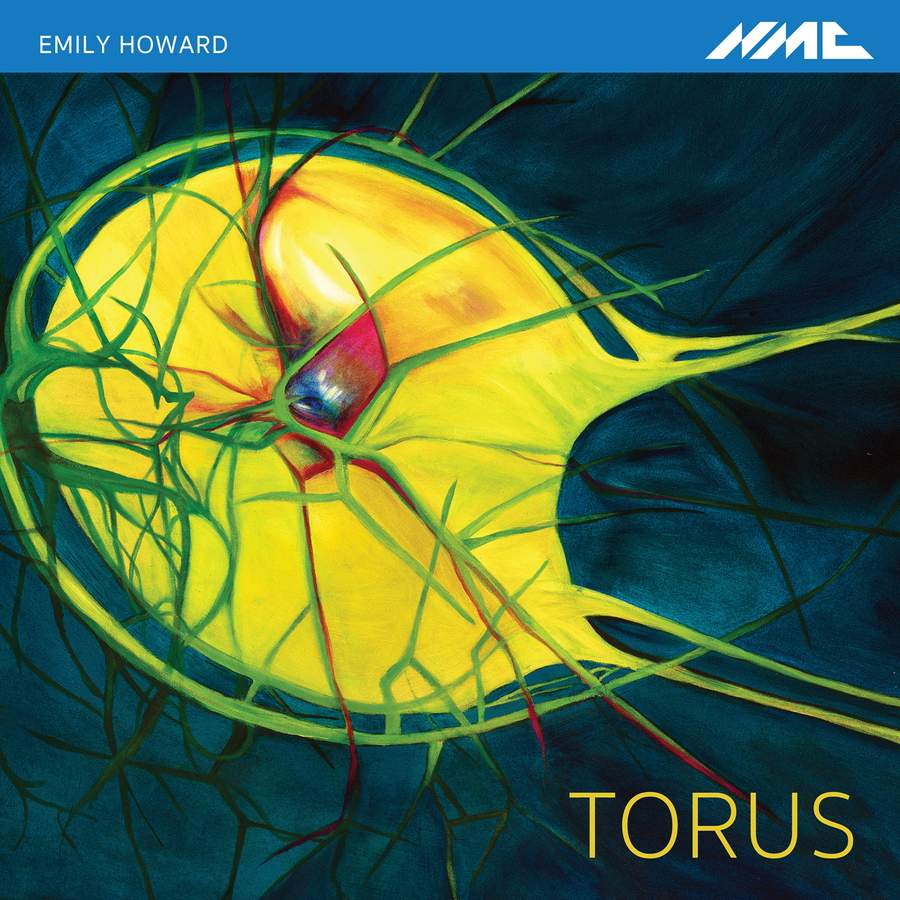
On Record: Emily Howard: Torus (NMC Recordings)

Emily Howard

Antisphere (BBC Philharmonic Orchestra / Vimbayi Kaziboni)
Producer Matthew Bennett, Engineer Stephen Rinker
Recorded 29 November 2022, Bridgewater Hall, Manchester

sphere (BBC National Orchestra of Wales / Mark Wigglesworth)
Producer Dean Craven, Engineer Stephen Rinker
Recorded at the Aldeburgh Festival, 23 June 2018, The Maltings, Snape

Compass (Julian Warburton (percussion), Birmingham Contemporary Music Group / Gabrielle Taychenné)
Producer & Engineer David Lefeber
Recorded 4 December 2022, Royal Northern College of Music, Manchester

Torus (BBC Symphony Orchestra / Martyn Brabbins)
Producer Ann McKay, Engineer Christopher Rouse
Recorded 11 November 2019, Barbican Hall, London

NMC Recordings D274 [68’58″]

Reviewed by Richard Whitehouse

What’s the story?

NMC releases a second collection of music by Emily Howard – now in her early forties and established among the most distinctive while forward-looking composers of her generation, heard in scrupulous performances by a notable line-up of British orchestras and ensembles.

What’s the music like?

Few world premieres from recent years have left an impression comparable to that of Taurus at the Proms in 2016. Its appearance, moreover, marked a further stage in an evolution which had commenced just over a decade earlier and has continued apace, with major commissions from British and European organizations. This has been paralleled by Howard’s commitment into researching the intrinsic properties of sound, most recently via the Centre for Practice & Research in Science and Music (PRiSM) at Manchester’s Royal Northern College of Music.

As it now stands, Torus is the first part in an informal trilogy of pieces collectively entitled Orchestral Geometries. It evolves along the perceived trajectory of a doughnut-shaped ball whose central void is crucial to music evoking absence as much as presence. Not that a work subtitled Concerto for Orchestra could be found lacking in either immediacy of content or virtuosity of gesture, which qualities come demonstrably to the fore as it unfolds and make for a composition involving in its expressive profile and fascinating in its formal process.

By contrast, Sphere is a succinct yet eventful journey through and around the global shape in question and which, in this context, might reasonably be thought an extra-terrestrial interlude – its ideas pithy while exuding enough potential for their development in subsequent pieces.

This is what happens in Antisphere which forms its conceptual opposite though also its aural continuation, the piece gradually encompassing the ‘sound-space’ through an engrossing and imaginative demonstration of orchestral prowess. Evident too is an increased focus upon the visceral nature of the musical content, likely reflecting a form which can precisely be defined in mathematical terms but remains all but intangible as regards human perception. Fortunate, then, that Howard has been able to render this concept as an emotional and affective whole.

Hardly less absorbing is Compass, the most recent of these pieces. This takes the spatial and nautical connotations of its title as the basis for music which unfolds as a cohesive dialogue between string septet and percussion that complements it and offers contrasts at every turn.

Does it all work?

It does, not least for providing an arresting take on that interplay of ‘heart and brain’ that has been a mainstay of Western music. The cerebral basis of all these pieces may be undeniable, though equally so is the precision of their forms and, above all, the allure of their expression judged intrinsically as sound. Much the same could be said of the music of Iannis Xenakis, the centenary of whose birth was commemorated last year, and whose thinking is continued by Howard from a vantage that is inherently personal while being decisively of the present.

Is it recommended?

It is, not least for its excellent performances by three of the BBC orchestras and Birmingham Contemporary Music Group, with booklet notes by Paul Griffiths and mathematician Marcus du Sautoy. This impressive release reinforces Howard’s significance in no uncertain terms.

Listen & Buy

Torus is released on Friday 28 April. You can explore buying options at the NMC Recordings website, and listen to clips from the album at the Presto Music site. You can read Arcana’s interview with Emily Howard by clicking on the link, and click on the names for more on the composer Emily Howard, plus performers Vimbayi Kaziboni, Mark Wigglesworth, Julian Warburton, Gabrielle Teychenné and Martyn Brabbins

Talking Heads: Emily Howard

Interviewed by Ben Hogwood

Meet Emily Howard, the featured composer at this year’s Aldeburgh Festival. We will hear four works from her impressive canon – a new orchestral piece, sphere, receiving its UK premiere together with Magnetite in a program from the BBC National Orchestra of Wales and Mark Wigglesworth. This concert comes a day after Afference, her string quartet, which will be played by the Piatti Quartet.

Her biggest work to date, however, is a new opera, To See The Invisible. Developed with writer Selma Dimitrijevic and director Dan Ayling, it will receive three performances at the head of the festival. Arcana was able to chat with Emily to get her thoughts on the new pieces. As is traditional, however, I began by asking for her earliest recollections of classical music.

“I was lucky that it was always around me since I was young,” she recalls. “My dad, a medic, also played the cello. I was brought up in the Wirral, near Liverpool, and I remember going to see the Liverpool Mozart Orchestra, and really loving it. I was taken to operas as well, and because my mum is a pianist too, I was around music all the time.”

Howard began learning her music in a traditional route, but soon realised composition was the discipline for her. “When I was really young I started learning the cello. I was never so good at very regular and disciplined practice – even then I was always more interested in exploring new sounds and tones. Composing came naturally in that way, at the age of eight or nine years old, and what I really wanted to do was write a piece for orchestra. I made a piece for the cello, and transcribed for orchestra. I wrote it all out and the composer/conductor Guy Woolfenden, who was a great influence, was really kind and got the orchestra to play it through!

Fast forward to 2016, when Emily’s Torus (Concerto for Orchestra) enjoyed its world premiere at the BBC Proms in 2016, her ‘home’ orchestra conducted by Vasily Petrenko. It made a strong impression on those present (including yours truly). She declares herself “really pleased, overwhelmed” with the reaction. “The piece has won a British Composer Award since then, too. You can’t tell necessarily how these things are going to go but I was absolutely delighted!”

To See The Invisible is her biggest work to date, and she considers the challenges in writing such a substantial piece for the stage. “It lasts about eighty minutes in total. To be honest I have no idea how I managed to write something that long, but I suppose you’ve got the narrative and texts, which have helped to extend it to a length similar to that of Mahler’s Third Symphony. I had worked with Selma before on Zátopek!, a mini-opera I completed several years ago. We have been talking ever since, and with our director Dan Ayling, the approach has been truly collaborative, making it a very exciting and enjoyable experience. Composing abstract music is not a sociable activity necessarily, and I have found that throughout the opera process, it really helps when you share ideas with your creative partners, and take on board their viewpoints, often very different. Collaboration is a wonderful thing, and it does change you.”

The opera takes its inspiration from a short science fiction story by Robert Silverberg. “For ages Selma and I had been talking about writing an opera based on the experience of a person who is shunned by a society. The central character would be ignored, rather like being sent to Coventry. While Selma was writing the libretto, her brother said about the Silverberg story in which a character is sentenced to a ‘Year of Invisibility’ for ‘a crime of coldness’. It turned out that Selma had been partially remembering the story and we read it and the opera became an adaption. We were really knocked out by the Silverberg.”

She describes the setting in more detail. “It is a sort of musical deuce, where this person is somehow different, and the story plays on the isolation of people who do not fit the system and are excluded from society. Therefore I wanted The Invisible, the opera’s protagonist, to be vocally distinct from the other characters and I chose for them to be represented by baritone and soprano voice simultaneously, particularly in the character’s private moments.” The singers are required to have great flexibility and dexterity here. “The soprano and baritone have really wide ranges, together they are a meta-voice portraying an emotional journey, with the baritone often a lot higher than the soprano.”

Musically, the opera is about collisions between The Invisible’s world and the World of Warmth. “I have intentionally set up contrasting sound worlds with The Invisible’s language consisting of musical extremes, ranging from ethereal to anguished. The World of Warmth is much more traditional and tempered in feel.” The opera looks beneath the surface of these different worlds. “With the World of Warmth, we are all asking is this really the world of warmth?”

One of the many intriguing elements of Howard’s work is its fascination with the relationship between music and mathematics. This is perhaps best captured in a recent work, The Music of Proof.

A collaboration with mathematician Marcus du Sautoy, it began while Howard was writing another – Torus (Concerto for Orchestra) – itself a musical work influenced by mathematics. “I met Marcus through a friend when I was writing Torus, and we had a coffee at the Royal Albert Hall. We really connected about the piece, and about the doughnut shape of the hall’s construction. He immediately said the Royal Albert Hall is torus-shaped (shaped like a doughnut), and since then we have been meeting and working together on various projects.”

“We presented The Music of Proof at New Scientist Live in 2017, featuring a newly composed work entitled Four Musical Proofs and a Conjecture premiered by the Piatti Quartet, five miniatures for string quartet. Each miniature is related to a different style of mathematical proof and in order to compose them, I had asked myself the question “What if I approach writing music as though I am proceeding with the construction of a mathematical proof?” This was a completely different way of working for me and certainly helped me to brush up on some mathematical proofs I had all but forgotten! In the show, Marcus explains the proof, and I explain what I did in response – I have found very different ways to translate aspects of these proofs into music, and then you get to hear the music. We’ve recently repeated the show in Sheffield at Music in the Round.”

The success of the collaboration has filtered through to Howard’s tuition work at the Royal Northern College of Music. “At the RNCM, we have started PRiSM (which stands for Centre for Practice & Research in Science & Music), and we are encouraging collaborations between music students, scientists and mathematicians. I feel that there are real links to be explored: for me both music and maths are about pattern-making.”

“As a composition student, I had wanted to take ideas from mathematics and science and create musical shapes with them, and to begin with I found this difficult. As my musical craft has grown, I feel as though I’ve become more successful at translating ideas from mathematics into musical ideas on which to base my work. For instance, when I created Torus, I imagined I was on the surface of the shape, travelling around and around in one direction, and encountering different landscapes as I went. Around 14 minutes into the work, there is a significant shift and a complete change of musical soundworld, and this is where I had instead imagined a rotation in the other direction. So considering mathematical shapes in this way does help me to define musical shapes and structure in my compositions.”

Returning to the Aldeburgh Festival, Afference – completed in 2014 – represents a significant foray into chamber music. “That was a very difficult piece to write”, she admits. “I had written several orchestral pieces and I really wanted to write some chamber music. I spent ages on it and it’s helped me a lot to write that piece. Perhaps with chamber music in general and certainly with this work, everything feels much sparser and I find that every note, every gesture has a poignant significance. The Piatti Quartet are playing it at the festival, and it will be very interesting to hear them perform another of my works – they’re such fantastic players. They’ve put in an incredible amount of work on the piece.”

Howard is naturally delighted to be given such a prominent role in this year’s festival. “It’s an honour, I’m really proud of being Composer In Residence, alongside esteemed colleagues such as Sir Harrison Birtwistle, Simon Holt, and of course it’s Benjamin Britten’s festival. It’s a wonderful festival and a magical place – especially for opera. In fact we developed To See The Invisible in Aldeburgh, so the piece has grown up there!”

For more information on Emily Howard, visit the composer’s website