
In concert – Martin Helmchen, CBSO / Kazuki Yamada: Mozart Piano Concerto no.26 & Bruckner Symphony no.9

Martin Helmchen (piano, below), City of Birmingham Symphony Orchestra / Kazuki Yamada (above)

Mozart Piano Concerto no.26 in D major K537 (1788)
Bruckner Symphony no.9 in D minor WAB109 (1887-96, ed. Nowak)

Symphony Hall, Birmingham
Thursday 12 December 2024

Reviewed by Richard Whitehouse Pictures (c) Beki Smith (Kazuki Yamada), Giorgia Bertazzi (Martin Helmchen)

This last concert before its Christmas and New Year festivities found the City of Birmingham Symphony Orchestra back with music director Kazuki Yamada for a coupling of Mozart and Bruckner that worked well as a programme over and above its D major-D minor framework.

Lauded for decades after his death, Mozart’s Piano Concerto no.26 was then dismissed as one of his few mature failures through a steely brilliance concealing little, if any, more personal expression. While it may lack the pathos or ambivalence that inform its dozen predecessors, its extrovert nature is complemented by a poise to which Martin Helmchen was well attuned. The martial undertow of its opening Allegro was offset by its winsome second theme and by the harmonic freedom of one of Mozart’s most capricious developments, then the Larghetto had a lilting charm cannily offset by the suavity of the closing Allegretto. That the autograph omits much of its piano’s left-hand part has led others to extemporize their own completion, but Helmchen restricted himself to cadenzas that were inventive and never less than apposite.

Yamada and the CBSO were unwavering in support, making for a performance that certainly presented this work to best advantage and reaffirmed Helmchen’s credentials as a Mozartian. Hopefully this soloist’s and conductor’s first Birmingham collaboration will not be their last.

Birmingham audiences had not so far encountered Yamada in Bruckner but, on the basis of his Ninth Symphony, here is a composer for whom he has real affinity. Not that this performance had it all its own way – the first movement, if not lacking either solemnity or mystery, did not quite cohere across its monumental span. Each thematic element was potently characterized, but their underlying follow-through felt less than inevitable such that the development lacked something of the centripetal force needed for a properly seismic impact, though the coda built with due remorselessness to a baleful close. If the Scherzo’s buoyant outer sections eschewed the ultimate violence, Yamada judged almost ideally the contrasting tempo for its trio – which latter emphasized a spectral or even sardonic humour which is surely unique in this composer.

In the absence of a finale (though such a movement was well on its way towards completion, as numerous realizations attest), the Adagio represents this work’s nominal culmination. Here orchestra and conductor gave of their interpretative best. Once again, the issue is how to fuse its almost disparate components into a sustained while cumulative totality and Yamada faced this challenge head on – the music exuding gravitas but with enough flexibility of motion to encompass its textural and emotional extremes right through to an apotheosis numbing in its unrelieved dissonance. Not that it pre-empted the coda’s benedictive quality from endowing closure on this movement as on the work as a ‘whole’, woodwind and strings gradually being drawn into the timbre of horns and Wagner tubas as these resounded eloquently into silence.

It hardly needs to be added that the CBSO’s playing abetted this impression, while Yamada’s placing of the double-bases in a row at the rear of the platform audibly galvanized the music-making and so set the seal on a performance which will doubtless linger long in the memory.

For details on the 2024-25 season A Season of Joy, head to the City of Birmingham Symphony Orchestra website. Click on the names to read more about pianist Martin Helmchen – and the orchestra’s principal conductor Kazuki Yamada

Published post no.2,394 – Sunday 15 December 2024
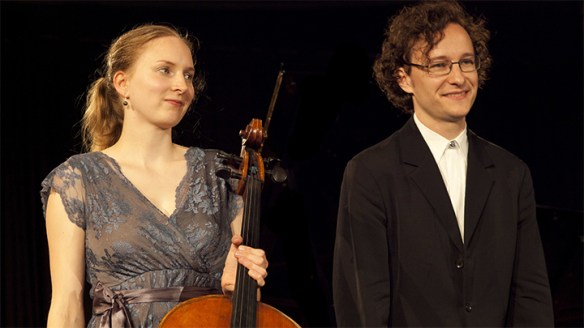
Wigmore Mondays – Marie-Elisabeth Hecker & Martin Helmchen

hecker-helmchen

Marie-Elisabeth Hecker (cello) & Martin Helmchen (piano)

J.S. Bach Viola da gamba Sonata no.3 in G minor, BWV1029 (late 1730s-early 1740s) (14 minutes)

Stravinsky Suite Italienne (arr. Piatigorsky) (1932/33) (20 minutes)

Brahms Cello Sonata no.1 in E minor Op.38 (1862-5) (23 minutes)

Listen to the BBC Radio 3 broadcast here, until 23 November

Arcana’s commentary

Pairing Bach with Brahms was a smart move for this concert.

When Bach was writing for the viola da gamba – essentially an early form of cello with no spike and sometimes five strings! – he was one of the first to recognise its potential as a treble instrument as well as a bass.

To that end the three sonatas he published for viola da gamba and ‘continuo’ – which in this case would normally mean a harpsichord. The pieces transcribe well for modern cello and piano though, as can be heard from 1:35 on the broadcast. It took a little while for Marie-Elisabeth Hecker to settle her tone and intonation in this performance, but once evened out the performance is notable for its clarity and expression at the higher end of the cello. This becomes especially obvious in the Adagio slow movement (from 7:00), which takes the form of an aria. The last movement (12:22) is like a fugue, with its question and answer phrases.

Stravinsky’s Suite Italienne comes from a period in his compositional life where he was looking back to the music of classical and baroque times, taking that music as inspiration, and remoulding it into something that sounded much more modern. For his ballet Pulcinella he took the music of Pergolesi (1710-1736) – or a contemporary, as was recently suggested – and gave it new musical clothes, with spiced-up harmonies and colourful orchestration. Several movements from Pulcinella were reworked for violin and piano to become the Suite Italienne, after which point the cellist Gregor Piatigorsky realised with a few more tweaks he could expand the repertoire of his own instrument.

This was done with Stravinsky’s approval, and the results – as you can hear from this concert – are invigorating and humourous. The nip and tuck between cello and piano is brilliantly caught in the Tarantella (29:49) but in truth all the movements carry the same levels of excitement – running through a sprightly Introduzione (17:33), Hecker’s graceful Serenata (20:00), a surprisingly vigorous Aria (23:45), a sombre and slow Minuetto that grows in stature (32:30) before leading into the vivacious Finale (34:48)

The Brahms (beginning at 39:25) is a piece that also looks back for its inspiration – to Bach, who inspires the finale (55:29) and perhaps to classical composers for the second movement minuet (50:00)

Marie-Elisabeth Hecker and Martin Helmchen give a superb and very fluent performance of this work, getting the balance between cello and the active piano part just right. The similarities between Brahms and Bach are clearest in the two composers’ use of counterpoint – that is a number of different melodies being played simultaneously or in complement to each other.

The flow of melodies in the first movement is unbroken and rather beautiful, especially when the piano briefly switches to a major key (42:13) Elsewhere the mood is darkly passionate and powerfully played.

The Minuet has an attractive poise, enjoying the relative mystery of its central section (from 51:43) while the finale has a steely sound to its theme from the piano (55:29) and the cello’s response (55:37) – all set out as a fugue, developing considerable momentum through to the end, which is straight faced but roundly optimistic at the same time.

This was a brilliantly played account of the Brahms, ideally balanced and communicating the composer’s rich abundance of melodies.

Further listening

The Spotify playlist below – Looking back to move forward – examines more of Brahms and Stravinsky’s use of techniques of the past to shape their own music of the future. You can also hear Marie-Elisabeth Hecker and Martin Helmchen in their new disc of the Brahms Cello Sonatas.

by Ben Hogwood