Live review – Royal Philharmonic Society Awards 2023 @ Queen Elizabeth Hall

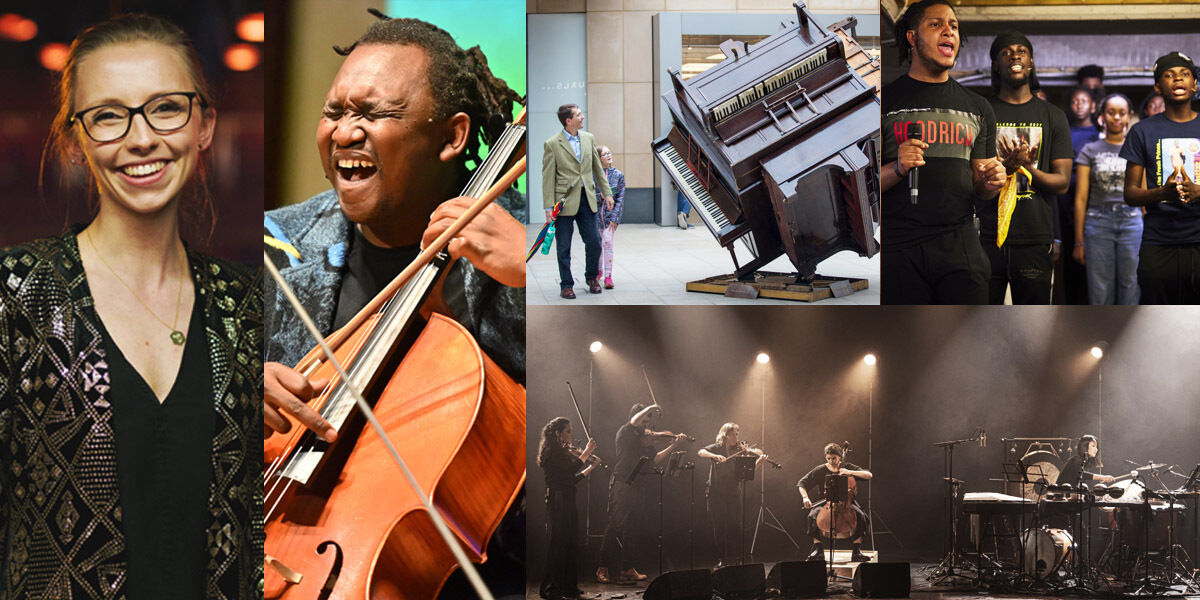
From left: RPS Awards winners Anna Lapwood, Abel Selaocoe, Leeds Piano Trail, The Endz, Manchester Collective

Queen Elizabeth Hall
2 March 2023

by Ben Hogwood

Timing is everything in music – and as the attendees of the Royal Philharmonic Society Awards unanimously agreed, both the show and its message at the Queen Elizabeth Hall were just what classical music needed.

As RPS chairman John Gilhooly emphasised in his no holds barred opening address, times in the industry are hard. Arts Council England have never been less connected with classical music than they are currently, looking past its versatility and potential to make increasingly bizarre funding decisions. All working in music are affected, from those starting out in education and learning their first instrument to those receiving music as therapy and stimulation for dementia and good mental health. Music, it is clear, should not be treated as a ‘nice to have’ extra. Rather, it is a galvanizing force bringing good into the lives of everyone ready to receive it, as we all saw during lockdown and as we experience from day to day.

Gilhooly’s passionate speech threw down a gauntlet to the government and Arts Council but did so in the spirit of collaboration and community. These two words appeared at regular intervals throughout the evening, which captured a wide range of heartwarming and inspirational work taking place around the country, in spite of these restrictions.

Winners included the Torbay Symphony Orchestra, representative of so many life-giving amateur ensembles around the UK in the joy they bring to so many who take part or spectate. Joy, too, is at the heart of Anna Lapwood’s tireless and effervescent work, the organist deservedly collecting the Gamechanger award for her achievements in bringing the instrument to a whole new audience. Put #playlikeagirl into TikTok or Instagram, and you’ll see what I mean!

The awards, stylishly presented by BBC Radio 3 anchors Petroc Trelawny and Hannah French, captured classical music in so many different forms. Timothy Ridout, a shining viola player of the present and future, credited his Luton and Bedfordshire musical roots as key to the Young Artist Award. Abel Selaocoe won the Instrumentalist Award, the cellist expanding the scope of his instrument to encapsulate non-Western musical traditions. How remarkable that an instrument with such a long history continues to develop.

There were even happy pandemic stories. Theatre of Sound won the Opera and Musical Theatre award, their production of Bartók’s Bluebeard’s Castle born during lockdown and executed in Stone Nest, just off Shaftesbury Avenue in London. Martyn Brabbins, music director of English National Opera, deservedly won the Conductor award for his fearless work with the beleaguered company, in which he continues to form strong connections with his musicians, old and new alike.

The Multi-Story Orchestra won the Impact Award for their searing production The Endz, expressing the feelings of a young Peckham group for the death of teenager Malcolm Mide-Madariola, killed while standing up for a friend in a knife fight. Even the brief excerpt we heard conveyed their strength of feeling, and their acceptance speech confirmed how cathartic music had been in expressing their feelings.

One of the most poignant moments of the night came when Manchester Camerata’s film Untold – Keith (above) earned them the Storytelling Award, confirming once again the power of music to help people cope better with dementia. Meanwhile on the streets Leeds Piano Trail won the Series and Events Award for their strategically placed pianos, bringing more than 200,000 aspiring musicians to the city centre, while composer Gavin Higgins took the Large-Scale Composition Award for his Concerto Grosso, a rousing success at the BBC Proms with the Tredegar Town Band and BBC National Orchestra of Wales under Ryan Bancroft.

The live music in the awards was astutely programmed. Sheku Kanneh-Mason gave a striking excerpt from the Cello Sonata no.2 by Leo Brouwer, written for him and fresh off the page in a first performance. Soprano Anna Dennis, winner of the Singer Award, sang a striking song of Elena Langer, Stay O Sweet beautifully weighted with beautifully floated counterpoint from oboist Nicholas Daniel.

The most distinctive musical voice of the night, however, was that of composer Ben Nobuto. Having won the Chamber-Scale Composition Award for the innovative SERENITY 2.0, and somehow achieving an authentic and wholly original balance between Frank Ocean and Caroline Shaw in the process, he joined Ensemble Award winners Manchester Collective for a performance of Danish folk song Old Reinlender. This was cleverly approached from the first movement of Bach’s Violin Concerto in A minor, the join between the two almost imperceptible but negotiated in joyful, songful music.

Sadly no members of Arts Council England were present to witness any of these musical tonics – it is to be hoped they will listen when the awards are aired on BBC Radio 3 on Monday 6 March. You should listen too, for you will find classical music, in spite of all its challenges, is swimming strongly against the tide.

You can watch the Royal Philharmonic Society Awards on the RPS website within the next week – while BBC Radio 3 will broadcast the ceremony, presented by Petroc Trelawny and Hannah French, on Monday 6 March. Click here to listen

In concert – Kate Trethewey, CBSO Youth Chorus, CBSO / Martyn Brabbins: Vaughan Williams at 150: Scott of the Antarctic

Vaughan Williams
Scott of the Antarctic (1948)
Directed by Charles Frend
Music by Ralph Vaughan Williams
Presented by Big Screen Live

Kate Trethewey (soprano), CBSO Youth Chorus, City of Birmingham Symphony Orchestra / Martyn Brabbins

Symphony Hall, Birmingham
Friday 11 November 2022

Reviewed by Richard Whitehouse

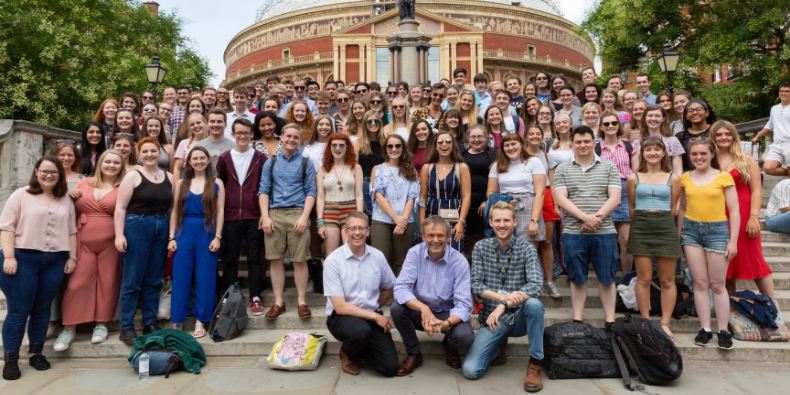
The City of Birmingham Symphony Orchestra’s commemoration of the 150th anniversary of Vaughan Williams’s birth concluding this evening in a showing, with live orchestral accompaniment, of Scott of the Antarctic which proved to be the composer’s most ambitious cinema project.

Directed by Charles Frend (who presided over several UK films in the 1940s and ‘50s, before having an equally prominent role in television) and released in November 1948, the film was a commercial success not least owing to the expressive scope and richness of its music. This extended to some 80 minutes, but Vaughan Williams was more than happy for it to be edited as required and was so in accord with Ernest Irving (director of music at Ealing Studios) that he dedicated to him his Sinfonia Antartica, evolved from the original score, four years later.

It was this close synchronization between image and music that Tommy Pearson (director of Big Screen Live) was intent on capturing when he prepared the film for concert presentation (and the background to which was described in entertaining detail in the programme for these concerts). Suffice to add while the overhauled soundtrack, consisting of dialogue and sound-effects, was all too evidently recorded in mono so that it is easily obscured by the music, the visual component has an opulence and immediacy as transcends its more than seven decades.

Occupying a space equivalent to the lower half of the organ in Symphony Hall, the screen was less dominant in a venue of this size than it would have been even in larger cinemas, but any wider or wrap-round treatment would doubtless have raised many technical obstacles and the print had, in any case, a clarity evident from the rear of the stalls. Much the same could also be said of the orchestra’s contribution, even if its seating on a level platform meant certain of those more intricate details and textures seemed less prominent than under concert conditions.

There can be little but praise for Martyn Brabbins’s direction. A Vaughan Williams exponent of stature (the latest instalment in his traversal of the symphonies has recently been issued on Hyperion), he has an instinctive feel for the emotional highs and lows of this music along with its myriad instrumental subtleties. That divide between what was retained for the soundtrack and what became the composer’s Seventh Symphony is greater than is often supposed, yet the degree to which the former effects and enhances one’s experience of the film is considerable.

This is not the place for any detailed overview of the film itself, though it is notable just how restrained and even absent is the music from the latter stages when Robert Scott and his team head towards oblivion the further they seem to be heading on their return journey. This might have been more to do with Frend or even Irving, but the resulting psychological dimension – beholden neither to inter-war expressionism nor wartime realism – was ostensibly new in a cinematic epic of this kind and makes the film historically as well as artistically significant.

The singing of Katie Tretheway and the CBSO Youth Chorus left nothing to be desired, but many attendees having stocked up on liquid refreshment beforehand saw a steady coming and going over much of the two hours: something that would not be tolerated in a concert, so why here?

You can read all about the 2022/23 season and book tickets at the CBSO website. For more information on the artists, click on the names of Kate Trethewey, Martyn Brabbins and the CBSO Youth Chorus

In concert – Soloists, University of Birmingham Voices & CBSO / Martyn Brabbins: Stanford: Requiem

stanford-requiem

Stanford Requiem Op.63 (1896)

Carolyn Sampson (soprano), Marta Fontanals-Simmons (mezzo-soprano), James Way (tenor), Ross Ramgobin (baritone), University of Birmingham Voices, City of Birmingham Symphony Orchestra / Martyn Brabbins

Symphony Hall, Birmingham
Saturday 25 July 2022

Written by Richard Whitehouse

Its official season may have ended over a week before, but the City of Birmingham Symphony Orchestra was heard this evening in a rare revival of a work whose premiere it gave 125 years ago at the Birmingham Triennial Festival – that of the Requiem by Charles Villiers Stanford.

As historian Paul Rodmell recounted in his programme note, this Festival saw the launching of a host of major choral works during its 128 years of existence – notably Mendelssohn’s Elijah in 1846 and Elgar’s The Dream of Gerontius in 1900. That the latter piece was soon regarded as trailblazing despite a largely unsuccessful premiere might be thought ironic given that, just three years earlier, Stanford’s Requiem had been received with some acclaim only to fall into obscurity along with the greater part of his sizable output in the wake of the First World War.

Not unexpectedly, Brahms instead of Berlioz or Verdi is the main presence – thus the Introit with its understated opening theme that recurs often in the work, while its distinction between sombre choral and aspiring vocal music is further emphasized by those expressive contrasts in the Kyrie. The vocalists come into their own in a Gradual whose orchestral textures find this composer at his most felicitous. A telling foil, moreover, to the Sequence with its menacing Dies irae or proclamatory Tuba mirum, then what follows bringing the soloists into individual focus: hence the heightened fervour of Carolyn Sampson, the more circumspect eloquence of Marta Fontanals-Simmons, slightly hectoring impulsiveness of James Way, and the brooding power of Ross Ramgobin; though the sequence overall exudes an almost symphonic cohesion.

Arguably the finest portion, however, comprises the final three movements. The Offertorium makes much of the contrast between warmly martial and intensively fugal sections, while the Sanctus has an ethereal radiance which carries through the ruminative Benedictus and into deftly resounding Hosannas. The funereal orchestral music preceding the Agnus Dei affords the darkest emotion of the whole work, but this only enhances the ensuing Lux aeterna with its serene fatalism that Frederic Leighton – artist and friend of Stanford, whose death early in 1896 was the catalyst – would doubtless have appreciated. Throughout this performance, the University of Birmingham Voices responded with alacrity to choral writing whose poise and translucency were always in evidence – not least in the most earnestly contrapuntal passages.

Special praise for Martyn Brabbins who, whether or not he considers it a masterpiece, directed this work with unwavering conviction. The balance between soloists or chorus and orchestra might largely take care of itself, but orchestral textures need astute handling if these are not to risk uniformity or even monotony and Brabbins drew a committed response from the CBSO such that the autumnal hues of Stanford’s writing came through unimpeded. Good to hear this performance is being released commercially, as it did full justice to a largely neglected work.

A last thought. One of Stanford’s earlier choral pieces is The Resurrection, a setting of the ode by Friedrich Klopstock. Maybe when the CBSO performs Mahler’s Second Symphony in a future season, it would be worth programming these assuredly very different works together?

For more information on the CBSO visit their website. For more information on Charles Stanford, meanwhile, visit the website of The Stanford Society

BBC Proms – Dame Sarah Connolly, BBC SO / Brabbins: Berlioz, Payne & Beethoven

sarah-connolly

Dame Sarah Connolly (mezzo-soprano, above), BBC Symphony Orchestra / Martyn Brabbins (below)

Payne Spring’s Shining Wake (1980-81) (Proms premiere)
Berlioz Les nuits d’été Op.7 (1840-41, orch. 1856)
Beethoven
Symphony no.6 in F major Op.68 ‘Pastoral’ (1808)

Royal Albert Hall, London
Friday 13 August 2021

Written by Richard Whitehouse

A family bereavement meant that Sir Andrew Davis was unable to conduct this Prom, the baton having been taken up by Martyn Brabbins – whose currently in-demand status is a reflection not least of his broad range of musical sympathies and an inherent ability to ‘get things done’.

Not too many conductors would have taken on at relatively short notice a long-unheard piece by the late lamented Anthony Payne then render it with the familiarity of a repertoire staple. Seemingly unheard for 15 years, Spring’s Shining Wake was a breakthrough piece in several respects: the composer fashioning a ‘contemporary’ yet never esoteric idiom, unencumbered by stylistic precedent, as reflected his love of an earlier generation of English music. Delius’s In a Summer Garden is a focal-point in several respects, but what comes over most strongly in its modest scoring (seven wind, one percussionist and strings) is a sense of organic growth from the overtly static formal framework; textures diversifying and intensifying, yet without changing as to their essential features, in music exemplifying the ‘same yet different’ maxim.

From there to the limpid Romanticism of Berlioz’s song-cycle Les nuits d’été is nearer than might be imagined, this latter being notable for its range of expressive nuance despite (even because of) its pervasive restraint. Certainly, there was no uniformity of response from Dame Sarah Connolly – whose whimsical response to Villanelle contrasting with the wide-eyed fantasy of Le spectre de la rose, and becalmed rapture of Sur les lagunes thrown into relief by the fervent heartache of Absence then the spectral imaginings of Au cimetière; itself finding purposeful response in the animated L’île inconnue with its vouchsafing new imaginative realms. Coordination between soloist and orchestra is paramount throughout, and there was no lack of that in a reading as conveyed this music’s potent sensibilities with acute insight.

Nor was there anything routine about Beethoven’s Pastoral after the interval. Readers may remember a cycle of all nine symphonies which Brabbins (above) gave with the Salomon Orchestra just over a decade ago, and his purposeful if never inflexible take on the opening movement left room for its reflective asides and heady flights of fancy. This was no less evident in the Scene by the brook, with its emphasis on seamlessness of transition and unity of content – not least in the way those bird-calls of the coda were integrated into their textural context.

Unfolding with consistency of pulse, the remaining three movements yielded few surprises but no failings. A touch of blandness in the scherzo was duly countered with the immediacy   of the Thunderstorm and its nexus of accrued emotion whose dispersal makes possible the Shepherd’s Song – less cumulative in its eloquence than others have made it, perhaps, but whose inevitability of progress was sustained through to a close of serene poise; underlining the degree to which any trace of ego has been sublimated in the enveloping cosmic dance.

Some elegant and characterful playing from the woodwind of the BBC Symphony Orchestra was a highlight of this performance, a reminder that even a work with a Proms tally running to several dozen never need sound routine when approached with such unaffected reverence.

For further information on the music of Anthony Payne, visit the composer’s website. You can find more information on the BBC Proms at the festival’s homepage

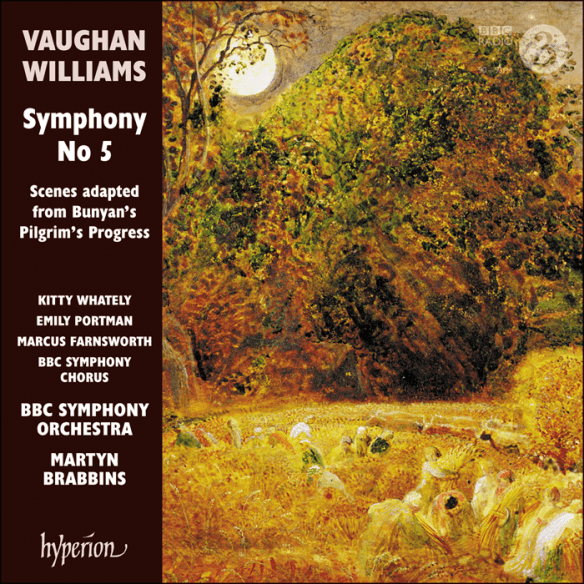
On record: BBC Symphony Orchestra / Martyn Brabbins – Vaughan Williams: Symphony no.5 & Scenes adapted from Bunyan’s Pilgrim’s Progress

*Emily Portman (singer); *Kitty Whatley (mezzo-soprano); *Marcus Farnsworth (baritone), *BBC Singers; *BBC Symphony Chorus, BBC Symphony Orchestra / Martyn Brabbins

Vaughan Williams
Symphony no.5 in D major (1938-43)
Scenes adapted from Bunyan’s Pilgrim’s Progress (1906)*

Hyperion CDA68325 [66’59”]
English text included
Producer Andrew Keener
Engineer Simon Eadon

Recorded 2 December 2018* & 4-5 November 2019 (Symphony 5), Watford Colosseum, UK

Reviewed by Richard Whitehouse

What’s the story?

Martyn Brabbins’s traversal of Vaughan Williams symphonies continues with the Fifth, long the most widely regarded of this cycle, alongside music written for a dramatized production which effectively launched the composer’s lifelong obsession with John Bunyan’s ‘allegory’.

What’s the music like?

Premiered in June 1943, the Fifth Symphony poses a challenge or even provocation through that inwardness all too easily regarded as escapism. A ‘less is more’ concept which Brabbins clearly appreciates – not least in a Preludio as builds incrementally, with little overt rapture going into the radiant second theme or a development understatedly accruing energy, toward a reprise whose climactic restatement of the second theme is (purposely?) less arresting than a coda in which any tonal ambiguity feels the more real for happening almost out of earshot. Easy to skate over, the Scherzo emerges with not a little malevolence in the deftness of its cross-rhythms – the chorale-like aspect of its trio questioning rather than affirming, then the return of the opening music exuding a sardonic quality left unresolved by the spectral close.

That the Romanza is the emotional heart of this work only increases a need for its contrast of moods to be (subtly) underlined. Brabbins achieves exactly so through an adroit interplay of the melodic and harmonic components whose cumulative yet unforced evolution accords the central phase of the movement an encroaching anxiety barely pacified at its culmination, before being more wholly transcended by a coda that is luminous in its simplicity and poise. Often thought unsatisfactory as a formal design, the final Passacaglia seems of a piece with what went before; its theme stated simply while purposefully before the variations build to a resolute central climax – after which, those conflicting elements of negation and affirmation are sublimated into a postlude which reaches out as though at once entreaty and benediction.

As a coupling, Scenes adapted from Bunyan’s Pilgrim’s Progress could not be more apposite. Written for a staging at Reigate Priory, the 13 short items unfold well as a continual sequence at the outset of an involvement with Bunyan’s novel that resulted in an evening-length drama 45 years on. Highlights are Emily Portman’s disarming take on the ‘Flower-girl’s song’, ‘The angel’s song’ eloquently rendered by Kitty Whately (her contribution an undoubted highpoint of ENO’s uneven 2012 production), Marcus Farnsworth’s fervour in a setting of Psalm 23 as constitutes the Shepherd’s Song, and lusty response from the BBC Symphony Chorus in The arming of Christian (best known as the hymn To be a Pilgrim) then a rapturous Final scene music which also serves as reminder that VW’s Tallis Fantasia was merely four years hence.

Does it all work?

It does. Brabbins’s Fifth may not be the most fervent or powerful but has the work’s measure as a cohesive and integrated entity. The Pilgrim’s Progress ‘Scenes’ makes for a fascinating comparison with subsequent versions in VW’s decades-long quest for a satisfying realization.

Is it recommended?

Indeed. The sound is on a par with previous instalments in its clarity and realism, and Robert Matthew-Walker’s booklet note expertly clears up any uncertainty over the genesis of VW’s Bunyan-related projects. Those remaining symphonies will hopefully not be long in coming.

For further information on this release, visit the Hyperion website, or the BBC Symphony Orchestra. You can also read Arcana’s interview with the conductor here