On Record – Helsinki Philharmonic Orchestra / Pekka Kuusisto; BBC Scottish SO / Martyn Brabbins – Jaakko Kuusisto: Symphony (BIS)

BBC Scottish Symphony Orchestra / Martyn Brabbins (Birthday Variations); Helsinki Philharmonic Orchestra / Pekka Kuusisto (Symphony)

Various Pictured Within: Birthday Variations for M.C.B. (2019)
Jaakko Kuusisto (comp. Pekka Kuusisto & Eskola) Symphony Op.39 (2020-21)

BIS 2747 [66’32”]
Producers Andrew Trinick (Variations), Robert Suff (Symphony) Engineers Graeme Taylor (Variations), Enno Mäemets (Symphony)
Live recordings, 13 August 2019 at Royal Albert Hall, London (Variations); 8 December 2022 at Music Centre, Helsinki

Reviewed by Richard Whitehouse

What’s the story?

The BIS label issues one of the most fascinating among recent releases, one that juxtaposes a latter-day equivalent to Elgar’s Enigma Variations with a posthumously completed symphony by one of Finland’s leading conductors which now becomes a tribute to his untimely passing.

What’s the music like?

It was clearly a great idea that the BBC commission a piece to mark Martyn Brabbins’s 60th birthday, featuring 14 composers with whom this stylistically most wide-ranging of current British conductors has been associated. The outcome is Pictured Within: Birthday Variations for M.C.B. – each composer having provided a variation on the ‘anonymous’ theme for what here becomes an inverse take on Elgarian procedure in the latter’s Variations on an Original Theme; a work whose ground-plan also furnishes the formal framework of the present piece.

It is worth considering the ways in which these composers seem either inhibited or liberated by their placing (determined beforehand by Brabbins) within the overall scheme. Given this theme – understated to a fault – yields its potential more from the harmonic then melodic or rhythmic angle, the most successful tend to make a virtue of such constraints: thus the ‘Tact 60’ of Variation I finds Dai Fujikura hinting guardedly at ‘C.A.E.’. David Sawer capriciously conjures ‘H.D.S-P.’, while Sally Beamish offers a deftly ironic parallel to ‘R.B.T’ and Colin Matthews rumbustiously complements ‘W.M.B.’ Iris ter Schiphorst captures the pensiveness if not the geniality of ‘R.P.A.’, whereas violist-turned-composer Brett Dean proves a natural fit for the undulating poise of ‘Ysobel’ and Win Henderickx evokes ‘Troyte’ with real gusto.

His ruminative Variation VII finds Richard Blackford emulating more the connection with a country house than ‘W.N.’, while Harrison Birtwistle throws caution to the wind in a darkly inward contrast to ‘Nimrod’, and ‘Sixty Salutations’ finds Judith Weir in an engaging take on the halting charms of ‘Dorabella’. Gavin Bryars rouses himself to unexpected activity in his reading of ‘G.R.S.’, whereas Kalevi Aho is more suited to the sombre eloquence of ‘B.G.N.’ and Anthony Payne ably plumbs the inherent mysteries of ‘***’. John Pickard then takes on the daunting challenge of ‘E.D.U.’ in The Art of Beginning – the mingling of portentousness and humour appearing to make light of its Longfellow association, but whose organ-capped apotheosis confirms real appreciation of the ‘right ending’ as constituting an art unto itself.

The coupling is as unexpected as it proves apposite. Remembered as a notable violinist and a versatile conductor, Jaakko Kuusisto (1974-2022) turned increasingly to composition and, at his untimely death through brain cancer, had planned a symphony for Osmo Vänskä and the Minnesota Orchestra. Acting on behalf of his widow, his younger brother Pekka and copyist Jari Eskola realized this piece from several minutes of extant fragments such that Kuusisto’s Symphony takes its place as the last statement by one who ostensibly had much more to give.

Playing just over 25 minutes, the work falls into two separate movements. Shorter and more outwardly cohesive, the first of these emerges as imperceptibly as it evanesces – taking in a tersely rhythmic central episode, then a warmly expressive melody with more than a hint of American post-Minimalism. Almost twice as long, the Lento seems more discursive but no less absorbing – picking up where its predecessor left off as it builds to impulsive climaxes, separated by an eloquent span derived from a chorale-like theme. Nothing, though, prepares one for the ending – a sequence of quietly interlocking ostinato patterns, evidently inspired by light signals beamed in the Gulf of Finland and underpinned by undulating timpani. The effect is haunting and unworldly but, for these very qualities, wholly fitting as a conclusion.

Does it all work?

Pretty much always. Those expecting an Elgarian ‘re-run’ may be disconcerted by Pictured Within, but this only serves to reinforce the stylistic autonomy and variety of the composers involved (three of whom sadly no longer with us) in what is a tribute to Brabbins’s acumen for involving them in the first instance. Quirky and compelling, the Kuusisto is appreciably more than a labour of love on behalf of those who brought about its completion: both works deserving revival for their intrinsic merits rather than commemorating a particular occasion.

Is it recommended?

Absolutely. These live performances (that of Pictures Within being that of the premiere) have come up well as presented here, while there are detailed notes on each piece by John Pickard and Jaani Länsiö. This fascinating release more than justifies itself musically and artistically.

Buy

For purchasing options, and to listen to audio clips, visit the Presto website. For more information on the artists, click on the names for more on Martyn Brabbins, Pekka Kuusisto, the BBC Scottish Symphony Orchestra and the Helsinki Philharmonic Orchestra For dedicated resources on the composer, you can visit a website dedicated to Jaakko Kuusisto

Published post no.2,265 – Friday 9 August 2024

On Record – BBC Symphony Orchestra / Martyn Brabbins, Sir Andrew Davis – Payne: Visions and Journeys (NMC)

BBC Symphony Orchestra / Martyn Brabbins, Sir Andrew Davis (Visions and Journeys)

Anthony Payne
Orchestral Variations: The Seeds Long Hidden (1992-4)
Half-Heard in the Stillness (1987)
Visions and Journeys (2002)

NMC D281 [62’15’’]
Producers Philip Tagney, Ann McKay (Visions and Journeys) Engineers Simon Hancock, Philip Burwell (Visions and Journeys)
Broadcast performances on 22 September 2006, Maida Vale Studios, London; live performance 9 August 2002 Royal Albert Hall, London (Visions and Journeys)

Reviewed by Richard Whitehouse

What’s the story?

NMC issues a tribute to Anthony Payne (1936-2021) featuring three of the most representative among his mature orchestral works and so makes for a viable overview, featuring an orchestra and conductors who between them gave numerous performances of his music in his lifetime.

What’s the music like?

Earliest here is Half-Heard in the Stillness, a short yet evocative tone poem making use of the Memorial Chimes which Elgar wrote for the Loughborough carillon in 1923. By this stage in his career, Payne had evolved an idiom that effortlessly but meaningfully elides between post -war Modernism and a late Romanticism (not necessarily British in derivation) such as gives his later output its tonal and expressive lustre. The outcome is ‘landscape’ music that intimates far more than it states, to an extent which the senior composer would surely have appreciated.

Most extensive of these pieces, The Seeds Long Hidden is a sequence of orchestral variations which outlines an autobiographical trajectory. Other than the opening gesture from Brahms’s First Symphony (a hearing of which in 1947 determined the course of Payne’s life thereafter), the works alluded to over the course of its 10 variations are not quoted directly but rather flit across the music and so inform the context from which the ‘theme’ variously emerges. While there is a constant and productive eddying between relative stasis and dynamism, moreover, the overall cumulative thrust seems one of clarification towards an emotional climax of self-realization which quickly recedes into the calm equivocation of the closing bars. If this is, as the composer states, a ‘musical autobiography’, it is an overtly self-effacing and oblique one.

As the first major work that Payne wrote in the aftermath of his realization of Elgar’s ‘Third Symphony’, Visions and Journeys is inevitably bound up with the re-establishing of his own idiom: a statement of intent to be pursued over what became the final phase of his creativity. Nominally inspired by frequent journeys he and his wife – the soprano Jane Manning – made to the Isles of Scilly, this is in no sense pictorial or illustrative in intent. That said, its overall follow-through from unforced anticipation, via understated fulfilment, to underlying regret could not otherwise have been made explicit; the degree to which this is transcended being both the music’s purpose and its primary fascination. A blueprint, indeed, for the select few works that were to come and which reinforced Payne’s standing as a composer of substance.

Does it all work?

Yes, as long as one approaches these works not as compromise between competing aesthetic tendencies but as their synthesis in music which is often eloquent and always appealing. The playing from the BBC Symphony Orchestra could hardly be bettered, with Martyn Brabbins and the late Sir Andrew Davis always committed in their advocacy. Occupying that amorphous middle-ground between the rarified and accessible, Payne’s music neither rejects nor courts popularity but the rewards are considerable for those willing to spend time in its company.

Is it recommended?

Indeed, in the hope a follow-up release which features Spirit’s Harvest (initially intended for inclusion here) and Payne’s culminative statement Of Land, Sea and Sky may yet be possible. The composer’s introductory notes explain everything while giving absolutely nothing away.

Listen & Buy

You can listen to sample tracks and purchase on the NMC website. For further information, click on the names for more on Martyn Brabbins, the BBC Symphony Orchestra and composer Anthony Payne

Published post no.2,218 – Sunday 23 June 2024

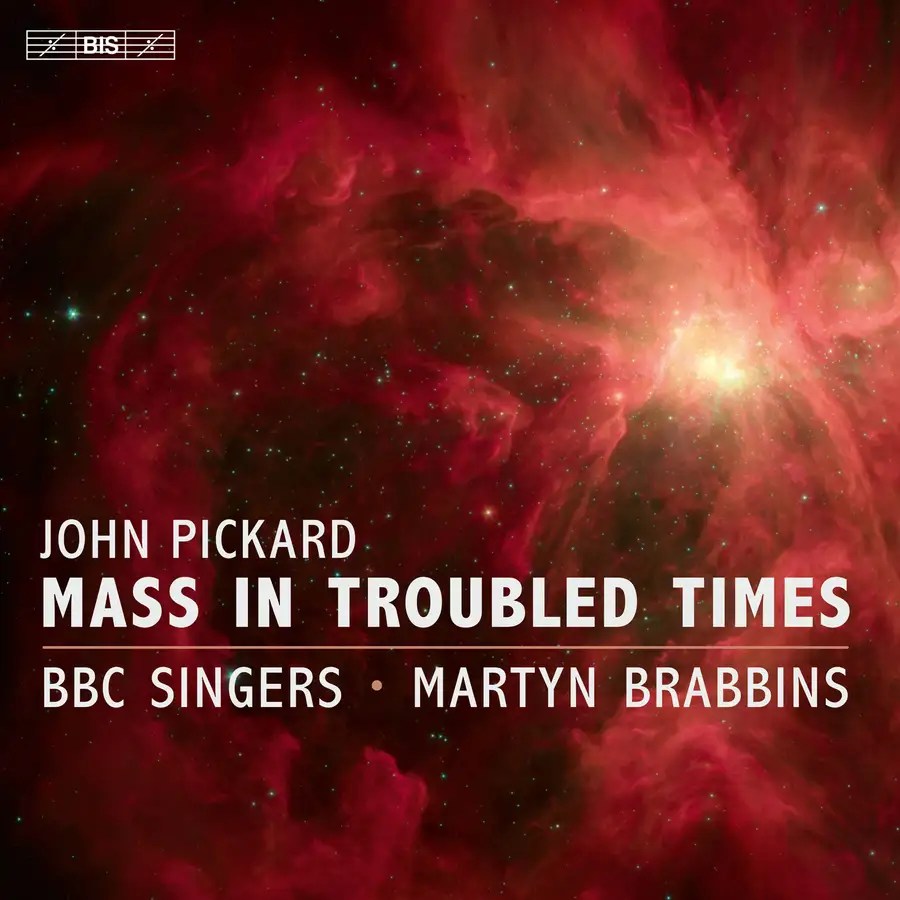
On Record – BBC Singers / Martyn Brabbins – John Pickard: Mass in Troubled Times (BIS)

John Pickard
Three Latin Motets (1983-7)
O magnum mysterium (2015)
Orion (2004)
Ave Maris Stella (1992)
Ozymandias (1983)
Tesserae (2009)
Mass in Troubled Times (2018)

BBC Singers / Martyn Brabbins with Chloë Abbott (trumpet/flugelhorn, Orion); David Goode (organ, Orion and Tesserae)

BIS 2651 [74’30’’] Texts and English translations included

Producer Adrian Peacock Engineer Pete Smith
Recorded 13 & 14 October, St Jude-on-the-Hill, Hampstead, London

Written by Richard Whitehouse

What’s the story?

Although known primarily for his substantial orchestral and chamber output, John Pickard has written several notable choral pieces. This latest release from BIS to be devoted to his music brings most of them together, and in the company of two major instrumental works.

What’s the music like?

Ranging across 35 years of his music, the collection features Pickard’s earliest acknowledged work – a teenage setting of Shelley’s Ozymandias that elicits a response both imaginative and impassioned. Already assured, his choral writing was further honed and refined in Three Latin Motets where limpid renderings of O nata lux and Ubi caritas et amor frame a melting Te lucis ante terminum for female voices. A rapturous Ave Maris stella and touchingly restrained O magnum mysterium duly reinforce Pickard’s confident handling of the a-cappella medium.

The two non-choral items indicate their composer’s abiding fascination with astronomy and antiquity. Scored for trumpet and organ, Orion strikingly evokes said constellation from the vantage of increasing energy in Nebula, an alternating lyricism (courtesy of the flugelhorn) and impetus in Alnitak, then incisive rhythmic interplay of Betelgeuse with its distanced close. Its title indicating those ‘tiles’ used in a mosaic, Tesserae builds cohesion via a steadily accumulating momentum such as tellingly underlies this showpiece with substance for organ.

For 18 unaccompanied voices (in six groups), Mass in Troubled Times is not a setting of the Mass, but a text assembled by the author Gavin D’Costa – lines from T. S. Eliot, Edith Sitwell and Matthew Arnold heard alongside extracts from the Syriac Orthodox Liturgy, the Shahada and the Qur’an. The key is a Turkish Twitter-hashtag from 2015, “Humanity washed ashore”, relating the flight from Aleppo then the drowning of Ayesha – her tragedy an emotional focus over six sections whose expressive intensity seems the greater for their formal concentration.

An Introitus precedes the customary sections of the Mass – reaching a dramatic apex at the climax of the Gloria while carrying the accrued intensity through those that follow; ending with the juxtaposition of lines from William Blake and thrice-repeated Agnus Dei that, next to an evocation of the child’s body off Palermo, has a poignancy shorn of sentiment thanks to Pickard’s acute eloquence. With its wide range of vocal techniques and demanding tessitura, Mass in Troubled Times is a rewarding challenge which all enterprising choirs should tackle.

Does it all work?

It does, not only through the quality of this music but also of these performances – the BBC Singers conveying the immediacy or pathos of Pickard’s response with unstinting clarity and precision. If a demonstration of this choir’s continued existence were needed, this surely is it – Martyn Brabbins (late of English National Opera) directing with his customary conviction. Nor are Chloë Abbott and David Goode to be found wanting in their pieces, rounding out a collection enhanced with vividly analytical recording and the composer’s informative notes.

Is it recommended?

It is, and not merely to those who have been following this invaluable series, which is set to continue with a coupling of Pickard’s Second and Sixth Symphonies. Certainly, the Mass in Troubled Times must feature in any representative selection of works from the 21st century.

For purchase options and more information on this release, visit the BIS website. Click on the names for more on composer John Pickard, the BBC Singers and conductor Martyn Brabbins, trumpeter Chloë Abbott and organist David Goode

On record – George Zacharias, Alexandros Koustas, LPO / Brabbins – Skalkottas: Two Concertos (BIS)

George Zacharias (violin), Alexandros Koustas (viola), London Philharmonic Orchestra / Martyn Brabbins

Skalkottas
Violin Concerto (1937-8, ed. Mantzourani)
Double Concerto (1939-40, ed. Zacharias)

BIS BIS 2554 SACD [57’57”]

Producers Matthew Bennett (Violin Concerto), Alexander Van Ingen (Double Concerto)
Engineers Dave Rowell (Violin Concerto), Andrew Mellor, Brett Cox (Double Concerto)

Recorded 5-6 January 2020 (Violin Concerto), 19-20 April 2022 (Double Concerto), Henry Wood Hall, London

Written by Richard Whitehouse

What’s the story?

BIS continues its long-running project devoted to music by Nikos Skalkottas (1904-49) with this revisiting of his Violin Concerto, alongside a first recording for his Double Concerto in what is a typically apposite pairing which none the less points up the diversity of his output.

What’s the music like?

It was with a release featuring the Violin Concerto that BIS inaugurated its Skalkottas series a quarter-century ago. This recording uses the ‘new critical edition’ prepared in 2019 by Eva Mantzourani, whose volume The Life and Twelve-Note Music of Nikos Skalkottas (Routledge: 2011) is necessary reading for anyone interested in this composer. Many of these corrections will only be evident to those having access to the score, but interpretive differences between Gorgios Demertzis in 1997 and George Zacharias in 2022 are clear from the outset. The latter adopts appreciably quicker tempos for the first two movements that make the opening Molto appassionato more febrile in its expressive contrasts, then the Andante spirito feels closer to an intermezzo after the example of Schoenberg’s Violin Concerto as is brought more directly into focus. Demertzis launches the final Allegro rapidly, Zacharias gaining momentum more gradually before tackling the Prestissimo coda with abandon. Which one prefers depends on how one views the competing expressionist and classicizing impulses of this masterly work.

Although finished barely two years later and pursuing a nominally similar formal trajectory, the Concerto for Violin, Viola and Wind Orchestra presents a markedly different take on its composer’s thinking. Different though not unexpectedly so, given Skalkottas’s approach to serial composition was anything but predictable while it took shape, moreover, in a cultural milieu where Hindemith and Weill (briefly his teacher) were as necessary a creative catalyst as Schoenberg. Not only does the scoring of this piece find accord with that of Hindemith’s concertante works and Weill’s Violin Concerto during that period, but the evolution of each movement in sometimes oblique though always discernible terms gives the overall design a distinctly neo-classical feel. Zacharias sounds even more ‘inside’ this work, and Alexandros Koustas is no less assured in viola writing which is (surprisingly?) always audible against an orchestra whose saxophone section accentuates the presence of jazz as against the militaristic element of brass and other woodwind. The result is a piece by turns engaging and disturbing.

Does it all work?

Pretty much always. Thoughtfully conceived and impressively executed, Skalkottas’s music does not play itself so that performers need to take the lead in rendering its inherent qualities as comprehensively as possible. Which is undoubtedly the case here – Zacharias and Koustas convincingly overcome any incidental technical difficulties, while Martyn Brabbins secures a trenchant and committed response from the London Philharmonic Orchestra in works with which neither he nor they have had the opportunity to come to terms via live performances.

Is it recommended?

It is. Those who already have that earlier recording of the Violin Concerto still need this new release which, with its immediate sound and detailed notes, brings the Skalkottas discography nearer fruition. How about a complete version of the Second Symphonic Suite as a follow-up?

Stream

Buy

For more information on this release visit the BIS website

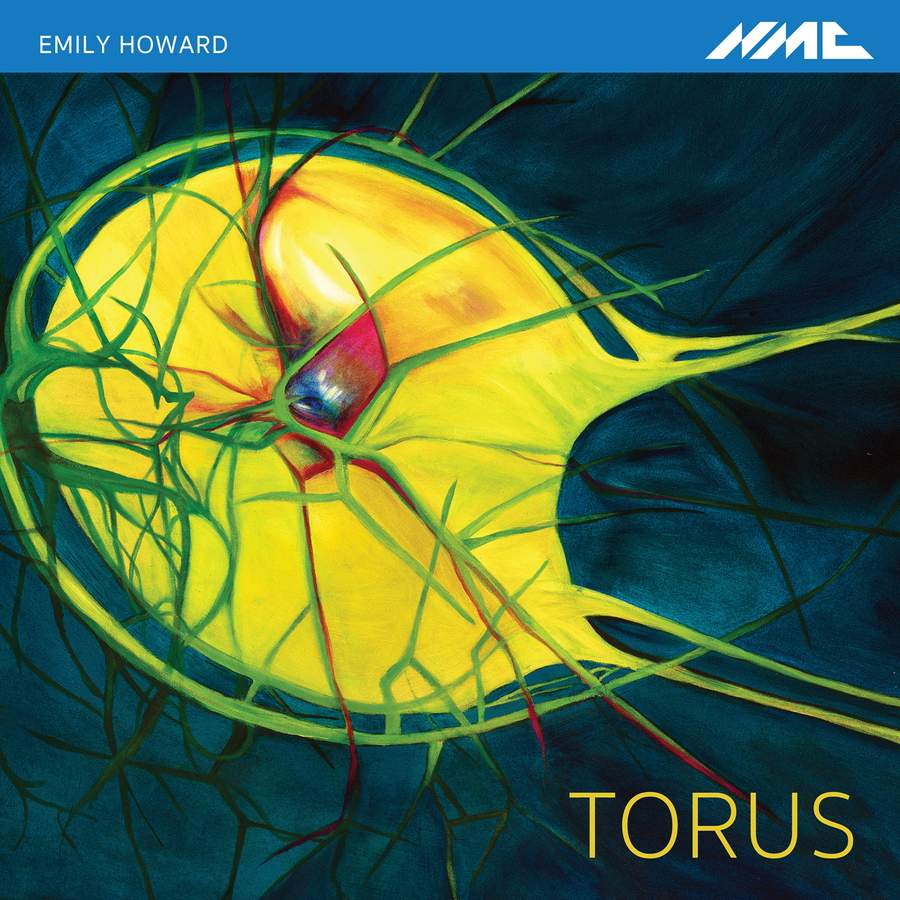
On Record: Emily Howard: Torus (NMC Recordings)

Emily Howard

Antisphere (BBC Philharmonic Orchestra / Vimbayi Kaziboni)
Producer Matthew Bennett, Engineer Stephen Rinker
Recorded 29 November 2022, Bridgewater Hall, Manchester

sphere (BBC National Orchestra of Wales / Mark Wigglesworth)
Producer Dean Craven, Engineer Stephen Rinker
Recorded at the Aldeburgh Festival, 23 June 2018, The Maltings, Snape

Compass (Julian Warburton (percussion), Birmingham Contemporary Music Group / Gabrielle Taychenné)
Producer & Engineer David Lefeber
Recorded 4 December 2022, Royal Northern College of Music, Manchester

Torus (BBC Symphony Orchestra / Martyn Brabbins)
Producer Ann McKay, Engineer Christopher Rouse
Recorded 11 November 2019, Barbican Hall, London

NMC Recordings D274 [68’58″]

Reviewed by Richard Whitehouse

What’s the story?

NMC releases a second collection of music by Emily Howard – now in her early forties and established among the most distinctive while forward-looking composers of her generation, heard in scrupulous performances by a notable line-up of British orchestras and ensembles.

What’s the music like?

Few world premieres from recent years have left an impression comparable to that of Taurus at the Proms in 2016. Its appearance, moreover, marked a further stage in an evolution which had commenced just over a decade earlier and has continued apace, with major commissions from British and European organizations. This has been paralleled by Howard’s commitment into researching the intrinsic properties of sound, most recently via the Centre for Practice & Research in Science and Music (PRiSM) at Manchester’s Royal Northern College of Music.

As it now stands, Torus is the first part in an informal trilogy of pieces collectively entitled Orchestral Geometries. It evolves along the perceived trajectory of a doughnut-shaped ball whose central void is crucial to music evoking absence as much as presence. Not that a work subtitled Concerto for Orchestra could be found lacking in either immediacy of content or virtuosity of gesture, which qualities come demonstrably to the fore as it unfolds and make for a composition involving in its expressive profile and fascinating in its formal process.

By contrast, Sphere is a succinct yet eventful journey through and around the global shape in question and which, in this context, might reasonably be thought an extra-terrestrial interlude – its ideas pithy while exuding enough potential for their development in subsequent pieces.

This is what happens in Antisphere which forms its conceptual opposite though also its aural continuation, the piece gradually encompassing the ‘sound-space’ through an engrossing and imaginative demonstration of orchestral prowess. Evident too is an increased focus upon the visceral nature of the musical content, likely reflecting a form which can precisely be defined in mathematical terms but remains all but intangible as regards human perception. Fortunate, then, that Howard has been able to render this concept as an emotional and affective whole.

Hardly less absorbing is Compass, the most recent of these pieces. This takes the spatial and nautical connotations of its title as the basis for music which unfolds as a cohesive dialogue between string septet and percussion that complements it and offers contrasts at every turn.

Does it all work?

It does, not least for providing an arresting take on that interplay of ‘heart and brain’ that has been a mainstay of Western music. The cerebral basis of all these pieces may be undeniable, though equally so is the precision of their forms and, above all, the allure of their expression judged intrinsically as sound. Much the same could be said of the music of Iannis Xenakis, the centenary of whose birth was commemorated last year, and whose thinking is continued by Howard from a vantage that is inherently personal while being decisively of the present.

Is it recommended?

It is, not least for its excellent performances by three of the BBC orchestras and Birmingham Contemporary Music Group, with booklet notes by Paul Griffiths and mathematician Marcus du Sautoy. This impressive release reinforces Howard’s significance in no uncertain terms.

Listen & Buy

Torus is released on Friday 28 April. You can explore buying options at the NMC Recordings website, and listen to clips from the album at the Presto Music site. You can read Arcana’s interview with Emily Howard by clicking on the link, and click on the names for more on the composer Emily Howard, plus performers Vimbayi Kaziboni, Mark Wigglesworth, Julian Warburton, Gabrielle Teychenné and Martyn Brabbins