On Record – Gavin Higgins: The Fairie Bride, Horn Concerto (Lyrita)

Gavin Higgins
Horn Concerto (2023)
Fanfare, Air and Flourishes (2021)
The Fairie Bride (2021)

Marta Fontanals-Simmons (mezzo-soprano), Roderick Williams (baritone), Ben Goldscheider (horn), Three Choirs Festival Chorus; BBC National Orchestra of Wales / Jaime Martin (Horn Concerto), Martyn Brabbins (The Fairie Bride)

Lyrita SRCD440 [84’14”] English/Welsh libretto included
Producer Adrian Farmer Engineer Andrew Smilie

Recorded in Hoddinott Hall, 11 January 2024 (Horn Concerto), Concert Hall, Wyastone Leys, Monmouth, 4 April 2024 (Fanfare, Air and Flourishes), live performance from Gloucester Cathedral on 23 July 2023 (The Fairie Bride)

Reviewed by Richard Whitehouse

What’s the story?

Lyrita adds to the already growing discography of Gavin Higgins (b.1983) with this release featuring two recent major works, both of which are heard in their first performances and thereby confirm this composer’s place among the leading British voices of his generation.

What’s the music like?

Listeners may have come across Higgins’s music via the release Ekstasis (see the link below), a collection of chamber pieces which attests to a distinctive and searching personality. Such is equally true of those here, not least the Horn Concerto that takes its place in a notable lineage of such works ‘in E flat’, while taking in Schumann and Ligeti as part of its range of stylistic or conceptual allusions. Its three movements have as their inspiration the Waldhorn – the first, Understorey, duly outlining an emergence from the (Wagnerian) depths to the forest floor in mounting waves of activity. There follow Overstorey with its airily expressive evocation of the forest canopy as builds considerable fervency over its course, then Myelium Rondo with its overtones of the hunt and energetic fanfares which propel this work to an affirmative close.

No stranger to the horn (being his own instrument), Higgins had indirectly prepared for this concerto with Fanfare, Air and Flourishes, a brief but eventful solo triptych which tries out several gestures or motifs to be developed in the larger work as well as in his second opera.

Commissioned by the Three Choirs Festival, The Faerie Bride takes a legend from the Book of Hergest for its synopsis of the coming together but eventual (its being inevitable) disunion between water spirit and earthly man. This is played out over seven scenes divided into two parts – Francesca Simon’s succinct yet artfully constructed libretto moving from their initial encounters at the lake, via the gradual dissolution of their relationship through events during each of the four seasons, to a climactic juncture when the woman returns with her extended family into the depths. Musically the work encompasses the range of Higgins’s idiom up to this point, its richness and variety of texture complemented by an instrumental clarity which ensures vocal audibility throughout – certain discrepancies between the libretto as published and as sung being immediately evident. That this opera keeps its emotions close to its chest much of the time only makes the closing stages the more powerful, not least in the way the ending reaches back to the beginning for a tangible sense of resolution borne of experience.

Does it all work?

Yes, in that Higgins is able to integrate his influences into a coherent and personal language. It helps that these performers are audibly attuned to this music – not least Marta Fontanels-Simmons as an otherworldly Woman and Roderick Williams as the uncomprehending Man – with Ben Goldscheider a consummate exponent of works for horn. The Three Choirs Festival Chorus characterizes the Villagers with suitable aggression, while Jaime Martin and Martyn Brabbins secure idiomatic playing of real finesse from the BBC National Orchestra of Wales.

Is it recommended?

Very much so. Those yet to do so should certainly acquire the earlier release on Nimbus, but the works featured here round out the potency of Higgins’s music accordingly. Detailed and informative notes by Gillian Moore, though watch out for those discrepancies in the libretto.

Listen & Buy

For purchase options, you can visit the Ulysees Arts website. For information on the performers, click on the names to read more about Ben Goldscheider, Marta Fontanals-Simmons, Roderick Williams, Jaime Martin, Martyn Brabbins and the BBC National Orchestra of Wales. Click to read more about composer Gavin Higgins and about Ekstasis

Published post no.2,465 – Thursday 6 March 2025
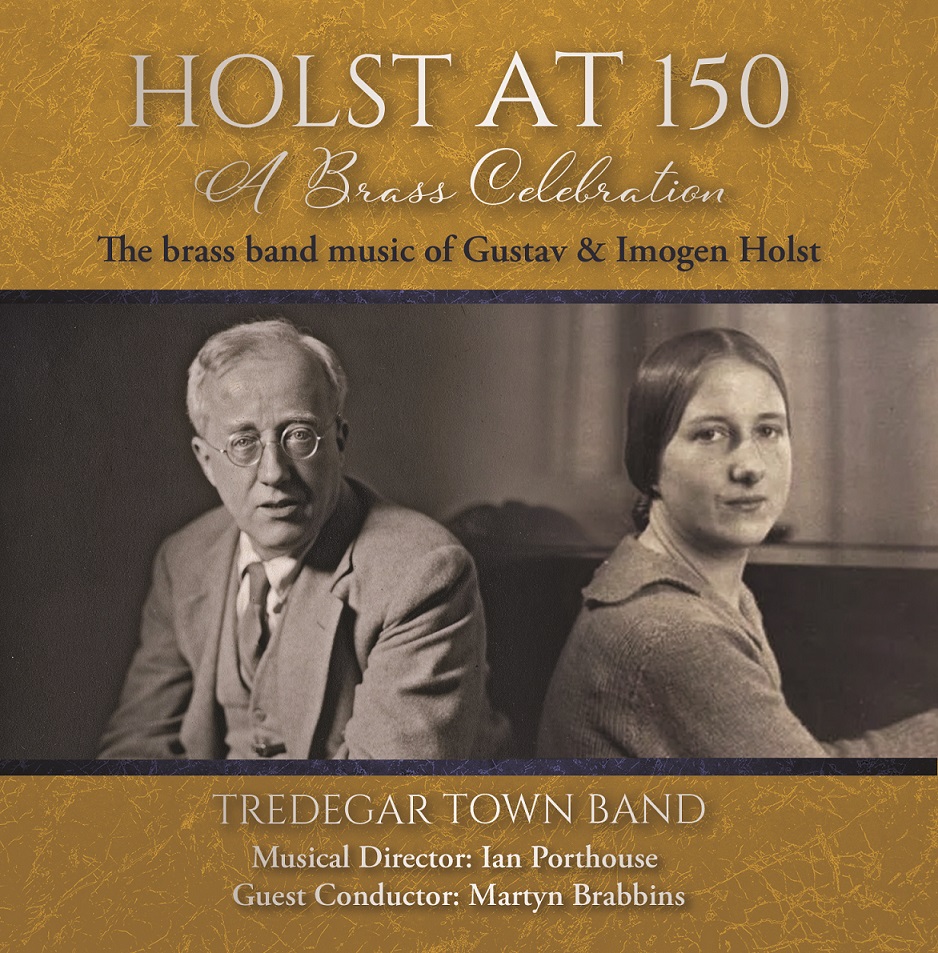
On Record – Tredegar Town Band / Ian Porterhouse, Martyn Brabbins – Holst at 150: A Brass Celebration (Doyen)

Gustav Holst
Suites for Military Band Op.28:
no.1 in E flat major (1909)
no.2 in F major (1911)
The Perfect Fool Op.39 (1918-22) – Ballet Music (all arr. Littlemore).
A Fugal Overture Op.40 no.1 (1922; arr. Wheeler)
Mr Shilkret’s Maggot (1932; arr. Hindmarsh)
A Moorside Suite (1928)
Imogen Holst
The Unfortunate Traveller (1929; ed. Hindmarsh)
Glory of the West (1969)

Tredegar Town Band / Ian Porthouse and Martyn Brabbins (A Moorside Suite)

Doyen DOYCD435 [74’37’’]
Producer Adam Goldsmith Engineer Daniel Lock
Recorded 18-19 May 2024 at Jack Williams VC Hall, The Works, Ebbw Vale

Reviewed by Richard Whitehouse

What’s the story?

The 150th anniversary of his birth, and 50th anniversary of his death, is an ideal opportunity to reassess the legacy of Holst in all its variety; not least with this anthology of his music for brass band that also finds space for her contribution to the medium by his daughter Imogen.

What’s the music like?

Typical and inimitable Holst – but, as he only wrote one work for the medium, much of this release consists of arrangements. The two Suites for Military Band were obvious candidates: the First Suite’s Chaconne emerges with renewed pathos, as too its whimsical Intermezzo or rumbustious March; no less idiomatic is the Second Suite with its recourse to traditional tunes in such as the effervescent initial March, then the final Fantasia with its memorable rendering of the Dargason. Philip Littlemore is an expert arranger here as of the Ballet Music from the opera The Perfect Fool – the sections that evoke ‘earth’ and fire’ lacking a degree of panache, but that of ‘water’ hardly less magical in this guise. Alastair Wheeler proves no less adept in capturing the impetus of A Fugal Overture, while Paul Hindmarsh gives what ought to be a new lease of life to the ‘jazz-band piece’ designated Mr Shilkret’s Maggot praised but never played by its commissioner. Imogen Holst’s 1967 orchestral arrangement as Capriccio rescued it from oblivion, but this new incarnation makes even more of its recalcitrant humour.

Mention of Imogen leads one to her pieces for brass band, both included here. Compact and characterful, her suite The Unfortunate Traveller was initially more successful as transcribed for strings, though Hindmarsh’s edition adds percussion and clarifies the brass texture as was doubtless intended. Its sure highlight is the winsome Interlude, conjuring a discreet though tangible profundity subsequently glimpsed with The Glory of the West – seven variations on said Morris Dance which confirms music written for amateurs need not involve compromise.

This just leaves A Moorside Suite, a work such as transformed the standing of test-pieces for brass band with that understated acuity surely unique to this composer. Whether in its gently satirical Scherzo, wistful Nocturne whose gradual building to a soulful culmination makes for the highlight of this collection, then a March which fuses energy and eloquence to round off the sequence with irresistible elan – this is Holst at his most engaging and communicative. Music, moreover, Martyn Brabbins clearly relished the chance to conduct for this recording.

Does it all work?

Absolutely, both in this piece and elsewhere, as long-standing music director Ian Porthouse puts the Tredegar Town Band exactingly and admirably through its collective paces. At the forefront of the modern brass-band movement, the latter is ideally placed to find this music an audience outside of its customary domain. That it succeeds is clear from the fact that one listens to this programme without thought of the medium or its context; rather, the emphasis is on those qualities of inspiration and substance as are hallmarks of any worthwhile music.

Is it recommended?

Indeed. Recorded with requisite clarity and definition, and featuring informative annotations by Hindmarsh and Littlemore, this is a significant release in Holst’s anniversary year and an evident first choice for acquiring a representative cross-section of his music in this medium.

Listen & Buy

You can listen to samples and explore purchase options on the World of Brass website Click on the names for more on conductors Ian Porthouse and Martyn Brabbins, the Tredegar Town Band, and for more on the composers Gustav Holst and daughter Imogen Holst

Published post no.2,307 – Friday 20 September 2024

Arcana at the Proms – Prom 53: Remembering Sir Andrew Davis

Stravinsky Symphony in Three Movements (1942-5)
Reich Jacob’s Ladder (2023) [BBC co-commission: UK premiere]
Tippett The Midsummer Marriage – Ritual Dances (1946-52)
Elgar Variations on an Original Theme ‘Enigma’ Op.36 (1898-9)

Synergy Vocals [Tara Bungard (soprano), Micaela Haslam (soprano/director), Will Wright, Ben Alden (tenors)], BBC Symphony Orchestra / Martyn Brabbins

Royal Albert Hall, London
Friday 30 August 2024

reviewed by Richard Whitehouse Photos (c) Andy Paradise

What should have been the 133rd concert that Sir Andrew Davis conducted at the Proms became a commemorative event after his untimely death in April but, with Martyn Brabbins presiding over a thoughtfully amended programme, the outcome could not have been more appropriate.

Proceeding unaltered, the first half began with Stravinsky’s Symphony in Three Movements in a performance redolent of Otto Klemperer in its deliberation if without that conductor’s heft – not least an opening movement whose rhythmic trenchancy felt a little dogged as it unfolded. Best was the Andante – its deadpan humour complemented by the beatific poise at its centre, then a transition of hushed expectancy to launch the finale. Here the closing build-up might have been more visceral, but the conclusiveness of that final chord could hardly be doubted.

Davis (above) was hardly known as proponent of Minimalism in general or Steve Reich in particular, thus his scheduling this first UK performance of the latter’s Jacob’s Ladder could be taken as significant. Playing just under 20 minutes, this is artfully structured as four short ‘expository’ sections followed by four longer ‘developmental’ ones. The former pitted its four vocalists – a telling number in this context of eight strings, six woodwind, two vibraphones and one piano – against an instrumental ensemble that took precedence in those latter sections; the final one brings them together in new-found accord. Dealing with scalic patterns in all their conceptual and metaphorical implications, the musical content typifies late Reich in ruminative elegance or subdued intensity which, if it offers no revelations, is yet satisfying in its stylistic deftness.

Schumann’s Second Symphony had been planned for a second half as now commenced with the Ritual Dances from Tippett’s The Midsummer Marriage – an opera, and composer, close to Davis’ heart. Unfailingly cohesive to the degree its series of elemental and seasonal dances interwove with their respective ‘transformations’ and ‘preparations’, this account was equally notable for its textural clarity even in those most contrapuntally intricate passages, along with a colouristic sense sustained up to the climactic return of its initial music for a magical envoi.

When Brabbins last conducted Elgar’s ‘Enigma’ Variations at the Proms, it was the final item in a 60th-birthday tribute that began with Pictured Within – a latter-day equivalent involving 14 different composers. Tonight’s account gave eloquent insight into what has become almost too familiar a work, evident from the outset in a ‘Theme’ of melting pathos. Highlights from those that followed included the soulfulness of ‘C.A.E.’, pensiveness of ‘R.P.A.’ or elegance of ‘Ysobel’ with its lilting viola from Sebastian Krunnies. ‘Nimrod’ started imperceptibly but built towards a nobly wrought apex, with the affectionate portrayed ‘Dorabella’ or searching evocation of ‘***(Romanza)’ no less affecting. The ‘E.D.U.’ finale moved confidently to an organ-clad peroration exuding what Elgar elsewhere termed a ‘‘massive hope for the future’’.

Just before this performance, Brabbins spoke for a capacity house in paying tribute to Davis with his dedication to music-making in the UK and beyond; something Sir Andrew brought to every one of his 132 appearances at the Proms, across 54 years of dedication to his cause.

You can get details about this year’s season at the BBC Proms website – and you can click on the names to read more about the BBC Symphony Orchestra, their conductor Martyn Brabbins, and an obituary of Sir Andrew Davis himself

Published post no.2,287 – Sunday 1 September 2024

On Record – Emma Tring, BBC NoW / Martyn Brabbins – John Pickard: Symphonies 2 & 6; Verlaine Songs (BIS)

John Pickard
Symphony no.2 (1985-87)
Symphony no.6 (2021)
Verlaine Songs (2019-20, orch. 2022)

Emma Tring (soprano), BBC National Orchestra of Wales / Martyn Brabbins

BIS 2721 [72’51’’] French text and English translation included

Producer Thore Brinkman Engineers Simon Smith, Mike Cox
Recorded 29-31 March 2023, Hoddinott Hall, Cardiff

Written by Richard Whitehouse

What’s the story?

BIS continues its coverage of John Pickard (b.1963) with a pertinent coupling of his Second and Sixth Symphonies, heard alongside his song-cycle to poems by Verlaine, in what is the most wide-ranging release – whether chronologically or stylistically – to date in this series.

What’s the music like?

It hardly seems 35 years since the Second Symphony blazed forth at its Manchester premiere, so establishing Pickard’s reputation. The composer had earlier studied with Louis Andriessen, to whose confrontational minimalism this piece is indebted in certain particulars – but, unlike other among his contemporaries who were so influenced, Pickard was alive to its symphonic potential. Unfolding over six continuous sections, the work builds via an intensifying process of tension and release to a seismic culmination as marks a seamless, even inevitable return to its start. Those familiar with that pioneering version by Odaline de la Martínez (on YouTube) will find this new one hardly less attentive to the visceral power of what, given its predecessor remains unheard, is a symphonic debut with few equals and one that urgently warrants revival.

Almost 35 years on and the Sixth Symphony offers a very different though no less involving perspective on what this genre might be. The first of its two movements channels a modified sonata design such that an almost whimsical opening has become brutalized well before the despairing close. Its successor refashions the expected continuity from an even more oblique vantage – the music heading eloquently if funereally toward a plangent climax that subsides into a delicate intermezzo, infused with the sound of nature, then on to a final section which recalls earlier ideas in a mood of rapt anticipation. Not that this understatement offers in any sense an easy way out: indeed, the work concludes with its composer poised at a crossroads as much existential as musical, and from where the whole creative process can begin afresh.

Separating two substantial statements of intent, the Verlaine Songs continues Pickard’s recent involvement with poetic texts and, while Paul Verlaine might seem far removed from Edward Thomas or Laurence Binyon, his evocations fanciful while sometimes unnerving – hence Le sqelette with its graphic aural imagery – finds the composer reciprocating in kind. Coming in between scorings with ensemble or violin and piano, this version with orchestra finds Pickard enriching a lineage of French song-cycles from Berlioz, via Ravel and Messiaen, to Dutilleux.

Does it all work?

It does, not least because Pickard is conscious of the need for his music to determine its own course. However dissimilar these symphonies might seem, the sensibility behind them is the same and any stylistic differences more apparent than real. It helps when Martyn Brabbins is a conductor familiar with this idiom as to inspire a committed response by the BBC National Orchestra of Wales, with Emma Tring alive to the manifest subtlety of the vocal writing, and the recordings consistently heard to advantage in the spacious immediacy of Hoddinott Hall.

Is it recommended?

Indeed, in the hope this series will be continued. Both the First and Third Symphonies await recording, as do Partita for strings and large-scale choral work Agamemnon’s Tomb, so that Pickard’s discography has a way to go even without addition of new pieces to his catalogue.

Listen

Buy / Further information

For purchase options and more information on this release, visit the BIS website. Click on the names for more on composer John Pickard, the BBC National Orchestra of Wales, conductor Martyn Brabbins and soprano Emma Tring

Arcana at the Proms – Prom 33: Christopher Maltman, BBC Symphony Orchestra / Martyn Brabbins – Elgar, Holst, Stanford & Vaughan Williams London Symphony

Elgar Overture ‘Cockaigne’ (In London Town) Op.40 (1901)
Holst Hammersmith (Prelude and Scherzo) Op.52 (1930)
Stanford Songs of Faith Op. 97 (1906): no.4 (To the Soul), no.5 (Tears), no.6 (Joy, ship-mate, joy); An Irish Idyll in Six Miniatures Op.72 (1901): no.2 (The Fairy Lough)
Vaughan Williams A London Symphony (Symphony no.2) (1912-13, rev. 1918-20)

Christopher Maltman (baritone), BBC Symphony Orchestra / Martyn Brabbins

Royal Albert Hall, London
Friday 9 August 2024, 6pm

reviewed by Richard Whitehouse

Concerts devoted to British music are by no means an unknown quantity at the Proms, but to have one as judiciously planned as that featuring Martyn Brabbins with the BBC Symphony Orchestra, on the conductor’s 65th birthday, was as unexpected as its realization ‘on the night’ proved consistently impressive.

Whether or not this account of Elgar’s Cockaigne ranked among the best of the previous 70 or so hearings at these concerts, it assuredly did the piece justice. Not its least attraction was Brabbins integrating this evocation of London on the cusp of Victorian and Edwardian eras with due perception of its ingenious sonata design, resulting in a reading as characterful as it was cohesive. Such as the emergence of the marching band at its centre and final peroration (Richard Pearce making his presence felt at the organ console) were the highpoints intended.

Whereas Elgar conveys London in its midst, Holst renders Hammersmith at a remove – his Prelude and Scherzo evoking those sights and sounds where the latter long made his home with a poise and precision no less involving for its objectivity. The orchestral version might be less often revived than its wind-band original but it yields little, if anything, in terms of expressive immediacy; not least with Brabbins mindful to underline how its two sections do not just succeed each other but are juxtaposed, even superimposed, prior to the rapt ending.

In the centenary of Stanford’s death, this selection of songs provided a welcome reminder of its composer’s prowess in the genre. The final three Songs of Faith denote an appreciation of Walt Whitman comparable to that of the next generation – whether in the eloquent musing of To the Soul, surging anguish of Tears or effervescence of Joy, shipmate, joy. Christopher Maltman then brought his burnished tone and clarity of diction to an affecting take on Moira O’Neill’s The Fairy Lough – proof Stanford could do ‘lightness of touch’ where necessary.

Whereas Stanford’s songs have barely featured here for almost a century, Vaughan Williams’s A London Symphony has accrued 36 performances, but what might be thought its ‘intermediate version’ had not been heard in nine decades. Actually, this is much closer formally to the final version of 1933 than the original – its main differences centring on those more extensive codas in the Lento and finale which, by aligning them more audibly with the introduction to the first movement, arguably ensures a more thematically close-knit trajectory across the work overall.

The performance was very much in accord with Brabbins’ recording (Hyperion). An unforced traversal of the opening Allegro, impetuous in its outer sections and affecting in that rapturous passage for solo strings at its centre, then a slow movement whose brooding introspection did not omit a sustained fervency at its climax. Nor did the Scherzo lack those ambivalent asides that find focus in its sombre close, while the nominally discursive finale built purposefully to a seismic culmination then an epilogue which drew solace from the aftermath of catastrophe.

‘‘The river passes – London passes – England passes’’. Whether the closing words from H.G. Wells’ Tono-Bungay determined or even influenced it, a sense of renewal was palpable as the music faded towards silence at the end of this persuasive performance and memorable concert.

For more on this year’s festival, visit the BBC Proms website – and to read more on the artists involved, click on the names: baritone Christopher Maltman, conductor Martyn Brabbins and the BBC Symphony Orchestra. Click on the name for more on The Stanford Society

Published post no.2,270 – Wednesday 14 August 2024