
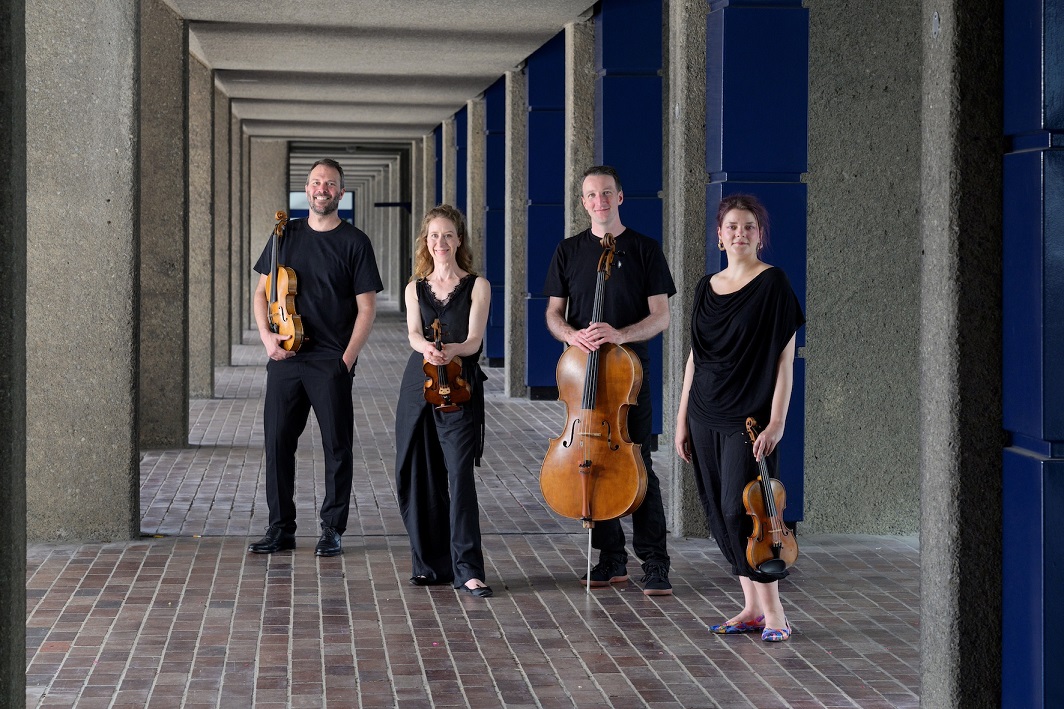
In concert – Heath Quartet @ London Chamber Music Society, St John’s Church Waterloo – Haydn, Bacewicz, Locke & Beethoven

Heath Quartet [Maja Horvat & Sara Wolstenholme (violins), Gary Pomeroy (viola), Christopher Murray (cello)]

Haydn String Quartet in G major Op.33/5 ‘How Do You Do?’ (1781)
Bacewicz String Quartet no.6 (1960)
Locke Suite III in F (c1660)
Beethoven String Quartet no.16 in F major Op.135 (1826)

St John’s Church, Waterloo, London
Sunday 28 September 2025, 6pm

Reviewed by Richard Whitehouse

This early evening concert marked not just the start of London Chamber Music Society’s new season but also that of its first at St John’s Waterloo, following some 17 seasons in residence at King’s Place. The actual programme, however, could not have been more typically LCMS.

What better than to start with a Haydn quartet? His Op. 33 abounds in ‘less is more’ writing, not least the fifth in this set whose buoyant opening Vivace features a cadential figure which provides the nickname, then a Largo whose keening melody for first violin and cadenza-like passage betrays likely operatic origin. The Heath Quartet was equally inside the Scherzo with its amiable impulsiveness, while the final Allegretto had a genial humour that carried through to its good-natured payoff. A piece deserving of greater prominence within the Haydn canon.

As does the Sixth Quartet in Grażyna Bacewicz’s output. Evidently a breakthrough in terms of her writing for strings, its stealthy yet never brazen Modernism is clear from the opening movement in its subtle overhaul of sonata design, then the Vivace with its intensive rhythmic interplay. A ‘song without words’ centred on cello, the slow movement is a soulful interlude prior to a final Allegro as makes inventive play with rondo design – the widening expressive gulf between its stable refrain and its unpredictable episodes deftly sidestepped at the close.

Purcell’s music for consort might be the most directly acknowledged precursor of the string quartet, but that by Matthew Locke is hardly less significant and preceded it by almost two decades. This third of his six four-part suites is no exception – the substantial and teasingly discursive Fantasia being followed with an elegant Courante and a soulful Ayre then a (surprisingly?) trenchant Saraband. Throughout, the Heath’s seamless interplay was such as to relativize any distinction between a consort of viols and the ensemble of strings it became.

An ensemble taken to a peak of perfection on the cusp of the Romantic era with Beethoven’s last string quartet. Here the Heath judged the equable poise of its opening Allegretto then the quixotic humour of its scherzo to perfection. Neither was there any lack of feeling in a slow movement whose pathos becomes the greater for its understatement; the ‘difficult decision’ that informs the finale duly rendered with a sure sense of this music’s venturing towards its playful conclusion. Beethoven was rarely so profound as when he was being this disarming. A persuasive start to a new season and a new chapter in the illustrious history of the LCMS. A wide range of recitals is scheduled between now and June, while those unfamiliar with St John’s need have no doubt as to the excellence of its acoustic or attractiveness of its setting.

Click on the links for more information on the Heath String Quartet, the London Chamber Music Society and events at St. John’s Church, Waterloo. You can also click for more on composer Grażyna Bacewicz

Published post no.2,676 – Friday 3 October 2025

Wigmore Mondays – Phantasm and Elizabeth Kenny play dance music of the 17th century

Phantasm (above), Elizabeth Kenny (theorbo)

Lawes Royal Consort No.10 (c mid-1630s)

Locke Consort of 4 Parts No 5 (c mid-1650s)

Lawes Royall Consort No 5 (c mid-1630s)

Locke The Flatt Consort ‘for my cousin Kemble’ (c mid-1650s)

Lawes Royall Consort No 6 (c mid-1630s)

Wigmore Hall, London; Monday 22 May, 2017

Listen to the BBC broadcast here

Written by Ben Hogwood

Want to know what dance music sounded like 400 years ago?

Well the answer to that question – in England at least – lay at the heart of this fascinating lunchtime in the company of Phantasm. The group are a viol consort, a kind of early form of string quartet, playing authentic viols – two trebles, a tenor, and a bass. The trebles are violin equivalents but are played like very small cellos, the instrument held in the lap. The tenor is an elegant looking instrument, around two-thirds the size of a cello and played in the same way, while the bass is essentially an ancestor of the modern cello, without the spike to keep it from slipping. Joining the four was Elizabeth Kenny, playing the distinctive lute relative, the theorbo.

They made a lovely sound in the music of William Lawes and Matthew Locke, two Englishmen of the early to mid-17th century. The contrasting styles were effective – we heard three Royal Consorts from Lawes, intended for the court of Charles I, and two Consorts from Locke. The pieces were built around dance forms, but as the entertaining note from leader Laurence Dreyfus pointed out, this is not music that would have been easy to dance to. Most dance music – in the West at least – is written in units of four, so that us luddites know when to change steps, but Lawes would write in blocks of seven, nine or eleven. The music is attractive and sunny, reflecting the daylight that streamed in through the Wigmore Hall roof.

We began with the Royal Consort no.10 of Lawes (from 4:32 on the broadcast link), an elegant collection of six short dance movements headed by a brightly voiced Pavan, then two each of Allemandes (8:02 and 11:09) and Courantes (9:40 and 12:51) before finishing with an unusually chirpy Saraband (13:57). The Allemande is a dance of German origin, the Courante and Saraband from France.

Then we moved on to Locke’s much more worrisome Consort of 4 Parts no.5 in G minor, abruptly changing mood from unexpectedly bleak to fiery exchanges in the Fantasy movement (16:23), then enjoying a stately Courante (20:22), a thoughtful Air (21:35) and brighter Saraband (23:12), which had a strange, abrupt finish. These were brilliantly characterised by the five players.

Returning to Lawes, we heard the Royal Consort no.5, beginning with pair of Airs at once serene (26:21) and lively (29:30). Then there was a short Allemande (31:06) and a pair of Courantes (32:16 and 33:53) before the highlight, a wonderful echo effect during the rustic Morriss (35:07) and an almost otherworldly Saraband (35:47). All were played with poise and flair, prompted by Elizabeth Kenny’s subtle theorbo playing.

Once more we took a darker turn for Locke’s The Flatt Consort ‘for my cousin Kemble’, so-called because of its minor key. The music, beginning at 38:55, was once again very changeable, moving between slow and fast, quiet and loud. The three contrasting sections with which it ended wore a gruff face (45:21), or a poised, elegant one (45:56), and finally resorted to a driving, brusque tempo from 47:24.

Finally we returned to Lawes for another cheery Royal Consort – no.6 – comprised of an Air (50:22), Allemande (51:55), Courante (53:44) and a brisk, energetic Morriss from 55:40 to finish, Kenny’s theorbo using a distinctive twang.

As an encore the group offered two numbers from the Royall Consort no.4 (58:01 and 59:28), again bright and breezy.

This was a superb concert, given with great enthusiasm, drive and poise, featuring five performers at the top of their game but playing very much as a group, and mastering the quirky tuning of their instruments to make a wonderful sound. I will definitely be catching it again on the iPlayer!

Further listening

You can hear the Lawes suites on the Spotify link below…from where you can access more from the composer.

Locke is more difficult to pin down…but the link below will take you to his dramatic incidental music for The Tempest: