“Around dawn is the best time to play piano,” says John Foxx. “Self-critical mechanisms mostly dormant, so I’m free to invent and enjoy for a while. The piano faces a window overlooking a valley surrounded by hills, where the sun comes up. There’s often an early mist in the valley – and quite often, it rains. Some notes and sounds resonate with remembered experiences and you get glimpses of times and people. It’s valuable. Quiet. Free association, myriad moments orbiting – and off you go.”
This set of eleven solo piano recordings was made in the wake of Foxx’s successful appearance at Kings Place in October 2023, where he took part in a ‘Night Tracks’ evening for BBC Radio 3. The title is mindful of friends, the music written in gratitude to them.
“So – simply, thanks.”, writes Foxx. “Wherever you are.”
What’s the music like?
Deeply personal, and extremely relaxing. There is no mistaking the intimacy of this music, that these are the thoughts of one person, but with each recording you feel as though Foxx is training his focus on a different friendship.
When She Walked In With The Dawn captures the very moment the light begins, Foxx’s piano surrounded by reverberation but revealing its thoughts with a steady gaze. By contrast Evensong is bathed in early evening sunshine, its musical language closer to the Baroque and Pachelbel’s Canon. Meanwhile Someone Indistinct goes higher in pitch, revealing a close association with the music of Erik Satie.
Foxx’s writing often has watery connotations. The water glints in the upper reaches of A Swimmer In A Summer River, while Once I Had A Love is gently reflective. The two Night Vision pieces unfold pleasantly, the latter especially evoking nocturnal memories, while Morning In A Great City, by nature, has a wider perspective. The closing title track has the warmth of appreciation.
Does it all work?
It does. Foxx’s sound world is both a comfort and a source of positive energy, giving relaxation but also helping focus the mind. Listen closely and you get hints of deeper emotion, the personal profiles difficult to ignore.
Is it recommended?
It is. Foxx has of course charmed with ambient albums in the past, and Wherever You Are draws from the best of his solo work and collaborations with Harold Budd and Robin Guthrie. These are deeply personal utterances, deceptively simple but meaningful, and offer a consoling arm around the shoulders of any listener.
For fans of… Erik Satie, Federico Mompou, Anthony Phillips, Steve Hackett
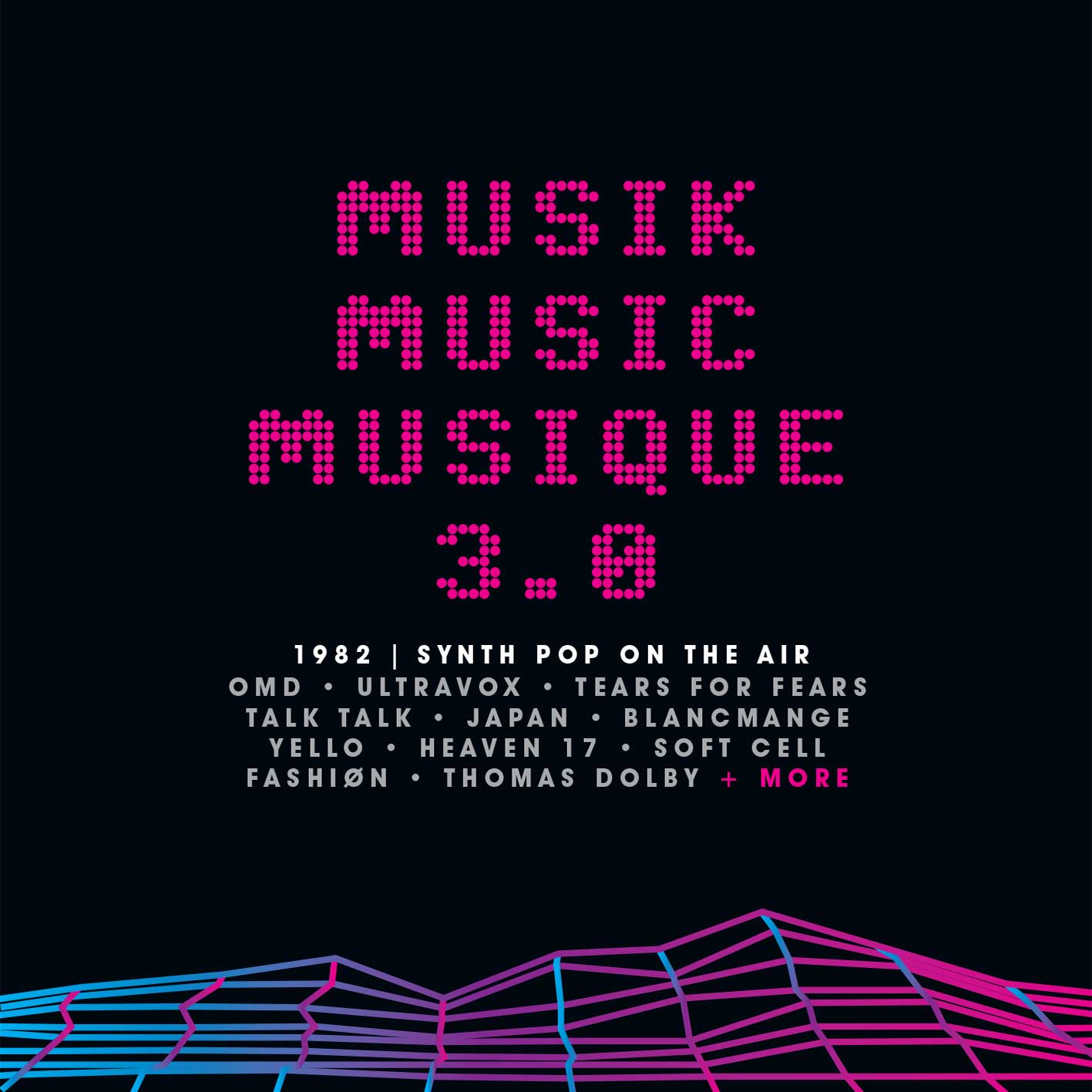
So good they named it thrice! Cherry Red build on the success they have enjoyed with the first two compilations in this series, which takes its name from the track of the same name by Zeus. On the first triple album they looked at music in 1980, and ‘the dawn of synth pop’ – followed by the rise of the same style in 1981.
Now we reach 1982 and synth pop is ‘on the air’ – and the shift in musical style as it starts to take over the airwaves is tangible.
What’s the music like?
A fascinating electronic diary. There is lots to discover here, whether you approach the collection as a knowledgeable pop music fan, or if you come in from the cold. It gets off to the best possible and most appropriate start, too. Radio Silence starts the first of three instalments, a great, deadpan start with Thomas Dolby‘s plea to ‘tune in tonight’. Elsewhere the joyous song The Passage, from XOYO, makes a strong impression, as does the poise of Talk Talk‘s Mirror Man. Orchestral Manoeuvres In The Dark make a majestic contribution with, as do Blancmange, who bring some gravitas with I’ve Seen The Word. Streetplayer is a bright and brassy number from Fashiøn, before Tears For Fears bring the emotion and the harmonic twists with Pale Shelter. Arthur Brown, Planning By Numbers and Ultravox complete a winning first part.
Part two starts strongly too, with Dramatis‘s The Shame and Fiat Lux‘s surprisingly graceful This Illness. New Order‘s Temptation could hardly be bettered in ’82, but cuts like Dead Or Alive‘s What I Want show there was plenty in reserve elsewhere. Soft Cell‘s Sex Dwarf and Yello‘s Heavy Whispers show just what variety there was too! The Human League‘s offbeat You Remind Me Of Gold shows a darker side, while the rougher sounding Hold Me by Section 25 shows electronic music in a murkier state, finding the middle of a darker dancefloor.
Clattering drums give way to elegance in Heaven 17‘s Let Me Go!, again a complete polar opposite to the scuttling beat of Siegmund Freud’s Party from Telex. Falco proves in the course of Maschine Brennt that he was capable of much more than one big hit, too. On this third part Cherry Red push the boat out further, Mikado‘s Par Hasard making an elegant impression, in contrast to Those French Girls and Sorry Sorry. Ukraine‘s Remote Control is brilliantly lo-fi, with cavernous production and a funky bass, but then Sergeant Frog‘s Profile Dance is compact and nippy. A final surprise awaits in the form of Omega Theatre‘s decidedly odd Robots, Machines and Silicon Dreams, moving between intimacy and choral bursts.
Does it all work?
Yes, mostly. The surprising aspect of this compilation is just how modern and fresh everything sounds, as though producers had just been let through the doors of their own studios. Not everything has aged ideally, but because the track ordering is so well thought out, there are natural peaks and troughs.
Is it recommended?
It is – and so is the series, going from strength to strength.
Anyone closely following the career of John Foxx over the last ten years will have been fascinated by his powers of invention. He is a rejuvenated musical presence, prolific in disciplines that include (but are not restricted to) electronic pop, broad musical ambience with substance, short stories (The Quiet Man, published by Essential Works in 2020) and now a first foray into the world of the solo piano.
Given his previous musical exploits, the only surprise here is that Foxx hasn’t done it before – but the time taken to enter such a crowded field is understandable. The Arcades Project takes its lead from a text by Walter Benjamin that Foxx read at art school in the 1960s, but which mysteriously disappeared from circulation until the internet made it available.
Foxx describes the book as “a sort of stroll through new ideas emerging from the city life of Paris in the 19th and early 20th century. It was also concerned with what the French poet Baudelaire had termed flâneurism. The flâneur enjoys walking randomly, drifting with the tides on the streets, taking great pleasure in a dreamlike state of coincidentalism – being open to all the unfolding daily events of a great modern city.”
What’s the music like?
The description of the book could also be levelled at the music John Foxx writes in response. For here is a true meander, the artist enjoying a slow pace in spite of the busy streets around him, operating at a much slower tempo.
That sensation comes through to the listener, should they walk with this music – which is a highly effective way to hear it. Somehow Foxx’s imprints are immediately recognisable. The restraint with which he uses the piano is commendable, but so is the manner in which its contributions are shaded, with reverb added to soften the sound and give it depth, without ever obscuring the melodic phrases.
A Formal Arrangement has a simple construction but is a thoughtful piece of music, while Floral Arithmetic sets off on a starry path, a single right hand phrase like a shooting star tracing across the sky. Daylight Ghost is not as eerie as you might expect; rather its airiness has an air of mystery behind it. In All Your Glory takes a sharper tone, securing a brighter colour, which ebbs on the softer hue of the mellow Last Golden Light.
Momentary Paris, through its title, conjures dreamy impressions of back streets and unexpectedly quiet reveries, away from the rushing traffic. Forgotten In Manhattan, meanwhile, has a penetrating piano sound with graceful wisps of accompaniment, very much in Foxx’s own distinctive style.
The Sea Inside is one of the more expansive pieces in the collection, and also the warmest, its blue waters inviting relaxation. Lovers And Strangers goes deeper still with a wistful melody, while Starlit Summer Night evokes the sort of sky Vincent Van Gogh would have been painting, taking the profile of a Satie piece but adding a roomy backdrop to the action close at hand.
Coincidentalism is a beauty, very much a case of less is more as each note is sustained across the musical sky, coming down to earth at the consonant close. This Evening needs even less on the note count to make its point, capturing the shutdown of the mind at this point in the day.
Does it all work?
It does, in a very unhurried sense. First time listeners to this area of John Foxx’s style may think there is not much going on, but as the album unfolds it is clear – as with all of his ambient music – that less is most definitely more.
Is it recommended?
Yes. This is another of John Foxx’s ambient works that hits the spot but remains slightly elusive in just how it does so. The piano is a very sympathetic vehicle for his music, and we will hopefully see further inspiration from this source.
John Foxx is very much back on the radar. His musical activity for 2023 begins with a limited edition, album length release. Avenham is documented as being ‘inspired by a place he knew as a young man but it’s more than a location. It’s less defined, more dispersed and mysterious than that’.
This intriguing text that will draw in fans of the instrumentalist and one-time Ultravox member, who has in his solo career shown himself to be a multi-disciplined musician. Avenham fits into a line of releases including London Overgrown, My Lost City, the revered Drift Music with Harold Budd and the Codex album as part of the Ghost Harmonic trio.
“Avenham is a real place”, says Foxx, “that’s also as mythical as the gates of Eden. So the music is likewise nebulous and impressionistic – a view from here to a time which occurs in almost everyone’s life, when the world becomes a radiant place of infinite mystery and promise – and everything seems possible.”
What’s the music like?
A mixture of serenity and activity. The relatively ambiguous accompanying text is helpful, for it means the listener can create their own Avenham. For this particular listener it feels like a green space, rich in both light and shade, a place of fertile ground but also slow-moving growth – all things that are reflected in the cover image.
Regular Foxx listeners will feel at home in the elegant lines of On Waking, a timeless evocation – unlike Ampurias to Ithaka, which is more obviously a distant relation of 1980s synthesizer music, with a slightly manipulated treble sound complemented by piano. Dream Through Trees is particularly lovely, a string-based composition with dappled textures, while time stands still as the single melodic lines of The Best Of Us spin silvery webs. Avenham itself carries more weight, while A Murmuration provides one of several moments where the influence on Moby’s longer ambient music can be discerned.
Does it all work?
Yes. Avenham is the ideal accompaniment for meditative thoughts and exercises, and is confident enough in its own abilities to often operate completely without a bass part. As a result it offers a uniquely weightless sound.
Is it recommended?
It is. As we eagerly anticipate Foxx’s first ever solo piano album, The Arcades Project, here is a more familiar side to his work. Avenham is a restful place for recharge and reparation.
John Foxx, the founding vocalist of Ultravox, is a prolific composer of electronic music, both instrumental and vocal. His recent endeavours include a solo release, London Overgrown, and an album Codex as part of the group Ghost Harmonic, recorded with classical violinist Diana Yukawa and frequent collaborator Benge (with whom he has also recorded as John Foxx and The Maths).
Because of his heritage and continued quest for making new music, Arcana spoke to him about his music, and in particular about the effect classical music has had on his life, in both positive and negative ways.
You seem to be in a very rich creative vein at the moment. Have you always been this productive, or are you finding that collaborations with others are bringing even more music out of you?
Collaboration is a fascinating thing – it’s so productive, but each time you have to figure out a new way to surf along with other people’s energies. You’ve both set yourself up – so then you have to put up or shut up. It puts you right on the spot and is very energising. Plus you both get to share the blame!
What does Diana Yukawa bring to your work with Benge that other classical violinists might not?
She enjoys improvising and enjoys being thrown in at the deep end with technological temporal disorientation devices. Not many classically trained musicians can handle that. She thrives on it and produces surprising results.
Diana has the sort of musical ability and agility that I find enviable. We’ve really only begun to glimpse her potential.
What is it about your relationship with Benge – and his studio – that inspires musical creativity?
It’s great fun – and always fascinating.
At first you think everything sort of half works but then you realise he’s managed to get beautifully rough sounds on sometimes beautifully rough equipment that excite you into the next stage without being able to resort to your own clichés.
When you listen back at home you realise you’ve been creatively misled into something you might have dismissed otherwise. And it all sounds very fine indeed.
I also love his take on mixing. The usual hierarchy gets dismantled and you hear sounds that don’t often get a just exposure. He’s completely fearless in that respect.
With London Overgrown, I first listened to it in bright early morning sunshine journeying into London, and the music and visuals seemed to go very well together. Is that how you see it?
Good – I think there’s a lot of English weather in the music, the sun through clouds and the sort of perspectives you might glimpse calmly gliding through overgrown streets. It is both detached and tranquil. ‘Serene Velocity’ was the phrase that best seemed to describe it.
Was it a conscious move to write music with these projects that seems to be more treble rather than bass?
Well, with London Overgrown the instrument I used most was an old DX7, and that can produce beautifully complex upper frequencies, so I simply enjoyed and went along with that. Many of the pieces were improvised using 30 second delays, and delays so long create their own ecologies. It’s like gardening. You let things grow. In the end I had a city that was completely overgrown.
In the case of Ghost Harmonic we were obviously focussed on Diana’s violin, so that defines the frequencies to a large extent. The bass end was supplied by the big Moog and textural intervals supplied through the interplay between those two and the reverberation and delays. I like the violin’s range – it really is a singing instrument, a human voice extension. I’d like to use a cello against it next time – a marvellous creative groaning device.
Would you say either Codex or London Overgrown are classical in any way – their form or melodic contours, say?
Well, that’s such an interesting question, and to some extent it supplied the reason for this recording. So I hope you’ll forgive me if I ride my wee hobby horse for a moment.
You see, I think the divisions between classical and other music are really illusory, but nevertheless interesting – ‘classical’ is a sort of ossified form, historically where music began to be written down instead of being played, personal and constantly evolving, as it was before the evolution of the orchestra – and this is what created all the problems.
You see, orchestras couldn’t improvise any longer because they’d become too big. They have marvellous, unlimited harmonic and melodic potential but they’re like an ocean liner to a canoe – they can’t manoeuvre instinctively.
Orchestras are also very hierarchical and bureaucratic – all instructions have to be written down and adhered to in order to operate effectively, otherwise chaos would ensue because of the sheer number of participants involved.
That’s when orchestral players became more focussed on obedience training than improvisation skills and agility, simply because it was necessary for the successful operation of the music.
Musicians unwittingly became a reproductive device. The conductor assumed the interpretive role, but even he couldn’t fundamentally alter the score. Writing things down also fixes them, it tends to inhibit or prevent any further development, so that’s another reason the whole thing became so inflexible.
I think it’s no accident that the orchestra evolved during the industrial revolution, where factory and bureaucratic systems also had to evolve, to deal with the massive scale of industry and populations.
They are really a sort of model of idealised, organisational harmony created through bureaucracy – powerful, monolithic and effective – but there’s always a price and the price paid here is the sacrifice of individual freedom of interpretation and expression. By logical increments you find we have unwittingly locked ourselves into a sort of bureaucratic form – bureaucratic music.
With Diana we were attempting to steal the fire of some of that marvellous technical skill that classical music demands – and set it free among the fields of infinite sonic possibilities that a modern recording studio can offer. You can change time relationships, even reverse them, and manipulate sequences, perceptual spaces, perspectives, harmonies and textures. You can focus down like a microscope, or out into landscapes and even create occurrences that behave like weather systems.
Of course the act of recording also captures, alters and defines a sort of music, just as written music does, but in very different ways – so there’s still a price for every gain.
We began by simply wanting to see what would happen if we mixed the most intriguing possibilities of both genres, without prejudice. Along the way we also began to realise it might offer a way out of this impasse that so called ‘classical music’ seems to have unwittingly entered.
Can you remember your first encounters with classical music?
Yes – first hearing of Nimrod by Elgar (from the Enigma Variations) and realising the power and subtlety of an orchestra.
I heard older music in church – the sung Latin mass, which was marvellous to hear and that oceanic feeling of dissolving into something greater than yourself. I also begun to understand how chants evolved by harmonising with your own delayed reflections from the architecture – architectural music as opposed to bureaucratic music.
When I hear music by Thomas Tallis I hear the astounding beauty of those interwoven voices, then realising the evolutionary connections between chants and orchestras and architecture.
Then the next thing that really impressed me was Satie‘s piano music. I heard someone play the Gymnopédies one afternoon in the old lecture room at art school.
I can still picture the instant – early summer, big open doors, the view down the marvellous avenue of trees at Avenham, and that beautiful elegant music. It is perfect minimalism, with poise and tranquillity, like distilled civilisation in a few notes and a sound. I was transfixed. it seemed to alter everything. I’ve loved piano ever since. It really is my favourite sound in the world apart from a blackbird’s song.
You said in an interview with me a while back how you liked what John Cage did, and the theory that music is organised noise. Is that how you see it – and is that why the noise of Benge’s studio, for instance, assumes the importance it does?
Yes to both. Understanding that music is organised noise was a great liberation. It enables you to understand and encompass lots of other sources of music from traffic to industrial noise to feedback and other accidental by-products such as tape hiss and glitches etc. Inherent imperfections become part of the landscape, so the landscape immediately becomes bigger and more textured, as well as more fun.
Would you ever consider writing for orchestral forces, or what are seen as more ‘classical’ forces, such as an electronic string quartet?
Maybe – but I’d need to have the motivation – usually some aspect of music that seems to need reconciling or some neglected possibility that intrigues enough to do the work. In the case of Ghost Harmonic, that was supplied by attempting to reconcile classical playing abilities with modern recording and improvisation.
What does classical music mean to you?
Something wonderful that became confined by its own form.
It means great possibilities still unrealised – what might happen if you facilitated a real interplay between the massive harmonic possibilities of orchestras and the full potential of a modern recording studio?
At present the classical world sees recording simply as a means of recording a single performance – any other manipulations are seen as inauthentic. There’s no attempt to access the massive compositional possibilities of modern recording. What a waste!
What are you listening to at the moment, and what piece of classical or modern music would you recommend Arcana readers go out and find?
Ruben Garcia made some beautiful piano and reverberation improvisations on a record called A Roomful of Easels. I often play some of these pieces at home.
There’s one David Darling recording, by the instigator of ECM Records Manfred Eicher, called Cello – improvisations against long delays. It’s a specific mood and poise, perfectly held, beautifully recorded and composed. Sadly, I didn’t much like his other recordings – except perhaps Dark Wood. It seems he needed the austerity of vision enforced by Eicher.
And Satie, always. He’s really the Marcel Duchamp of modern music – the point it all began, for me. His work embodies purity of intention and gorgeous simplicity with elusive intelligence. A benchmark.
London Overgrown is out now on Metamatic Records – and on the same label, the Ghost Harmonic album Codex is also available – their website can be viewed here




 Arcana.fm