
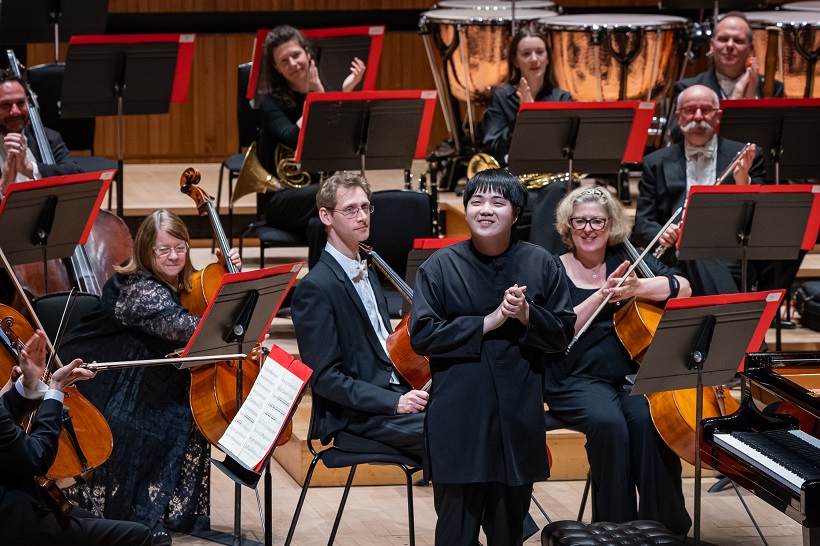
In concert – Mao Fujita, Philharmonia Orchestra / Osmo Vänskä: Missy Mazoli, Mozart & Mendelssohn

Mao Fujita (piano), Philharmonia Orchestra / Osmo Vänskä

Missy Mazzoli These Worlds In Us (2006)
Mozart Piano Concerto no.25 in C major K503 (1786)
Mendelssohn Symphony no.5 in D minor Op.107, ‘Reformation’ (1830)

Royal Festival Hall, London
Thursday 20 March 2025

Reviewed by Ben Hogwood Picture (c) Marc Gascoigne

Japanese pianist Mao Fujita has shown his impressive Mozart credentials in highly praised recordings of the composer’s complete piano sonatas. More recently his focus has shifted to the piano concertos.

Here he was partnered by the Philharmonia Orchestra and the visiting Osmo Vänskä in the substantial Piano Concerto no.25 in C major K503, a ceremonial work with fulsome orchestral accompaniment. Yet less is often more in Mozart performance, and that was certainly the case with Fujita as his fingers spun a magical web of notes. The piano’s magical first entry, after the pomp and circumstance of the introduction, was notable for its lightness of touch, Fujita listening closely to the Philharmonia wind players.

With so much to enjoy in this performance, Fujita exuded technical brilliance but also commendable restraint, always with affectionate shaping of the melodic line. That is, until the unattributed first movement cadenza. Here the rulebook was torn asunder, and a flow of unpredictable counterpoint broke loose, revealing links back to Bach but notably forward towards Beethoven.

Back under control, Fujita made the piano sing in the operatic slow movement, aided again by the quality of the wind section under Vänskä, who secured typically detailed, transparent clarity. The first violins began the finale with their touch as light as a feather, after which Fujita put the pedal to the metal once again, taking great pleasure in Mozart’s sparky dialogue with the orchestra. His encore, the first movement of Mozart’s Piano Sonata in C major K545, featured a delightful ‘wrong’ chord near the end, affectionately given and rounding off a truly memorable performance.

Prior to this we heard Missy Mazzoli’s These Worlds In Us, dedicated to her father, who was a soldier in the Vietnam War. Her imaginative orchestration extended to the use of wheezy melodicas in the outer section, adding a dreaminess and heightening the link with the music of Bali. The sighing violin theme was profound, but most telling of all was the soft rat-a-tat of the snare drum, a quiet but ominous reminder of war amidst the otherwise bright scoring. Mazzoli’s music has deeply human qualities that came alive in this performance.

For the second half, Vänskä led a dramatic account of Mendelssohn’s Symphony no.5, the Reformation. Second in order of composition, it was the last of his symphonies to be properly published, on account of its troublesome reception in 1832. In more recent years however the work has enjoyed greater exposure, rewarding its portrayal of triumph in turbulent times.

The magical hush from the strings of the Dresden Amen, quoted by the composer in the first movement, drew the audience in before Vänskä powered through a turbulent Allegro. The second movement danced like a late Haydn minuet, brisk and with a charming trio, while the Andante looked inwards, initially beyond comfort but ultimately softening to the touch. Mendelssohn’s quotation of the Lutheran chorale Ein feste Burg came to the rescue, sweetly intoned by flautist Samuel Coles, before the orchestra enjoyed Mendelssohn’s exuberant finale, and its parallels to Handel’s Messiah. As is his wont, Vänskä revealed previously hidden orchestral detail, giving a fully convincing account of a symphony whose cumulative power is all the more remarkable given Mendelssohn was 21 at the time of composition. Youth and experience were ideal foils here.

For details on the their 2024-25 season, head to the Philharmonia Orchestra website

Published post no.2,481 – Saturday 22 March 2025

On Record – Peter Herresthal, Arctic Philharmonic, Bergen Philharmonic Orchestra – Missy Mazzoli: Dark with Excessive Bright (BIS)

abfPeter Herresthal (violin); bMembers of Arctic Philharmonic [Oganes Girunyan, Øyvind Mehus (violins), Natalya Girunyan (viola), Mary Auner (cello), Ingvild Maria Mehus (double bass)]; cdeArctic Philharmonic / Tim Weiss; aBergen Philharmonic Orchestra / James Gaffigan

Mazzoli
Dark with Excessive Bright (2021 – versions with string orchestra (a) and string quintet (b)). Sinfonia (for Orbiting Spheres) (2013)c
These Worlds in Us (2021)d
Orpheus Undone (2021)e
Vespers for Violin (2014)f

BIS BIS-2572 [66’22’’]
Producers Jørn Pedersen, Hans Kipfer Engineers Gunnar Herfel Nilsen, Håkan Ekman

Recorded 4 June 2021 (a) at Grieghallen, Bergen; March 2022 at Storman Concert Hall, Bodø

Reviewed by Richard Whitehouse

What’s the story?

BIS issues the first release to be devoted to the orchestral output of Missy Mazzoli (b.1980), New York-based and firmly established among the most significant opera composers of her generation, recorded with a stellar cast of musicians at venues on the west coast of Norway.

What’s the music like?

In his prefatory note, American author Garth Greenwell characterizes Mazzoli’s music thus – ‘‘Each piece is a journey no step of which is forgotten, so one arrives in a place that feels at once familiar and absolutely new’’, which seems a fair description of its audible connection with the past while, at the same time, absorbing accrued influences into an idiom wholly of today. That each of the works bears this out, albeit in different ways and with unpredictable outcomes, says much about the effectiveness of her modus operandi these past two decades.

Earliest here is These Worlds in Us – its title drawn from a poem by James Tate concerning the wartime death of his father, leading to music whose interplay between feelings of pain and elation is abetted by a tightly focussed evolution. An identical duration aside, Sinfonia (for Orbiting Spheres) could hardly be more removed in its formal corollary to that of the solar system; such abstraction offset by the ‘sinfonia’ connotations with a Medieval hurdy-gurdy whose modal drone, recreated here on an electronic keyboard, underlies the headily increasing velocity of this piece. Nominally the paraphrase of a larger work, Vespers for Violin combines solo violin with an electronic soundtrack where overtones of keyboards, voices and strings subsumed into a texture such as proves at once rarified and evocative.

Framing this release are two versions of the title-track. Having started out as a concerto for double bass and strings, Dark with Excessive Bright was reworked for violin at the request of Peter Herresthal – a quotation from Milton being the catalyst for a piece that refashions Baroque techniques from a present-day vantage, and one which succeeds equally well with orchestral strings or string quintet. Most compelling, though, is Orpheus Undone – a suite whose two movements (respectively 10 and five minutes) open-out that emotional trauma    of Eurydice’s death with a methodical while always cumulative inexorability as to suggest that Mazzoli could distinguish herself in the symphonic domain were she to take time-out from that of opera. Certainly, one of the most absorbing orchestral pieces of recent years.

Does it all work?

Pretty much always, though the composer is fortunate to have had such advocacy from the musicians heard here. Herresthal reaffirms his standing as go-to violinist for new music, his playing as subtle and as resourceful as this concerto requires. The much in-demand James Gaffigan gets luminous playing from the Bergen Philharmonic, as does Tim Weiss from the Arctic Philharmonic of whose Sinfonietta he is artistic director. Sound of spaciousness and clarity, along with succinctly informative notes by the composer, are further enhancements.

Is it recommended?

It is, and those suitably drawn into Mazzoli’s sound-world are encouraged to check out other releases – notably the powerful and unsettling opera Proving Up (Pentatone PTC5186754) or the endlessly thought-provoking Vespers for a New Dark Age (New Amsterdam NWAM062).

Listen

Buy

You can explore purchase options for this recording at the Presto website. Click on the names for more on the artists – Peter Herresthal, Tim Weiss, James Gaffigan, Arctic Philharmonic and the Bergen Philharmonic Orchestra – and for more on the composer Missy Mazzoli

Published post no.2,174 – Friday 9 May 2024