
On Record – Havergal Brian: Symphonies nos. 29 – 32 (Heritage Records)

Havergal Brian
Symphony no.29 in E flat major (1967)
Symphony no.30 in B flat minor (1967)
Symphony no.31 (1968)
Symphony no.32 in A flat major (1968)

Philharmonia Orchestra / Myer Fredman (nos.29 & 32), Sir Charles Mackerras (no.31), BBC Symphony Orchestra / Lionel Friend (no.30)

Heritage HTGCD130 73’20”
Recorded 12 March 1979 (nos.29 & 32) and 16 March 1989 at Maida Vale Studio One, London (no.30), 9 January 1979 at Henry Wood Hall, London (no.31)

Reviewed by Richard Whitehouse

What’s the story?

The enterprising Heritage label continues its coverage of Havergal Brian with this volume featuring the last four of his 32 symphonies, three of them in pioneering studio broadcasts that were organized by Robert Simpson during his last years as music producer at the BBC.

What’s the music like?

The 29th Symphony is the culmination of a classicizing tendency Brian pursued throughout the 1960s, falling into four continuous if clearly demarcated sections whose formal poise is matched by their lucidity of expression. Thus, a ruminative Lento then genial Allegretto are balanced by the rumbustious though not unduly truculent Allegros either side but it is those framing Adagio sections, launching the piece before bringing it full circle in a mood of rapt contemplation, which leave the deepest impression and so set the seal on an eloquent work.

Barely four months later, the 30th Symphony inhabits a wholly different and fractious world. Likely drawing on material for an abandoned opera on Sophocles’ Oedipus Coloneus, its two continuous parts unfold from a restive, increasingly ominous Lento into the most disjunctive of Brian’s numerous Passacaglia movements; its inherent logic countered at every stage with a visceral and even assaultive impetus prior to the suitably implacable apotheosis. Definitely a work for all times, and among a select handful of orchestral masterpieces from this period.

Five months later and the 31st Symphony emerges as among its composer’s most enigmatic statements, abetted by its single movement being the most seamless of Brian’s symphonies and the one whose key-centre is most difficult to discern. Evolving almost intuitively from casual gestures, it builds with unsparing focus towards a climax whose dynamism is thrown into relief by the inevitability of those final bars. Easy to underestimate in context, it might be considered a rule-book for Brian’s late maturity did it not break those rules at every turn.

Completed six months later, the 32nd Symphony is the longest work here – pursuing a sustained evolution across its four movements divided into two parts. Its thoughtful while not untroubled Allegretto is followed by an Adagio of keen inner strength, its seriousness of purpose subtly offset by a leisurely, often capricious scherzo then finale whose contrapuntal ingenuity underpins the determined onward course to a coda defiant in its resignation. Brian was to finish no further works, so leaving this symphony to stand as an inimitable testament.

Does it all work?

Yes, once the essence, recalcitrant but never intractable, of Brian’s symphonism in this final creative decade is grasped. It helps when performances of the 29th and 32nd were entrusted to Myer Fredman, his appreciation of Brian’s music evident elsewhere in this Heritage series, and the 31st to Sir Charles Mackerras who made a fine studio recording eight years on. The 30th is heard in a reading by Lionel Friend far more assured than its premiere by Harry Newstone, but it was not until Martyn Brabbins’s 2010 studio account that this work came into its own.

Is it recommended?

It is. The sound of the older performances has been cleaned up and opened out, much to their advantage, and that of the 30th offsets the dryness of the Maida Vale acoustic. John Pickard’s insightful booklet notes are further incentive to acquiring this welcome and necessary release.

Listen / Buy

Published post no.2,627 – Friday 15 August 2025
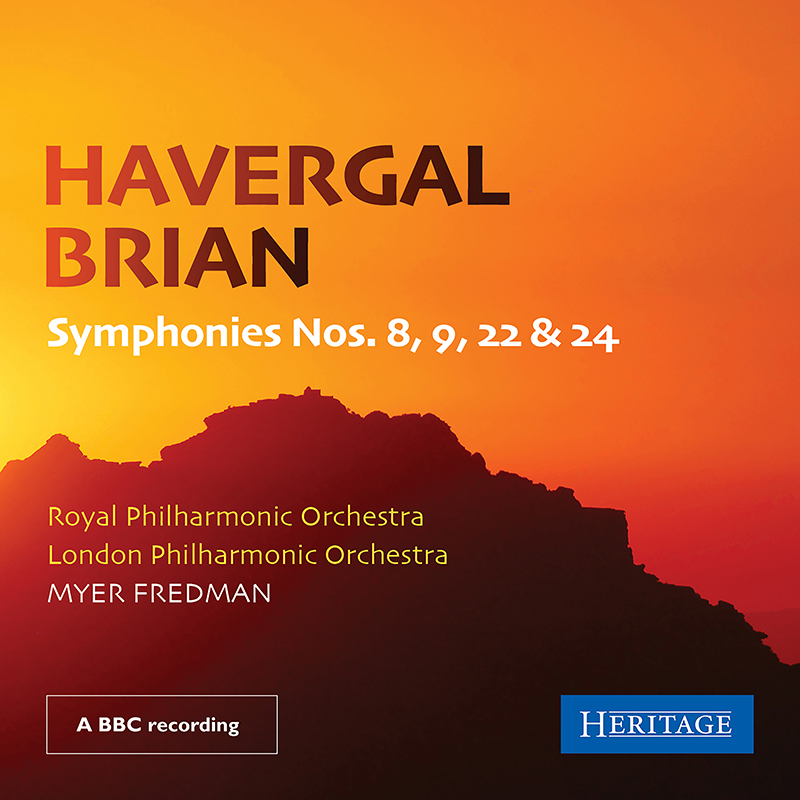
On Record: RPO, LPO / Myer Fredman – Havergal Brian: Symphonies nos. 8,9,22 & 24 (Heritage)

Brian
Symphonies – no.8 in B flat minor (1949); no.9 in A minor (1951); no.22 in F minor, ‘Sinfonia Brevis’ (1964-5); no. 24 in D major (1965)

Royal Philharmonic Orchestra (nos.8,9 & 22), London Philharmonic Orchestra (no.24) / Myer Fredman

Heritage HTGCD146 [77’46’’]

Broadcast performances from St John’s, Smith Square, London on 28 March 1971 (nos. 9 & 22) Maida Vale Studios, London on 27 June 1971 (no.8) and 1 April 1973 (no.24)

Reviewed by Richard Whitehouse

What’s the story?

Heritage continues its releases of pioneering symphonic broadcasts by Havergal Brian with this issue of performances from the 1970s conducted by Myer Fredman, two of these being world premieres in what was a productive decade for furthering the music of this composer.

Born in Plymouth and later resident in Australia, Fredman (below) (1932-2014) set down Bax’s first two symphonies, together with Brian’s Sixth and Sixteenth Symphonies (Lyrita) that remain among the finest such recordings. He also made studio broadcasts of the present symphonies which, as John Pickard indicates in his detailed booklet notes, are among the most revealing of Brian performances from the period either side of the composer’s death – making them a natural inclusion for a series such as that now undertaken by the enterprising Heritage label.

What’s the music like?

This was the fourth hearing of the Eighth Symphony, coming after two live broadcasts with Adrian Boult in 1954 and one by Rudolf Schwarz in 1958. In many ways a template for what came after, its single span elides sonata-form and multi-movement design with a cohesion the greater for its overt unpredictability. The initial rhythmic figure (one of Brian’s most striking such openings) is not quite together, but thereafter Fredman exerts firm while never inflexible control over the interplay of martial dynamism and contemplative stasis, building its central climax superbly if losing momentum into the contrasted passacaglias – the second of which brings only a fugitive calm in its wake. Commercially recorded by Charles Groves in 1977 (EMI/Warner) and Alexander Walker (Naxos) in 2016, this work awaits public performance.

Preceded by live broadcasts with Norman del Mar in 1958 and ’59 (the latter now on Dutton), the Ninth Symphony features three continuous movements that outline a Classical framework. Fredman launches the initial Allegro with due impetus and charts a secure course through its quixotic changes of mood – the hushed transition into the reprise especially striking. He is no less focussed in a central Adagio whose musing reverie is constantly undercut by militaristic aggression, a reminder Vaughan Williams’s Sixth had appeared three years before, while the final Allegro tempers its festive cheer with a plaintive interlude which even the jubilant coda only just outfaces. Surprising that since Groves’ public performances in Liverpool and at the Proms in 1976, then his commercial recording a year later, this work has remained unheard.

The remaining performances are both world premieres of works which form outer parts of a symphonic triptych. Lastly barely 10 minutes, the Twenty-Second is (as its subtitle implies) the shortest of Brian’s cycle if hardly the least eventful. More impulsive than Lázsló Heltay with his 1974 recording (CBS/Heritage), let alone Groves in his spacious 1983 performance, Fredman teases out the eloquence of the initial Maestoso through to its fervent culmination, then brings a deft nonchalance to the ensuing Tempo di marcia such as makes contrast with its baleful climax the more telling. Brooding and fatalistic, the coda ranks among the finest passages in post-war symphonic literature and Fredman captures its essence. Walker comes close with his 2012 recording (Naxos), but this account effortlessly transcends its 52 years.

A pity Fredman never tackled No. 23, who three Illinois hearings by Bernard Goodman in October 1973 make it only the Brian symphony premiered outside the UK, but he did give the Twenty-Fourth. After its intense then impetuous predecessors, this one-movement piece feels more expansive for all its methodical ingenuity. The martial opening section is adroitly handled so its breezy extroversion reveals unexpected inwardness towards its centre then at its close; a whimsical and lightly scored interlude making way for the (relatively) extended adagio which, in its searching if often equivocal repose, brings both this work and those two before it to an affirmative end. Walker’s 2012 account (Naxos) enables all three symphonies to be heard in consecutive order, but the insights of this first performance remain undimmed.

Does it all work?

Almost always. Fredman has an audible grasp of Brian’s often elusive thinking, so that these performances unfold with a formal inevitability and expressive focus often lacking elsewhere. The Royal Philharmonic Orchestra betrays passing uncertainty with Brian’s more idiosyncratic touches, whereas the London Philharmonic Orchestra copes ably with what is among his most approachable later symphonies. Heritage has done its customary fine job opening out the sound, and anyone who knows these performances through the pirated Aries LPs will be delighted at the improvement.

Is it recommended?

Indeed. Those familiar with these symphonies from the studio recordings will find Fredman’s interpretations an essential supplement. Hopefully this series will continue apace, ideally with John Poole’s 1974 performance of the Fourth or Harry Newstone’s 1966 take on the Seventh.

For purchase information on this album, and to hear sound clips, visit the Heritage website. For more on the composer, visit the Havergal Brian Society – and for more on Myer Fredman, visit a dedicated page on the Naxos website