
Live review – Nash Ensemble: War’s Embers – Elgar Piano Quintet & John Ireland Piano Trio no.2

Nash Ensemble (above) [Ian Brown (piano), Stephanie Gonley, Michael Gurevich (violins), David Adams (viola), Adrian Brendel (cello) (N.B. the line-up pictured above is not the same as the one appearing at this concert)

LSO St Luke’s, Friday 12 October 2018 (lunchtime concert)

Ireland Piano Trio no.2 (1917)
Elgar Piano Quintet in A minor Op.84 (1918)

Written by Ben Hogwood

The First World War had a profound effect on composers of classical music. Many of them served or were closely involved with the conflict, and even those who weren’t used their music as a vehicle for the shock and dismay felt at the turn of events.

John Ireland expressed his horror through two chamber works completed in 1917, the Violin Sonata no.2 and the Piano Trio no.2. The latter work began this concert from the Nash Ensemble, part of their War’s Embers series focusing on music written around the War in England. Set in one compact movement, it is a powerfully expressive utterance, even when the music is quiet – as it was when the first cello melody began – to when it reaches peaks of intensity in the march sections, depicting the war itself. Ian Brown, Stephanie Gonley and Adrian Brendel were united in voice, their three instruments often linked in melody, while Brendel’s eloquent solo at the start set the solemn tone.

Stylistically the work draws part of its inspiration from Debussy and Ravel, and these links were nicely played up by the trio, but the opening music dominated to the point of obsession, sweeping all before it. As evidenced in an interview with BBC Radio 3 host Fiona Talkington after the performance, the players had a clear understanding of Ireland’s writing, and his still underrated status in chamber music form.

Ireland’s trio was first heard at the Wigmore Hall in June 1917, and at the same venue nearly two years later audiences heard the premiere of Sir Edward Elgar’s Piano Quintet. Composed in Sussex, this autumnal work, written just prior to the Cello Concerto, reflects a fascination the Elgars held with a group of dead trees in Flexham Park, their branches twisted ‘in an eerie manner’.

The spidery tendrils of the first few bars reflected this eerie vision, and refused to release their grip on the piece despite a first movement that really got into top gear in this performance, passionately played and majestically poised. There was an affecting second theme before we heard for the first time some Spanish rhythms, also inspired by legend around the dead trees and refracted through a prism in Elgar’s mind, strangely sketched but never fully coloured-in.

The relative serenity of the slow movement, was countered by an emotional distance, as though here Elgar was conscious of the War, itself audible to him through the use of artillery just across the Channel. Perhaps because of this the trees made themselves known in closer proximity as the finale began, though here Elgar – and the Nash Ensemble – threw off the shackles to power through to an upward looking conclusion.

This was a fine performance of a work the Nash – and certainly Ian Brown – have had in their repertoire for more than 25 years. Brown displayed a natural instinct with the tricker phrases and was helped by a lovely string tone from the quartet in a performance that made sense of some of Elgar’s more distorted rhythms.

War’s Embers will come to BBC Radio 3 on Tuesday 13 November and I urge you to hear it, placing this elusive work in the context of a fine performance.

Further listening

You will be able to listen to this concert on BBC Radio 3 on Tuesday 13 November. In the meantime recordings of the works heard are on the Spotify playlist below:

For further information on the Nash Ensemble’s War’s Embers series, visit the diary section on the ensemble’s website
The Nash Ensemble play Julian Anderson at the Wigmore Hall

julian-anderson

Contemporary Music Series: Julian Anderson, Composer in Residence – Wigmore Hall, Saturday 7 November

Stravinsky: Three Pieces
Ravel: Chansons madécasses
Anderson: The Colour of Pomegranates; Seadrift; Ring Dance [UK premiere]
Woolrich: Pluck from the Air [London premiere]
Anderson: Van Gough Blue [World premiere]

Claire Booth (soprano), Nash Ensemble [Philippa Davies (flute/piccolo), Richard Hosford, Marie Lloyd (clarinets), Laura Samuel, David Adams (violins), Laurence Power (viola); Adrian Brendel (cello), Peter Buckoke (double bass), Sally Pryce (harp)]
Alexandre Bloch, conductor

Review by Richard Whitehouse

nash-ensemble
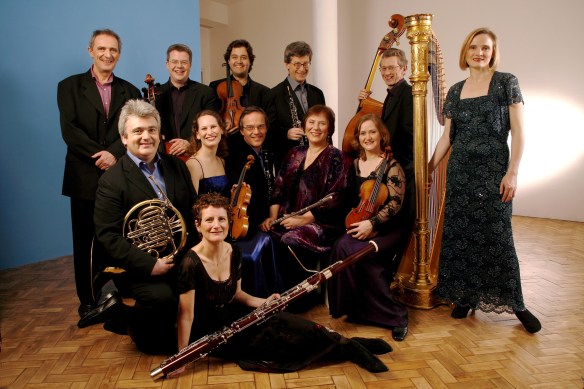
The Nash Ensemble. © Hanya Chlala/ArenaPAL

Julian Anderson’s residency at Wigmore Hall has brought a variety of artists and ensembles in performances of music – notably from the early twentieth century – so often difficult to schedule in recitals. One such opened tonight’s programme: Stravinsky’s Three Pieces for string quartet (1914) – a work no less radical than the ballets preceding it, given with the rhythmic trenchancy, gestural precision and harmonic plangency as characterize each piece.

Quite a contrast with Ravel’s Chansons madécasses (1926), a song-cycle whose singular scoring – soprano with flute, cello and piano – makes it awkward to find the right context. Not that this inhibited Claire Booth, whose unforced eloquence in the sensual ‘Nahandove’ and languorous ‘Il est doux de se coucher’ was balanced by the accusatory wrath of ‘Aoua’.

Anderson was represented in this first half by two pieces from two decades ago. The Colour of Pomegranates (1994) is less the encapsulation of Sergey Paradjanov’s film so much as a recollection of its magical aura, Philippa Davies unfolding the alto flute part with admirable dexterity as partnered by Ian Brown. Seadrift (1993) is a continuous sequence of songs such as renders Walt Whitman’s fabled text from a decidedly fresh perspective – soprano joined by flute (doubling piccolo) clarinet and piano in music that, without downplaying the purely emotional or even sentimental qualities of this poetry, enfolds it within a sonic canvas that underlines the aspects of union and separation at its core. Another fine showing from Booth, with members of the Nash taking its harmonic and rhythmic intricacies decisively in hand.

After the interval, Laura Samuel and David Adams gave the first UK hearing – and the first anywhere in 27 years – of Ring Dance (1987), Anderson’s piece which combines his then fascination for microtonal tuning with harmonic and timbral facets of Norway’s Hardanger fiddle tradition. The result pivots between relative consonance and dissonance in a way that intrigues rather than provokes (though first-night listeners in Stockholm evidently thought otherwise!) and, as with Anderson’s recently revived First String Quartet, a reminder of how early preoccupations have continued along more oblique lines. John Woolrich’s Pluck from the Air (2013) sprang few surprises in comparison, this tensile quintet for piano and strings outlining a longer-term engagement which might have been pursued in a second movement.

All the members of the Nash Ensemble then took the stage for the first hearing of Van Gough Blue (2015), Anderson’s homage to the artist whose preoccupations with colour and shade are embodied over its 20 minutes. Thus ‘l’Aube, soleil naissant’ evokes a tangible awakening, its inwardness duly offset by the pungent rhythmic and melodic interplay of ‘Les Vignobles’ and the ‘coming into focus’ of ‘Les Alpilles’ with its lively apex. The suspenseful harmonic stasis of ‘Eygalières’ then makes way for the culmination of ‘la nuit, peindre les étoiles’: a musical translation of the morning (4:40am on 25th May 1889) when Van Gough sketched his Starry Night painting, heard in terms of a ‘cosmic dance’ as carries all before it to the disintegrative final lament. Alexandre Bloch presided over this assured reading of a significant new work.