
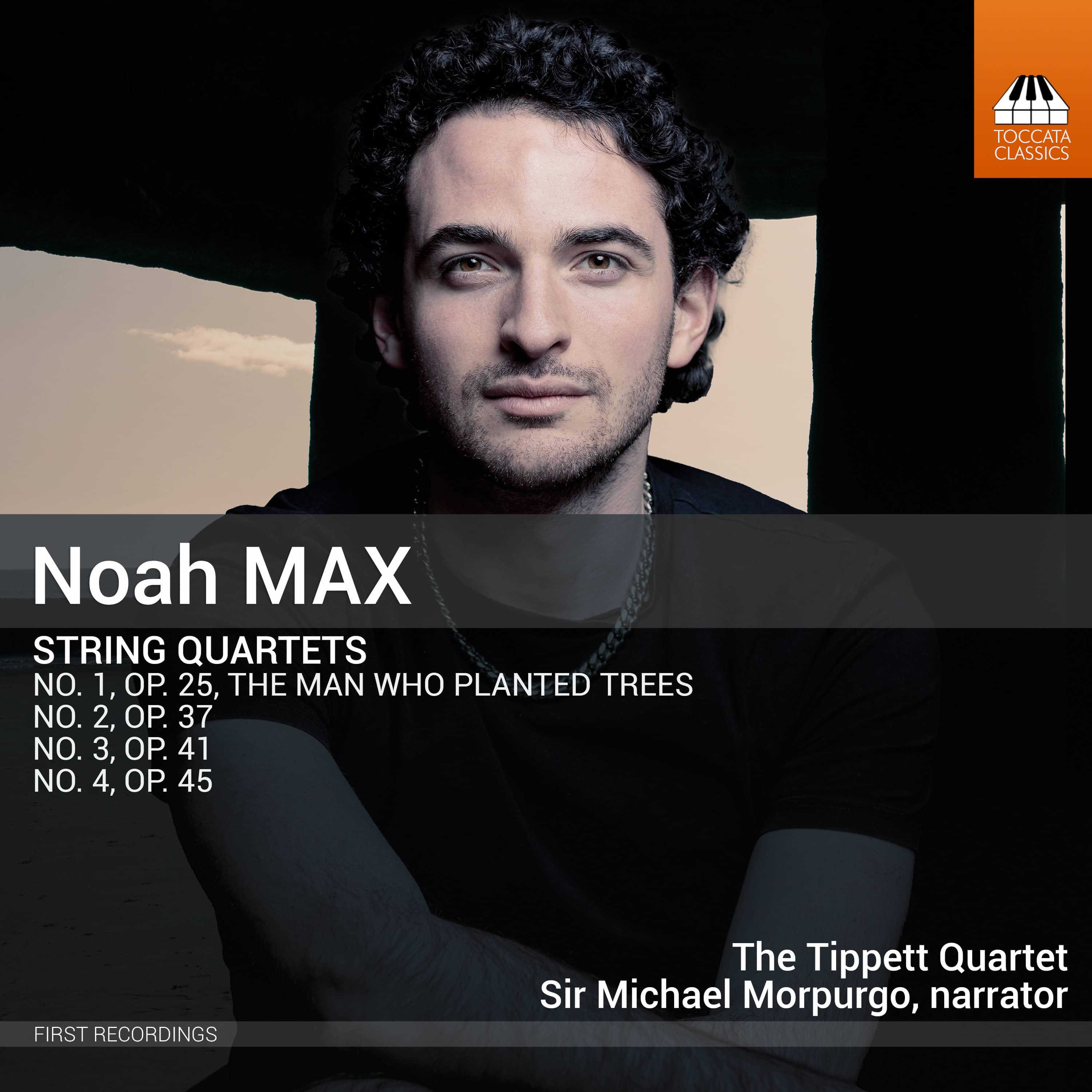
Tippett Quartet [John Mills, Jeremy Isaac (violins), Lydia Lowndes-Northcott (viola), Božidar Vukotić (cello)], Michael Morpurgo, narrator (‘The Man Who Planted Trees)
Noah Max
String Quartet no.1 Op.25 ‘The Man Who Planted Trees’ (2020)
String Quartet no.2 Op.37 (2021-22)
String Quartet no.3 Op.41 (2022)
String Quartet no.4 Op. 45 (2022-23)
Toccata Classics TOCC0749 [68’46”]
Producer Andrew Keener Engineer Oscar Torres
Recorded 16 August 2023 at St Silas Church, Kentish Town, London (‘The Man Who Planyed Trees’), 29-31 January 2024 at SJE Arts, Oxford
Reviewed by Richard Whitehouse
What’s the story?
Toccata Classics issues a second volume of music by Noah Max – devoted to his four string quartets which emerged at pace during the early years of this decade, and rendered here with conviction by the Tippett Quartet as part of its ongoing commitment to contemporary music.
What’s the music like?
As is emphasized in Martin Anderson’s introductory note, Max is nothing if not versatile for a creative figure still in his late twenties. Other than composition, he has been equally active as a cellist and conductor while also being a poet, film-maker and visual artist. Listeners are most likely to have encountered his music via the chamber opera A Child in Striped Pyjamas, after the novel by John Boyne, which premiered to considerable acclaim in London just over three years back and is an acknowledged influence on what he has composed subsequently.
Not just inspired by Jean Giono’s fable The Man Who Planted Trees, Max’s First Quartet also incorporates this text – eloquently narrated by Michael Morpurgo – across its three movements that chart a course from speculative uncertainty, via rapt inwardness, to dynamic resolution. It may also have three movements, but the Second Quartet is otherwise its antithesis. The initial subtitle, ‘The Ladder of Escape’ (after Joan Miró), affords real insight into its unfolding from fractured and sometimes fractious indecision, via an impulsiveness which ultimately turns in on itself, to a gradual accumulation of sound that yet leaves its overall formal and expressive trajectory in abeyance. One reason, perhaps, why this piece has been placed out of sequence at the close of the programme, as if in anticipation of a response which has yet to be written.
As the composer himself notes, the Third Quartet is designed around the number ‘three’ that imparts instability to almost every aspect; not least a volatile interplay between its harmonic density and a clearly defined chorale as comes into focus in a visceral if (almost inevitably) self-destructive climax – made the more plangent by down-tuning the lowest string on each instrument such that darkness overcomes the ensemble. Likewise cast in a single movement, the Fourth Quartet draws on aspects of Max’s aforementioned opera – but this is only made concrete by the emergence of Jewish liturgical chant during its anguished final stages. Max further draws attention to a conclusion whose demonstrably provisional manner makes the writing of a ‘fifth quartet’ to conclude this putative trilogy a likely and intriguing prospect.
Does it all work?
Pretty much throughout. What becomes evident, above all, is the ease with which Max moves between differing styles and aesthetics so as to result in an approach beholden to none. While this may seem relevant to the work at hand rather than establishing consistency across these quartets as a whole, it should not be taken as failure of intent but rather as an indication that he is still in the formative stages of a composing career which will doubtless throw up more than its fair share of surprises and circuities before one can speak of a definable ‘Max idiom’.
Is it recommended?
Yes it is – not least as these readings have a conviction expected from the always enterprising Tippett Quartet, along with an almost ideal ‘quartet sound’. Those who have Toccata’s earlier anthology of Max’s chamber music (TOCC0638) need not hesitate to acquire this follow-up.
Listen / Buy
You can hear excerpts from the album and explore purchase options at the Toccata Classics website. Click on the names to read more about the Tippett Quartet, Michael Morpurgo and composer Noah Max
Published post no.2,825 – Friday 13 March 2026
 Arcana.fm