New music – After The Hunt OST (Nonesuch)

from the press release:

Nonesuch Records releases the soundtrack to Luca Guadagnino’s film After the Hunt digitally on October 10; it will be available on CD from October 17.  After the Hunt stars Julia Roberts, Ayo EdebiriAndrew GarfieldMichael Stuhlbarg and Chloë Sevigny, and opens in cinemas from October 17, following its world premiere at the 2025 Venice International Film Festival.  The album features the score by Trent Reznor & Atticus Ross, a selection of works by the composer John Adams, as well as additional music from the film by Ambitious LoversJulius EastmanRyuichi Sakamoto and Everything But The Girl among others.  Find the full track list below. 

From visionary filmmaker Luca Guadagnino, After the Hunt is a gripping psychological drama about a college professor (Julia Roberts) who finds herself at a personal and professional crossroads when a star student (Ayo Edebiri) levels an accusation against one of her colleagues (Andrew Garfield), and a dark secret from her own past threatens to come into the light.  After the Hunt is written by Nora Garrett. 

“I was excited to make a movie about now,” Guadagnino says. “After the Hunt is a thriller that asks not what is the truth of this event but how many truths are there?  And who should decide which is right?  And, as a filmmaker, it was also a way of exploring how to tell a story showing all the possibilities of truth without saying one point-of-view is most valuable.”

The film’s suspense, feeling, and questioning is heightened by the texturally inventive score from the two-time Oscar-winning team of Trent Reznor and Atticus Ross.  This marks the fourth film Reznor and Ross have scored for Guadagnino.  “I always show Trent and Atticus the full movie without any music first.  Then we start talking about principles and ideas,” Guadagnino explains.  “In this case it was all about creating doubt.  They brought me these extraordinary piano notes that underline the question of do we believe this person or not.  This theme of doubt starts up in the first scene and keeps expanding.  And then, around the structure they created, we brought in pop music as well as contemporary composers like John Adams.”

Adams’ music has featured in almost all of Guadagnino’s work, beginning with I Am Love (2009).   Inspired by and scored entirely to Adams’ pre-existing music, this was the first time Adams had allowed his work to be used in this way.  Guadagnino subsequently featured pieces by Adams in his films A Bigger Splash (2015), Call My Be Your Name (2017), throughout the eight episodes of his miniseries We Are Who We Are (2020), as well as the documentaries Inconscio Italiano (2011) and Salvatore: Shoemaker of Dreams (2020).

“Adams’ music comes to me constantly.  Discovering it was transformative and changed my life as a director forever,” admits Guadagnino.  “It comes with a capacity of interpreting reality, interpreting the history of the reality, interpreting the history of the United States, and understanding even the boundaries of music to become a cunning exploration of the identity of human nature and the politic relationship that ties all us in.”

Filmmaker Luca Guadagnino is an Academy Award, BAFTA, and GRAMMY nominee.  Over the last three decades, his career as a director, writer, producer, and designer has been defined by rigorous dedication to artistic craft and creative experimentation.  Celebrated for his bold and emotionally resonant work, his films include The Protagonists (1999), I Am Love (2009), A Bigger Splash (2015), Call Me by Your Name (2017), Suspiria (2018), Bones and All (2022), Challengers (2024), and Queer (2024).

Trent Reznor and Atticus Ross are accomplished musicians, composers and producers who have achieved significant popular and critical success in both film and rock music.  Most recently, the duo composed the scores for Luca Guadagnino’s Challengers and Queer.  Both scores received wide acclaim, with Challengers winning Golden Globe and Critics Choice awards, as well as a GRAMMY nomination.  Over the years, the pair has composed music for a diverse array of film and television projects, beginning with David Fincher’s The Social Network (2010), which earned them an Academy Award and a Golden Globe.  Their next collaboration with Fincher, The Girl With The Dragon Tattoo (2013), earned them a GRAMMY Award.  Beyond their work in film, Reznor founded the iconic band Nine Inch Nails in 1988.  Ross joined Reznor and the band in 2016.

John Adams occupies a unique position in the world of music.  His works are among the most performed of all contemporary classical music, long embraced by the world’s leading orchestras and conductors, instrumental soloists and singers, choreographers, and opera directors.  Nonesuch Records made its first record with Adams in 1985.   He was signed exclusively to the label that year, and since then the company has released more than 40 first recordings and over 30 all-Adams albums, including the soundtrack to Luca Guadagnino’s I Am Love, as well as 2022’s 40-disc Collected Works box set

After the Hunt track list:

Disc 1

  1. Clock, One
  2. A Child Is Born – Tony Bennett, Bill Evans
  3. Let’s Walk – Mark Harelik, Victoria Clark, Adam Guettel
  4. After the Hunt, One – Trent Reznor & Atticus Ross
  5. It’s Gonna Rain – Ambitious Lovers
  6. György Ligeti: Piano Concerto: II. Lento e deserto – Pierre-Laurent Aimard, Asko Ensemble, Reinbert de Leeuw
  7. Terrible Love – The National
  8. John Adams: Gnarly Buttons: II. Hoe-down (Mad Cow) – John Adams, London Sinfonietta
  9. John Adams: Gnarly Buttons: III. Put Your Loving Arms Around Me – John Adams, London Sinfonietta
  10. After the Hunt, Two – Trent Reznor & Atticus Ross
  11. Break With – Ryuichi Sakamoto

Disc 2

  1. Clock, Two
  2. Julius Eastman: Evil Ni**er – Julius Eastman, Frank Ferko, Janet Kattas, Patricia Martin
  3. L’incontro – Piero Ciampi
  4. John Adams: The Death of Klinghoffer, Act II: “It is as if our earthly life were spent miserably” – Kent Nagano, Orchestra of the Opéra de Lyon, The London Opera Chorus
  5. John Adams: The Death of Klinghoffer, Act II: Desert Chorus – Kent Nagano, Orchestra of the Opéra de Lyon, The London Opera Chorus
  6. After the Hunt, Three
  7. John Adams: City Noir: III. Boulevard Night – David Robertson, St. Louis Symphony
  8. É Preciso Perdoar – Ambitious Lovers
  9. Nothing Left To Lose – Everything But The Girl

Soundtrack compiled by Luca Guadagnino & Matthew Rankin

Music supervisor: Robin Urdang

Published post no.2,686 – Monday 13 October 2025

New music – Brad Mehldau – Tomorrow Tomorrow (Nonesuch Records)

from the press release, edited by Ben Hogwood

Nonesuch Records releases pianist and composer Brad Mehldau’s Ride into the Sun – a songbook record of music by the late singer, songwriter, and guitarist Elliott Smith – on 29 August.

Featured musicians include singer/guitarist Daniel Rossen (Grizzly Bear); singer/mandolinist Chris Thile (Punch Brothers, Nickel Creek); bassists Felix Moseholm (Brad Mehldau Trio, Samara Joy) and John Davis (who also engineered and mixed the album); drummer Matt Chamberlain (Fiona Apple, Tori Amos, Randy Newman); and a chamber orchestra led by Dan Coleman, who also conducted on Mehldau’s 2010 album Highway Rider.

Two album tracks, Tomorrow Tomorrow and Better Be Quiet Now, are available and can be watched below, together with an in-the-studio video of the musicians recording, directed by Matthew Edginton:

Published post no.2,549 – Friday 30 May 2025

New music – Jeremy Denk – Ives / Denk (Nonesuch)

published by Ben Hogwood, with text appropriated from the press release

Nonesuch Records releases Jeremy Denk’s Ives Denk on October 18. The pianist, known as a champion of Charles Ives, is acclaimed for his performances of the great American composer’s works. Ives Denk, released in celebration of the 150th anniversary of Ives’ birth, features the composer’s four violin sonatas, performed with violinist Stefan Jackiw, as well as remastered versions of his Sonatas No. 1 and 2 for piano, from Denk’s 2010 debut recording, Jeremy Denk Plays Ives. ‘In the Barn’, the second movement of Sonata No. 2 for violin and piano, is available to download and can be listened to here:

In his liner note, Denk says that Ives’ “deepest dream was to create an original musical style, a fresh and uniquely American voice. He achieved this. But it was a voice most didn’t want to hear, and still don’t. He is one of history’s least popular populists … Ives’ writing – especially the later ones, when he was in terrible physical decline – are… often unhinged with anger, full of mean-spirited nicknames and simplistic binaries, they reflect some of the worst angles of America. One thing that saves Ives’ music from these dangers is his sense of humour, and his willingness to embrace failure.”

“If there is one piece that sums up for me Ives’ difficult virtues, it is the slow movement of the first violin sonata, a jagged musical reflection on the Civil War, so eerily relevant now, with America split into red-blue madness. It is interesting to compare this kind of piece, profound yet unloved, with the far more identifiably American voice of Aaron Copland … Ives is optimistic but always messy, always falling apart at the seams. His music suggests America will just have to muddle through, and wrestle with its own failure. At this particular historical moment, Ives seems to be more right than ever.”

“‘In the Barn’ is a joyful disaster,” Denk says of the second sonata movement, above. “It starts with country fiddling, slips slyly into urban ragtime, and as time passes, every imaginable genre makes a cameo – overheated Wagnerian Romanticism, fashionable exoticism, a dizzying tour of the early twentieth century musical world.”

Ives / Denk will contain the following repertoire:

Violin Sonata no.4 ‘Children’s Day at the Camp Meeting’
Violin Sonata no.3
Violin Sonata no.2
Violin Sonata no.1
Piano Sonata no.1
Piano Sonata no.2 ‘Concord, Mass., 1840-1860’

Published post no.2,277 – Wednesday 21 August 2024

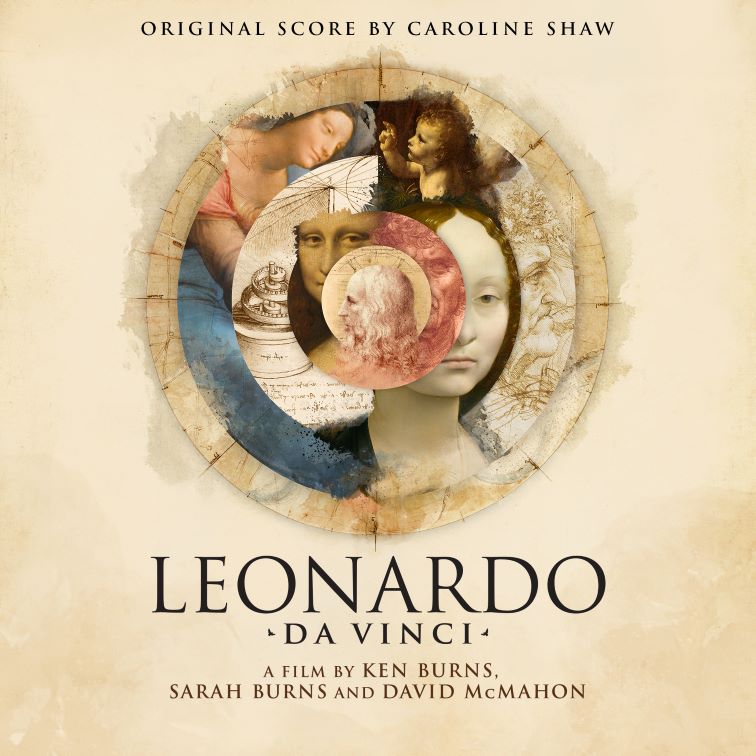
New music – Caroline Shaw: Leonardo da Vinci (Original Score) (Nonesuch)

published by Ben Hogwood, with text appropriated from the press release

The original score for Ken Burns’s new two-part documentary, LEONARDO da VINCI, with new compositions by Caroline Shaw, is available via Nonesuch Records on 25 October. The album features performances by the composer’s long time collaborators Attacca Quartet, Sō Percussion, and Roomful of Teeth as well as John Patitucci. Shaw wrote and recorded new music for LEONARDO da VINCI, marking the first time a Ken Burns film has featured an entirely original score. The video for Intentions of the Mind, from the album, can be viewed here:

LEONARDO da VINCI is directed by Ken Burns, Sarah Burns, and David McMahon. The film, which explores the life and work of the fifteenth century polymath Leonardo da Vinci, is Burns’s first non-American subject. It also marks a significant change in the team’s filmmaking style, which includes using split screens with images, video, and sound from different periods to further contextualize Leonardo’s art and scientific explorations. LEONARDO da VINCI looks at how the artist influenced and inspired future generations, and it finds in his soaring imagination and profound intellect the foundation for a conversation we are still having today: what is our relationship with nature and what does it mean to be human?

“No single person can speak to our collective effort to understand the world and ourselves,” said Ken Burns. “But Leonardo had a unique genius for inquiry, aided by his extraordinary skills as an artist and scientist, that helps us better understand the natural world that we are part of and to appreciate more fully what it means to be alive and human.”

“To help give depth and dimension to Leonardo’s inner life, and to carry our viewers on his personal journey, we enlisted the composer Caroline Shaw,” McMahon says in the album’s liner note. “Caroline’s existing body of music—joyful, daring, at times transcendent, and wholly unique—seemed to speak directly to Leonardo, a seeking soul who, 500 years after his death, can come across as strikingly modern. A fully original score, we believed, would add crucial connective tissue to areas where the record of Leonardo’s life is thin and it’s possible to briefly lose his trail. The music Caroline created is dynamic, enthralling and filled with wonder.

“This soundtrack is a testament to the inspired efforts of Jennifer Dunnington, who marshaled it into being, the brilliant musicians and vocalists who, with the help of Alex Venguer, Neal Shaw, Colton Dodd and Tim Marchiafava, made it soar, and most of all Caroline Shaw, who might be Leonardo’s soulmate from across time,” he continues. “With her help, the Leonardo who emerges is no wizard shrouded in mystery, but a prideful, obsessive, at times lonely or flustered, occasionally ecstatic, and, in the end, content man who is in ways both modern and thoroughly of his time.”

“As we set out to explore Leonardo’s life, we realized that while he was very much a man of his time, he was also interested in something more universal,” said Sarah Burns. “Leonardo was uniquely focused on finding connections throughout nature, something that strikes us as very modern today, but which of course has a long history.”

You can read more about Caroline Shaw at her website – and also more about Nonesuch here

Published post no.2,242 – Wednesday 17 July 2024

On Record: Los Angeles Philharmonic / Susanna Mälkki – Steve Reich: Runner / Music for Ensemble and Orchestra (Nonesuch)

Steve Reich
Runner (2016)
Music for Ensemble and Orchestra (2018)

Los Angeles Philharmonic / Susanna Mälkki

Nonesuch 7559791018 [35’25”]

Producer Dmitriy Lipay, Engineer Alexander Lipay

Recorded 1-4 November 2018 (Music for Ensemble and Orchestra), 6-7 November 2021 (Runner), Walt Disney Concert Hall, Los Angeles, CA

reviewed by Ben Hogwood

What’s the story?

It is best to let Steve Reich himself tell the story of these two closely related orchestral pieces. Runner, he says, is ‘for a large ensemble of winds, percussion, pianos, and strings.  While the tempo remains more or less constant, there are five movements, played without pause, that are based on different note durations.  First, even sixteenths, then irregularly accented eighths, then a very slowed-down version of the standard bell pattern from Ghana in quarters, fourth a return to the irregularly accented eighths, and finally a return to the sixteenths but now played as pulses by the winds for as long as a breath will comfortably sustain them.  The title was suggested by the rapid opening and my awareness that, like a runner, I would have to pace the piece to reach a successful conclusion.’

Meanwhile its companion, the Music for Ensemble and Orchestra, is in effect Runner 2. It is described by Reich as ‘an extension of the Baroque concerto grosso where there is more than one soloist. Here there are twenty soloists – all regular members of the orchestra, including the first stand strings and winds, as well as two vibraphones and two pianos.  The piece is in five movements, though the tempo never changes, only the note value of the constant pulse in the pianos.  Thus, an arch form: sixteenths, eighths, quarters, eighths, sixteenths.  Music for Ensemble and Orchestra is modelled on my Runner, which has the same five movement form’.

The recording marks the first foray of both the Los Angeles Philharmonic and conductor Susanna Mälkki into the music of Reich in recorded form.

What’s the music like?

Reich clearly enjoyed writing these pieces, as he tells David Lang in the liner notes for this release. The quick tempo means that as the starting gun fires, Runner is immediately into its stride with brisk music and rich colours. When the tempo marking halves to become Eighths, and then Quarters, the slower music is beautifully managed through sustained notes, pulling out the tension. The piano and vibraphones come through beautifully here, while the harmonies continue to negotiate new corners and scenery as a runner would do. The feeling persists, though, that Reich is at his happiest in the music of Sixteenths, where the busy conversations of the woodwind and the bell tolls of the vibraphones give the music impressive stature. The piece ends quickly, with one of the composer’s trademark ‘fades’.

Music for Ensemble and Orchestra feels weightier in its own Sixteenths section starts, pianos oscillating and strings gathering in hymn-like unison before the pianos create an impressive grandeur with their sustained low notes. Reich’s command of the orchestra is immensely assured, more so than it was in earlier works such as the Variations for wind, strings and keyboards or The Four Sections, but never losing the luminosity of those works, nor their capacity to pan out into larger spaces.

The Eighths section is the most emotionally powerful music yet, with large scale harmonies that move freely between weighted dissonance and brief consonance, the latter appearing like shafts of light in the music. Quarters brings forward the choirs of woodwind, their distinctive motif alternating with the piano, before the percussive instruments drive Eighths to greater heights, pianos chiming with the vibraphones. In typical Reich fashion the acceleration from Eighths to Sixteenths is both seamless and thrilling, the clarinets pushing to the front as the music gathers itself for the finish. Then just as suddenly – and seamlessly – the bottom drops away and the figures float away like birds on the wing, all treble and no bass.

Does it all work?

It does. The performances from the Los Angeles Philharmonic and Susanna Mälkki are of a uniformly high degree, and the writing is subtly complex – meaning that Reich’s workings reward close inspection, but that the overall whole is beautifully realised and works well even in the middle foreground for the listener.

Is it recommended?

Of course. Steve Reich is a composer where nearly every move he makes is captured on record, to our advantage – and this pair of works, representing one of his most recently published chapters, are typically rewarding listening.

Listen

Buy

You can buy this new release at the Presto website. For more on Steve Reich himself, visit the composer’s website