
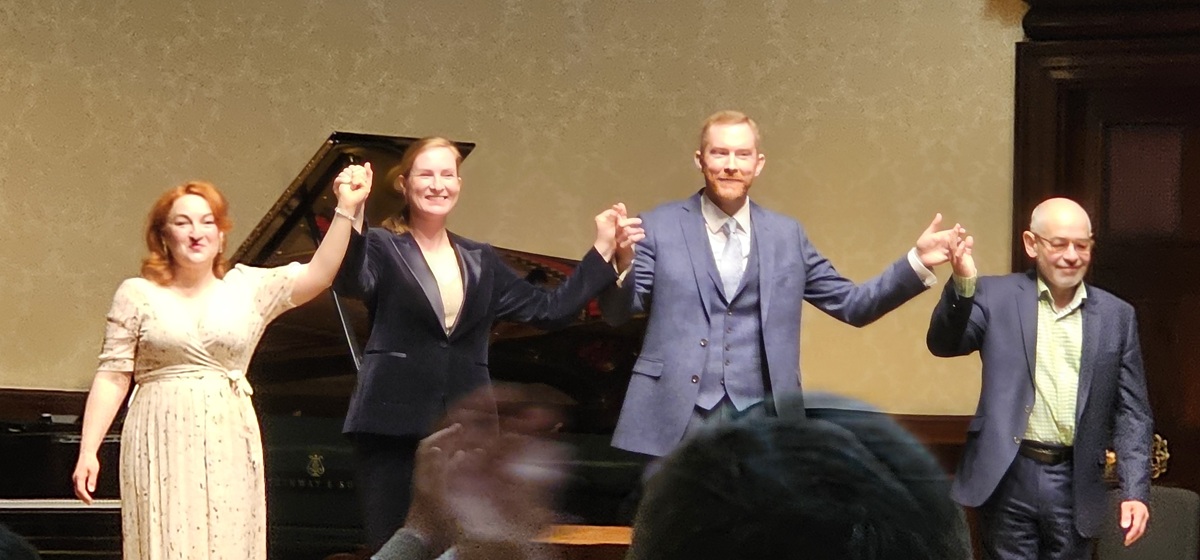
Ailish Tynan (soprano), Paula Murrihy (mezzo-soprano), Robin Tritschler (tenor), Iain Burnside (piano)
Boyle A soft day, thank God (1912); Looking Back: Carrowdore (1961-6); The Joy of Earth (1914); 2 Christmas Songs: Blyssid be the Tyme (1923-4); Himself and his Fiddle (1929); Have you news of my boy Jack (1916); Looking Back: O ghost, that has gone
Vaughan Williams Orpheus with his Lute (1925)
Boyle Looking Back: The mill-water
Vaughan Williams The Water Mill (c1922)
Maconchy Sun, Moon and Stars from Sun, Moon and Stars (1977)
Boyle Spring goeth all in white (1924); A Song of Enchantment (1921-2)
Wood The blackberry blossom (1897)
Boyle Roses (1909)
Wood Oh! Skylark, for thy wing! (1884)
Boyle All Souls’ Flower (1928)
Wood Darest thou now, O Soul (1897)
Boyle The Last Invocation (1913)
Wigmore Hall, London
Tuesday 9 March, 1pm
Reviewed by Ben Hogwood Photo (c) Ben Hogwood
“I think it is most courageous of you to go on with such little recognition,” wrote Vaughan Williams to his pupil, Irish composer Ina Boyle. “The only thing to say is that it does come finally.”
This Wigmore Hall concert gave the strongest possible proof of recognition at last for Boyle’s work, her songs brought to life by a starry cast of singers with pianist Iain Burnside. The program helpfully complemented her work with that of teacher Vaughan Williams, cousin by marriage Charles Wood, and good friend Elizabeth Maconchy.
The texts reflected a love of the outdoors, surely gained during her relative seclusion in home territory at County Wicklow, and also celebrated the season of spring, evident to all arriving at the Wigmore Hall for this lunchtime recital.
The brightly voiced A soft day, thank God, took us outdoors immediately, the ‘scent of drenching leaves’ and the rain that ‘drips, drips, drips from the leaves’ brought to life from Winifred M Letts’ words. They were sung with clarity by Robin Tritschler in the first verse and a brightly voiced Ailish Tynan in the second. Boyle’s songwriting is simple – not a criticism – and direct in its communication, reflecting the shy disposition of its composer but growing in assurance as her style developed.
This was evident in the selections from the song cycle Looking Back, with Carrowdore lost in thought through Paula Murrihy’s thoughtful account. The elusive and more playful O ghost, was laced with humour by Tritschler, while Murrihy’s full-bodied vocal was complemented by the flowing current of Burnside’s piano in The Mill Water.
The Joy Of Earth was noticeably more demonstrative, while Blyssid be the Tyme benefitted from both Tynan’s effortless projection and Boyle’s clean melodic line. Murrihy did extremely well with the wordy Himself and his Fiddle, accentuating the song’s folksy triple time with Burnside, while the brief but bright Robert Bridges setting, Spring goeth all in white, was beautifully phrased by Tynan.
Boyle’s inwardly facing songs were the most moving, notably A Song of Enchantment, a setting of De la Mare given mysterious light and shade from Tritschler, who held the stillness of twilight exquisitely as the shadows advanced. The tenor also kept the inner questions of Roses in a confidential tone, while Burnside’s wandering right hand line aided the wonder of All Souls’ Flower, where the three singers took a verse each. Most affecting of all Boyle’s songs here was a setting of Rudyard Kipling’s First World War poem, Have you news of my boy Jack?, Murrihy and Tritschler playing a tense scene of anxious questions, with answers that a mother dreaded to hear.
Vaughan Williams was represented by a beautifully sung account of Orpheus with his Lute from Tynan, then a vividly pictorial account of The Water Mill from Tritschler, where Burnside’s characterisations of the roaring waters, the ticking of the mill clock and the miller’s tabby cat were exquisite.
The composer Charles Wood, Boyle’s cousin by marriage, is known primarily for Anglican church music rather than exploits in the concert hall, so it was satisfying that the centenary of his death this year was marked with three characterful songs. Paula Murrihy worked wonders with another wordy composition, the frivolous The blackberry blossom, and with the serious tones of Whitman setting Darest thou now, O Soul. Tynan was in her element for the soft tones of Oh! Skylark, for thy wing!, Burnside allowing her room to spread her wings.
Elizabeth Maconchy nearly stole the show with Sun, Moon and Stars, a modern song of striking musical language reflecting the ‘new and strange’ of its first line. The top notes reached for celestial highs, and were found unerringly in an exceptional performance by Tynan.
Wrapping up a memorable hour of music was Boyle’s The Last Invocation, an impassioned setting of Whitman throwing open the doors with the strongest possible advocacy from Robin Tritschler. It completed a concert where the songwriting craft of Ina Boyle was confirmed beyond doubt, her voice at last projecting further afield.
You can listen to the music from this concert in a Tidal playlist, including songs by Ina Boyle recorded by the artists at the Wigmore Hall for Delphian in 2020.
Published post no.2,827 – Thursday 12 March 2026
 Arcana.fm