
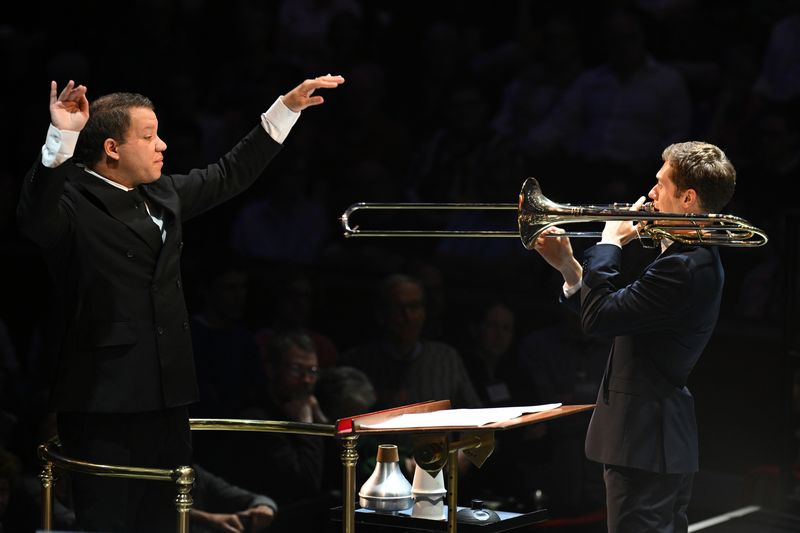
In concert – Peter Moore, London Symphony Orchestra / Ryan Bancroft @ BBC Proms: Folk Songs & Dances

Peter Moore (trombone), London Symphony Orchestra / Ryan Bancroft

Vaughan Williams English Folk Song Suite (1923)
Schuller Eine kleine Posaunenmusik (1980) [Proms premiere]
Tippett Triumph (1992) [Proms premiere]
Arnold arr. Johnstone English Dances Set 1 Op.27 (1950, arr. 1965)
Grainger The Lads of Wamphray (1904), Country Gardens (1918, arr. 1953), Lincolnshire Posy (1937)

Royal Albert Hall, London
Saturday 30 August 2025 11am

Reviewed by Richard Whitehouse Photos (c) BBC / Chris Christodoulou

His pained countenance may have adorned its programme cover but Sir Simon Rattle’s ‘routine surgery’ meant this morning’s Prom was directed by Ryan Bancroft, though the works played by woodwind and brass (and basses) of the London Symphony Orchestra remained the same.

The concert duly breezed into life with Vaughan WilliamsEnglish Folksong Suite, heard in its original scoring for concert (i.e. – military) band such as imparts a forthright impetus to its outer marches – the former alternating brusqueness with insouciance, and the latter similarly balancing energy with geniality. In between these, the intermezzo provided welcome respite with its soulful medley. Expert as are the arrangements for orchestra by Gordon Jabob or for brass band by Frank Wright, this remains the ideal medium for an unassuming masterpiece.

It would have been remiss of the Proms not to include a piece by Gunther Schuller in the year of his centenary, with Eine Kleine Posaunenmusik being a fine choice in context. Fastidiously scored for trombone and ensemble, whose wind and brass melded into tuned percussion with notable solos from piano and harpsichord, its five succinct movements outline a succession of vignettes in which Peter Moore sounded as attuned expressively as technically. With music as distinctive as this, Schuller’s fourth appearance at these concerts will hopefully not be his last.

Surprising that Michael Tippett’s Triumph should have remained so obscure within his output. Seemingly made during work on The Rose Lake, this ‘Paraphrase on Music from The Mask of Time’ is for the greater part his arrangement of the oratorio’s sixth movement, though it could be heard as encapsulating his music over the decade from the mid-’70s. The main portion pits fractured lyricism against dissonant outbursts as befits its genesis in a setting of Shelley’s The Triumph of Life and, if the closing affirmation sounds added-on, its finality is hardly in doubt.
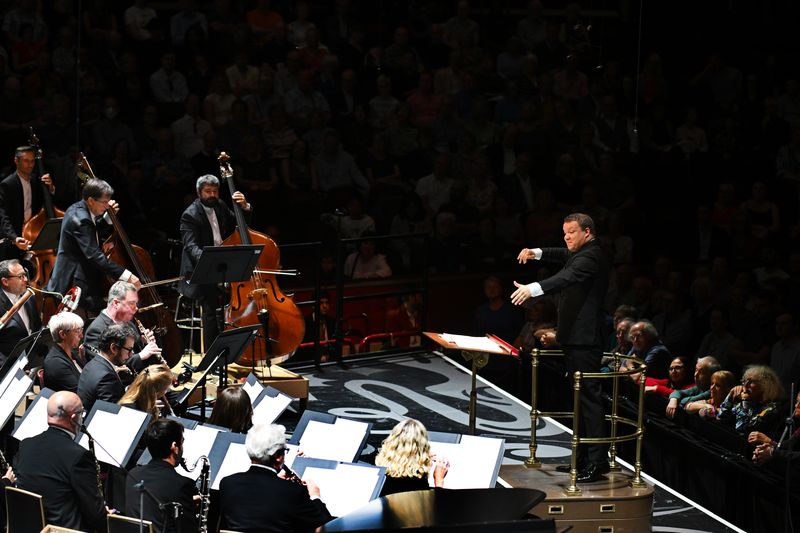
There could hardly have been a more pointed contrast than with Malcolm Arnold’s initial set of English Dances – its sequence of winsome, bracing, elegiac then energetic numbers ideally conveyed in Maurice Johnstone’s arrangement. Their concision was thrown into relief by the relative garrulousness of The Lads of Wamphray, an early example of Percy Grainger’s love for folksong which, in this instance, rather outstays its welcome. Rattle presumably enjoys it and Bancroft gave it its head, but its inclusion here was not warranted by its musical quality.

From the other end of Grainger’s career, his concert-band arrangement of Country Gardens exudes all the wit and irony of his later creativity. It made a canny upbeat into Lincolnshire Posy, one of a select handful of concert band masterpieces and where the LSO gave its all. Thus, the incisive Lisbon (Dublin Bay) was followed by the pathos-drenched Horkstow Grange then intricately imaginative Rufford Park Poachers; the jaunty The Brisk Young Sailor by the darkly rhetorical Lord Melbourne (very different from Britten’s elegiac take).

The surging impetus of The Lost Lady Found brought to a suitably rousing close this suite and what was a fine showcase for the LSO woodwind and brass, an unexpected if welcome appearance by Bancroft and, above all, a demonstration of the potential of the concert band.

Click on the artist names to read more about Peter Moore, the London Symphony Orchestra and conductor Ryan Bancroft. Click also for more on composer Gunter Schuller and the BBC Proms

Published post no.2,644 – Monday 1 September 2025

On Record – David Quigley – The Fair Hills of Éire: Irish Airs and Dances (Heritage Records)

david-quigley

David Quigley (piano)

Beach The Fair Hills of Éire Op.91 (1922)
Esposito Two Irish Melodies Op.39 (1883)
Field Go to the Devil and Shake Yourself (1798)
Hammond Miniatures and Modulations (2011) – No. 5, Old Truagh; No. 21, The Beardless Boy
Hennessy Variations sur un air Irlandais ancien Op.28 (1908)
Hough Londonderry Air (2014)
Martin Sionna – Spirit of the Shannon (2018)
Moeran Irish Love Song (1926); The White Mountain (1929)
Smith Paraphrase on ‘The Last Rose of Summer’ Op.173 (1883)
Stanford arr. Grainger Four Irish Dances Op.89 (1916) – no.1: Maguire’s Kick; no.4: A Reel

Heritage Records HTGCD152 [62’39”]
Producer / Engineer David Marshalsea

Recorded 9 & 11 April 2022 at Elgar Concert Hall, The Bramall, University of Birmingham

Reviewed by Richard Whitehouse

What’s the story?

The enterprising Heritage label continues its association with David Quigley in this recital   of Irish piano works as cover over two centuries, reminding listeners of the wealth of folk or traditional music from that island and its influence on successive generations of composers.

What’s the music like?

Published as Favorite (sic) Irish Dance Arranged as a Rondo for the Piano Forte, the first item is not unreasonably attributed to the teenage John Field and make for a breezy recital-opener – following which, pianist Stephen Hough demonstrated his prowess as an arranger with what is surely the most famous of all Irish melodies. Two pieces by the Italian émigré Michele Esposito – the trenchant Avenging and Bright, followed by the pensive Though the Last Glimpse of Erin – complement each other ideally, whereas the first from a set of dances by Charles Villers Stanford exudes bracing humour most likely accentuated in this idiomatic arrangement by no less than Percy Grainger. By some distance the longest piece here is from Swan Hennessy, an Irish/American later resident in France – his 12 variations on an (unidentified) theme in the lineage of various such works from the 19th century but diverting in its ingenuity. Best known as an inquiring pianist, Philip Martin the composer is represented by this evocative set of ‘rhapsodic variations’ written for the present artist.

Sidney Smith’s Paraphrase de concert on another Irish staple is the most virtuosic music and would make a dashing encore even today. Philip Hammond is the other contemporary composer featured – the present brace, part of a sequence of 21 drawn from the Edward Bunting collection and likewise written for Quigley, respectively searching and animated     in their emotional profile. From among her many mood-pieces, that by Amy Beach yields       a limpid poetry that more than deserves to provide the title for this collection overall. An English composer with direct Irish ancestry, Ernest Moeran’s predilection for all-things Celtic is made plain by the two pieces heard here, their recourse to traditional melodies enhanced by an idiomatic pianism which adds greatly to the winsomeness of their appeal. Back, finally, to those Stanford/Grainger dances with the fourth from this set a reminder that the former, whatever his formidable reputation as a pedagogue, was never averse to indulging his Irish roots in the writing of music as scintillating as it remains appealing.

Does it all work?

Admirably. Quigley is as committed to the music of his homeland as have been numerous of his predecessors, not only with performing these pieces in recital but also by finding ways of integrating them into a cohesive overall programme. Only one achieves (just) the 10-minute mark and another is almost eight minutes, making them ideal for combining into a judicious sequence – one which, at little more than an hour’s length, can be enjoyed at a single hearing. Quigley will hopefully have the chance to mine the ‘Irish piano-book’ further in due course.

Is it recommended?

Indeed. Quigley is a perceptive exponent of this repertoire, his Kawai Shigeru SK-EX heard to advantage in the spacious yet detailed acoustic of the Elgar Concert Hall. With succinctly informative notes from Andrew H. King, this recital warrants the warmest recommendation.

For further information on this release, and to purchase, visit the Heritage Records website, and for more on David Quigley click here