
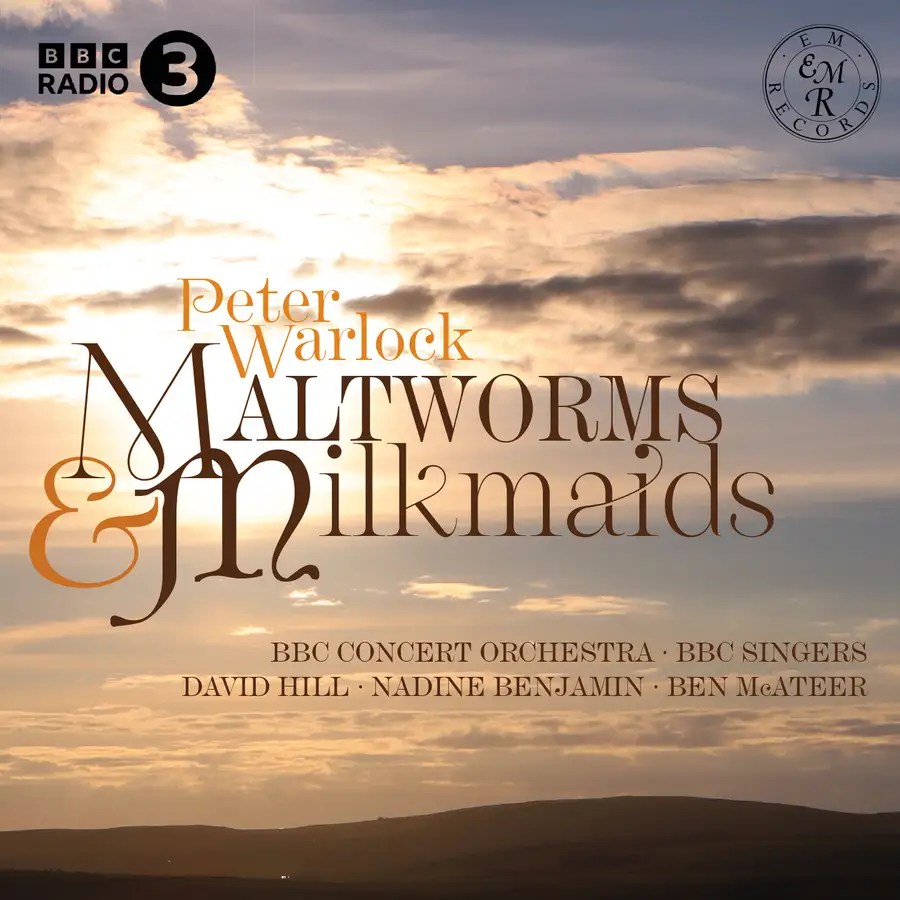
On Record – Maltworms and Milkmaids: Warlock and the Orchestra (EM Records)

Warlock
As Ever I Saw (1918, orch. anon)
An Old Song (1917-23)
Mr Belloc’s Fancy (1921/30, orch. Frederick Bye)
Captain Stratton’s Fancy (1921, orch. Peter Hope)
Serenade (1921-2)
Milkmaids (1923, orch. Henry Geehl)
Adam Lay Ybounden (1922, orch. Reginald Jacques)
Little Trotty Wagtail (1922, orch. David Lane)
The Birds (1926, orch. anon)
The Country-man (1926, orch. Gerrard Williams)
Yarmouth Fair (1924, orch. Kenneth Regan)
Sorrow’s Lullaby (1926-7)
One More River (1925)
Maltworms (1926, with E. J. Moeran)
Capriol (1926-8)
A Sad Song (1926)
Pretty Ring Time (1925)
The First Mercy (1927, orch. Fred Tomlinson/John Mitchell and William Davies)
Three Carols (1923)

Nadine Benjamin (soprano), Ben McAteer (baritone), BBC Singers, BBC Concert Orchestra / David Hill

EM Records EMRCD080 [73’52”] English texts included. Orchestrations by Warlock unless stated
Producer Neil Varley Engineer Robert Winter
Recorded 14-16 January 2022 at the Colosseum, Watford

Reviewed by Richard Whitehouse

What’s the story?

The always enterprising EM Records issues yet another ‘first’ in the guise of this collection featuring the songs with orchestra by Peter Warlock (aka Philip Heseltine), which includes many of those orchestrated by others with two-thirds of them here recorded for the first time.

What’s the music like?

Although his output barely extended beyond a decade and centred largely upon miniatures, Warlock left a substantial legacy of songs whose piano accompaniments mostly respond well when arranged for larger forces. Most of them are divided between soprano and baritone, in which latter Ben McAteer fairly captures their essence – whether the modal poise of the early If Ever I Saw, the heady (slightly forced?) jollity of those ‘fancies’ inspired by Mr Belloc and Captain Stratton, or the deftly barbed humour of Milkmaids. He draws tangible pathos from The Countryman and panache from Yarmouth Fair, with the rumbustious One More River and uproarious The Cricketers of Hambledon duly given their head. A highlight is the first recording of Maltworms, co-written with Ernest Moeran and rendered with suitable levity.

Nor is Nadine Benjamin other than fully attuned to the sentiments of her selection. Hence the soulfulness of A Sad Song or limpidity of Pretty Ring Time, both heard in what are Warlock’s only orchestrations of his solo songs, with The First Mercy an eloquent setting of words by frequent collaborator Bruce Blunt. Most affecting, though, is Sorrow’s Lullaby where soprano and baritone combine for a lengthy and often plangent setting of Thomas Beddoes in which the stark introspection of Warlock’s masterpiece The Curlew is never far beneath the surface.

The BBC Singers make their presence felt in the carol Adam Lay Ybounden and the whimsical Little Trotty Wagtail and winsome The Birds. No compromise is brooked in the rousing Fill the Cup, Philip or wistful choral incarnation of The First Mercy, then a closing trio of carols takes in the capricious Tyrley, Tyrley, the serene Balulalow and the aminated As I Sat Under a Sycamore Tree for a suitably rousing conclusion. Warlock would surely have approved and, had he known of the Singers’ recent travails, doubtless have responded in no uncertain terms.

The BBC Concert Orchestra gives of its best throughout under the astute direction of David Hill, duly coming into its own with the three orchestral pieces that Warlock completed. The evergreen suite Capriol is heard in its seldom heard and appealingly astringent version for full orchestra, the Serenade commemorates Delius’s sixtieth birthday in suitably rapturous terms, and the little-played An Old Song exudes a potent atmosphere as indicates what might have been possible had Warlock felt able to realize his musical ambitions on a larger canvas.

Does it all work?

It does, especially when heard in the continuous sequence as presented here. Warlock might increasingly have fretted about his ability as a composer, but the best of what he did achieve is sure to keep his name alive well beyond the approaching centenary of his untimely demise.

Is it recommended?

It is and not least when the presentation – with full texts, together with detailed notes from David Lane (vice-chairman of the Peter Warlock Society) reflects the always high standards of EM Records. In the words of a latter-day songster, ‘‘a splendid time is guaranteed for all’’.

Listen

Buy

You can explore purchase options for this album at the EM Records website. For more information on the artists click on the names of David Hill, Nadine Benjamin, Ben McAteer, BBC Singers and BBC Concert Orchestra. For more on all things Warlock, click on the name to head to the Peter Warlock Society

Published post no.2,078 – Monday 5 February 2024

On record: Mark Bebbington, RPO / Jan Latham-Koenig – Grieg & Delius: Piano Concertos (Somm)

Mark Bebbington (piano), Irene Loh (piano duet), Royal Philharmonic Orchestra / Jan Latham-Koenig

Delius
Piano Concerto in C minor (final version) (1907)
3 Preludes (1921)
On Hearing the First Cuckoo in Spring (arr. by Peter Warlock for two pianos, 1913)
Grieg
Piano Concerto in A minor Op.16 (1869)
Sketches for Piano Concerto no.2 in B minor (1881) (edited / orchestrated Robert Matthew-Walker

Avie SOMMCD269 [74’59”]

Recorded 1-2 August 2017 (Grieg) and 22 October (Delius)

Producers Siva Oke (Grieg), Paul Arden-Taylor (Delius)

Reviewed by Richard Whitehouse

What’s the story?

Mark Bebbington continues his recording schedule for Somm with this enterprising coupling of concertos by Grieg and Delius, heard alongside shorter pieces and an unexpected novelty.

What’s the music like?

The novelty is the extant sketches for a ‘second piano concerto’ on which Grieg worked in the early 1880s, and which amount to some 150 bars. Robert Matthew-Walker has put these into performable shape, but it cannot be pretended the outcome is of more than passing interest. Bebbington also renders the sketches as a solo item and this might prove viable in terms of a recital addition or encore.

There are good things in his account of the A minor Concerto, the limpid interplay between soloist and orchestra in the central Adagio or raptness of response to the finale’s central episode with its ineffable flute melody, but the first movement is for the most part earthbound and the work’s apotheosis not free from bathos. Bebbington plays with scrupulous regard for dynamic nuance and timbral subtlety though, as in his recent account of the Gershwin concerto (SOMM260), the performance feels conscientious rather than inspired.

Fortunately. the remainder of this disc is far more persuasive. Heard here in its final version, Delius‘s Piano Concerto is a three-movements-in-one design whose occasional awkwardness of transition and tendency to rhetorical overkill is more than outweighed by the resourceful evolution of its ideas and the allure of its melodic contours. Bebbington duly responds with playing of sensitivity and panache, reinforcing the not inconsiderable claims of this work to a place in the standard repertoire.

Also featured here are the Three Preludes, their rhythmic vitality and improvisatory freedom more than usually in evidence, and a duet transcription by the teenage Peter Warlock (aka Philip Helseltine) of On Hearing the First Cuckoo in Spring that is alone worth the price of the disc: its ruminative vistas deftly and unerringly uncovered.

Does it all work?

For the most part. Bebbington is up against several decades of stiff competition in the Grieg, and his reading does not offer any great revelations. The Delius, however, is arguably a front runner for this final version, while the fill-ups are of similarly high quality.

Is it recommended?

With reservations. The playing of the Royal Philharmonic Orchestra under Jan Latham-Koenig is never less than responsive, with Irene Loh an able partner in the Delius. Sound is spacious if a little too resonant in tutti passages, and Matthew-Walker’s notes are a model of informed insight.

Further listening

You can listen to this new release on Spotify:

Further reading

You can read more about the release on the Somm Recordings website

On record: Heracleitus (EM Records)

heracleitus

Butterworth: Songs (1910/11)*/** – When the Lad for Longing Sighs; Bredon Hill; On the Idle Hill of Summer; With Rue My Heart is Laden. Songa (1911/12)*/** – Fill a Glass with Golden Wine; On the Way to Kew

Gurney: Ludlow and Teme (1919)*/**/***. Adagio (1924)***. Songs*/** – The Cloths of Heaven (1918); Severn Meadows (1917); By a Bierside (1916).

Warlock: Songs */*** – Heracleitus (1917); Sweet Content (1919)

*Charles Daniels (tenor); **Michael Dussek (piano); ***Bridge Quartet [Colin Twigg, Catherine Schofield, violins; Michael Schofield, viola; Lucy Wilding, cello]

Summary

The centenary of the Battle of the Somme has seen various commemorations in music, with this latest release from EM Records among the most significant. It centres on two composers – one of whom died during the Somme offensive, while the other never recovered from being gassed at Passchendaele the next year. The disc also opens-out appreciation of their output in featuring autonomous pieces for string quartet and as accompaniment to several of the songs.

What’s the music like?

All these forces are brought together in Ludlow and Teme, Ivor Gurney’s song-cycle on verse from A.E. Housman’s collection A Shropshire Lad. A notable though unstable creative force in those years after the cessation of war, it was long considered among Gurney’s largest and most inclusive works; its expressive range more than compensating for any lack of sustained intensity across its six songs. One of these, ‘On the Idle Hill of Summer’, was set by George Butterworth prior to the War – his version confirming both a greater emotional lightness and textural subtlety which are no less apposite. Also included are two Butterworth settings of W. E. Henley, suffused by that dry wit and wistful charm emblematic of the Edwardian era. The disc closes with more Gurney – moving backwards in time so the pathos of W.B. Yeats’s The Cloths of Heavens, and poignancy of the composer’s Severn Meadows, is rounded-off by the eloquence of John Masefield’s By a Bierside in what ranks among Gurney’s greatest settings.

Two songs by Peter Warlock (aka Philip Heseltine, who seems to have avoided conscription via a mixture of guile and happenstance) are among several conceived with accompaniment for string quartet, and have been idiomatically arranged as such by John Mitchell. Of these, Heracleitus is a setting of W.J. Cory (after Callimachus) as evinces the influence of Bernard van Dieren in its sombre tread and harmonic richness, while that of Thomas Dekker’s Sweet Content exudes the chic vacuity which is often to be encountered in Warlock’s lesser songs.

The other two works are also first recordings. Odd that Butterworth’s Suite for String Quartet should have had to wait 15 years since publication, as it is the composer’s largest extant piece and offers valuable insight into his wresting with abstract forms. The opening Andante is well argued, though the Scherzando and Allegro might profitably have been integrated, while the fourth movement is insufficiently contrasted with a final Moderato whose faltering progress is indication of a project lacking the ultimate focus. Not so the Adagio from a String Quartet in D minor, seemingly the only surviving chamber work from Gurney’s final manic outburst of creativity and whose heightened emotion bodes well for a hearing of the complete work.

Does it all work?

Yes, when seen as an overall programme that skilfully interweaves its vocal and instrumental items to give a thoughtful and revealing portrait of the two main composers featured herein.

Is it recommended?

Indeed, not least as the contribution of Charles Daniels (best known for his interpretation and editions of Baroque music) is so attuned to the songs in question. Michael Dussek is as ever an attentive accompanist, and the Bridge Quartet continues its persuasive exploration of English music. Both recording and annotations are up to the customary high standard of EM Records.

Richard Whitehouse

For more information on their extensive catalogue of English music, visit the EM Records website