
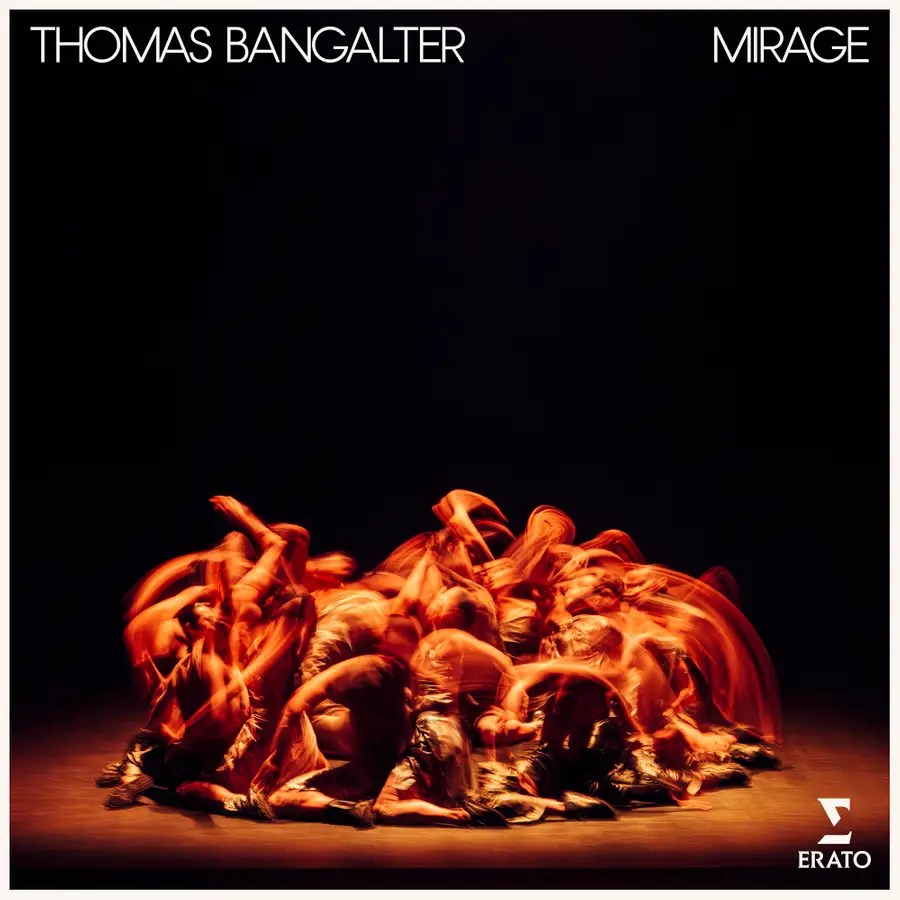
On Record – Thomas Bangalter: Mirage (Erato)

Reviewed by Ben Hogwood

What’s the story?

Mirage is the latest work by Thomas Bangalter, formerly of Daft Punk, to show his credentials for a more through-composed style of composition. Bangalter had an education in classical music, which can be felt through the cleverly constructed songs Daft Punk made, and perhaps most vividly in their score for Tron: Legacy.

More recently we have heard an orchestral album, Mythologies, a sizeable ballet characterising a series of wonderful and awful creatures – following in a line of French composers who have done this with such wonderfully pictorial writing. Mirage, however, is an electronic score, conceived by choreographer Damien Jalet and contemporary artist Kōhei Nawa, with the ballet premiered at the Grand Théâtre de Genève in 2025. It continues to tour Europe throughout 2026.

What’s the music like?

Very different to Mythologies, and arguably less colourful – but more compelling.

Mirage is a very slow build, a brave tactic from Bangalter but one well worth sticking with, especially on headphones. Starting with the pulse of a sonorous bass note, like a subterranean signal from another planet, the wave form starts to go wavy, as though the electromagnetic winds were picking up, and that slight shift is critical to the momentum of the ensuring piece. On Part II the drums get bigger and momentum builds through fidgety hi hats, the sense of forward movement increasing like an accelerating train.

Part III cuts to a bass drone before what feels like the mirage itself on Part IV, shapes dancing in the middle ground before an ominous wavering of the drone pulls the rug from under the listener’s feet. Part VI opens out into wide space before mirage images appear again, rich in colour. The tension relaxes audibly into Part VII, dappled figures and light interference suggesting the space beyond. Then, as a conclusion, Part VIII drops again towards inaudible bassy figures, the distant knock confirming the signal is still out there.

Does it all work?

Yes, though is clearly most effective if you experience the whole piece in one sitting, on equipment that can do justice to the range of frequencies employed.

Is it recommended?

It is. Bangalter’s musical trajectory will be very interesting to watch, for here he is aligning himself more with experimental composers such as Xenakis rather than the French ballet masters. The suspicion is that his sweet spot will be somewhere between the two, and will include both electronic and acoustic instruments, and hopefully on the Erato label, whose livery appropriately dresses this release. An auspicious second album, and highly recommended.

For fans of… Daft Punk, A Winged Victory For The Sullen, John Murphy, Vangelis

Listen / Buy

You can explore purchase options for Mirage on the Presto Music website

Published post no.2,919 – Tuesday 16 June 2026

Let’s Dance: Defected presents House Masters: Deetron (Defected)

reviewed by Ben Hogwood

What’s the story?

Swiss DJ and producer Deetron gets the Defected anthology treatment with a generous package numbering 34 tracks. A mixture of original productions and remixes, In The House marks the career of a figure first recognised for his creative DJing across three decks, before in 2014 he started his own label, Character.

The remixes cover a wide range, from Jamiroquai and Ben Westbeech to Danny Howells and The Juan Maclean, while the originals include two new exclusives, Filter (House Mix) and Save. While the 34 tracks are available digitally, a 2LP vinyl package runs to eight tracks.

What’s the music like?

Consistently strong and versatile. While Deetron’s main modus operandi is house music, he is equally comfortable moving in the directions of garage or techno, while the distinctive Rollerskate remix of T Ski Valley’s Catch The Beat shows he can bring the funk too.

Of the remixes, there is a sure-footed take on The Juan Maclean’s A Simple Design, and a bass-led beauty to catch the riffing of Todd Terje’s Alfonso Muskedunder. Jamiroquai’s Automaton is a spacious epic, while Ben Westbeech’s smooth as silk vocal goes on a rewarding garage excursion with Rhythm. Deetron proves particularly good at keeping the personality of the original artist in his remixes, keeping Daphni’s nervy momentum in the technicolour Fly Away, or preserving the Inner City vibe of Fiorious’s Future Romance. Arguably trumping all of these, mind, is the brilliant Everything’s Here, taking Danny Howells’ original to a higher Balearic level.

The originals are excellent, led by the urgent piano riffing of Glass, a proper peak-time anthem, or the piano-led Chicago house vibe of AM_909. Dr. Melonball also benefits from a lean piano, while Body Electric hits a rich groove. The House mix of Filter is good to have also, making great use of the stereo picture with its rolling bass drums.

Does it all work?

It does, with the quality maintained through this generous collection. Given they had a whole host of remixes to choose from, Defected have given us an excellent and varied anthology here.

Is it recommended?

Completely. A deserved addition to the series for a DJ whose versatility and quality spread right throughout his music. Deetron has always made music with an eye on the crowd, and this one should be lapped up.

Published post no.2,917 – Sunday 14 June 2026

On Record – Flore Laurentienne: Volume III (Secret City)

Reviewed by Ben Hogwood

What’s the story?

With Volume III, a trilogy begun seven years ago by Quebec composer Mathieu David Gagnon is complete. For Gagnon is the man behind the Flore Laurentienne project, looking to bring organs, analogue synthesizers and string ensembles together in a series of movements to fully appreciate the natural history of the Canadian province. As the press release states:

“The message, the shareable essence, on this third album by Flore Laurentienne, is light; it is the seed in the ground that becomes a plant and then a flower, blooming at its peak and then inevitably wilting so that the cycle can begin again; it is the quest for beauty in chaos, from which harmony is born. On Volume III, Mathieu David Gagnon and his Flore Laurentienne return to celebrate the magnificence of the river and its floral and sylvan surroundings.

This new milestone also marks the end of a trilogy that began in 2019 with Volume I – with the inherent and parallel aspiration of reaching a third volume in order to pay tribute to Volume 3, L’Infonie’s (a Quebec cult collective that blended jazz, prog, art music, and poetry) first album. The latter did not influence Flore Laurentienne’s music per se, but rather its conception of freedom in composition, combining classical and improvisation.

What’s the music like?

As fresh and as beautiful as the wide-open Canadian outdoors. Gagnon has an attractive style, and the interaction between acoustic and electronic is ideally judged.

Fleurs sets out the colourful and genial musical language, describing a flower’s life cycle with bright phrases that interact with instinct and skill. The musical patterns hark back to Baroque times but sound fresh while doing so, enhanced by the electronics bubbling up through the texture.

Régate is initially made of sterner stuff, with a granite outline laid by piano before being joined by warmer strings, which is then cleverly checked until becoming ever more thoughtful.

Le temps is a dreamy play led by the harp, before Fleuve VII begins with intimate piano thoughts before swelling into a joyous paean when joined by strings.

Gagnon saves the best until last, however, with the profile of Navigation VII resembling a bird on the wing, big sweeps of string sound flying overhead before diving beneath the listener. It is a thrilling listen, its mood maintained by the heady orchestral exchanges as (À travers les) Chablis reaches for the skies.

Does it all work?

Yes, and even more so when the first two volumes of the trilogy are included.

Is it recommended?

It is – and this listener, who began with the last part, will be purchasing the previous two. Flore Laurentienne stands for true appreciation of our surroundings, its music capable of transmitting the feeling and heady emotion of being at one with nature.

For fans of… Craig Armstrong, Olafur Arnalds, Max Richter, Sigur Ros

Listen / Buy

Published post no.2,907 – Thursday 4 June 2026

New music – TEED: Another Day (!K7)

by Ben Hogwood, incorporating text from the press release

Following the announcement of his DJ-Kicks mix and the release of first offering Never Seen You Dance (DJ-Kicks Version)”, TEED today shares Another Day, the first original track to be unveiled from the forthcoming compilation, arriving 26th June via !K7. You can listen here:

One of five exclusive productions created for the project, Another Day provides one of the deeper, mysterious and introspectively soulful moments on the release. Built around warm melodies, understated rhythms and a quietly hypnotic atmosphere, the track reveals another side of a mix largely driven by uplifting house music and dancefloor energy.

Inspired by what Americans call “pre-gaming” before a night out, DJ-Kicks: TEED draws on more than a decade of life in Los Angeles. While the mix opens with big, vocal-led house music and the carefree energy of a night just beginning, Another Day arrives as the mood starts to shift, offering a more reflective moment amongst the momentum.

At the heart of the release are five TEED exclusives in total: two reworks, two original tracks and a cover of KC & The Sunshine Band’s Please Don’t Go. Alongside these sit carefully selected tracks and exclusives from artists including Joe Goddard, Austin Ato, Jacques Greene, Casino Times and Oscar Farrell, each helping shape the mix’s journey through house, deeper club sounds and increasingly atmospheric territory.

As the mix unfolds, the energy sources flicker, the synths grow heavier and the drums become crunchier. House gradually unfurls into more progressive and psychedelic spaces, with tracks such as Under the Metal pushing further into rolling, cerebral grooves and euphoric release. Another Day sits comfortably within this world, bridging the warmth of the opening stretch with the dreamier, more introspective moments that follow.

Arriving on 26 June via !K7, DJ-Kicks: TEED captures the excitement, possibility and transformation of a night out, moving seamlessly between moments of movement and reflection before drifting into a hazy, ambient close.

Published post no.2,906 – Wednesday 3 June 2026

Switched On – Max Cooper: Feeling Is Structure (Mesh)

Reviewed by Ben Hogwood

What’s the story?

The music of Max Cooper continues to fire the imagination. His latest album is borne of a commission from the Royal Albert Hall for a live show, and he chose to explore “the relationship between physical form and human emotion.”

The press release nails his ability to fuse deep thinking and raw emotion. “Across 10 spatial audio-visual works, Cooper examines how structure in sound, architecture, biology and art, shapes the way we feel. Musically, Feeling Is Structure leans into Cooper’s more intricate and deliberate compositional side. Rather than improvisation, the record focuses on carefully designed systems and processes that build evolving sonic architectures. Precise at the micro level, but deeply emotive in impact.”

What’s the music like?

Very satisfying, especially on headphones. There is always a lot going on in Max Cooper’s music, with a great level of detail revealing itself with repeated listening. That said, the first few encounters are satisfying too, as there is a lot of feeling behind these beats.

The bleeps and loping beats of Pattern Index set the scene, a dubby rhythm bringing an unexpected similarity with early music from The Orb. Gradually the sonic canvas pans out, with the spacious Becoming supporting what feels like the workings of a large machine.

Cooper uses complex rhythms to often thrilling effect, with This Is A Bridge ratcheting up the tension and releasing a good deal of kinetic energy, while the beats get super busy on Obsessive Compulsive Order. Meanwhile the busy Bass Mosaic reaches all corners of the audio system. Four Tones Reflected and Ebb And Flow are rich sonic tapestries, while the beats retreat for the spectacular spectrum of Chrysalis to fully reveal itself.

Does it all work?

It does. A great deal of thinking has gone into the structure of this album – hence the title – and the quasi-orchestral textures are full of incident and colour.

Is it recommended?

It is. Feeling Is Structure is a deeply effective and thoroughly modern fusion of process and emotion. Max Cooper plays to his strength with music that emphatically ticks the intellectual and emotional boxes. Arguably his most successful album to date.

Listen / Buy

Published post no.2,888 – Friday 15 May 2026