In Concert – Ailish Tynan, Pauline Murrihy, Robin Tritschler & Iain Burnside @ Wigmore Hall: Ina Boyle – A Rediscovery

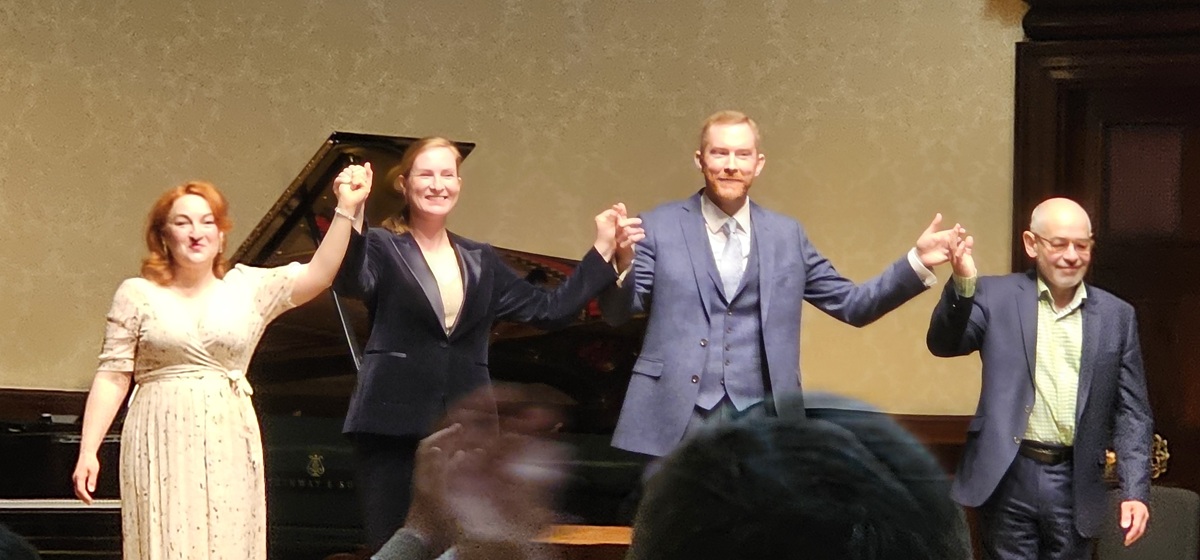
Ailish Tynan (soprano), Paula Murrihy (mezzo-soprano), Robin Tritschler (tenor), Iain Burnside (piano)

Boyle A soft day, thank God (1912); Looking Back: Carrowdore (1961-6); The Joy of Earth (1914); 2 Christmas Songs: Blyssid be the Tyme (1923-4); Himself and his Fiddle (1929); Have you news of my boy Jack (1916); Looking Back: O ghost, that has gone
Vaughan Williams Orpheus with his Lute (1925)
Boyle Looking Back: The mill-water
Vaughan Williams The Water Mill (c1922)
Maconchy Sun, Moon and Stars from Sun, Moon and Stars (1977)
Boyle Spring goeth all in white (1924); A Song of Enchantment (1921-2)
Wood The blackberry blossom (1897)
Boyle Roses (1909)
Wood Oh! Skylark, for thy wing! (1884)
Boyle All Souls’ Flower (1928)
Wood Darest thou now, O Soul (1897)
Boyle The Last Invocation (1913)

Wigmore Hall, London
Tuesday 9 March, 1pm

Reviewed by Ben Hogwood Photo (c) Ben Hogwood

“I think it is most courageous of you to go on with such little recognition,” wrote Vaughan Williams to his pupil, Irish composer Ina Boyle. “The only thing to say is that it does come finally.”

This Wigmore Hall concert gave the strongest possible proof of recognition at last for Boyle’s work, her songs brought to life by a starry cast of singers with pianist Iain Burnside. The program helpfully complemented her work with that of teacher Vaughan Williams, cousin by marriage Charles Wood, and good friend Elizabeth Maconchy.

The texts reflected a love of the outdoors, surely gained during her relative seclusion in home territory at County Wicklow, and also celebrated the season of spring, evident to all arriving at the Wigmore Hall for this lunchtime recital.

The brightly voiced A soft day, thank God, took us outdoors immediately, the ‘scent of drenching leaves’ and the rain that ‘drips, drips, drips from the leaves’ brought to life from Winifred M Letts’ words. They were sung with clarity by Robin Tritschler in the first verse and a brightly voiced Ailish Tynan in the second. Boyle’s songwriting is simple – not a criticism – and direct in its communication, reflecting the shy disposition of its composer but growing in assurance as her style developed.

This was evident in the selections from the song cycle Looking Back, with Carrowdore lost in thought through Paula Murrihy’s thoughtful account. The elusive and more playful O ghost, was laced with humour by Tritschler, while Murrihy’s full-bodied vocal was complemented by the flowing current of Burnside’s piano in The Mill Water.

The Joy Of Earth was noticeably more demonstrative, while Blyssid be the Tyme benefitted from both Tynan’s effortless projection and Boyle’s clean melodic line. Murrihy did extremely well with the wordy Himself and his Fiddle, accentuating the song’s folksy triple time with Burnside, while the brief but bright Robert Bridges setting, Spring goeth all in white, was beautifully phrased by Tynan.

Boyle’s inwardly facing songs were the most moving, notably A Song of Enchantment, a setting of De la Mare given mysterious light and shade from Tritschler, who held the stillness of twilight exquisitely as the shadows advanced. The tenor also kept the inner questions of Roses in a confidential tone, while Burnside’s wandering right hand line aided the wonder of All Souls’ Flower, where the three singers took a verse each. Most affecting of all Boyle’s songs here was a setting of Rudyard Kipling’s First World War poem, Have you news of my boy Jack?, Murrihy and Tritschler playing a tense scene of anxious questions, with answers that a mother dreaded to hear.

Vaughan Williams was represented by a beautifully sung account of Orpheus with his Lute from Tynan, then a vividly pictorial account of The Water Mill from Tritschler, where Burnside’s characterisations of the roaring waters, the ticking of the mill clock and the miller’s tabby cat were exquisite.

The composer Charles Wood, Boyle’s cousin by marriage, is known primarily for Anglican church music rather than exploits in the concert hall, so it was satisfying that the centenary of his death this year was marked with three characterful songs. Paula Murrihy worked wonders with another wordy composition, the frivolous The blackberry blossom, and with the serious tones of Whitman setting Darest thou now, O Soul. Tynan was in her element for the soft tones of Oh! Skylark, for thy wing!, Burnside allowing her room to spread her wings.

Elizabeth Maconchy nearly stole the show with Sun, Moon and Stars, a modern song of striking musical language reflecting the ‘new and strange’ of its first line. The top notes reached for celestial highs, and were found unerringly in an exceptional performance by Tynan.

Wrapping up a memorable hour of music was Boyle’s The Last Invocation, an impassioned setting of Whitman throwing open the doors with the strongest possible advocacy from Robin Tritschler. It completed a concert where the songwriting craft of Ina Boyle was confirmed beyond doubt, her voice at last projecting further afield.

You can listen to the music from this concert in a Tidal playlist, including songs by Ina Boyle recorded by the artists at the Wigmore Hall for Delphian in 2020.

Published post no.2,827 – Thursday 12 March 2026

Online music recommendations – Oxford Lieder Festival

Over the last few years the Oxford Lieder Festival has established itself as one of the most attractive prospects in the autumn events calendar for classical music. Given the challenges faced by the sector in this most trying of years, it gives great pleasure to report that the team, led by artistic director Sholto Kynoch, have gone above and beyond the call of duty to present this year’s model.

An online extravaganza lasting ten days, the festival continues its penchant for the use of attractive venues in the city, presenting them in an online format with Tall Wall Media which is both easy to navigate and admire.

The artistic standard remains as high as ever, as does the programming. Viewers on Saturday were treated to James Gilchrist immersing himself in ancient lute songs, with the florid tones of Elizabeth Kenny alongside, from where we switched to the Hollywell Music Room. Here we found the redoubtable Dame Sarah Connolly (above) and Eugene Asti in a program including Schumann’s Frauenliebe und -leben and a rapt account of Mahler’s Rückert-Lieder, time standing still during the final two songs, a darkly atmospheric Um Mitternacht and an expansive Liebst su um Schönheit.

Many of the Oxford Lieder concerts include a slot for emerging artists, a healthy recognition of the outstanding young talent coming through in the world of song. On this occasion it was bass William Thomas who lent his fulsome tones to a quintet of Schubert songs. We also heard a nicely linked quintet songs from Finzi, Quilter, Haydn and Geoffrey Bush.

The festival has a very healthy instinct for presenting songs in context and giving them the right level of background through guest musicological experts. Natasha Loges illuminated Brahms’ Lieder contributions with music from baritone James Atkinson and pianist Ana Manastireanu while on Saturday 17 October, the festival’s final day, we will get a fascinating chance to explore the song prior to Beethoven in the company of baritone Stephan Loges and Eugene Asti.

On Tuesday 13 October, the lunchtime concert found tenor Robin Tritschler (above) giving a superb hour of music with pianist Graham Johnson from the Hollywell Music Room, journeying round the Zodiac with all the spirit of first-time voyagers. Travelling through works from Barber, Schubert, Ives, Rebecca Clarke and Argento, their ultimate destination was the Songs of the Zodiac of Geoffrey Bush. This inventive cycle provides a setting for each sign, helpfully introduced by Johnson before the two offered vivid characterisation. Here there was plenty of wit but tenderness too.

The following lunchtime tenor James Gilchrist and pianist Anna Tilbrook included a substantial world premiere of a work by Michael Zev Gordon, a composer Gilchrist studied with at King’s College Cambridge in the 1980s. There was a rather nice irony about a work with its genesis in Cambridge receiving its first performance in Oxford, and Gordon’s Baruch – Ten Propositions of Baruch Spinoza showed itself to be an impressive piece indeed.

Fusing elements of chant and more modern, English song – Holst’s great Betelgeuse came to mind in the final Ex hoc tertio cognitionis… – it was a dramatic performance that definitely warrants a further viewing. The cycle started with Gilchrist using a harsher tone but as it unfolded the voice blossomed to fill the space around, helped by the sensitive balance provided by Tilbrook. In the words of Gordon, these were ‘aphorisms meant to be heard and pondered; here sung and pondered’. Gilchrist complemented this with an affectionate and yearning account of a work he has known since childhood, Beethoven’s An die ferne Geliebte – the first clearly defined song cycle.

Today’s lunchtime concert was rather special with Ian Bostridge (above) joined by pianist Saskia Giogini at Merton College Chapel in a characteristically intense account of Britten’s Canticle I: My Beloved Is Mine. The camera work should be mentioned here, as it captured the glorious chapel in an ideal complement to Britten’s arrangements of Five Spiritual Songs, where Bostridge was masterly, and in the beautiful Bach, the arias Ich habe genug, from the cantata of the same name, and Der Ewigkeit saphirnes Haus (from Laß, Fürstin, laß noch einen Strahl). Taken on their own, these two – with the Oxford Bach Soloists – reminded us of the true value of live performance, even when given online in these restricted times.

The Oxford Lieder Festival continues until Saturday 17 October, where it will include a performance of Schubert’s Schwanengesang from tenor Christoph Prégardien and pianist Michael Gees. Before then you can enjoy concerts from baritone Benjamin Appl and Sholto Kynoch, mezzo-soprano Kitty Whately and Simon Lepper and a keenly anticipated collaboration between soprano Lotte Betts-Dean and guitarist Sean Shibe. All concerts are available online until 1 November, or 15 November with the event’s Pioneer Pass – which is much appreciated if you want to catch up with recommended concerts from Carolyn Sampson and Joseph Middleton, not to mention the Hermes Experiment!

For further details visit the festival website

Wigmore Mondays – Britten and Auden from Robin Tritschler & Gary Matthewman

robin-tritschler

Robin Tritschler (tenor, above), Gary Matthewman (piano)

Wigmore Hall, London, 4 April 2016

written by Ben Hogwood

Audio (open in a new window)

http://www.bbc.co.uk/programmes/b074zd45

Available until 4 May

Britten To lie flat on the back; Fish in the unruffled lakes; Berkeley Night covers up the rigid land (1939); Underneath the abject willow (1941); Berkeley Lay your sleeping head, my love (1937), Britten: When you’re feeling like expressing your affection (17 minutes)

Trad, arr. Britten The Jolly Miller (1946), The Ash Grove (1941), The Salley Gardens (1940), The Bonny Earl O’ Moray (1940); The Foggy, Foggy Dew (1942) (12 minutes)

Tippett 3 Songs for Ariel (1961) (5 minutes)

Britten On This Island, Op.11 (1937) (14 minutes)

Spotify

If you cannot access the concert, the below Spotify playlist contains all the songs. Robin Tritschler has yet to record these, but they are given here in versions from Philip Langridge:

About the music

Both the personality and the poetry of W.H. Auden were a revelation to the young Benjamin Britten when he was living in New York…and not just Britten either, for Lennox Berkeley also fell briefly under the poet’s spell.

His unique and highly descriptive way with the English language was a perfect foil for song composers such as Britten and Berkeley in the late 1930s and early 1940s, and here are some choice settings that use the piano as well as the verse to paint vivid pictures.

A selection of Britten’s folksong settings follow, with familiar tunes in songs such as The Ash Grove and The Foggy, Foggy Dew given new clothes from Britten.

The Shakespeare 400th celebrations are marked with the music of Sir Michael Tippett, all too infrequently performed these days. His 3 Songs for Ariel are brief but concentrated miniatures.

Finally Britten’s first published collection of songs, On This Island, is a quintet of Auden settings, not as closely linked as subsequent song cycles such as the Serenade for tenor, horn and strings or Winter Words, but showing his increasing prowess as a song composer.

Performance verdict

Robin Tritschler is a natural in the music of Britten, and clearly enjoyed the nuances of Auden’s poetry as he sang these songs. With Gary Matthewman an excellent, attentive accompanist he caught the tension of this period in Britten’s life, where the young composer was trying to find his feet but also feeling the pressure of being a member of Auden’s ‘circle’.

Tritschler sings with great clarity – the words are always easy to hear – and Matthewman matches his ear for detail with some virtuosic piano playing that somehow sounds effortless.

What should I listen out for?

W.H. Auden selection

1:59 – Britten To lie flat on the back

4:27 – Britten Fish in the unruffled lakes – an incredibly vivid picture of the water issues forth from the piano, followed with an oblique melody that is somehow memorable, fitting Auden’s poetry perfectly. The twinkling right hand of the piano finishes the song.

6:59 – Berkeley Night covers up the rigid land

9:38 – Britten Underneath the abject willow – a poem of Auden’s that again has very pictorial references that Britten delights in referring to in his piano part. A bracing main part leads to a softer, shadowy central section, before the bracing theme returns (10:44)

11:33 – Berkeley Lay your sleeping head, my love – a soft lulling to sleep from the piano chords that toll softly, before a caring and rather romantic vocal is revealed. From around 14:40 a powerful climax is reached.

17:10 – Britten When you’re feeling like expressing your affection – a humorous advert for using the telephone that is also quite affecting personally.

Trad, arr Britten

19:49 The Jolly Miller (from Hullah’s song-book) Britten’s ability to paint a picture through his piano accompaniments is put to especially vivid use here, the waters swirling rather ominously around the miller. The constant clash of notes gives the setting a rather darker air, as the idea of the ‘jolly miller’ is given a twist by the final line, ‘I care for nobody, no not I, if nobody cares for me’.

22:04 The Ash Grove (Trad) A deceptively simple beauty. The graceful melody gets the ideal response from Britten here, as he uses one of his favourite musical forms – the canon – to keep the melody on the piano running at a distance of half a bar behind the voice. The graceful but slightly watery piano part sets up a mood of reflection, until later in the song when voice and piano part company, at which point the piano heads into a completely different key. Britten’s genius is fully at work here, and The Ash Grove becomes less folk song, more English ‘Lied’. It is a strangely unsettling song.

24:30 The Salley Gardens (W.B. Yeats) A simple, yearning song that makes the most of its beautiful melody. There is a deep sense of longing in the harmonies Britten chooses to go with the tune here, and he achieves this as early as possible in the piano introduction, despite the words remaining largely positive until the revelation at the end that ‘now I am full of tears’.

27:08 The Bonny Earl O’Moray (Trad) Britten’s setting is a regal funeral march, an invitation for the singer to completely let rip against a piano accompaniment that has grand pretensions too. He moves between the major and minor key rather like Schubert used to do, keeping the listener guessing until the downcast end in the minor.

29:12 The foggy, foggy dew (Trad) Britten’s piano is appropriately cheeky, offering a nod and a wink to the listener outside of its Schubert influence, and it’s a memorable tune that sticks in the head for a while after listening.

Tippett (words by Shakespeare)

33:11 Come unto those yellow sands Tippett uses a florid vocal line here, a direct influence from Purcell. The words are clear, the piano accompaniment fast moving – and at the end the tenor evokes a dog barking

35:08 Full fathom five A solemn song with Tippett’s imagery of the ‘ding dong bell’ striking both in the vocal and piano lines.

36:46 Where the bee sucks Quite a jumpy setting this, with Tippett’s jaunty, staccato piano introduction finding a match in the tenor’s line.

Britten – On This Island (W.H. Auden)

39:38 Let the florid music praise! A grand opening to the collection, the tenor’s declamation matched by a busy, regal piano line. The mood turns, however, into a more carefully considered and slightly sorrowful song.

43:07 Now the leaves are falling fast The detached piano figures reflect the tension in this song. interpreted by Humphrey Carpenter as laced with sexual frustration. Carpenter’s commentary on this period of Britten’s life is thoroughly engaging, bringing through the tensions of grief versus the true beginning of the composer’s adulthood.

45:12 Seascape A more agile song, this, but a restless one too – perhaps because of its evocation of the rising and falling tide in the piano part.

47:28 Nocturne The finest song of the five, where Britten’s simplicity wins through – as does Auden’s poetry, talking of ‘night’s caressing grip’. This is a very moving song, the slow tolling of the piano enhancing its impact – and reminding us that it is a lament for Britten’s recently departed friend, Peter Burra.

51:38 As it is, plenty A typically ‘smart’ Auden poem that gets a similar response from Britten. The piano part is like pointed footsteps, until gradually the celebratory mood of the first song in the collection asserts itself towards the end.

Encore

54:27 Fishing by Arthur Oldham, Britten’s only pupil on his return to England from America. Even in the incredibly brief 40 seconds of this song, taken from the Five Chinese Lyrics, you get a sense of the influence!

Further listening

English song is a maligned but very enjoyable musical area – and arguably the best people to take us through it are the tenor Ian Bostridge and pianist Julius Drake. Here is their album The English Songbook: