Baldur Brönnimann conducts the Ensemble Intercontemporain at the BBC Proms on Friday 2 September, in a Prom also featuring violinist Jeanne-Marie Conquer, IRCAM computer music artists Andrew Gerzo, Carlo Laurenzi and Jérémie Henrot, and the BBC Singers. (c) Chris Christodolou
Prom 65; Royal Albert Hall, Friday 2 September 2016
BartókThree Village Scenes (1926); BoulezAnthèmes 2 (1997); CarterPenthode (1985); BoulezCummings ist der Dichter (1970)
Tonight’s late Prom suggested a certain nostalgic element in that the composers performed were at the forefront of these concerts from the late-1960s to the early 1990s, since when the evolution of contemporary music has increasingly become divorced from notions of progress.
Not least in the case of the Three Village Scenes that Bartók wrote in response to a hearing of Stravinsky’s Les noces, and that essentially freed his music from any vestige of late-romantic rhetoric. Not heard at the Proms for over three decades, these concise pieces alive with vitality and (in the second of them) pathos responded well to the poise and precision accorded by the Ensemble Intercontemporain (who gave this piece with Pierre Boulez in 1974 and ’79) – with the BBC Singers conveying the abrasiveness and humour of the vocal writing in like measure.
Although among his late works, Boulez’s Anthèmes 2 looks back via a brief solo predecessor to the Stravinsky memorial tribute a quarter-century earlier. Less encompassing in its musical scope than his other electro acoustic pieces, it brings to a head Boulez’s preoccupation with a cumulative s verse-and-refrain format unfolding as continuous variations in sound and space. Ably as the three IRCAM engineers facilitated this latter, it was the playing of Jeanne-Marie Conquer (below) – a world-class soloist if she chose to be – which took centre stage in every respect.
A rather different side of Boulez’s composing was evident with Cummings ist der Dichter – a work which, for all that its title came about by accident, represents an oasis of conviction from an era beset by creative uncertainty. How much of this is due to harmonic enrichment brought about by the 1986 revision is arguable, though the manner in which the text emerges out of its syllabic and parenthetical austerity to assume unexpected textural richness and intricacy was inherent from the outset, and the present account left little doubt as to this music’s eloquence.
Between these works came Elliott Carter’s Penthode, not heard at these concerts since being premiered here 31 years ago and that could not then have been heard as merely an instalment in a creative odyssey still having over two decades to run. The five paths of its title taken by five ‘broken’ ensembles, the piece unfolds as a single-movement chamber symphony whose slow underlying pulse is increasingly overridden by music of a quizzical and often humorous demeanour; not least when directed with evident verve and assurance by Baldur Brönnimann.
An increasingly familiar figure in the UK, Brönnimann is in a line of conductors – stretching back to Boulez and beyond – as ensures this music retains its relevance for later generations, such that tonight’s Prom could never be mistaken for a nostalgic look back to a lost future.
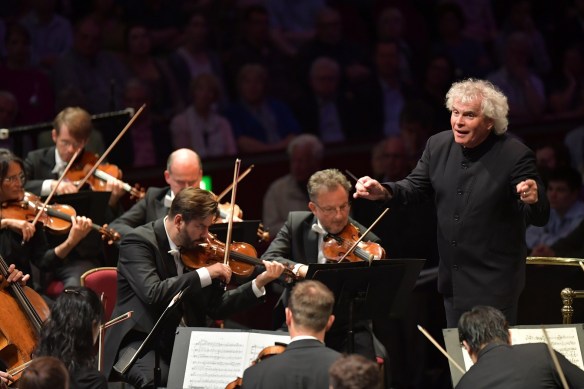
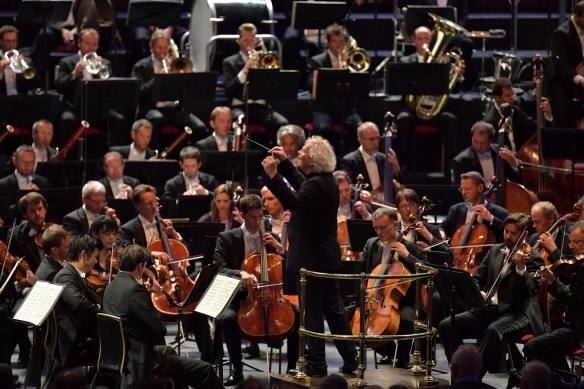
Mahler is the composer Sir Simon Rattle was born to conduct. That may sound like a grandiose statement, but for four decades now Rattle has been immersed in the composer’s music. Now he is at the top of the musical pile, on the verge of taking over the London Symphony Orchestra job next year, and this Prom was another opportunity to appraise the results of his tenure – not always easy – with the Berlin Philharmonic.
The results were little short of spectacular. To see the Berlin Philharmonic in the flesh is to witness the pinnacle of orchestral playing, especially when the woodwind principals are soloists in their own right – flautist Emmanuel Pahud, clarinetist Andreas Ottensamer and oboist Albrecht Mayer to name but three.
All were integral to a performance of Mahler’s Symphony no.7 that will live long in the memory. The work is often regarded as problematic, and sprawling, but in this performance Rattle and his charges brought compelling characterisation to the central movements in particular.
In the right performance the work still sounds remarkably modern given its 1913 composition date, using sonorities composers of today would struggle to create. Mahler writes two Nachtmusik movements, placed two and four in the five-movement structure, and here it felt as though we had stepped unwittingly into a magical garden in the heat of summer.
The night time flying bodies were out in force, realised through music that was at turns macabre, enchanting or just downright weird – allusions to the Habañera could be detected in the second movement. The mandolin and guitar in the fourth movement were odd in the extreme but also gave prime examples of Mahler’s amazing scoring, able to reduce a symphony orchestra of 110 from ear splitting climaxes to near-silent conversation in the blink of an eye.
Horn player Stefan Dohr was rightly cheered for his contribution to the first Nachtmusik, a recurring folk-like motif that set the outdoor tone beautifully. The first movement was an invigorating Alpine march, with warmer moments when the violins swept into the second main theme, and a colder, steely approach when the march took a greater hold. The scherzo, placed third, had no such let-up, and was a macabre dance into the darker areas of the mind.
This undercurrent followed the music to the end, for although the last movement was largely jubilant, and let timpanist Rainer Seegers off the hook with a riotous opening solo, it frequently looked into the unknown. Nowhere was this more evident than the approach to the end, Rattle making sure the brief but significant pause and harmonic detour was signposted.
Rattle is often accused of micro managing Mahler but here his interventions were both instinctive and stylish, followed to a letter by his superb orchestra. The audience hung on their every note, and although some of Mahler’s phrases and turns of foot are difficult to follow and comprehend, this account was as strong and sweeping as any.
By way of a palette cleanser, Rattle and some of his charges began with the 1965 piece Éclat by Pierre Boulez. This was an exercise in texture and resonance, Boulez using instruments primarily for their reverberant qualities. It was indeed a vibrant set of sounds, but they were occasionally difficult to connect – purely because of the anticipation of the Mahler to follow and the exuberance of the crowd. We were there to see a memorable performance – and Rattle duly delivered. Berlin’s loss will most definitely be London’s gain.
Ask The Audience Arcana at the Proms This is the latest in the series where Arcana invites a friend to a Prom who does not normally listen to classical music. In an interview after the concert each will share their musical upbringing and their thoughts on the concert – whether good or bad! Here, Annie Turner (above) gives her thoughts on Prom 62.
Baiba Skride (violin), Siobhan Stagg (soprano), Christopher Maltman (baritone) BBC Symphony Orchestra / Siobhan Young
Bayan NorthcottConcerto for Orchestra (2014-2016, world premiere); MozartViolin Concerto no.5 (1775); ZemlinskyLyric Symphony (1922-23)
I was born in 1980 and so my earliest musical memories would be Vangelis, Dire Straits, Phil Collins and stuff like that, so I’m very fond of that music in a sentimental way. I was really interested in playing music, and I remember when I was about seven or eight I was absolutely desperate to learn the recorder, as the older kids in school were playing them. My mum asked the teachers but they said I was too young, and I had to wait until I was nine!
I learned recorder and got to play in the school concerts, but after that you pick up another instrument, so I did keyboard. I went to a country school in Australia, so there wasn’t a big music program. I learned piano for a while but struggled with the music because I didn’t find it interesting! It was classical, and it was a bit boring for me as a kid, but I really loved listening to music and working out the fidelity for myself. My dad was really into Andrew Lloyd Webber, and I used to work out bits of melody from Phantom of the Opera and Cats.
Then I stopped and didn’t pick it up again until high school when I was interested in bands. I got interested in grunge and wanted to play it, so I got into drums and guitar lessons, and really loved that. By the time I was that age I got really shy and didn’t want to play in front of anybody, so I was a bedroom musician. I still kept studying music at school though, and then when I graduated from high school I really wanted to play in a band.
I moved to Melbourne to go to university, and it was my dream to play in a band, so I just had to get over my stage fright! I joined any band that would have me…and I’ve played in some terrible bands and some awesome bands, but I mostly ended up playing drums in all of them, so I dropped the guitar. I played in a heavy metal band, a punk band and an experimental bands, a few jam bands. I did that for a few years, and we recorded and toured which was great. Then I moved to London and didn’t do it again, because London was a bit too big and intimidating and it was hard to have the resources. So that was my musical upbringing!
Could you name three musical acts you love, and why you love them?
There is a Norwegian black metal band called Satyricon, which I love, and I love them because I find their music is well written, well-constructed, engaging, it’s very melodic, atmospheric, it’s quite dark as well which I find when you’re in that mood. It’s frenetic, there’s a lot of energy to it, and I find it really interesting.
I don’t find I listen to acts any more, I listen to songs rather than acts…but I actually love Calvin Harris! I’ve followed his career, and I don’t love everything that he’s done, but I really love the fact he’s a pop purist. He writes and produces but he does it very well in a purely pop way but I think he respects that genre. He does quality work and it’s such good, good pop I think it’s genius – the construction, the way he has that mix of happiness and sadness in one song. Pop music you have to capture the kind of strategy of teen romance, which is kind of ‘gaggy’ but at the same time it’s got drama, some of it’s got humour, and I just think he’s excellent and very intelligent pop auteur.
For the third I would have to say I love Nirvana really, because that was the band I really got into in depth, because it was rebellious, artistic, subversive, but also even though it was very aesthetically abrasive it was pop music right down the line in the middle. It got me very interested in playing music as well as listening to music, and as well it had more implications for popular music. I was very obsessed with that band for a good five years!
What has been your experience of classical music so far?
I’m generally familiar with the big hits because you hear them on TV, and on adverts, and there are definitely pieces I’ve come to know and like, but other than that it’s really through watching films. I did a degree in film theory, and studied lots of films, but didn’t really study the music on the film.
I guess also there was a time when I would tune the radio to Classic FM because I didn’t want anybody to sing at me, I didn’t want to hear any words! I wanted something I knew would be relatively calm and peaceful. I know it’s not always like that though, and that classical music can be tumultuous! I was seeking something that would be a bit more calming I suppose. I remember I did buy an iTunes album of the greatest hits of the classics, but I didn’t really follow it any further than that.
How did you rate your first Proms experience?
I really enjoyed it. I had no expectation, and I guess I thought I might have got bored because if I didn’t know the music I might not follow it. I was surprised that I really did find myself getting enthralled, so I rated it to the point where I would definitely come back on my own. I would like to investigate it more, ask for tips, you know?
I like the opera Carmen, but any other opera I don’t like, because sometimes it sounds to me like yelling. I know you could say I listen to death metal, and that’s shrieking, but you know, it’s just yelling! The vocal music we just saw I didn’t think about it that way, I heard the music and looked at their faces, saw that emotion, and it felt a bit like I was watching a play. I think I might be coming around to being converted!
What did you think of the Bayan Northcott Concerto for Orchestra, the first piece?
That started off really avant-garde, and more modern, and I guess that surprised me in how it developed. It developed very smoothly into something that was a bit more formulaic in a classical sense. I had to remind myself that I didn’t really know what was going on, and the transitions I enjoyed. I felt that one took you on a bit of a journey that was quite surprising. I particularly liked the dynamics where you could hear something that was really loud, layered and reverberant, and then you could get something that was really quiet and minimal on one instrument. I enjoyed the delicacy of the sound, because when you see a band or a DJ you don’t get that, you just get ‘loud’ or ‘off’!
What did you think of the Mozart?
I thought I recognised it from having heard it before. I really liked it, and having someone palying solo you can focus in on it and follow their emotion, which was new and interesting, and I thought it was interesting too how the orchestra seemed to be all on the same level.
Normally you go to see a band and you think I’m seeing my idols, or seeing this famous person, and the people who created the music. They’re in a higher hierarchy so to speak. With the orchestra I had this sense that they’re just normal people, serving the music and all enjoying it. I liked it when it wasn’t about the composer, the rock star, and not about the conductor – they’re not facing us, they’re just delivering it. I really liked that sense of the music being the star. That was a new experience, you could see a different perspective even in the formalities of ‘now it’s my tern to stand up and play’, the ritual of it. It was really touching, and I think classical music might tend to have this image of being a little bit posh, a little bit fancy, but actually these people are not royalty, they’re working for the music. There wasn’t any grandiosity, it was very humble.
And the Zemlinsky?
That was probably my favourite. I was a bit apprehensive because it was like opera, and I’ve not really liked opera before, plus it sounded like it was in German. I don’t speak German, but I wouldn’t have thought it would be a language that would lend itself to singing! But OK, I was really surprised. I stopped thinking about the music. My mind did keep wandering and I was thinking about my own life, and I don’t know if the music was really influencing that or not, but it wasn’t like I was standing there going oh, that was a great bit of trombone, I was thinking about my own life! I was thinking about what was going on in my life.
I’ve recently started doing meditation, and know that it’s good to be present and mindful, so I did start to drag myself back and focus on the sounds and what was going on. It was good, though I did feel like it was a soundtrack to my thoughts. There was a lot of percussion and I really liked the textures of the drums, how deep that sound is, and I think there was a lot of melancholy and ‘blue’ notes. I like that darker sound, I guess that might be a bit of a cliché, but the sadder stuff probably says more to me than the jolly little dances I suppose!
I deliberately didn’t research the program, so think I will read that on the bus home which will be really interesting, to see what was in the text!
Would you go again?
I would. It would be amazing to see a piece I was already familiar with and really liked, so next year I can find out which composers I like more and make a plan to see more of them. At the same time I would also select something at random – something familiar and something new – and see how that works!
Soloists Christopher Maltman and Siobhan Stagg take the applause with conductor Simone Young and the BBC Symphony Orchestra after their performance of Zemlinsky‘s Lyric Symphony(c) Chris Christodoulou
Every festival has its ‘down’ periods – and here it was the turn of the Proms. Don’t stop reading there though, as by ‘down’ period I mean a Royal Albert Hall that was perhaps half full and music that was relatively unknown. The combination can on occasion lead to an unsatisfactory evening, but here it was a heartening opposite.
It was good to note a rare UK appearance for the Australian conductor Simone Young, her first at the Proms. Young is predominantly an opera specialist, so it was perhaps inevitable that Zemlinsky’s Lyric Symphony of 1923 should bring out the very best in her brief relationship with the BBC Symphony Orchestra.
This powerful, passionate account got off to the best possible start, assertively bringing Zemlinsky’s themes of doomed love to the front of the layered texture and packing the music with drama. Here Young was helped by the woodwind and brass, horn player Nicholas Korth in particular, though when singers Christopher Maltman and Siobhan Stagg got into action theirs was the defining contribution.
Baritone Maltman’s silky contribution was brilliantly judged, an ideal complement to Stagg’s soaring soprano, though the biggest notes on her part were saved for the particularly anguished lines in the poems of Rabindranath Tagore. When she began Stratt was a little coy, beautifully so, for this got the audience on to her side and meant we all felt her tragedy in Vollende denn das letzte Lied (Then finish the last song). Maltman it was who ended the symphony, striving for peace, which Young ultimately found in the beautifully floated coda.
The performance was the shade to the light of Mozart’s Violin Concerto no.5. This did receive a slightly heavy performance in comparison to others, but the strings of the BBC SO were beautifully graceful in the slow movement and accommodating to soloist Baiba Skride (below, with the orchestra) in the outer fast movements.
Skride’s violin makes a beautiful sound, and it was a feature of her performance that the notes were floated towards the audience, respectful of the orchestral accompaniment but making the most of Mozart’s melodic inspiration. The choice of cadenzas by Brahms’s contemporary Joseph Joachim was a little risky but the virtuosic passages were sensitively handled, while in the finale, the so-called ‘Turkish’ part of the concerto that actually sounds more Hungarian, there was a pleasing rustic feel, as though we had all been ushered outdoors together. As a footnote to this, Skride chose a movement from a sonata by the eighteenth century composer Johann Paul von Westhoff as her encore.
First up on the program was a world premiere, Bayan Northcott’s Concerto for Orchestra. It is great to have so many in the Proms season, with the unfortunate caveat that not many of these pieces get a second hearing. This one was a premiere in two respects, being Northcott’s first work for orchestra alone. At the age of 76 that is an impressive achievement, and his care over the composition could be sensed in a compressed piece that was full of incident. Debts to 20th century composers such as Hindemith were occasionally felt, but the enthusiasm of the two fast movements drove the music forward, speaking in tunes but also impressing the ear with their instrumental textures too.
You can listen to this Prom from its BBC broadcast here
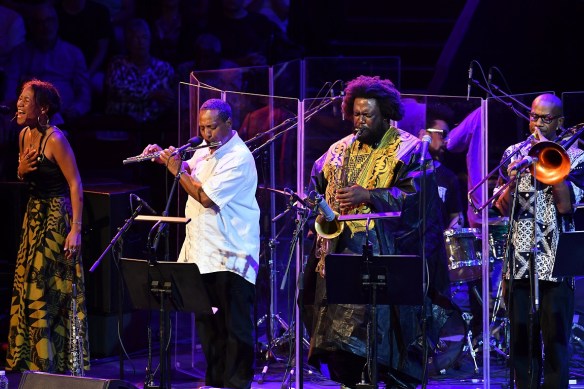
Late night Proms at the Royal Albert Hall are usually special – and this one even more so. Kamasi Washington arrived to a great fanfare in 2015, firstly for his work as orchestrator and band leader on Kendrick Lamar’s album To Pimp A Butterfly, then latterly for his extraordinary triple album Epic, released to great acclaim on Ninja Tune.
Washington, while perhaps not earmarked as the future of jazz, is definitely a figure to whom audiences are turning. Some approach him from the hip hop direction, from Lamar or Snoop Dogg, while others with jazz more embedded in their listening recognise the influences of Sun Ra and John Coltrane. But how would all these elements blend with a 32-voice choir and the strings of the City of Birmingham Symphony Orchestra?
Extremely well, as it turned out. It helps that Washington has a wonderful, almost beatific stage presence. He is a mixture of assertion and modesty, which suits his music too, for there were long, ecstatic phrases where the Royal Albert Hall itself seemed to be lifted from its foundations on a tide of good feeling. As the long phrases swelled from the ground up, supported by cellos, basses, the bass of Miles Mosley and the drums of Ronald Bruner Jr and Tony Austin, the treble instruments and assembled chorus were swept along on the good vibes.
That was certainly the case in Change of the Guard and The Next Step, while in The Magnificent 7 there was more of a soloistic approach, Washington’s band each invited to present their extraordinary virtuosity. Top of the pile were Mosley and pianist Brandon Coleman, both placed centre stage and forming a supple rhythmic base as well as a source of boundless musical enthusiasm.
However the praise for the effectiveness of the arrangements should also be directed at Jules Buckley, for whom this was a third appearance at this year’s Proms. Buckley is a master arranger, responsible for a lot of last year’s Ibiza Proms arranging but also this year taking on Quincy Jones and Jamie Cullum – each foils for the music of Washington, where he conducted the strings.
It also helps that Washington’s music is so well orchestrated, for although he allows his band solo time, in the quieter music things stripped back to allow the string orchestra room to be heard. Although they were swamped in the opener Change of the Guard there was plenty of room for the bittersweet cello lines of Henrietta, Our Hero to make a strong impact.
This was one of many high points in the concert, Washington introducing his father Rickey as they both paid homage to Kamasi’s grandmother in a song beautifully intoned by Patrice Quinn. There was a new piece, too, The Space Traveller’s Lullaby, which formed an effective mid-set interlude, stripping back to saxophone, trombone, voices and strings. Washington’s moving solo was backed by twinkling stars projected onto the backboard.
The music lingered long into the night. Some extraordinary phrases, both loud and quiet, issued from Washington’s saxophone, played with the utmost of care. His music has the power to move from tiny, quiet moments or through the massive, surging crests of the wave where all 80 performers were involved. Its wholly positive outlook won the day.



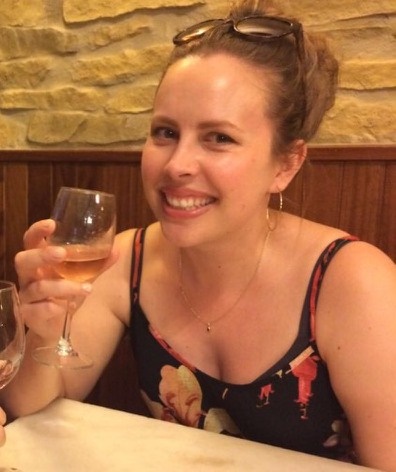 This is the latest in the series where Arcana invites a friend to a Prom who does not normally listen to classical music. In an interview after the concert each will share their musical upbringing and their thoughts on the concert – whether good or bad! Here, Annie Turner (above) gives her thoughts on Prom 62.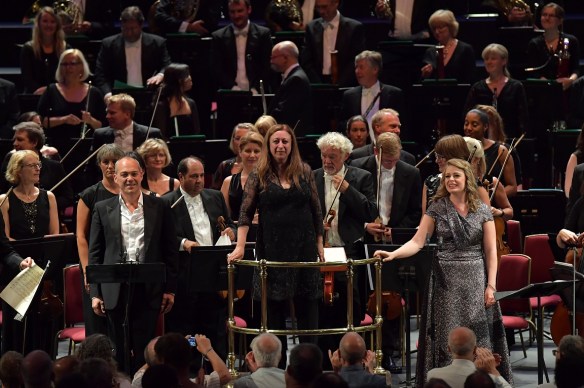


 Arcana.fm