BBC Proms 2017 – Christian Tetzlaff, Scottish Chamber Orchestra & Robin Ticciati: Brahms, Berg, Thomas Larcher & Schumann’s ‘Rhenish’ Symphony

Prom 40: Christian Tetzlaff (violin), Scottish Chamber Orchestra / Robin Ticciati

Brahms Tragic Overture Op.81 (1880)

Berg Violin Concerto (1935)

Thomas Larcher Nocturne – Insomnia (first UK performance) (2008)

Schumann Symphony no.3 in E flat major Op.97, ‘Rhenish’ (1850)

Royal Albert Hall, Tuesday 15 August 2017

You can listen to this Prom here for 28 days from the date of the performance

The Scottish Chamber Orchestra are one of the UK’s finest ensembles, and they proved their worth once again with outgoing chief conductor Robin Ticciati leading a fine Prom tracing a course from darkness to light.

Brahms’s Tragic Overture is one of the composer’s deepest orchestral statements, and Ticciati was determined to present its steely side. Often the strings were without vibrato, the lean sound complemented by raucous horns and open textures in the woodwind. Lower strings growled ominously, and only the softer woodwind passages offered occasional respite in their beautifully choreographed choir.
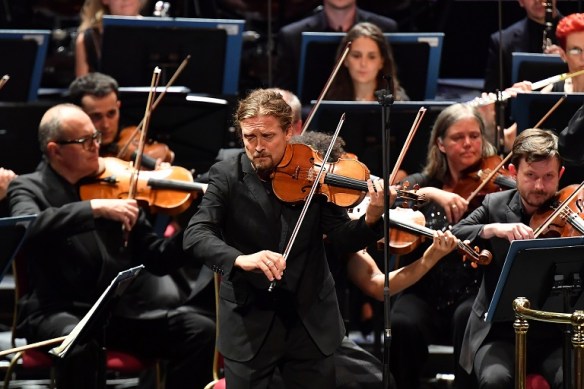
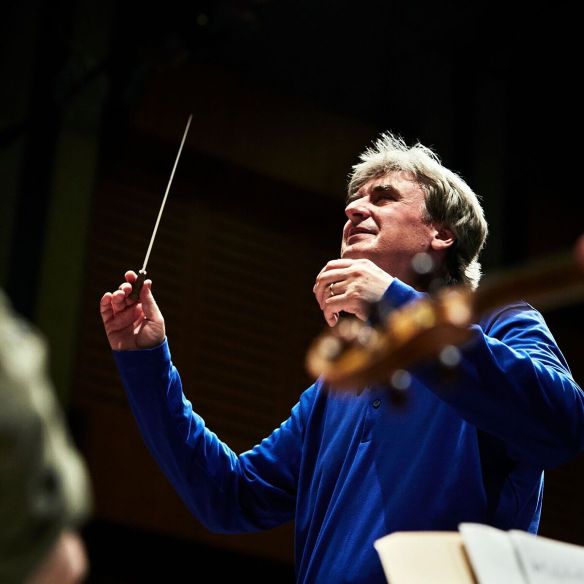
Berg’s Violin Concerto contains music of similarly ominous qualities, in this case uncannily heralding the composer’s final year despite its dedication elsewhere. Though the violin begins with elegiac tones it has a broad emotional range, and Christian Tetzlaff (above) rose magnificently to the occasion, finding Berg’s many and varied colours but crucially balancing them with the excellent orchestral contributions.

The coded messages Berg inserts into the music were on occasion stripped bare, and the anger at the heart of the second movement was almost completely unconcealed. Its crowning moment lies in quiet simplicity, however, and when the quotation of Bach’s chorale Es Is Genug arrived on clarinets the mellow tones were deeply moving. Capping the concerto with his rise to a high ‘G’ at the end, Tetzlaff held the note at a barely audible volume so that it sounded like one last breath in his ascent to another world.

As the evening progressed the darkness drew in ever more closely for Thomas Larcher’s Insomnia – Nocturne, an orchestral piece receiving its first UK performance. Written for a relatively small orchestra of eighteen, it was an uncomfortably accurate portrayal of sleep’s refusal to take hold, with a high pitched glockenspiel tone becoming particularly tiresome. Sitting in the background, its tone made an uncomfortable backdrop for the increasingly fractious instrumental activity in front, which finally subsided into a fitful slumber, the sort where it is already too late in the night to be rescued. The piece began with promising tonal material, but in a manner akin to insomnia this was rendered much less appealing by the end.

Thankfully Schumann’s Rhenish Symphony was on hand to pierce the darkness with music of unrestrained joy. The opening surge is one of the happiest in all classical music, and like the river on which it is based it takes everything with it downstream. The Scottish Chamber Orchestra were superb, the lofty horns enhancing the open-air sound while the woodwind worked together in beautifully shaded colours, as did the strings with more vibrato this time.

If anything the second movement Ländler was even better, flowing forward with purpose and charm, while the Intermezzo following also had a softer heart. The mood became solemn for Schumann’s powerful evocation of Cologne Cathedral in the fourth movement, the symphony turning inwards with self-doubt and contemplation, but from this the finale emerged with resolve and conviction.

A strong Prom, then, the Scottish Chamber Orchestra giving us something old (Brahms and Schumann), something new (Larcher), something borrowed in the Berg and something blue in the mood that ran throughout. Thankfully the shade of this particular blue changed from deep and dark at the outset to a bright and breezy azure by the end.

Ben Hogwood

Stay tuned for the next in Arcana’s Ask The Audience series, where Sam Hogwood will give her verdict on the Scottish Chamber Orchestra Prom. Coming shortly!

BBC Proms 2017 – John Storgårds conducts the BBC Philharmonic Orchestra in Sibelius, Grieg, Schumann & Hindemith

Prom 33: Lise Davidsen (soprano), Alban Gerhardt (cello), BBC Philharmonic Orchestra / John Storgårds

Grieg Peer Gynt Op.23 (excerpts) (1876)

Sibelius Luonnotar Op.70 (1913); Karelia Suite Op.11 (1893)

Schumann Cello Concerto in A minor Op.129 (1850)

Hindemith Symphony, Mathis der Maler (1934)

Royal Albert Hall, Thursday 10 August, 2017

You can listen to this Prom by clicking here

John Storgårds has been making his mark on the BBC Proms in his appearances as Chief Guest Conductor of the BBC Philharmonic. Tonight’s tale of two geographical halves commenced with excerpts from Grieg’s music to Peer Gynt; starting with the lively Overture (hardanger fiddles in evidence thanks to the violas), then continuing with a vehement Ingrid’s Lament, a deftly propelled Morning and a pensive Solveig’s Song undermined by Lise Davidsen’s fluttery vocal; finishing with the suitably quirky Dance of the Mountain King’s Daughter.

Davidsen (above) was then heard to better advantage in Sibelius’s tone-poem Luonnotar, coping ably with the stratospheric range of this singular creation myth – not the least of whose fascinations was having been premiered at the Three Choirs Festival in Gloucester Cathedral. There have been some memorable accounts of this piece over recent years, and if Davidsen did not efface memories of such as Mattila and Komsi, she duly pointed up its drama and mystery in what was, for the greater part, a sympathetic account. The Proms audience was suitably attentive.

Sibelius’s comparatively mellifluous Karelia Suite brought this Nordic first half to its close. Storgårds’s widely contrasted tempi for the Intermezzo left a rather disjointed impression, and while the Alla Marcia sounded rumbustious enough, a certain coarseness of playing rather limited one’s enjoyment. Best by far was the Ballade, one of the composer’s most arresting earlier pieces in its enfolding modal harmonies and given a notably rapt reading with such aspects as the wistful cor anglais melody towards its close eloquently phrased.

The Germanic second half began in more restrained mood with Schumann’s Cello Concerto. Rarely performed for decades (and more often in the transcription for violin), this deceptively genial piece is among its composer’s most ingenious in terms of form and motivic continuity. Alban Gerhardt (above) maintained a determined while never merely inflexible course across its three continuous movements, the BBC Philharmonic providing support as attentive yet unobtrusive as the music required. Interesting to hear that the soloist thought the finale musically the least successful, as this emerged as arguably the most successful part – not least with its engaging dialogue kept on its toes and with no sense of dourness or grittiness as regarded the orchestral texture. Overall, a perceptive and convincing account of a work still too easily overlooked.

Storgårds then rounded-off the programme with a taut and tensile reading of the symphony that Hindemith derived from his opera Mathis der Maler. This retelling of cultural meltdown and social antagonism during the Thirty Years War proved too ‘contemporary’ for the Nazi regime to stomach, and it was no surprise that the premiere of the complete opera took place in Zurich. Storgårds had the measure of the Angelic Concert with its austere chorales and angular though never impersonal polyphony. The Entombment of Christ was affecting for all its brevity, while the climactic Temptation of St Anthony built surely and impulsively from its stark introduction, through a central interlude of tangible pathos, to a culmination such as blazed forth in affirmation. All credit to Storgårds for ensuring so cathartic an impact.
Richard Whitehouse (photo of Lise Davidsen (c) Ole-Jørgen-Bratland)

BBC Proms 2017 – Rachmaninov’s All Night Vigil with the Latvian Radio Choir

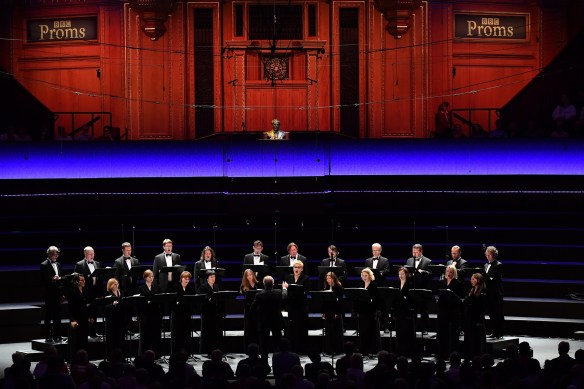
Latvian Radio Choir / Sigvards Kļava (above)

Rachmaninov All Night Vigil (Vespers), Op.37 (1915)

Royal Albert Hall, Sunday 13 August 2017 (late night)

You can listen to this Prom here

Once in a while it is good to be reminded that some of the most moving music does not have to rely on volume to make its point.

Rachmaninov’s All Night Vigil is a case in point, sung here by the Latvian Radio Choir in a highly atmospheric late night Prom. This notoriously self-critical and doubting of composers believed in it as one of his very best compositions, and even wanted the central Nunc Dimittis sung at his funeral. Though designed to be performed in the course of a Russian orthodox day (beginning and ending at sunset) it lasts for just over an hour if performed in an unbroken span, and here it created a wonderful spell.

The work has been sung at the Proms three times before, in the Late Night slot each time, and its blend of music for the spirit and the soul is ideal for late night contemplation. That state of mind was easily reached here, in a clean and relatively understated way. Recordings of great Russian choirs performing this music show how great depth and volume can be achieved, but with six singers to each part the Latvian Radio Choir were daringly exposed, and their relative lack of heft encouraged the audience to listen more attentively.

That they did so was an indication of just how well observed this performance was. Delicately controlled by Sigvards Kļava, each section merged almost seamlessly into the next, and yet there was room for each hymn or anthem to breathe. The refrains of the third anthem, Blessed Is The Man, were beautifully observed, by now the reduced forces acclimatised to the cavernous Royal Albert Hall acoustic.

The pacing felt ideal too, so that when the bigger numbers – the Glorifying song of the Resurrection and the Great Doxology – arrived, they did not flag, and the high points of each were unfailingly hit. The longer melodic threads were beautifully phrased, unexpectedly drawing the parallels between this music and some of the big tunes elsewhere in Rachmaninov’s output, such as the opening of the Third Piano Concerto, heard earlier in the evening.

The standard of performance was high throughout, with a level of control and ensemble that never dipped below excellent. The sopranos were relatively bright in sound, and the basses controlled their notes down to the depths beautifully, not least the Nunc dimittis, where the audience were visibly straining to hear their descent. Earlier in this number the tenors showed restraint, but there was emotion in their voices nonetheless.

All these elements contributed to a night that frequently stopped the heart with its subtle but lasting beauty. The text, and Rachmaninov’s response, had a timeless feel that transcended this single concert experience, which will last long in the memory.

Ben Hogwood

You can hear the Latvian Radio Choir’s recording of the Rachmaninov All Night Vigil on the Spotify link below:

BBC Proms 2017 – BBC Scottish Symphony Orchestra with Thomas Dausgaard: Mahler & Schubert ‘Unfinished’

Prom 36: BBC Scottish Symphony Orchestra, Thomas Dausgaard (above)

Schubert Symphony No. 8 in B minor, D759, ‘Unfinished’ (1822)

Mahler Symphony No. 10 in F sharp, realized Deryck Cooke (1910; 1959-76)

Royal Albert Hall, Saturday 12 August, 2017

You can listen to this Prom by clicking here

Having made an auspicious start to his tenure with the BBC Scottish Symphony Orchestra, Thomas Dausgaard tonight brought the orchestra to the BBC Proms for its most ambitious concert this season – Mahler’s I, given in the ‘performing edition’ by Deryck Cooke.

Left unfinished at Mahler’s death in 1911, the work was partially premiered in 1924 though it was not for another four decades that a complete rendering was heard – Berthold Goldschmidt conducting the London Symphony Orchestra at the Proms in Cooke’s realization. Since when his (subsequently revised) edition has become the preferred option for those tackling Mahler’s last symphony in its entirety. Dausgaard recently won praise for his recording with the Seattle Symphony, and his account this evening proved no less successful as an overall interpretation.

Other than the notably deliberate tempo for the violas’ initial theme, such as made it almost an epigraph to the movement overall, the opening Adagio was flexibly paced; the wrenching theme heard on massed strings finding contrast with the sardonic, waltz-like music as passed between solo woodwind. The development’s polyphonic intricacy was eventfully unfolded, then the climactic dissonance – with its piercing trumpet note – was pointedly drawn into the whole so that the lingering coda evinced a serenity whose fulfilment was at best provisional.

The first Scherzo emerged even more impressively. Texturally the least cohesive movement as Mahler left it, its contrapuntal density allied to elliptical harmonic progressions make it the most radical (the earlier music of Hindemith and Weill tangibly within reach) and Dausgaard expertly integrated its increasingly close-knit sections into a stretto of mounting excitement. The brief, fulcrum-like Purgatorio which follows was a little matter-of-fact for its glancing irony wholly to come through, and Dausgaard ought to have made an attacca into the second Scherzo (the three movements of this second part ideally form a continuous whole). Not that there was much to fault in this latter as it pivoted between anguish and appeasement, before vanishing into that ‘tunnel’ of darkness whose nihilistic overtones were palpably to the fore.

Come the Finale and Dausgaard might ideally have deleted the opening drum stroke, while the climax of the central Allegro really needed underpinning from drums for its intensified reprise of the first movement’s dissonance to make its fullest impact. But these were minor flaws in a perceptive rendering overall – sepulchral opening brass making way for the most eloquent flute melody in the symphonic literature (not least as played by Charlotte Ashton), transformed into a radiant string threnody which brings about this work’s cathartic ending.

An impressive reading was fittingly programmed within the context of Schubert’s Unfinished, of which Dausgaard has made a fine account with the Swedish Chamber Orchestra. While his rapid take on the first movement (little ‘moderato’ about this Allegro) did not transfer ideally onto full orchestra (at least in the resonance of the Albert Hall acoustic), the ensuing Andante had no lack of poise: the hushed dynamics of its coda no less arresting than the blissful final cadence in which Mahler’s transcendent leave-taking, 88 years on, was not hard to perceive.

Richard Whitehouse (photo of Thomas Dausgaard (c) Thomas Grøndahl)

You can listen to Dausgaard’s recordings of these pieces on the Spotify playlist below:

Ask the Audience at the BBC Proms – Steve Hodges on the Philharmonia Orchestra playing John Adams

Arcana returns to the BBC Proms in the company of friends – and for our second visit this season we are dipping into one of the festival’s themes, the music of John Adams. Offering his thoughts was Steve Hodges (above)

Marianna Crebassa (mezzo-soprano), Philharmonia Orchestra / Esa-Pekka Salonen

J.S. Bach arr. Stravinsky Canonic Variations on Vom Himmel hoch, da komm, ich her (1956)

Ravel Shéhérazade (1904)

Adams Naive and Sentimental Music (1999)

You can listen to this Prom on the BBC iPlayer here

Arcana: Steve, what was your musical upbringing?

Personally, I would say it was broad. It started with The Beatles, The Monkees and The Rolling Stones. I grew up through the 1970s and enjoyed glam, and Sparks, and Elton John. Then after meeting people who had some really broad taste, I lapped up everything through electronica, David Bowie and punk.

I’ve gone on from there really, and gone sideways as much as I possibly could. I like to reflect on music and on what was going on at the time, socially, and what it actually represents. I think that’s an important factor about music. I really enjoyed the punk ideals that said anybody could do it, it made a new wave of music that was enormously important. Just because people could make a record didn’t mean they necessarily should, because some of them were awful, but there was so much choice and so many good things in the 1980s. Since then we’ve been through house and drum ‘n’ bass as well. My classical representation is a bit smaller, but I enjoy what I enjoy!

Could you name three musical acts you love, and why you love them?

Starting with an old one, The Beatles – that was through my father’s record collection, which was a great influence as a young person. I appreciated them as they were. Then The Human League, as a lot of the Sheffield music was important to me, because at the time I was fortunate to be dabbling in music myself. It really crossed over, and Manchester music was a reference as well – so I would put Ultravox! in there as well. Those were the things that mattered really.

Turning to the concert, what did you think of the Bach / Stravinsky?

I thought there were subtler things here, I was surprised at the quiet volume, there were not so many people on stage I suppose. I was fascinated by the people playing, and the movement between the sections. I was watching for the technical side as much as the musical side. It was a nice ‘warmer-upper’ for the rest of it.

What about the Ravel?

I was much more in to this, and felt reflections of 1960s TV in the music, there were flurries that I kind of recognised. I really liked it. For the singer to remember the words was good, and being able to follow along in the book was interesting. I liked the shape of the music.

And the John Adams?

There was much more to think about with that one! I think the first movement built up, and we had the pleasure of seeing the orchestra and the punctuation, the offset rhythms, the bouncing around of the parts. There was a lot more percussive use here and the intricacies of the first piece were astonishing. He was definitely testing the technical abilities of the musicians. The crescendo at the end was almost human madness in my mind, it was almost too much to bear. The build up at the end, it went from the crossrhythms going on that were clear and observed, you could feel the pulses, and then that broke down at the end and it was completely consuming. You almost wanted to put your hands over your head.

The second movement was really nice at the start, I really liked that one. Because I’ve worked with sequencing a lot you could feel the repetition, the softness of the play, again testing the musicians in a different way at the limits of musicality. The lightness of touch stood out, and it was mostly driven by the harps to start with, and that was the bass, the pulse that drove it along to start with. I liked the guitar in there, I hadn’t spotted him and wondered where that was coming from.

What I liked about it most was where he was getting the strings to crescendo, it was like reversing an attack, and it was going round and round in a really interesting way. It was powerful and really interesting to hear that executed. I enjoyed that one most of all for sure. The arpeggios on the strings were really good, it was so delicate and ambient in its way. Even though it was gentle it was really strong.

How did you find the Proms as an experience?

Very nice. The reverence for the music was striking, and full marks for the quality of what you saw. The audience were obviously there to enjoy it, and treated it with the respect it duly deserved. It was a beautiful environment to hear such things. I’m almost a little disappointed it was quieter at the beginning but I guess we should have stood closer at the start. After a while though, you tune your ears into it. Everybody shut up so that we could all hear.

Having said that, the volume at the end of was enormous! The variety of the use of the instruments, like bowing the percussive instruments in the last piece, that was a softer element. It wasn’t orchestral techno by any means but there was a lot of crossover. It really was a testing thing for the musicians, and it really resonated how much was being put on them.

Is there anything you would change about the experience?

I did browse the catalogue and felt it was something I would like to do. I don’t think there is anything I would particularly change about it, and I’d be inclined to come again. I heard a few things on the TV last week, and I think I shall be listening out for more!

Verdict: SUCCESS