
In concert – Philharmonia Orchestra Music of Today: Messiaen’s Quartet for the End of Time

Mark van de Wiel (clarinet, above), Zsolt-Tihamér Visontay (violin), Karen Stephenson (cello), Tom Poster (piano)

Messiaen Quatuor pour le fin du temps (Quartet for the End of Time) (1941)

Royal Festival Hall, London
Thursday 7 March 2024 (6pm)

Reviewed by Ben Hogwood Pictures (c) Guy Wigmore (Mark van de Wiel, Zsolt-Tihamér Visontay), Marina Vidor (Karen Stephenson), Elena Urioste (Tom Poster)

The Philharmonia Orchestra’s long-running Music of Today series continued with an opportunity to experience Olivier Messiaen’s 1941 masterpiece. Given its first performance in a German prisoner-of-war camp (in what is now Zgorzelec, Poland), the Quatuor pour la fin du tempsQuartet for the End of Time – was very much a product of circumstances.

The composer, in one of his rare forays into chamber music, had just three instruments available to him, plus himself at the piano. He thrived on the restrictions, using the New Testament book of Revelation as his stimulus to create an eight-movement piece that if anything has grown in stature and relevance with every passing year.

Tonight’s venue may have been a great deal more spacious than the cramped conditions of the premiere, but the quartet here lacked nothing in close-up intimacy, the sizeable audience leaning forward in their seats to engage with the music. Initially it was the piano of Tom Poster (below) that provided a strong foundation, his spacious chords catching the chill of the dawn air in Liturgie de cristal as the other three instruments circled with attractive birdsong, the music awakening softly.
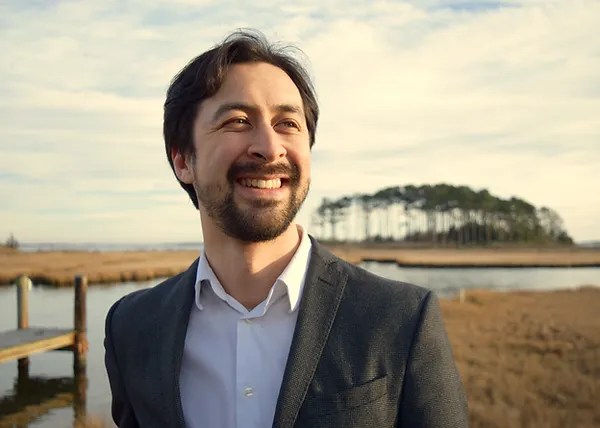
The Vocalise, pour l’Ange qui annonce la fin du temps (Vocalise, for the Angel who announces the end of time) provided a firm reality check, though here too its dramatic lines were clear and spacious rather than combative, the players continuing to find an inner serenity through Messiaen’s writing. Violinist Zsolt-Tihamér Visontay and cellist Karen Stephenson thrived on these long melodic phrases, derived from plainchant.

The emotive centre of this performance was undoubtedly the solo for clarinet, Abîme des oiseaux (Abyss of birds), an incredibly moving soliloquy played with exceptional technique by Mark van de Wiel. Some of the notes started with barely audible attack while others were at the outer limits of his volume in a performance of incredible poise and control. Standing while the other musicians sat, he also let the silences between notes speak as loudly as the phrases themselves, so that even the persistent coughing of the audience was rendered into silence.
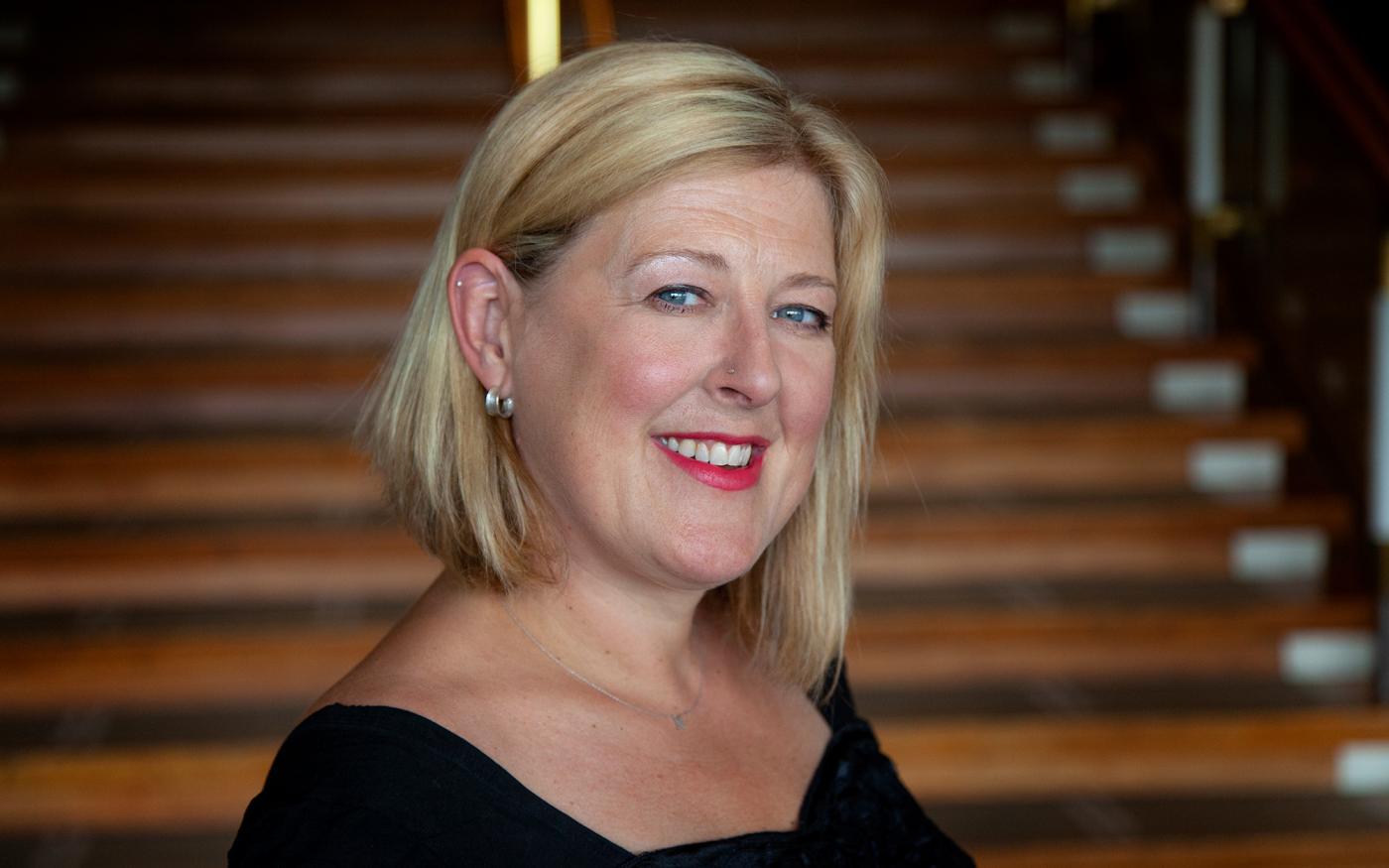
The delicate Intermède broughout out the dance elements of Messiaen’s writing, before Stephenson (above) and Poster gave a thoughtful, meditative Louange à l’Éternité de Jésus (Praise to the eternity of Jesus), beautifully played and appropriately reverent. This ensured a vivid contrast with the following Danse de la fureur, pour les sept trompettes (Dance of fury, for the seven trumpets), where the four instruments played their angular melodies with commendable precision.

Fouillis d’arcs-en-ciel, pour l’Ange qui annonce la fin du temps (Tangle of rainbows, for the Angel who announces the end of time) found Visontay (below) to the fore in the audio balance, van de Wiel slightly backward in the mix, before Visontay and Poster led us to the end itself with a radiant Louange à l’Immortalité de Jésus (Praise to the immortality of Jesus). This remarkable piece of music continues to carry a strong impact, and as the two instruments strained at the edge of audibility, Visontay reaching the highest pitch, the sense of arrival was all-consuming.

They put the seal on a memorable performance, one of the more emotive ‘rush hour’ concerts you could wish to hear, and one whose impact was felt far beyond that evening’s orchestral concert.

You can listen to a recording of Quatuor pour le fin du temps below, with Mark van de Wiel and Zsolt-Tihamér Visontay joined by cellist Mats Lidström and pianist Min-Jung Kym on the Psalmus label:

Meanwhile you can find more information on further concerts at the Philharmonia website

Published post no.2,111 – Friday 8 March 2024

In concert – Alice Coote, Philharmonia Orchestra / John Eliot Gardiner: The Sea and the Land: Mendelssohn, Elgar & Dvořák

Mendelssohn Hebrides Overture Op.26 ‘Fingal’s Cave’ (1830, rev. 1832)
Elgar Sea Pictures Op.37 (1899)
Dvořák Symphony no.5 in F major Op.75 (1875, rev. 1887)

Alice Coote (mezzo-soprano), Philharmonia Orchestra / John Eliot Gardiner

Royal Festival Hall, London
Thursday 16 February 2023

Reviewed by Ben Hogwood Picture credits – John Eliot Gardiner (c) Sim Canetty-Clarke; Alice Coote (c) Jiyang Chen

This was an ultimately invigorating concert, using a cleverly constructed programme to look at how composers respond to the earth itself.

We began off the west coast of Scotland, the Inner Hebrides to be exact – and the uninhabited island of Staffa. Here it was that Mendelssohn saw Fingal’s Cave (above) in the summer of 1829. His musical response has become one of the composer’s best-loved pieces, an early and remarkably vivid example of the symphonic poem. Under John Eliot Gardiner, the Philharmonia Orchestra recounted the scene with remarkable accuracy, capturing the unusual, organ-like appearance of the landmark as well as the sea spray crashing around it. Gardiner steered a sure-footed and clear course through the water, aided by a wonderful clarinet duet from Mark van de Wiel and Laurent Ben Slimane in the second theme.

Alice Coote (above) then joined the orchestra, transporting us to the rarefied waters of Elgar’s Sea Pictures, the mezzo-soprano bringing to life five carefully chosen gems that took the composer far from his desk in Malvern in 1899. It took a while for singer and orchestra to achieve the optimum balance, so the words on the screen above were helpful as Coote found her feet. She did so quickly, and the somnambulant atmosphere of Sea Slumber-Song was cast, the strings lapping at the edges of Coote’s beautifully placed words. As she grew into the role so the gently rocking In Capri was attractively weighted and subtly intense.

Sabbath Morning At Sea was solemn yet soon reached for the heights, Coote’s innate grasp of the text matched by Gardiner’s control and shaping of the melodic line from the orchestra. The celebrated Where Corals Lie was perhaps inevitably the highlight, but The Swimmer ran it close, running all the way to a richly coloured high register from the singer at the end. Support came from the depths, too, with Alistair Young’s sensitive contribution on the Royal Festival Hall organ one to savour.

We returned to land for Dvořák’s Symphony no.5, the work with which he ‘rebooted’ his career as an orchestral composer in 1887, his publisher having spotted an opportunity to re-promote a piece finished in 1875. In this concert the parallel with the seasons was irresistible, the symphony’s first movement in particular resembling the flourishing of flowers in spring. Fleet footed strings were complemented by fresh faced woodwind, headed by the burbling clarinets who shone once again in the opening theme.

The Fifth is a sunny work, sitting in the shadow of the last three symphonies (nos.7-9) where live performances are concerned. As this concert revealed, however, it is a descendant of Beethoven’s Pastoral symphony, a work with considerable depth of its own and many different orchestral colours in which to revel. After a vivacious first movement, where Dvořák’s themes were given the best possible chance to shine, the cellos took the lead in their burnished opening to the romantic slow movement. This serious, minor key theme – surprisingly similar to the main tune of the Mendelssohn – was supplemented by an attractive, triple-time dance in the major key.

The slow movement segued effortlessly into the Scherzo, where the flurry of violins conjured up a vision of dancers trying to find their feet on the floor. The give and take between orchestral sections was a delight both to hear and to watch, as it was in the finale. The material here turns a little sour initially, Dvořák struggling manfully to regain the positive demeanour of the first movement. In Gardiner’s hands this was a compelling argument, ultimately won with the help of the superb Philharmonia brass, trombones punching out their melodies to thrilling effect. Once the ‘home’ key was reached the winter storms retreated and we basked in glorious musical sunshine, capping a fine evening where spring really did seem within touching distance.

You can read all about the 2022/23 season and book tickets at the Philharmonia Orchestra website.

In concert – Leonidas Kavakos, Philharmonia Orchestra / John Wilson: Elgar Symphony no.3; Barber & Korngold

Leonidas Kavakos (cello), Philharmonia Orchestra / John Wilson (above)

Royal Festival Hall, Southbank Centre, London
Thursday 27 February 2020

Barber First Essay Op.12 (1937)
Korngold Violin Concerto in D major Op.35 (1945)
Elgar, realized Anthony Payne Symphony no.3 in C minor Op.88 (1933; 1993-4)

Reviewed by Richard Whitehouse
Photo credit (John Wilson) Sim Canetty-Clarke

It is good to see John Wilson taking up more concert engagements, so putting his talent at the service of symphonic repertoire. Tonight, he directed the Philharmonia in a programme that culminated with quite possibly the finest reading Elgar’s Third Symphony has yet received.

The relatively brief first half commenced with Barber’s First Essay, written in the wake of his soon-to-be ubiquitous Adagio and given a high-profile launch by Arturo Toscanini with the New York Philharmonic. Succinct to a fault, the sombre rumination of its initial section soon makes way for music of brittle aggression (such as Britten surely had in mind writing the Dies irae section of his Sinfonia da Requiem two years later), and reaches a short-lived climax with the return of the piece’s opening which itself subsides into musing expectation.

A timely revival, whereas Korngold’s Violin Concerto now seems almost too familiar since coming in from the cold some quarter-century ago. Leonidas Kavakos has become one of his staunchest advocates, but while his recent Proms account often verged towards the soporific, this evening saw much greater focus; not least an initial Moderato whose yearning melodies were rendered with real incisiveness, then a Romanze whose lush textures and diaphanous harmonies never risked becoming cloying. If the final Allegro was even more impressive, this was because what is ostensibly the weakest movement emerged on a par with those before – Kavakos pointing up its effervescence while keeping any indulgence in check on route to the heady return of its opening theme, in what is a coup de théâtre even by Korngold’s standards.

Wilson has already demonstrated his Vaughan Williams credentials, and is evidently no less at home in Elgar. Some 22 years on from its premiere and the Third Symphony, as realized by Anthony Payne, continues to fascinate and exasperate in equal measure – yet, while there can be no denying its conjectural status, what came over here was Wilson’s conviction as he steered a purposeful course through the opening movement – pulling together what can feel a prolix development then evincing similar grip and determination in the coda. What follows was ideally poised between scherzo and intermezzo, its balletic and song-like strains eliding seamlessly, while the Adagio has seldom sounded more potent in its wrenching dissonances and wan consolation as lead to a coda whose fragmented texture only emphasized its pathos.

On to the finale (Wilson rightly ensured minimal pause between movements) and while there was no lack of finesse in the shaping of its themes, Wilson made relative light of there being no concrete development section by bringing its nominally tentative variants into tensile and, above all, cumulative accord. This carried through into the coda – undoubtedly the best Payne which Elgar never wrote and whose spirit of reaching out towards whatever might lie beyond was palpably conveyed as the music receded, slowly but never disconsolately, toward silence.

At some 50 minutes this was as taut and incisive a reading as the piece can yet have received, but the essential rightness of Wilson’s approach could not be doubted. Payne himself looked mightily impressed, and one can only hope a recording with the Philharmonia is in the offing.

In concert – Sol Gabetta, NHK Symphony Orchestra Tokyo / Paavo Järvi: Takemitsu, Schumann & Rachmaninov

Sol Gabetta (cello), NHK Symphony Orchestra Tokyo / Paavo Järvi (above)

Royal Festival Hall, Southbank Centre, London
Monday 24 February 2020

Takemitsu How slow the wind (1991)
Schumann Cello Concerto in A minor Op.129 (1850)
Rachmaninov Symphony no.2 in E minor Op.27 (1906-07)

Reviewed by Ben Hogwood

This Royal Festival Hall concert offered the relatively rare chance to catch the NHK Symphony Orchestra, on a mini-tour from Tokyo in the company of their chief conductor, Paavo Järvi.

As he told Arcana in an interview the previous week, Järvi has been acquainting himself with the music of Toru Takemitsu in recent years, culminating in a recording of his orchestral works with the NHK. One of them, How slow the wind, was a descriptive and colourful way in which to open the concert, presenting a picture of relative calm.

One of Takemitsu’s best qualities is the descriptive power of his music, which is able to capture the elements in a subtle but meaningful way. Rain, earth and air are three you can expect to encounter with particularly vivid results, and the latter was to the fore in this intriguing symphonic poem. As the title suggests, it really was the slowed down movement of air, and was played with attention to detail and affection, painting a picture far away from the Southbank. The influence of Debussy, as outlined by Järvi, was clear, but so too were elements of Ravel and Messiaen, though the percussive colours in which Takemitsu dressed the piece were wholly his own.

Sol Gabetta then took charge of the Schumann Cello Concerto. Clearly this is a piece she loves, and it is gratifying in recent years to see the concerto come into the centre of the instrument’s repertoire. The first movement, dominated by a nagging theme that stays in your head for long after, was a dramatic affair, the cellist seizing the initiative but ensuring Järvi and the relatively small orchestral forces were with her every step of the way. Gabetta’s high register tone was probing, with unerring accuracy in her tuning.

When Schumann moves seamlessly into the slow movement it is like walking into a different, calmer room of the same house, but Gabetta ensured the links throughout were clearly signposted, and her duet with leader of the NHK cellos Ryoichi Fujimori was both sensitive and ideally balanced.

The finale found a bold approach from Gabetta capitalizing on Schumann’s innovative writing, with the written-out cadenza particularly strongly executed before a thoroughly affirmative end. Gabetta capped this with the inclusion of the first movement of VasksGramata cellam as an encore. Gabetta gave this at the first night of the BBC Proms in 2016 and it is no less startling heard once again with its vocalisation.

For the second half it was slow burning Rachmaninov, the NHK smoothly into their stride for the first movement of the Symphony no.2 in E minor. If the moody bass strings at the opening were slightly withdrawn, that gave Järvi plenty to work with as the music unfolded. With the faster tempo came an airy texture as though the sun was shining through outdoors. Once we had glimpsed the brightness it was hard not to let go of it, and the Scherzo, taken at a fastish tempo, glinted at the edges.

Järvi judged the famous Andante just right, indulging in the gorgeous textures but never overdoing it, so that Kei Ito’s clarinet was given the best possible platform to deliver a heartstopping solo. Yet it was in the excited whoops of the finale where this interpretation really delivered, the orchestra stepping up another gear as the music excitedly passed between the instrument groups, percussion adding a sheen to the wonderful wall of sound.

It being Estonian Independence Day, Järvi – while noting the amusement of celebrating the day in London with a Japanese orchestra – gave us a glimpse of summer through Heino Eller’s sunkissed Homeland Tune, from the 5 Pieces for Strings. It was a fitting end to a concert that helpfully reminded us of the approach of spring – and in the process told of classical music’s potential reach. A Japanese orchestra conducted by an Estonian with an Argentinian cellist. What’s not to like about that?!

Further listening

You can listen to a playlist of the programme performed by the NHK Symphony Orchestra and Paavo Järvi. It includes Gabetta’s recording of the Schumann, and leading recordings of the other repertoire (including encores):

For a very fine disc of Heino Eller’s music for string orchestra, this collection from the Tallinn Chamber Orchestra and Tonu Kaljuste on ECM is just the ticket:

In concert – Orchestra of the Age of Enlightenment / Iván Fischer: Mozart’s Final Flourish

Orchestra of the Age of Enlightenment / Iván Fischer

Royal Festival Hall, Southbank Centre, London
Friday 7 February 2020

Mozart
Symphonies: no.39 in E flat major K543; no.40 in G minor K550; no.41 in C major K551 ‘Jupiter’ (all composed in 1788)

This concert was recorded for broadcast on BBC Radio 3 on Wednesday 12 February. You can listen to it here

Reviewed by Ben Hogwood

Few orchestras inspire their audience as consistently as the Orchestra of the Age of Enlightenment. Tonight was no exception, presenting ‘Mozart’s Final Flourish’ – his three final symphonies, nos. 39-41, written unusually in a short space of time, without commission, in 1788. The three works represent Mozart’s mastery of the symphonic form, and as conductor Iván Fischer explained to us before the performances began, there is an argument for the three works being viewed as one.

Fischer structured the concert to support his point, the trinity performed in order but with the interval positioned between the second and third movements of the Symphony no.40. This did not prove as much of a hindrance as expected, for the ‘one giant stucture’ – seen as such by no less than Nikolaus Harnoncourt, Fischer’s teacher – was merely paused half way through. Fischer encouraged applause between movements, a tactic which fragmented the performance a little but added to the relaxed atmosphere and will have encouraged first-time attendees.

The performances were very fine indeed. Symphony no.39 in E flat major, no.543 in Köchel’s catalogue of Mozart compositions, does not always get the appreciation it deserves. This is a shame as it is a wonderfully affirmative work, packed full of good tunes that responded well to the orchestra’s lean sound and fresh phrasing. The slow movement Andante was really nicely characterised, its middle section appropriately stern, while the busy finale chattered excitedly, Fischer leading the conversation.

The Symphony no.40 in G minor came as something of a shock to audiences with its ‘Sturm und drang’ approach, in keeping with Haydn and other artistic movements of the day but clearly plumbing emotional depths for the composer. The first movement was tautly argued, relenting a little for the Andante which was perhaps too relaxed in tone. When we returned after the interval the Menuetto disappeared rather quickly, with Fischer’s brisk tempo and an absence of repeats, while the fourth movement brought more abstract qualities to the fore before its final flourish.

And so to the Symphony no.41 in C major, nicknamed the ‘Jupiter’ 40 years or so after its publication. What a remarkable achievement this is, its surface simplicity masking complex inner workings with the serenity of a swan. Fischer, who smiled throughout, revelled in another fine performance, typified by the extra spring given to the exuberant second theme of the first movement. The tender heart of the Andante cantabile was aided by a lovely muted string sound, while the floated delivery from the violins helped the deceptively straightforward themes in the Menuetto. All this was headed for the finale, however, and its masterful fugue. This conversation between parts is the closest thing to perfection in Mozart’s symphonic writing, and the OAE relished both their individual parts and the ensemble workings resulting from them, building enough kinetic energy to sweep us home.

This was a thought provoking and ultimately uplifting evening, and the ideal setting of the scene for anyone moving on to Beethoven next!

Further listening and viewing

A reminder that this concert was recorded for broadcast on BBC Radio 3 on Wednesday 12 February. You can listen here

You can find out more about the Orchestra of the Age of Enlightenment on their website, and you can get an introduction to them in a minute through the video below:

The orchestra appear not to have recorded Mozart’s last three symphonies, but their one-time guest conductor Frans Brüggen made these excellent live recordings with the Orchestra of the 18th Century. They sit relatively closely to the sound heard at this concert: