On Record: Mark Bebbington, Duncan Riddell, RPO – Vaughan Williams: Fantasia, Piano Quintet, The Lark Ascending, Romance (Resonus Classics)

Vaughan Williams
Piano Quintet in C minor (1903, rev. 1905)
The Lark Ascending (1914, rev, 1919)
Romance (c1914)
Fantasia (quasi variazioni) on the ‘Old 104th’ Psalm Tune (1949)

Mark Bebbington (piano), Duncan Riddell (violin, Piano Quintet, Lark), Abigail Fenna (viola, Piano Quintet, Romance), Richard Harwood (cello, Piano Quintet), Benjamin Cunningham (double bass, Piano Quintet), City of London Choir, Royal Philharmonic Orchestra / Hilary Davon Wetton (Fantasia)

Resonus RES10311 [64’53’’]

Producer Adam Binks
Engineers Dave Rowell (Piano Quintet, Fantasia), Adam Binks (The Lark Ascending, Romance)

Recorded 8, 9 June, 25 July 2022 at St John’s Smith Square, London

Reviewed by Richard Whitehouse

What’s the story?

Mark Bebbington assumes centre-stage for this diverse collection of pieces by Ralph Vaughan Williams, ranging across almost a half-century of his output as well as providing an effective showcase for his (unjustly criticized) piano writing heard here within three different contexts.

Does it all work?

One from a number of early chamber works as have only been revived and published in recent years, the Piano Quintet finds its composer seeking an accommodation between the Germanic and French models. The opening Allegro drives its fiery and wistful main themes through an intense development and curtailed reprise to an uneasy close, while the Andante contrasts the hymnic eloquence of its outer sections with the agitation at its centre. Most distinctive is the closing Fantasia, whose five variations on a plaintive theme shared between piano and strings evince no mean motivic ingenuity or expressive variety as they build to a fervent conclusion. Bebbington and the RPO players make a persuasive case for this uneven yet absorbing piece.

The two duo works make for a telling contrast in themselves. Although now ubiquitous in its orchestral incarnation, The Lark Ascending as originally conceived with piano is appealing and evocative in its own right – not least given with unforced pathos by Duncan Riddell and accompanied by Bebbington with sensitive understatement. Probably dating from the same time, the Romance seemingly went unheard in the composer’s lifetime (one of several pieces intended for but never played by Lionel Tertis) and received its first public hearing in 1962. Its build-up to an impassioned climax and return to its initial serenity is a familiar trajectory though one which is flawlessly carried through here, as least as rendered by Abigail Fenna.

Forward some 35 years to the Fantasia (quasi variazioni) on the ‘Old 104th’ Psalm Tune – a piece whose infrequent performance is explained by the unlikely scoring for piano, chorus and strings but also the hybrid nature of its conception; the forthright nature of its four choral settings duly offset by the formal and expressive freedom of its alternating piano ‘cadenzas’ on route to a powerfully, even starkly drawn coda. Bebbington acquits himself with aplomb in the latter, while the City of London Choir and Royal Philharmonic Orchestra respond with confidence to Hilary Davon Wetton, though perhaps this might have been the ideal occasion to revive the piece with accompaniment for string quartet as heard at its first private hearing.

Does it all work?

Almost. The follow-through of this selection is unusual to say the least, but its distinctiveness of content is undoubted – as, too, the quality of these performances. This is now the seventh version of the Piano Quintet and arguably the finest yet, the duos can stand comparison with any predecessor while that of the Fantasia has greater cohesion than the benchmark account by Adrian Boult with Peter Katin (EMI/Warner). Those familiar with Bebbington’s previous discs of VW’s piano music or early Fantasy (both Somm) will find comparable insights here.

Is it recommended?

Indeed. The recalcitrant acoustic of St John’s, Smith Square here yields the requisite warmth and no little clarity, while Nigel Simeone’s notes are informative if (purposely?) contentious on occasion. Anyone who is wanting to acquire some or all of these works need not hesitate.

For purchase information on this album, and to hear sound clips, visit the Resonus Classics website. For more on the artists, click on the names for information on Mark Bebbington, Hilary Davan Watton, City of London Choir and Royal Philharmonic Orchestra
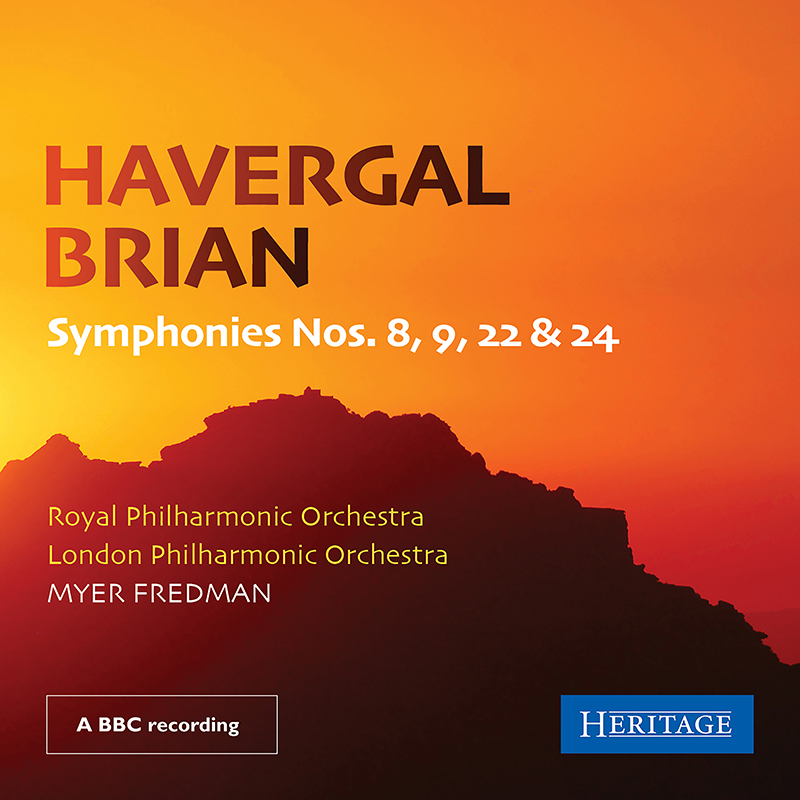
On Record: RPO, LPO / Myer Fredman – Havergal Brian: Symphonies nos. 8,9,22 & 24 (Heritage)

Brian
Symphonies – no.8 in B flat minor (1949); no.9 in A minor (1951); no.22 in F minor, ‘Sinfonia Brevis’ (1964-5); no. 24 in D major (1965)

Royal Philharmonic Orchestra (nos.8,9 & 22), London Philharmonic Orchestra (no.24) / Myer Fredman

Heritage HTGCD146 [77’46’’]

Broadcast performances from St John’s, Smith Square, London on 28 March 1971 (nos. 9 & 22) Maida Vale Studios, London on 27 June 1971 (no.8) and 1 April 1973 (no.24)

Reviewed by Richard Whitehouse

What’s the story?

Heritage continues its releases of pioneering symphonic broadcasts by Havergal Brian with this issue of performances from the 1970s conducted by Myer Fredman, two of these being world premieres in what was a productive decade for furthering the music of this composer.

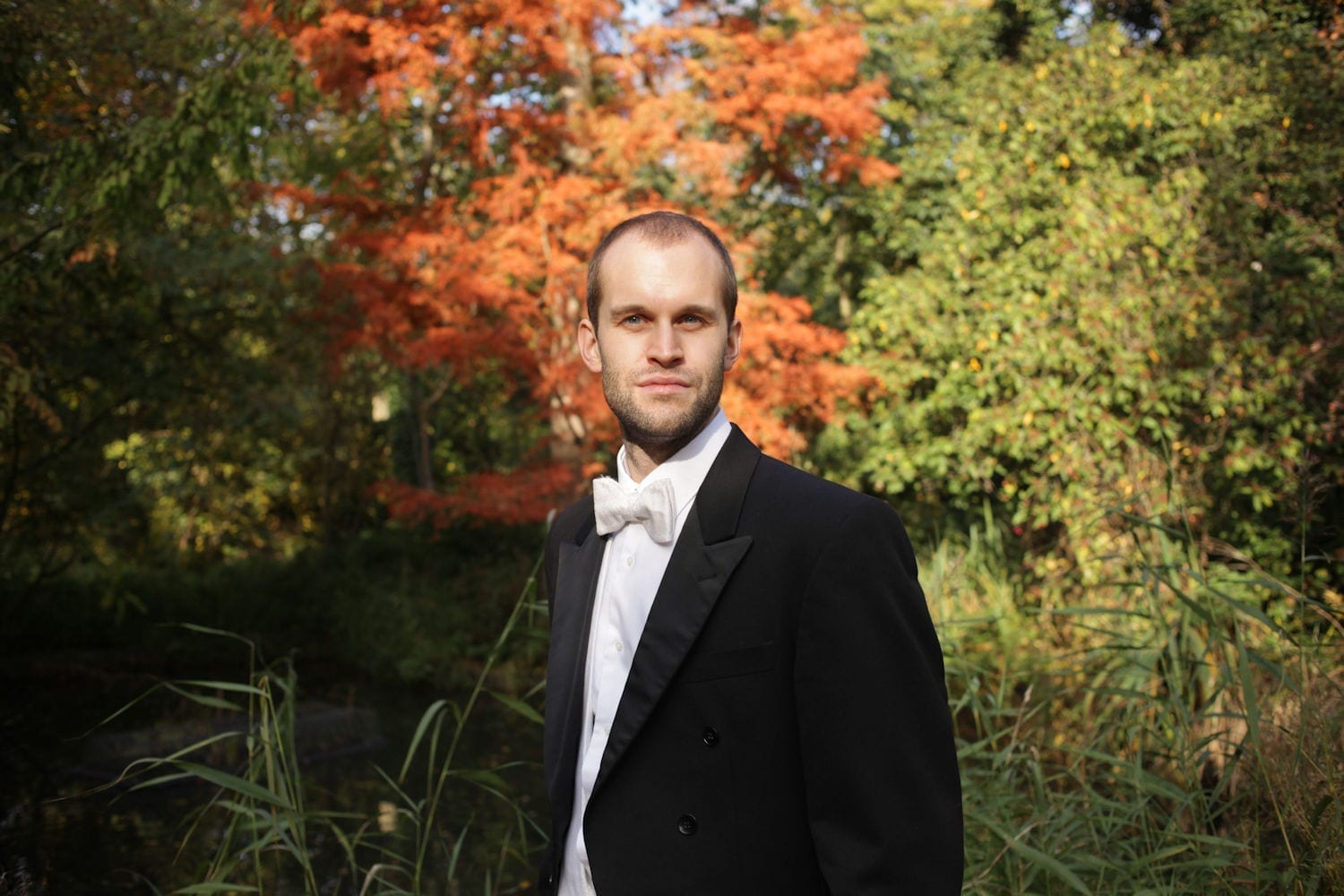
Born in Plymouth and later resident in Australia, Fredman (below) (1932-2014) set down Bax’s first two symphonies, together with Brian’s Sixth and Sixteenth Symphonies (Lyrita) that remain among the finest such recordings. He also made studio broadcasts of the present symphonies which, as John Pickard indicates in his detailed booklet notes, are among the most revealing of Brian performances from the period either side of the composer’s death – making them a natural inclusion for a series such as that now undertaken by the enterprising Heritage label.

What’s the music like?

This was the fourth hearing of the Eighth Symphony, coming after two live broadcasts with Adrian Boult in 1954 and one by Rudolf Schwarz in 1958. In many ways a template for what came after, its single span elides sonata-form and multi-movement design with a cohesion the greater for its overt unpredictability. The initial rhythmic figure (one of Brian’s most striking such openings) is not quite together, but thereafter Fredman exerts firm while never inflexible control over the interplay of martial dynamism and contemplative stasis, building its central climax superbly if losing momentum into the contrasted passacaglias – the second of which brings only a fugitive calm in its wake. Commercially recorded by Charles Groves in 1977 (EMI/Warner) and Alexander Walker (Naxos) in 2016, this work awaits public performance.

Preceded by live broadcasts with Norman del Mar in 1958 and ’59 (the latter now on Dutton), the Ninth Symphony features three continuous movements that outline a Classical framework. Fredman launches the initial Allegro with due impetus and charts a secure course through its quixotic changes of mood – the hushed transition into the reprise especially striking. He is no less focussed in a central Adagio whose musing reverie is constantly undercut by militaristic aggression, a reminder Vaughan Williams’s Sixth had appeared three years before, while the final Allegro tempers its festive cheer with a plaintive interlude which even the jubilant coda only just outfaces. Surprising that since Groves’ public performances in Liverpool and at the Proms in 1976, then his commercial recording a year later, this work has remained unheard.

The remaining performances are both world premieres of works which form outer parts of a symphonic triptych. Lastly barely 10 minutes, the Twenty-Second is (as its subtitle implies) the shortest of Brian’s cycle if hardly the least eventful. More impulsive than Lázsló Heltay with his 1974 recording (CBS/Heritage), let alone Groves in his spacious 1983 performance, Fredman teases out the eloquence of the initial Maestoso through to its fervent culmination, then brings a deft nonchalance to the ensuing Tempo di marcia such as makes contrast with its baleful climax the more telling. Brooding and fatalistic, the coda ranks among the finest passages in post-war symphonic literature and Fredman captures its essence. Walker comes close with his 2012 recording (Naxos), but this account effortlessly transcends its 52 years.

A pity Fredman never tackled No. 23, who three Illinois hearings by Bernard Goodman in October 1973 make it only the Brian symphony premiered outside the UK, but he did give the Twenty-Fourth. After its intense then impetuous predecessors, this one-movement piece feels more expansive for all its methodical ingenuity. The martial opening section is adroitly handled so its breezy extroversion reveals unexpected inwardness towards its centre then at its close; a whimsical and lightly scored interlude making way for the (relatively) extended adagio which, in its searching if often equivocal repose, brings both this work and those two before it to an affirmative end. Walker’s 2012 account (Naxos) enables all three symphonies to be heard in consecutive order, but the insights of this first performance remain undimmed.

Does it all work?

Almost always. Fredman has an audible grasp of Brian’s often elusive thinking, so that these performances unfold with a formal inevitability and expressive focus often lacking elsewhere. The Royal Philharmonic Orchestra betrays passing uncertainty with Brian’s more idiosyncratic touches, whereas the London Philharmonic Orchestra copes ably with what is among his most approachable later symphonies. Heritage has done its customary fine job opening out the sound, and anyone who knows these performances through the pirated Aries LPs will be delighted at the improvement.

Is it recommended?

Indeed. Those familiar with these symphonies from the studio recordings will find Fredman’s interpretations an essential supplement. Hopefully this series will continue apace, ideally with John Poole’s 1974 performance of the Fourth or Harry Newstone’s 1966 take on the Seventh.

For purchase information on this album, and to hear sound clips, visit the Heritage website. For more on the composer, visit the Havergal Brian Society – and for more on Myer Fredman, visit a dedicated page on the Naxos website

Preview – Hastings International Piano Competition: Prize Winners’ Gala Concert

If you live in London or the south of England and love the piano, then consider this: Did you know there is a fully-fledged, international piano competition right on your doorstep?

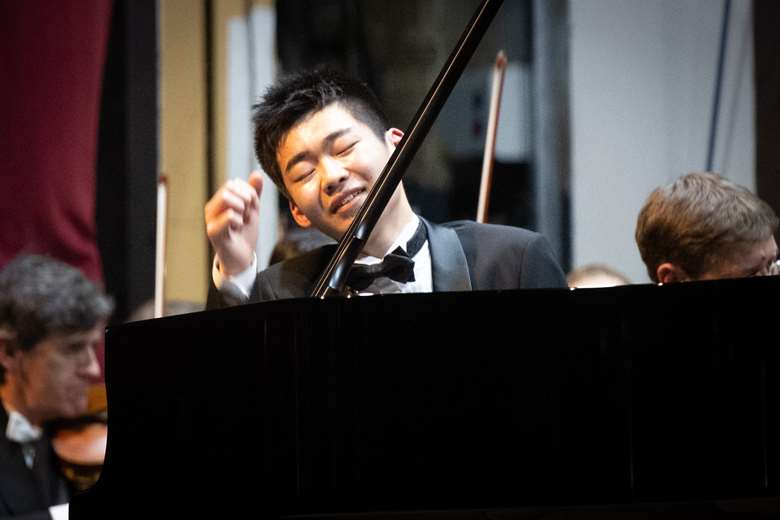
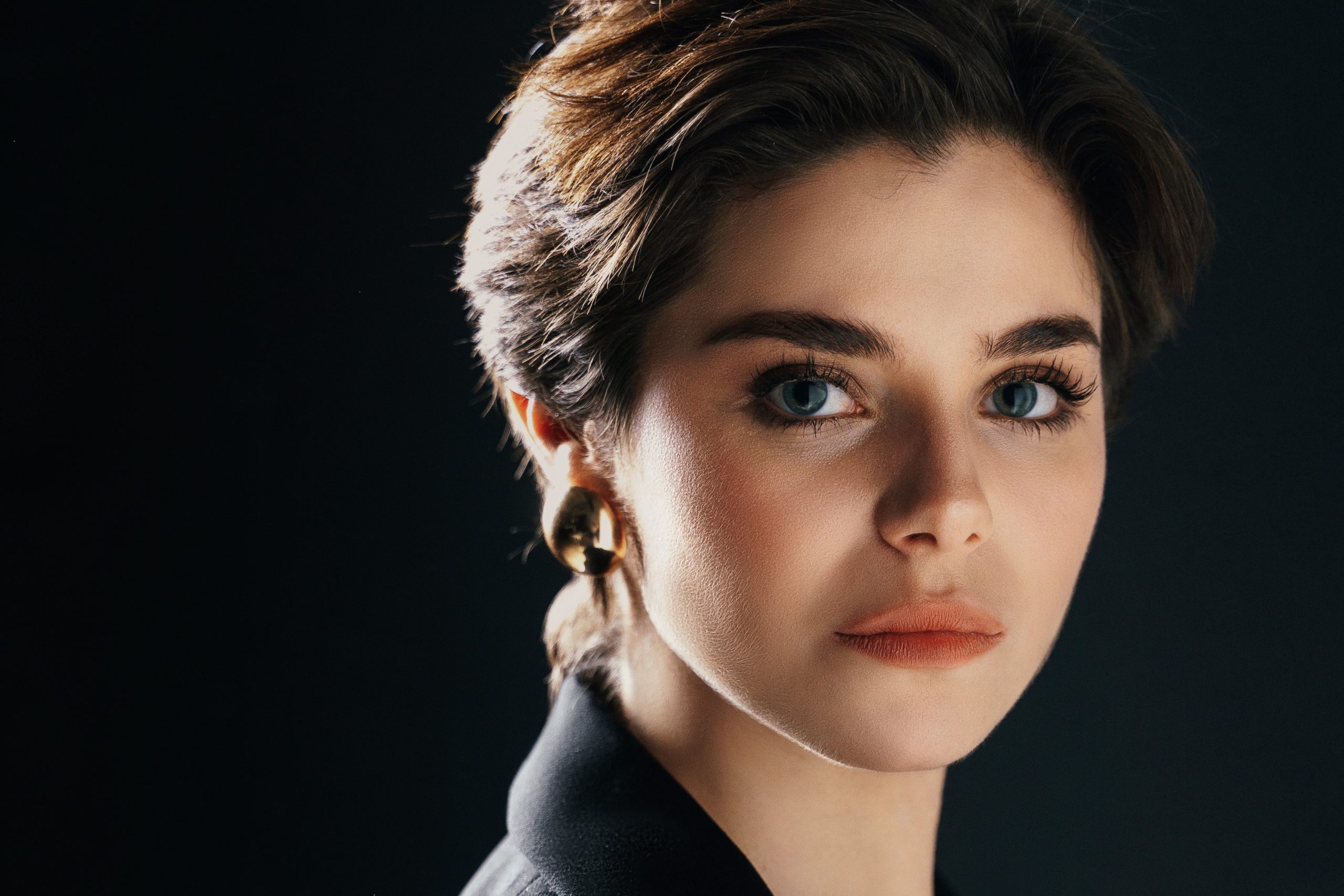
It is, of course, the Hastings International Piano Competition, hosting their Prize Winners’ Gala Concert at the White Rock Theatre in the town this Saturday 4 March. Performing at the concert, and accompanied by the Royal Philharmonic Orchestra under Rory Macdonald, will be two of the stars of last year’s competition. The winner, Japanese pianist Shunta Morimoto (above), will perform Beethoven’s Piano Concerto no.4, while third-placed Mariamna Sherling (below) will close the concert with Rachmaninov’s much-loved Rhapsody On A Theme of Paganini.

“It is a great honour for me to perform again on the historical stage of the White  Rock Theatre”, said Sherling. “The Royal Philharmonic Orchestra is absolutely incredible!  I was lucky to perform with this outstanding orchestra a year ago in the final of the Hastings International Piano Concerto Competition.  I can’t wait to collaborate with them again.”

Shunta, meanwhile, is similarly excited for his performance of the Beethoven. “It will be my greatest delight to bring to my performance with the Royal Philharmonic Orchestra all the beauties I have uncovered studying the 4th concerto of Beethoven. It will be my honour to share this with the public of my most beloved city in England.”

The Hastings International Piano Competition is under the authoritative guidance of Paul Hughes who moved to the role from his previous post as Director of the BBC Symphony Orchestra. The competition itself has its roots in the Hastings Music Festival, which dates all the way back to 1908 – and it evolved from the festival, growing at a startling rate. Last year’s competition, says Hughes, was its best yet. “Yes, very much so. We had a record number of applicants – 360 – and a truly international field.”

Morimoto’s winning concerto in the 2022 competition, says Hughes, “demonstrated his extraordinary musicality and the maturity of his playing, as well as meeting all the technical demands of that particular work. Beethoven’s Piano Concerto no.4 has parallels in that it requires a deep understanding of the music, exceptional phrasing and an appreciation of the architecture of the concerto; all qualities that Shunta has in abundance.”

The concerto will begin with Dvořák‘s effervescent Carnival Overture, while Tchaikovsky’s Romeo and Juliet Fantasy Overture opens the second half – a prelude to Sherling’s Rachmaninov. “Mariamna (above) is the possessor of a fabulous technique, a razor-sharp mind and a sense of fun”, says Hughes. “I am expecting she will employ all of this to demonstrate many facets of Rachmaninov’s set of variations.”

Hastings has a reputation of being ‘The Friendly Competition’, which Hughes attributes to “a combination of the efficient organisation of HIPCC combined with the warmth of the community whose hospitality in looking after and supporting the young pianists at every stage of their progress through the competition makes such a difference. It is also the friendliness and openness of the jury who share insights and give constructive feedback to the competitors.”  

Following the contestants after the competition has finished is imperative. “That is an important part of the Hastings International Piano experience”, he stresses. “We follow, support and offer performance opportunities to our pianists, and not just the finalists.” When choosing the winners, he says that “formally we don’t discuss the artists as a group of jurors.  The range of experience within the jury means we are all looking for different aspects of a performance, and make our selections individually.”

Hughes (above) considers the future of the competition to be rosy. “Professor Vanessa Latarche was President of the jury in 2022 and fulfilled that role magnificently.  She is now Artistic Director of Hastings International Piano and so I am confident we will attract an even wider range of pianists from across the world. One of the elements of the competition that distinguishes it from many others is that it focuses predominantly on the piano concerto; to that end we have conductor Rory Macdonald returning to conduct not just the finals,  but also the semi-final round.   One further innovation new to the Hastings competition is that we are commissioning a new piano solo work that each competitor will be required to perform in their solo recital round.”

These exciting developments are a natural progression from Paul’s previous role with the BBC Symphony Orchestra. “In my role there I have worked with and presented very many pianists, from early career new generation artists to the most distinguished pianists working today.    I have commissioned new work for them, supported and developed long term relationships with these amazing artists and fostered a sense of loyalty that I believe is so important in our profession. I am calling on all those experiences in Hastings to create a platform where we can discover, support and nurture young pianists and engage the Hastings community in the wonderfully exciting journey of a young pianist from competition to the very top of the profession.”

You can book tickets for The Hastings International Piano Competition Prize Winners’ Gala Concert by clicking on the link. Meanwhile the Piano Concerto Competition will return in February-March 2024 – with updates appearing on the competition website

In Concert – Soloists, City of London Choir, Royal Philharmonic Orchestra – Hilary Davan Wetton: Vaughan Williams & Ravel

Anita Watson (soprano), Maya Colwell (mezzo-soprano), John Cuthbert (tenor), Ashley Riches (bass-baritone), City of London Choir, Royal Philharmonic Orchestra / Hilary Davan Wetton

Ravel Menuet antique (1895, orch. 1929)
Vaughan Williams Serenade to Music (1938)
Ravel Le Tombeau de Couperin (1914-17, orch. 1919)
Vaughan Williams Dona nobis pacem (1936)

Cadogan Hall, London
Thursday 10 November 2022

Reviewed by Ben Hogwood

This concert deftly assembled a number of threads to bring the Royal Philharmonic Orchestra’s celebration of RWV150 – the handy abbreviation for Vaughan Williams‘ birth anniversary year – to a close.

Vaughan Williams studied with Ravel in Paris in 1908. Just over a decade later, the lives of both men had been altered forever by the First World War. It affected both of them deeply – Ravel in a brief stint as a lorry driver and Vaughan Williams as an ambulance driver and artillery officer in France.

Both Le Tombeau de Couperin and Donna nobis pacem are affected by their experiences, but first we heard another act of musical remembrance in Ravel’s charming Menuet antique. Written in memory of Chabrier, this bittersweet work presents a winsome smile while it dances, but darker thoughts lurk in the middle ground, expressed through the gruff voices of lower woodwind. Hilary Davan Wetton conducted a sprightly reading, though it took a little while for the RPO to settle. After a soft-centred middle section, the second reading of the Menuet itself was on much firmer ground.

Le Tombeau de Couperin is both a commemoration and celebration of French baroque music, but its deeply personal connections mark the passing of Ravel’s mother in 1917 as well as close friends lost to the First World War. Originally written for piano, the suite comprises six movements, four of which the composer arranged for orchestra, his painterly touch evident at every turn.

This was a touching performance, led by a fine contribution from RPO oboist Timothy Watts, who led off the Prélude with beautifully flowing phrases. The orchestra responded with silvery strings and harp, the music shimmering but shivering too. The personal reverberations were close to hand in the underlying sadness of the Forlane, which nonetheless danced with poise and grace. The Menuet, taken relatively quickly, found time to express its innermost feelings in the thoughtful trio section, while the Rigaudon gained a spring in its step, bouncing along but soon checked by the sparse textures of its central section. This was a fine performance, earning the RPO woodwind a deserved curtain call of their own.

Vaughan Williams’ Serenade to Music is a softly voiced tribute to Sir Henry Wood’s Golden Jubilee as a conductor. In recognition, the composer sets the scene between Lorenzo and Jessica from Act Five of Shakespeare’s The Merchant of Venice. It is a versatile piece, written initially for 16 selected soloists but performed here by four singers and the sensitively controlled voices of the City of London Choir, who revelled in the cushioned carpet of sound Vaughan Williams creates. This was established by an affectionate solo from orchestra leader Duncan Riddell, establishing the serenity of D major under Davan Wetton’s watchful eye.

The balance between choir and orchestra, tricky to achieve in the Cadogan Hall, felt just right – as did the poise of soprano Anita Watson (above), floating up to the high ‘A’s with impressive control. She was aided by fine contributions from Maya Colwell, John Cuthbert and Ashley Riches, whose bass-baritone had a particularly attractive, rounded quality.

Two years prior to the Serenade, Vaughan Williams completed Dona nobis pacem, whose very different outlook reflects the worrisome mood in Britain and Europe in the mid-1930s. The composer’s dread of war, heightened by his experiences 20 years hence, was palpable in the central setting of Dirge For Two Veterans, using part of Walt Whitman’s poem Drum Taps in music that ironically dates from 1911.

Dona nobis pacem brings together texts from both sacred and secular sources, anticipating Benjamin Britten’s War Requiem some 26 years later, which used a similar tactic to startling effect. Here Vaughan Williams’ ‘catharsis’ – as Hilary Davan Wetton eloquently referred to it – received a heartfelt performance, anchored by Anita Watson’s recurring pleas for peace as the soprano soloist. The choir echoed these sentiments, but in a more fretful manner as they reflected on previous losses through Whitman’s poetry.

The music was remarkably prescient for our times, and the cautionary snare drum strokes bringing in the Dirge held a Mahlerian tension that stayed long in the memory. So, too, did the setting of Beat! Beat! Drums! (from the same Whitman poem), which was reached through a dramatic turn of the page from the full Agnus Dei plea. There was exultation from the choir, but also a constant ache beneath the surface.

Watson and Ashley Riches (above) were surefooted and expressive soloists, while Davan Wetton ensured the combination of choir and orchestra captured that wonderful sheen that Vaughan Williams can achieve when writing for the combined forces. The percussion, awkwardly hidden beneath the Cadogan Hall balcony with the organ, made a telling contribution as the dreaded ammunition, which was finally silenced as the peace for which we all surely strive came to pass at the end. The rapt closing bars were pure in their sincerity, soprano and acapella choir achieving an ideal balance and fade.

Before the Dona nobis pacem, Hilary Davan Wetton spoke briefly to the audience on the importance of the arts in the wake of a slew of funding cuts and falling attendances. As he so subtly reminded us, how lucky we are that in times of war in Europe and further afield we can still attend and enjoy concerts in person. It is a privilege never to be taken for granted, particularly on nights of Remembrance such as this.

From closed doors to a heavenly host: The completion of a Mahler symphony cycle

by John Earls pictures (c) Andy Paradise

Two years ago, in the midst of the pandemic, I wrote a piece for Arcana FM on ‘Mahler’s Eighth and coming out of COVID-19’. I concluded by saying that I wouldn’t get to see a performance of this epic ‘Symphony of a Thousand’ – and complete my personal Mahler live symphony cycle – any time soon, but that when I did it would have a very particular significance.

I certainly didn’t know that the performance would be by the Royal Philharmonic Orchestra conducted by Vasily Petrenko at the Royal Albert Hall on a Sunday afternoon in late October 2022, a concert that was itself rescheduled due to the pandemic.

And what a performance it was. The Royal Albert Hall could be said to be purpose built for this work, accommodating not just an expanded orchestra (including seven off-stage brass players in the gods) but three choirs, two boys’ choirs, eight soloists and a huge concert organ (the Royal Albert Hall’s was once the largest instrument in the world).

You get the full blast of the organ from the off with the tumultuous opening of Part 1’s Veni Creator Spiritus. It’s quite a ride from there on in, and Petrenko and the RPO handled it superbly all the way through to the powerful finale of Part 2’s setting of the end of Goethe’s Faust. This was not just about the big sections, the delicate moments were deftly done too.

But this work is really all about the singing, and the assembled choirs of the Philharmonia and Bournemouth Symphony Choruses and City of London Choir, as well as the Tiffin Boys’ Choir and Schola Cantorum of the Cardinal Vaughan Memorial School were magnificent.

And it wasn’t just the massed voices, as glorious as they were. The soloists – and let’s name them (above): Sarah Wegener (Magna Peccatrix), Jacquelyn Wagner (Gretchen), Regula Mühlemann (Mater Gloriosa), Jennifer Johnston (Mulier Samaritana), Claudia Huckle (Mary of Egypt), Vincent Wolfsteiner (Doctor Marianus), Benedict Nelson (Pater Ecstaticus) and James Platt (Pater Profundus) – were excellent too.

I made the point in my earlier piece that there is something about the combination of the mass assembled forces performing together and being joined by an audience in an even bigger collective. I think the standing ovation from the near sell-out crowd at the end was testimony to this.

Mahler’s Eighth is definitely one of those pieces that you need to see performed live. I’m so glad that I finally did.

John Earls is Director of Research at Unite the Union and tweets at @john_earls