
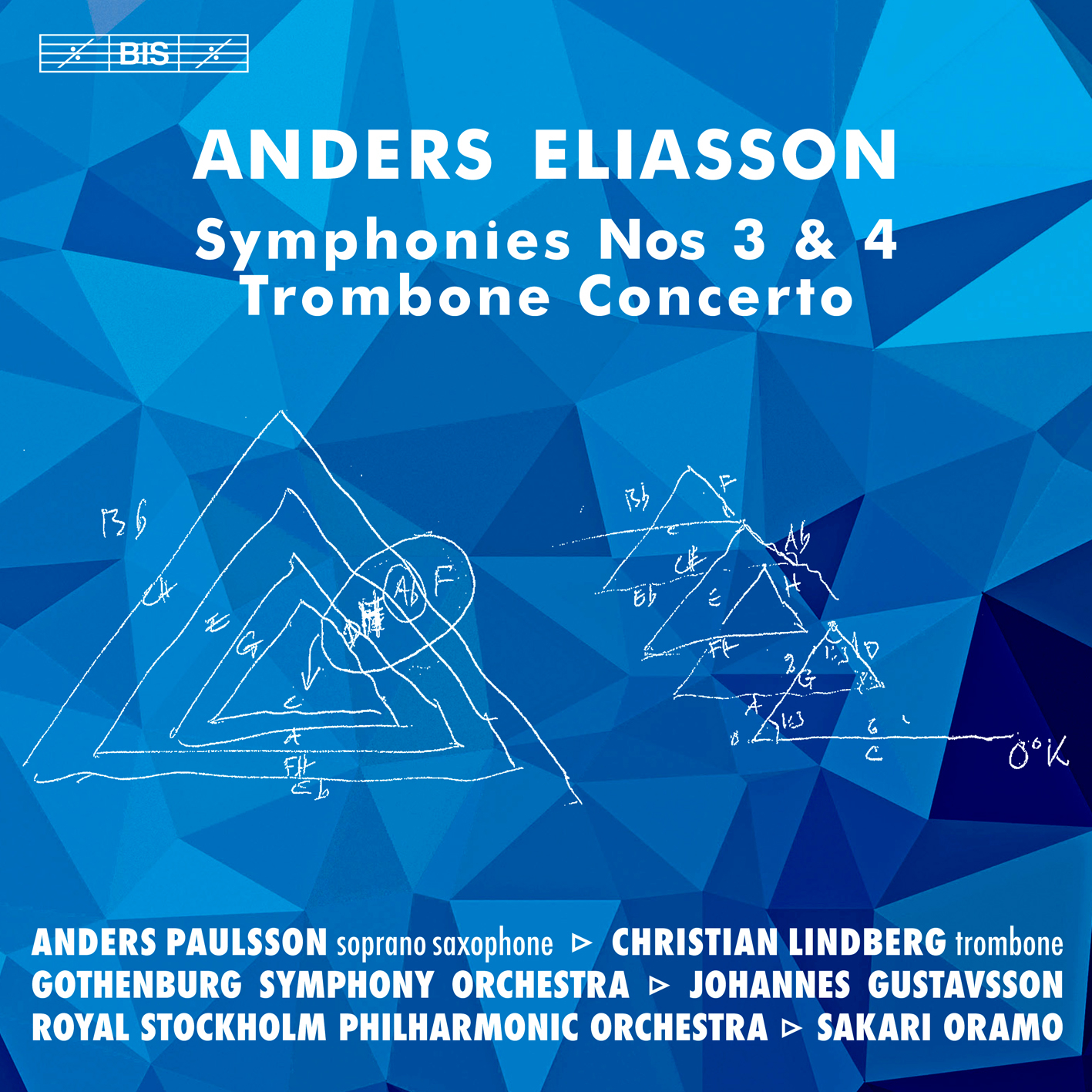
Anders Eliasson
Symphony no.3 (1989/2010) (a)
Symphony no.4 (2005) (b)
Trombone Concerto (2000) (c)
Anders Paulsson (soprano saxophone) (a), Christian Lindberg (trombone) (c), Gothenburg Symphony Orchestra / Johannes Gustavsson (a), Royal Stockholm Philharmonic Orchestra / Sakari Oramo (b) and (c)
BIS 2368SACD [77’03”]
Producers Thore Brinkmann (a) Hans Kipfer and Mats Engström (b) and (c) Engineers Andreas Ruge (a), Fabian Frank (b), Mathias Spitzbarth (c)
Dates: (a) – 8-10 November 2017, Concert Hall, Gothenburg; (b) 23 September 2011, (c) 11 January 2020, Konserthuset, Stockholm
Reviewed by Richard Whitehouse
What’s the story?
BIS issues a follow-up to its ‘4 X Anders Eliasson’ (BIS2270) in this no less fine collection of his Third and Fourth Symphonies – together with a first recorded outing for the Trombone Concerto and featuring musicians who have long been associated with the Swedish composer.
What’s the music like?
Anders Eliasson (1947-2013) enjoyed an ambivalent relationship with the symphony. Among the most notable debuts in the genre of the post-war era, his First Symphony (1986, recorded on Caprice under CAP 21381) prompted a successor as failed to progress beyond sketches, with the Fourth intended as initial part of a trilogy that never materialized due to his untimely death, though the Fifth was commissioned with a date set for its premiere. There are also two chamber symphonies, with the violin concerto Solitary Journey (2010) arguably a symphony in all but designation.
Written for and frequently performed by American-born saxophonist John-Edward Kelly, the Third Symphony was written for alto (Neos NEOS11301) but later revised for soprano sax. Despite Kelly’s objections, this latter instrument undeniably merges even more effectively within its orchestral context. Anders Paulson has its measure as he traverses its five continuous sections – from an agitatedly expectant Quest, via the guardedly expressive Solitude and assaultive Shudders, to a plaintively affecting Sad before dissolving into the postlude that is Mists.
A decade on and the Trombone Concerto continues this integrative and inherently symphonic approach. As with Eliasson’s earlier concertos there are three continuous movements, though here a slow-fast-slow sequence opens with a ruminative Adagio that acts as ‘prologue’ to an extensive Allegro moderato whose frequent restraint yet requires a dexterity and incisiveness such as dedicatee Christian Lindberg typically meets head-on. A keen momentum is no less evident across its eventful course, prior to the ruminative Lento that duly serves as ‘epilogue’.
One of Eliasson’s most often heard works since its Munich premiere, the Fourth Symphony is among his most characteristic in its formal and expressive aims. Here a powerfully wrought Allegro summons up some of this composer’s most uninhibited music; evolving with no little motivic ingenuity to an Adagio whose concertante role for flugelhorn, eloquently rendered by Joakim Agnas, exudes a wistfully evocative tone. A scherzo-like section marked ‘threatening’ then builds to a climax, from where a brief Adagio returns the flugelhorn for a subdued envoi.
Does it all work?
Yes. Although his music could never be mistaken for that of his predecessor Allan Pettersson, Eliasson was similarly unequivocal in a musical language whose seriousness of purpose does not preclude lightness of touch or barbed humour. The latter two pieces here find his idiom at its most refined, unfolding with a cumulative inevitability that could be thought Nordic in its ethos. Performances are uniformly committed, and hopefully Sakari Oramo might yet take the Fourth Symphony to London in his ongoing association with the BBC Symphony Orchestra.
Is it recommended?
Indeed. The sound is on a par with BIS’s numerous other recordings from its Gothenburg and Stockholm venues, with Peter Kislinger’s annotations as informed and insightful as expected given his long-time advocacy of Eliasson’s music. Further such releases would be welcome.
For further information and purchasing options, visit the BIS website For more information on Anders Eliasson, click here, while you can click on the artist names for the websites of Anders Paulsson, Christian Lindberg, Johannes Gustavsson and Sakari Oramo, the Gothenburg Symphony Orchestra and the Royal Stockholm Philharmonic Orchestra
 The final Ask The Audience from the 2017 BBC Proms is with Leanne Mison, who promotes and endorses an impressive roster of electronic music artists for Bang On PR. Leanne talks to Arcana about a Prom given by the Royal Stockholm Philharmonic Orchestra and their chief conductor Sakari Oramo, – with two solo vocal turns from the superstar New York soprano Renée Fleming.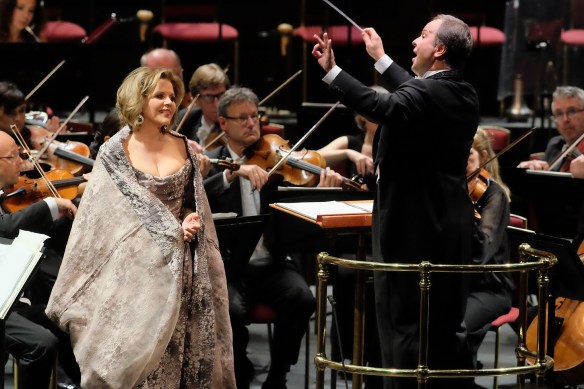
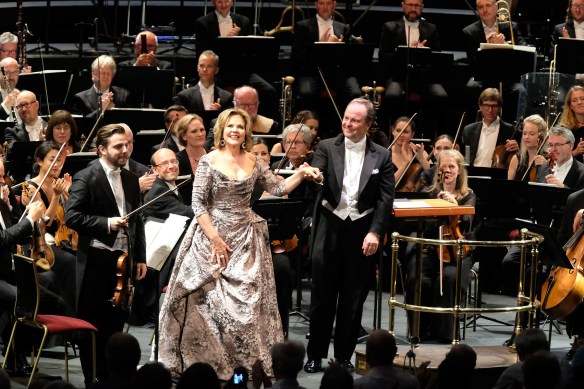 Fleming’s contributions grouped into a loose theme of distant light and transformation. Barber’s Knoxville: Summer of 1915 is a love letter to the American home, and its dappled evening sunlight flickered beautifully under the hands of Oramo, the composer’s warm harmonies setting the scene for Fleming’s characteristically full bodied interpretation. She inhabited the storyteller’s guise with effortless and instinctive calm, though the animated middle section was also very well judged. With just the right amount of sentimentality, this was an ideal performance, and an aptly chosen encore of the song Sure on this shining night blazed a similar trail.
 Finally we heard Carl Nielsen’s Second Symphony, ‘The Four Temperaments’, receiving its second Proms performance in three years after the festival’s complete neglect of it in the 20th century. It is a powerful piece, and this account made a strong impression. Although the feverish first movement (Choleric) was convincing and brilliantly played the emotional centre lay in the Melancholic third movement, where Oramo wrought music of impressive angst and depth. Nielsen’s struggles were resolved by the Sanguine finale, where the composer lets rip perhaps a little too easily, but again the structure and the melodic groups made perfect sense. Oramo has built a strong affinity with the Danish composer’s music over the years, and there was something very satisfying in these days of disunity at seeing a Finn conduct a Swedish orchestra in Danish music.
 Arcana.fm