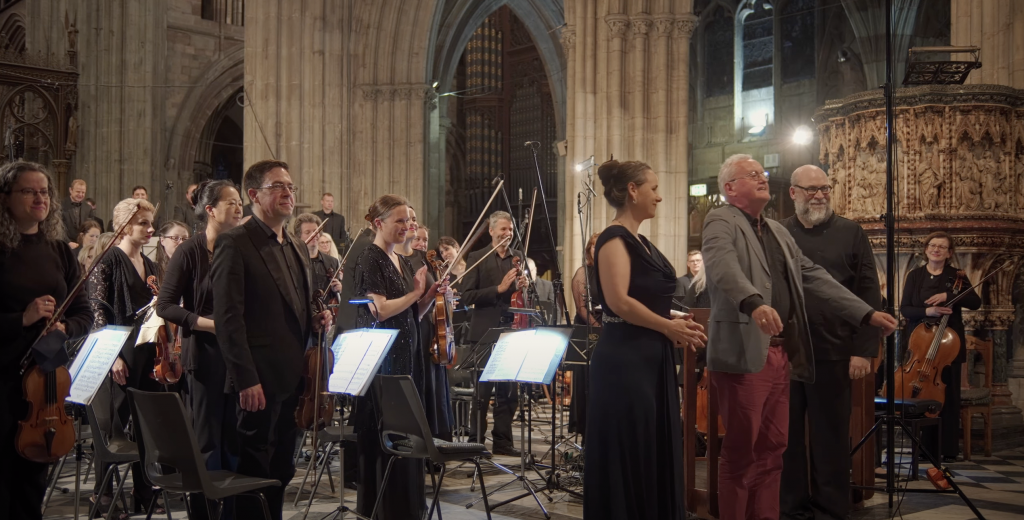
The latest addition to ESO Digital, the online concert arm of the English Symphony Orchestra, is the world premiere performance of Wreck, the orchestral piece by Steve Elcock.
This is the concert Arcana’s Richard Whitehouse saw at the 2022 Elgar Festival, at the Malvern Theatres in Great Malvern. You can read his review here.
Described by its composer as ‘‘a message of salvation beyond despair, of consolation beyond grief’’, Wreck is performed by mezzo-soprano Kathryn Rudge, with the English Symphony Orchestra conducted by Kenneth Woods. Click here to go to the ESO website and watch the performance.
Nimbus NI6446 [56’24’’] Producer and Engineer Phil Rowlands Recorded 28 July 2021 (Symphony), 26 May 2022 (Violin Concerto) at Wyastone Concert Hall, Monmouth
Reviewed by Richard Whitehouse
What’s the story?
The English Symphony Orchestra and Kenneth Woods add to their much lauded 21st Century Symphony Project with this release devoted to Steve Elcock (b.1957), juxtaposing two major works which confirm his standing among the leading European symphonists of his generation.
What’s the music like?
Both works heard here only gradually assumed their definitive form. Composed at stages over almost a decade, the Violin Concerto marks something of a transition between less ambitious pieces for local musicians and those symphonic works which have come to dominate Elcock’s output. Its initial Allegro vivo is a tensile sonata design whose rhythmic energy is maintained throughout, with enough expressive leeway for its second theme to assume greater emotional emphasis in the reprise. There follows a Molto tranquillo whose haunting main theme, at first unfolded by the soloist over undulating upper strings in a texture pervaded by change-ringing techniques, is a potent inspiration. A pavane-like idea soon comes into focus while the closing stage, reaching an eloquent plateau before it evanesces into silence, stays long in the memory. The short but eventful finale is a Passacagliawhose theme (audibly related to previous ideas) accelerates across five variations from Andante to Presto, before culminating in a heightened cadenza-like passage on violin and timpani then a peremptory yet decisive orchestral pay-off.
The Eighth Symphony has its antecedents even further back, having begun as a string quartet in the early 1980s, though it continues those processes of evolution and integration central to the seven such works which precede it. It reflects the impact of the Sixth Symphony by Allan Pettersson (still awaiting its UK premiere after 58 years), but whereas that epic work centres on fateful arrival, Elcock’s single movement is more about striving towards a destination that remains tantalizingly beyond reach. Numerous pithy motifs are stated in the formative stages, as the music alternates between relative stasis and dynamism before being thrown into relief by the emergence (just before the mid-point) of a trumpet melody that goes on to determine the course of this piece as it builds inexorably towards a sustained climax then subsides into a searching postlude. Overt resolution may have been eschewed, yet the overriding sense of cohesion and inevitability duly outweighs that mood described by the composer as ‘‘one of desperation in the teeth of impending catastrophe’’ which, in itself, becomes an affirmation.
Does it all work?
Certainly, given both works receive well prepared and finely realized performances – notable for the way Elcock’s demanding yet idiomatic string writing is realized with real conviction. The concerto is a tough challenge for any soloist and one Zoë Beyers meets with assurance – its close-knit interplay of soloist and orchestra brought off with admirable precision, and its occasional modal subtleties rendered as enrichments of the tonal trajectory. Elcock has been fortunate in his recorded exponents, and this new ESO release is emphatically no exception.
Is it recommended?
Indeed, and good to hear that, as the ESO’s current John McCabe Composer-in-Association, Elcock will feature on a follow-up issue of his pieces Wreck and Concerto Grosso, along with the recent Fermeture. For now, this latest release warrants the strongest of recommendations.
Steve Elcock String Quartets – The Girl from Marseille, Op. 17 (2010); The Cage of Opprobrium, Op. 22 (2014); Night after Night, Op. 27 (2017); The Aftermath of Longing, Op. 36 (2021)
Tippett Quartet [John Mills & Jeremy Isaac (violins), Lydia Lowndes-Northcott (viola), Božidar Vukotić (cello)]
Toccata Classics TOCC0688 [80’31”]
Producer Michael Ponder Engineer Adaq Khan
Recorded 6-8 October 2022, Studio TQHQ, Ruislip, London
Reviewed by Richard Whitehouse
What’s the story?
Toccata Classics continues its survey of Steve Elcock (b1957) – arguably its most important ongoing project – with this collection of his four (to date) string quartets, performed by the enterprising Tippett Quartet and reaffirming his stature among composers of his generation.
What’s the music like?
Elcock is not the first composer to eschew numbering his quartets (Daniel Jones, for instance, differentiated his eight by date), with The Girl from Marseille preceded by at least four such works (one of these refashioned into his Eighth Symphony). Coming after weighty pieces as the Second and Third Symphonies (the latter on TOCC0400), these eight diverse variations in search of a theme – its identity in the title – find his music at its most playful and entertaining, though the fractious final variation pointedly invokes the brutal origins of its source material.
It was the location of this work’s first performance that provided ‘inspiration’ for The Cage of Opprobrium, namely a 16th-century metal pillory used to incarcerate women found walking unaccompanied after dark. Its five continuous sections graphically evoke the imagined victim through alternate slow and fast sections – building towards a violent culmination (its alluding to a famous quartet less striking than the way in which this music is transformed into Elcock’s own), before subsiding into a postlude where mourning is informed by emotional exhaustion.
Emerging in a relatively long gap between Elcock’sFifth and Sixth Symphonies (TOCC0445 and TOCC0616), Night after Night takes its cue from the poem in Robert Louis Stevenson’s Songs of Travel. The first of its six continuous sections, entitled ‘Somniloquy’, evokes those unbidden thoughts of a chronic insomniac then returns between episodes of a more volatile nature. Its climax comes in the aggressive final ‘Incubus’ (later extended into an autonomous orchestral piece), which elides between sleep and wakefulness without hope of reconciliation.
Elcock’s most recent quartet, The Aftermath of Longing is likewise in six continuous sections but is very different in mood. It is also the most inherently abstract of these works, moving fitfully between varying degrees of emotional ambivalence to a penultimate episode whose releasing of the pent-up intensity results only in a desolate recollection of the initial music. Something of its character can be sensed in the composer’s subsequent symphonies, notably the Ninth that is his largest such work to date and may well prove to be his most impressive.
Does it all work?
Indeed, it does and not least because Elcock has put his formative years of playing the violin to profitable use with his idiomatic and resourceful writing for strings. For all their technical demands, nothing is left to chance in these quartets which are evidently building into a cycle scarcely less involving than that of the symphonies. Suffice to add the Tippett Quartet, which premiered Night after Night, proves an assured and persuasive exponent while the running order, of 2-1-4-3, makes for a programme well worth experiencing as a continuous sequence.
Is it recommended?
Very much so. Sound is vivid and detailed, if a little confined in more tumultuous passages, while the composer’s notes are informative without prejudicing the response of each listener. Hopefully these quartets will be taken up by other suitably equipped and inquiring ensembles.
Zoë Beyers (violin), English Symphony Orchestra / Kenneth Woods
Filmed at the Wyastone Concert Hall, Monmouth, Thursday 26 May 2022. Producer Phil Rowlands / Videographer Tim Burton
by Richard Whitehouse
The English Symphony Orchestra’s online schedule got off to a fine start for this year with a studio account of the Violin Concerto by composer-in-association Steve Elcock. It may have taken shape across nearly a decade, but the work is no less impressive for that. It also marks something of a transition from less ambitious pieces, often conceived with local musicians in mind, to the symphonic works as have recently been performed and recorded to great acclaim – whose formal as well as expressive concerns it anticipates and shares in various instances.
The concerto opens with an Allegro vivo whose rhythmic energy is maintained throughout, yet with sufficient contrast for its second theme to assume greater emotional emphasis in the reprise, prior to a forceful conclusion. The undoubted highlight is a Molto tranquillo whose haunting main theme, first unfolded by the soloist over undulating upper strings in a texture evidently inspired by change-ringing techniques, is a memorable inspiration. A pavane-like idea latterly comes into focus and the closing stage, which opens onto an eloquent plateau before evanescing almost regretfully into silence, lingers long in the memory. The finale is a relatively taut passacaglia whose theme accelerates through five variations from Andante to Presto, culminating in a combative ‘cadenza’ for violin and timpani then a decisive pay-off.
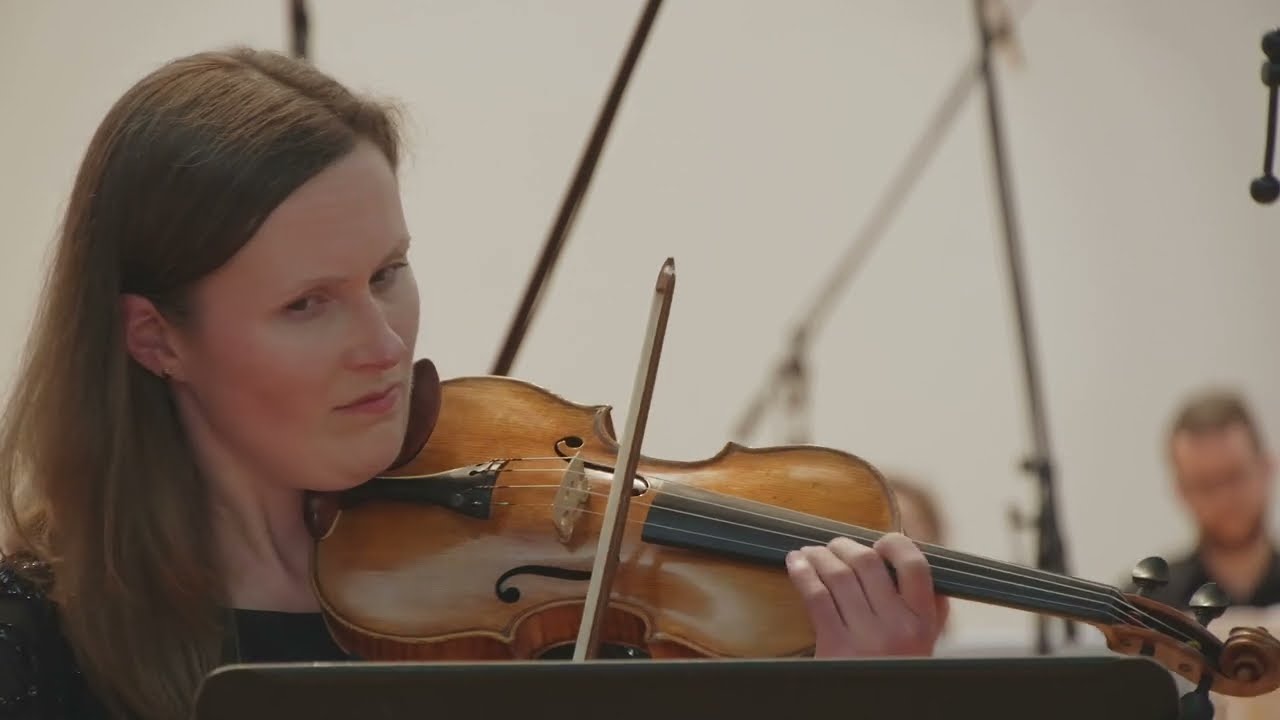
A tough challenge, indeed, for any soloist and one such as Zoë Beyers and the ESO, under Kenneth Woods, met with assurance over its 33 minutes. Aside from its sheer velocity, the first movement is notable for a close-knit interplay between soloist and orchestra here brought off with admirable precision, while the modal subtleties of the slow movement were deftly rendered as enhancements to its overall tonal trajectory. If its sequence of accelerating variations seemed to be over rather too soon, the finale was nevertheless a cohesive entity that saw this piece to a defiant conclusion.
Good to hear that this performance will be released commercially in due course, as a coupling for the Eighth Symphony which the ESO premiered in 2021 and the tone poem Wreck it gave last year – hence making for a persuasive overview of this increasingly significant composer.
Mendelssohn Calm Sea and Prosperous Voyage Op.27 (1828) Elcock Wreck Op.10 (1998) [World Premiere] Britten Four Sea Interludes from Peter Grimes Op.33a (1945) Elgar Sea Pictures Op.37 (1899)
Kathryn Rudge (mezzo-soprano), English Symphony Orchestra / Kenneth Woods
Malvern Theatres, Great Malvern Saturday 15 October 2022
Reviewed by Richard Whitehouse
This first full-length concert in the English Symphony Orchestra’s new season focussed on the sea in all its varied qualities, taking in four works whose encompassing a span of almost two centuries also identified crucial aesthetic differences as to what music itself can express.
Not least as it comes between masterpieces of the early Romantic era (A Midsummer Night’s Dream and The Hebrides), Mendelssohn’s Calm Sea and Prosperous Voyage has often been overlooked on its own merits. Yet this concert overture, as inspired by two of Goethe’s best- known poems, is a fine example of the still-teenage composer’s prowess – Kenneth Woods securing a rapt intensity in its introductory phase, then steering its characterful continuation through to a grand while not unduly bathetic peroration with the sea accorded the final word.
From here to Steve Elcock’s Wreck is to encounter more elemental, even existential forces – what the composer refers to as a ‘‘symphonic allegory’’ portraying a ship’s struggle against intemperate weather at sea. This unfolds as a constantly evolving design, juxtaposing music of unchecked aggression with that of fraught serenity, while highlighting Elcock’s mastery of large-scale formal and expressive contrasts, toward a seismic culmination whose gradual subsidence makes possible the sustained closing section. Here, off-stage mezzo sings in an invented (hence unknown) language what he describes as ‘‘a message of salvation beyond despair, of consolation beyond grief’’ but even this is tempered by encroaching doubt. The ESO gave its all in a piece as demonstrably commended itself to the appreciative audience.
Marine vignettes rather than epics came after the interval. Woods had an audible grasp of the diverse moods in the Four Sea Interludes that Britten drew from his opera Peter Grimes, but more notable was his successful segueing between them – the keening plangency of Dawn leading into the equivocal assurance of Sunday Morning, emergent tonal and emotional blur of Moonlight, then the visceral conflict of Storm with its yearning oasis of calm and brutal closing onslaught. A few failings of ensemble hardly offset the intent continuity of the whole.
The ESO previously recorded Elgar’s Sea Pictures in an arrangement with chorus by Donald Fraser, but it was good to hear this song-cycle as Elgar realized it for mezzo – not least when Kathryn Rudge (taking her customary place at front of stage) proved so eloquent an exponent. The troubled pathos drawn from Roden Nole’s Sea-Slumber-Song was duly complemented by the whimsical charm of Alice Elgar’s In Haven (Capri) – tension rising accordingly for Elizabeth Barrett Browning’s Sabbath Morning at Sea, its larger emotional contrasts well defined. Expressive nuances in Richard Garnett’s Where Corals Lie might have been more subtly pointed, but there was no doubt as to Rudge’s identification here or in Adam Lindsay Gordon’s The Swimmer with its anxious though determined progress to certain affirmation.
It set the seal on a rewarding programme and fine start to what will hopefully be an eventful season for the ESO. More concerts will be announced soon, but for now the recent release of Adrian Williams’s First Symphony (Nimbus NI6432) confirms this as an orchestra on a roll.




 Arcana.fm