In concert – Guy Johnston, Britten Sinfonia / Thomas Gould @ Barbican Hall: The Protecting Veil

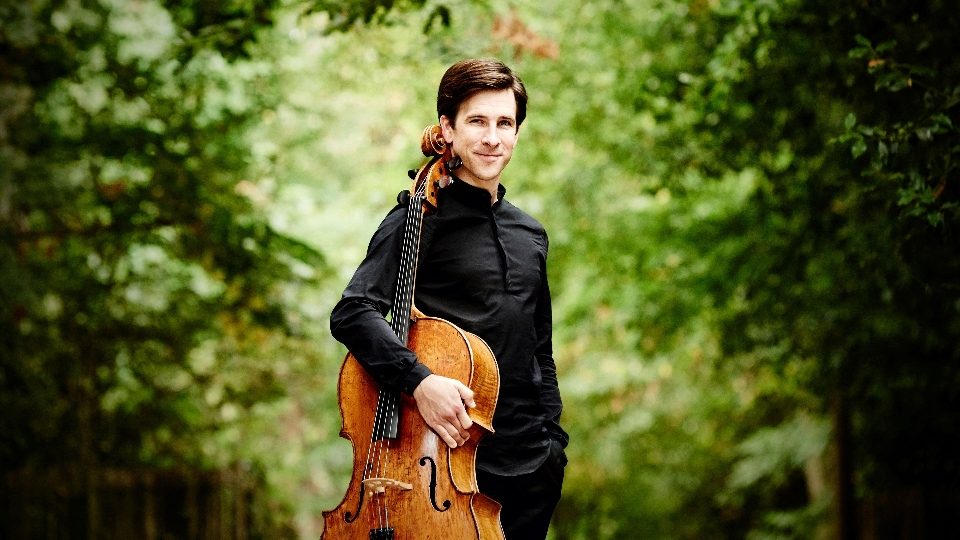
Guy Johnston (cello, above), Britten Sinfonia / Thomas Gould (violin)

Beethoven arr. Weingartner Grosse Fuge Op.133 (1826)
Bartók Divertimento for String Orchestra Sz113 (1939)
Tavener The Protecting Veil (1988)

Barbican Hall, London
Thursday 15 February 2024

Reviewed by Ben Hogwood

The Protecting Veil is a special piece. Written by John Tavener in 1988, this musical meditation for cello and orchestra is based on and inspired by the Greeks resisting Saracen invasion in the early tenth century. They are heartened by a vision of Mary, the Mother of God, surrounded by a host of saints and spreading out her Veil as a protective shelter over the Christians.

In what is effectively a single-movement concerto, the cello represents the Mother of God, leading the string orchestra in eight prayerful chapters that respond to landmark events in which she is present. It may sound elegiac and deeply ambient for much of its duration, but to achieve this elevated state the performers require poise, concentration and inner strength.

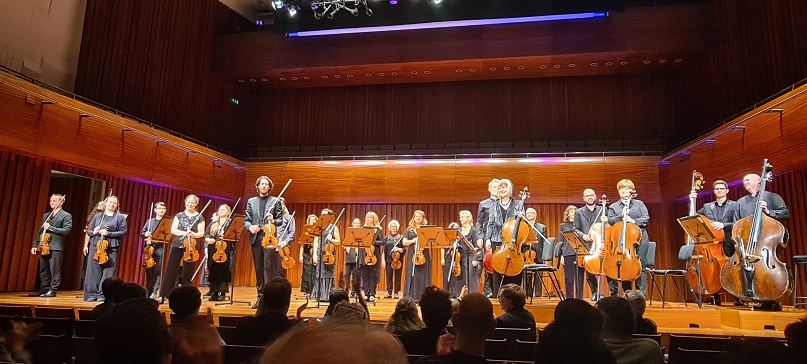
It is hard to imagine a better performance than this one experienced at the Barbican. Guy Johnston led us in contemplation, the serenity of his upper register cello line immediately establishing a mood of calm, in complete contrast to the bustling city outside. The Britten Sinfonia responded in kind, conducted where necessary by violinist Thomas Gould but largely following the cello, a congregation responding to his prompting.

In spite of its inner serenity, The Protecting Veil is troubled by the shadows of violence throughout the world. This performance was a stark reminder of how little has changed in eleven centuries, for in the ominous falling motif that recurs for the cello it was impossible not to think of bombs and missiles raining down in the many warzones we see today. The Barbican fell largely silent as those images undoubtedly projected to many listeners, aided by a sympathetic light show that cast the distinctive markings of the back of the stage as a wooden chapel. When Johnston played alone in the central section, The Lament of the Mother of God at the Cross, he could easily have been playing solo Bach, the intimacy of his and Tavener’s thoughts laid bare.

There was, ultimately, consolation and redemption, and the lights burned yellow when the music soared back to the heights with which it began. Feverish anticipation gripped the strings as they responded excitably to the higher cello, and with a surety of tone that never dimmed, Johnston led us to the end. His was a remarkable performance of stamina and poise, those long notes held for what seemed like an eternity, their pure tones never dipping.

The musical contrast with the opening piece, Beethoven’s Grosse Fuge, was notable. Here is a piece that still sounds as new and every bit as challenging as the day it was written, the Everest of fugues. In this arrangement for string orchestra by Felix Weingartner, its angular subject is a touch smoother at the edges, though here the sharp lines were just as clear as in the string quartet original, the fugue subject escaping its restrictions. The Britten Sinfonia found its core in a well-drilled performance.

Bartók’s Divertimento for String Orchestra was lighter in mood to begin with, the ensemble celebrating the great outdoors as the folksy first tune went with a swing. Yet here too there were troubled minds, the slow movement wary of its place in history. Bartók wrote the Divertimento in 1939 in Switzerland, with Europe on the brink of the Second World War. The oppressive approach of the conflict could be felt in a profound slow movement, which began with feathery violas and reached a forbidding climax, emotion wrought from its pages. Those worries were largely banished by the finale, whose powerful unisons were led by Gould as the piece swaggered and bustled to the finish.

Guy Johnston and the Britten Sinfonia continue their tour with The Protecting Veil to Dublin and Manchester – for more details visit the Britten Sinfonia website

Published post no.2,090 – Saturday 17 February 2024

In concert – Britten Sinfonia / Thomas Gould & Agata Zając @ Milton Court: Musical Everests – The Year 1953

Thomas Gould (violin/director), Miranda Dale (violin), Caroline Dearnley (cello), Britten Sinfonia / Agata Zając (Maconchy)

Corelli Concerto Grosso in F major Op.6/2 (publ. 1714)
Tippett Fantasia Concertante on a theme of Corelli (1953)
Maconchy Symphony for Double String Orchestra (1953)
Phibbs Flame and Shadow (2023)
Walton Finale from Variations on an Elizabethan Theme (1953)

Milton Court, London
Wednesday 24 May 2023

Reviewed by Ben Hogwood Pictures (c) Ben Hogwood

This typically imaginative concert devised by the Britten Sinfonia took as its starting point the events of 1953, where the United Kingdom shifted on its axis. It was of course the year in which Britain witnessed a Coronation, and in which Everest was scaled, but other than Walton’s jubilant finale to the collaborative composer project Variations on an Elizabethan Theme, no explicit musical links were made.

Instead, the Britten Sinfonia concentrated on two major works written for string orchestra in that year – one now well-known and one barely performed. The underdog, Elizabeth Maconchy’s Symphony for Double String Orchestra, made a very strong impression in this performance, brilliantly played by string players using a handwritten manuscript from 1953. The difficulty of this task necessitated a conductor, with Agata Zając joining at short notice. Hers was a dynamic presence, helping emphasise the rhythmic flair and dramatic impetus of the piece.

Maconchy’s music has often been critically coveted but is rarely heard in the concert hall – sadly an all-too familiar plight for a female composer innovating in the 20th century. Where many British composers wrote to include the countryside around them she wrote in a continental style, her music powered by fertile melodic imagination and rhythmic vitality. At times there are elements of Stravinsky and Bartók in her music but the closest parallel is Frank Bridge, with whom she shared an ability to explore the outer reaches of tonality without selling listeners short on melody.

The first movement of the Symphony grips the listener immediately, its powerful forward momentum complemented by soaring violin solos, which Thomas Gould played to perfection here. The febrile main motif bore close resemblance to Stravinsky’s Symphony in Three Movements, and Maconchy’s treatment of it was economical and engaging. Emotionally, however, the heart of the piece lay in the second movement Lento, where an eerie figure crept slowly upwards from cellos and basses, refusing to give way to the sweeter intimate melodies above. A rustic Scherzo, laden with syncopation, was followed by an equally captivating finale, initially pensive but with gathering intensity and drive. Just before the end the music broke out into a joyous country dance before returning to its more angular outlines.

The Britten Sinfonia were at the top of their game, subtly and superbly drilled by leader Gould. Each player was fully engaged, with smiles and nods of encouragement frequently passing between the team. When these qualities are natural, as they were here, a performance is elevated for the audience – and that was certainly the case for Corelli’s Concerto Grosso in F major, second in his set of twelve published as Op.6 in 1714. This opened the concert, dovetailing neatly into the work of Sir Michael Tippett, which it inspired.

Elegance and style were to the fore in the Corelli, with clean melodic lines given just a hint of vibrato for expression, and the interplay and balance between the three soloists and orchestra ideally judged. The work’s sunny countenance spilled over into the Tippett, though here the sun’s rays took on a more ecstatic quality.

The Fantasia Concertante on a theme of Corelli, also dating from 1953, is a compelling study in time travel. Tippett presents the original 18th century material unadorned, but adds his own unique musical language incrementally, so the piece becomes awash with bright colour and reaches a feverish intensity. Gould led a performance to savour, with fulsome support from fellow soloists Miranda Dale (violin) and Caroline Dearnley (cello). Together with the enhanced Sinfonia they rendered the golden textures beautifully, enhancing the elegance of the original material.

With the Tippett and Maconchy works a formidable pair either side of the interval, it says much for the London premiere of Joseph Phibbs’ new work that it was not in any way overshadowed. Though Flame and Shadow looked beyond events of 1953 for its stimulus it nonetheless bore a resemblance to the new coronation, its fresh take on music for strings revealing a busy contemporary approach.

Phibbs has an original and imaginative way with writing for strings, using audience-friendly melodic figurations but allowing them to roam harmonically, changing their perspective. The punchy rhythms of the Dance section here were a thrill, as were the combination of rapid fire and sustained open string pizzicato heard throughout the Interlude. Flame and Shadow, taking its title from a collection of verse by Sara Teasdale, was an edge of the seat piece, even to its closing Vocalise section, where a melody closely related to that found at the opening of Sibelius Symphony no.4 had a sobering effect. The contrasts of darkness and light were vivid and left a lasting impression – as indeed did the whole concert.

In twenty years of covering Britten Sinfonia concerts, and marvelling at their programming and technical prowess, this Milton Court evening confirmed their musical health to be stronger than ever. If only the same could be said for their long-term financial prospects, thrown into doubt by the withdrawal of funding in the latest Arts Council England cuts. Without the immediate publicity of similar actions levelled at English National Opera and the BBC Singers, the Britten Sinfonia have just launched their Play On fundraising campaign. The initial response has been encouraging, but it needs to raise more to secure the organisation’s future. Please do consider giving – I certainly will. This is the only way their imaginative concerts and a wealth of community-based outreach across East Anglia – where they are the only full time orchestra – can continue.

You can read all about future concerts from the ensemble at the Britten Sinfonia website. Click on the composer names to read more about Joseph Phibbs, Elizabeth Maconchy and Sir Michael Tippett – and for more details on concerts at the venue, visit the Milton Court website

Under the surface – Introit: The Music of Gerald Finzi (Decca)

finzi-introit

Composer: Gerald Finzi (1901-1956)

Nationality: English

What did he write? Finzi’s output is slender but there are reasons behind that – not least the fact he lost his father, teacher and three brothers all at the age of eighteen. This compilation reinforces his reputation as a miniaturist, capable of producing some exquisite pieces of around five or ten minutes in length. This is rather unfair, as his vocal writing and works for soloist and orchestra reveal a composer of much greater substance.

Dies natalis and Intimations of Immortality are the vocal works of choice, while there are concertos for cello and clarinet that are worth exploring. On a smaller scale Finzi loved setting the words of Thomas Hardy, with A Young Man’s Exhortation and Earth and Air and Rain two fine song cycles for voice and piano.

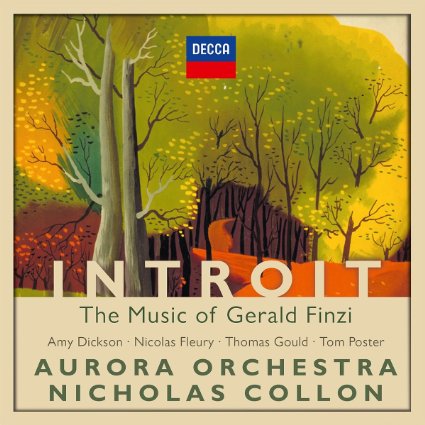
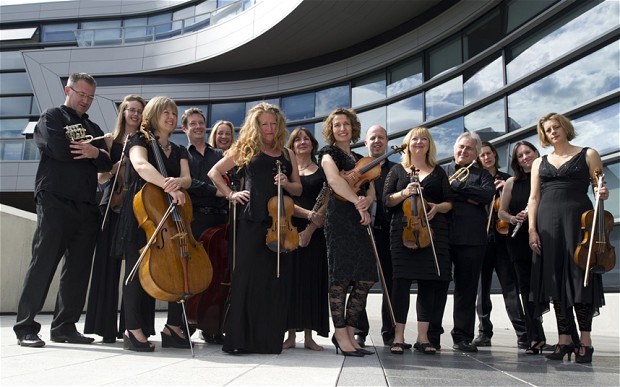
What are the works on this new recording? This is an anthology of Finzi’s shorter works from the Aurora Orchestra and Nicholas Collon. It concentrates on the string orchestra, his principal means of expression. A Severn Rhapsody, Prelude and Romance are all originals, as is the Eclogue for piano and orchestra, while Mike Sheppard, Paul Mealor and Patrick Hawes contribute specially commissioned arrangements that give extra prominence to saxophone (Amy Dickson) and horn (Nicolas Fleury).

The disc, headed by the beautiful artwork How bravely autumn paints upon the sky by Edward McKnight, celebrates the composer’s 60th anniversary in collaboration with The Finzi Trust.

What is the music like? Finzi’s music is like a late summer evening – often beautiful to the ear, but with creeping shadows in the background that make their presence felt in a subtle but meaningful way. These shadows are found especially in the yearning Romance and Prelude, and the consoling but darkly shaded Eclogue.

There is a lot of slow music here, perhaps reflecting the fact that Finzi’s shorter works are often at a slower tempo. As a result they do not give us every aspect of the composer’s output. It does however show how his writing for string orchestra is almost without equal in 20th century English music – fans include Neil Hannon of the Divine Comedy – and it also shows how, in works like the Romance and the livelier Rollicum-Rorum especially, he could pen a memorable tune.

The Introit for violin and orchestra also has a good tune, and is sweetly performed by soloist Thomas Gould, while Rollicum-Rorum is sensitively played by Dickson, who shows impressive agility too.

What’s the verdict? This is a compilation that has clearly been put together with love, care and attention, but there is not as much variety as there could be. Finzi comes across here as relatively one-dimensional, and well-played though the performances are, it feels like an opportunity only partially taken.

Give this a try if you like… the lighter side of Elgar, Vaughan Williams and Delius

Listen

Watch the album trailer below:

You can also listen to an excerpt from the disc on Spotify:

Britten Sinfonia at Lunch – Reinventing the piano trio

britten-sinfonia

Britten Sinfonia at Lunch – Wigmore Hall, 4 March 2015.

If chamber music is not your forte, then I cannot imagine a better way into it than by the Britten Sinfonia’s ‘At Lunch’ concert series, held in London, Cambridge and Norwich.

Each program explores works written for a particular instrumental combination, but always includes a world premiere from a living composer. The informal atmosphere is both performer and audience friendly, and as a diversion from work or a pause in the middle of the day, the experience is ideal.

This second concert of the 2015 season chose to look at the piano trio, a misleading label since the standard combination of instruments for the trio is piano, violin and cello. Yet, as the program observed, the form is less often used by contemporary composers, and has a heritage of works running from Haydn in the mid-18th century through to 20th century composers such as Shostakovich, who featured here.

What the Britten Sinfonia did really well was to present possible solutions to the form, which here included adding percussion. To begin we heard Lou Harrison’s Varied Trio, for violin, piano and percussion. Harrison, an American composer who lived from 1917-2003, took as his inspiration the music of a number of different countries including China and Indonesia, and his original approach here included a set of rice bowls played with chopsticks. The resultant sounds were often soothing and rather wonderful, drifting as though on the breeze from percussionist Owen Gunnell, but with pianist Huw Watkins also reaching around inside the instrument to produce some unusual sounds. Completing the trio was violinist Thomas Gould, whose sweetly toned Elegy formed the third of the Varied Trio’s five movements and made it the emotional centre.

The new piece was from 22-year old composer Joey Roukens, who described his Lost in a surreal trip as ‘a psychedelic, kaleidoscopic 12-minute piece’. It was vividly coloured and brilliantly realised by the players, adding cellist Caroline Dearnley to their number. Early on the music cast spells of dappled light through harmonics on the strings and intriguing percussion sounds, but then a more mechanical energy took hold as though we were being transported by train to a place without a firm surface. With bags of reverberation and some enchanting sounds from the marimbas, this piece was consistently inventive and will be well worth hearing.

From the conventional piano trio legacy came one of its finest works in the 20th century, the Piano Trio no.2 by Shostakovich. This concentrated wartime work from 1944 is packed full of anguish, marking the death of the composer’s close friend Ivan Sollertinsky but also expressing outright anger at conflict and war. Gould, Dearnley and Watkins had no need for percussion here, not with the rhythmic profile Shostakovich establishes, but theirs was a keenly felt performance that left the listener in no doubt of the composer’s feelings and concerns.

A Spotify playlist containing the Varied trio and the Shostakovich Piano Trio no.2 can be accessed here: