
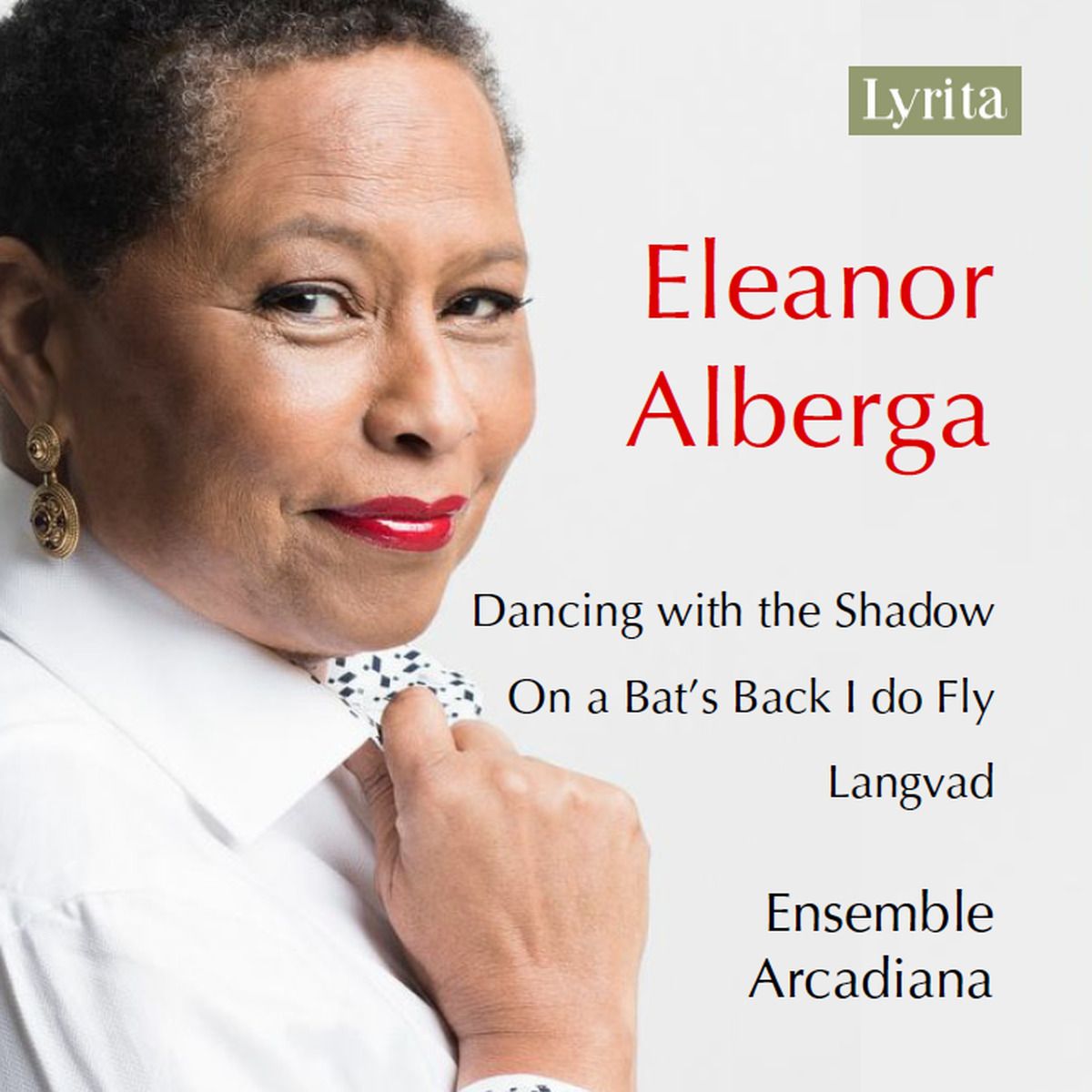
On Record – Ensemble Arcadiana – Eleanor Alberga: Works for Chamber Orchestra (Lyrita)

Ensemble Arcadiana / Thomas Kemp

Alberga
Dancing with the Shadow (1990, rev. 2021)
On a Bat’s Back I do Fly (2000)
Langvad (2006).

Lyrita SRCD446 [53’36”]
Producer/Engineer Stephen Frost

Recorded 11-12 October 2021 at Wyastone Concert Hall, Wyastone Leys, Monmouth

Reviewed by Richard Whitehouse

What’s the story?

Lyrita issues a further release of music by Eleanor Alberga, featuring three sizable works for chamber ensemble played by Ensemble Arcadiana and which between them amply underline this composer’s flexible while imaginative response when writing for this particular medium.

What’s the music like?

Now in her mid-70s, Alberga came from her native Jamaica to study in London and enjoyed early success as a concert pianist before joining London Contemporary Dance Theatre where she latterly became music director. This past quarter-century has seen her focus increasingly on composition – creating a substantial output as includes a symphony, two violin concertos (both released on Lyrita SRCD405), three string quartets plus a range of other works across the major genres – in an idiom which is contemporary without being obscure or inaccessible.

The earliest and largest of these three works, Dancing with the Shadow started out as music for dance and was commissioned by the ensemble Lontano, which also recorded two of the movements on the second volume of its series British Women Composers (Lorelt LNT103). Taking as its starting-point the Jungian concept of exploring the individual’s darker side or ‘shadow self’, these five movements variously combine the six musicians as part of a steady accumulation taking in the simmering anticipation of a Duo and lilting elegance of a Trio; then the animated interplay of a Quartet, enfolding eloquence of a Quintet (the emotional heart in all senses) and the heady excitement of a Sextet that affords a close as decisive as it is infectious – whether, or not, those competing halves of the psyche have been reconciled.

Each playing continuously, the remaining pieces are no less individual or engaging. Written for the Bournemouth mew-music ensemble Kokoro, On a Bat’s Back I Do Fly takes its cue from Ariel’s song in the final act of Shakespeare’s The Tempest and appealingly tackled by Thomas Arne, whose 1740s song-setting is alluded to over the course of music that proves as dextrous though ultimately as elusive as the text implies. Its title the Danish for ‘length’, Langvad is also a rural hamlet in Denmark as well as the setting for a summer festival run by the composer and her husband. Here the ongoing narrative (if, indeed, there is one) feels as elusive as the sound-world conjured from quintets of wind and strings – one, moreover, likely to prove as personal for each listener as it must no doubt be for the composer herself.

Does it all work?

Very much so. This is ensemble music that, informed and frequently permeated with dance rhythms, makes considerable demands on the technique of its exponents, who duly respond with conviction and audible enjoyment throughout. A pity, perhaps, that another of Alberga’s ensemble works could not have been included, though the programme as it stands can hardly be faulted as a representative overview. Neither does the dance component make these pieces other than self-sufficient in abstract terms and make for an engaging listen in their own right.

Is it recommended?

Indeed it is. The recording is as spacious yet immediate as expected from the acoustics of Wyastone Concert Hall, and there are informative annotations by Donald Sturrock. Those who acquired that previous Lyrita album should not hesitate to investigate this new release.

Listen / Buy

You can hear excerpts from the album and explore purchase options at the Presto Music website, and click on the names for more information on composer Eleanor Alberga, Ensemble Arcadiana and conductor Thomas Kemp

Published post no.2,803 – Thursday 19 February 2026

In concert – Birmingham Contemporary Music Group: Mark-Anthony Turnage

Mark-Anthony-Turnage

Pre-Concert Event:
Ma Xiao-Qing Back to the Beginning (2021)
Skempton Heinen Skizzen (2021) [BCMG Commission: World premiere]
Colette Overdijk (violin), Ulrich Heinen (cello)

Concert:
Turnage This Silence (1992)
Alberga On a Bat’s Back I do Fly (2000)
Saunders Stirrings (2011)
Turnage Concertino for Clarinet and Ensemble (2020) [BCMG commission: World premiere]

Jon Carnac (clarinet), Birmingham Contemporary Music Group / Thomas Kemp

CBSO Centre, Birmingham
Sunday 12 September 2021

Written by Richard Whitehouse

Birmingham Contemporary Music Group began its new season with a concert centred around music from Mark-Anthony Turnage, and what should have been a premiere to mark his 60th birthday last year but which still left a favourable impression however belated its emergence.

First came an earlier Turnage piece, This Silence drawing clarinet, bassoon, horn and string quintet into an intensive dialogue whose opening Dance built up a fair momentum that the ensuing Dirge channelled towards an eloquent if by no means unruffled set of variations as found just tentative closure. Three decades (and a brief Uli fanfare) later, Concertino exudes a far more relaxed aura, doubtless occasioned by its being a tribute to clarinettist (and fellow sexagenarian) Jon Carnac – his artistry to the fore in the playful Study in Fifths and incisive Carnac with its ingenious workout on the soloist’s name. In between, a soulful Romanza afforded contrast but if this and the final Sad Soliloquy found Turnage’s cool-jazz leanings at their smoothest, the alluring interplay of clarinet and ensemble was no less appealing for it.

In between these works came, firstly, a timely revival for Eleanor Alberga. On a Bat’s Back   I do Fly takes its cue from Ariel’s final song in Shakespeare’s The Tempest for music whose fluid contrasts of motion and expressive force, ably drawn into a cohesive whole, brought an agile response from BCMG – not least percussionist Julian Warburton. Appreciably different was Stirrings, the third in a sequence of ‘‘quiet and fragile collage compositions’’ by Berlin-based composer Rebecca Saunders, which took extracts from Samuel Beckett as the starting-point for an evocative soundscape whose simple yet effective spatial disposition – woodwind being situated around the gallery, with strings and piano spread across the platform – audibly enhanced the succession of echoes and resonances informing this frequently intangible score.

The pre-concert event (essentially the first half, given the interval which followed) brought a welcome further hearing of Ma Xiao-Qing’s Back to the Beginning, arguably the most striking of the ‘Soliloquys and Dialogues’ series written for BCMG musicians during the pandemic – violinist Colette Overdijk eliding between some vividly rhetorical passagework and spoken interpolations with a confidence borne of familiarity. Ulrich Heinen then gave the premiere of Heinen Skizzen, a miniature wholly typical of Howard Skempton in its deceptive simplicity.

This latter piece ably served its purpose of honouring Heinen’s retirement from BCMG after 35 years of commitment to the ensemble and its music-making. Not a few listeners (including the present writer) fondly recall his cycle of Bach’s Cello Suites given at St. Paul’s, Hockley in the late 1980s, with his subsequent recordings of the initial five of these – placed within a stimulating contemporary context – well worth investigating on the Métier Sound and Vision label. Hopefully his retirement will not preclude the occasional reappearance with BCMG.

Back to the present, this evening’s main concert is being repeated at West Malling in Kent on September 26th, with BCMG’s subsequent recitals in Birmingham and Bristol on November 12th and 13th. A full programme of activities for the 2021/22 season hopefully (!) lies ahead.

You can find information on further BCMG activities here, while further information on Ulrich Heinen’s Bach can be found at the Divine Arts website