
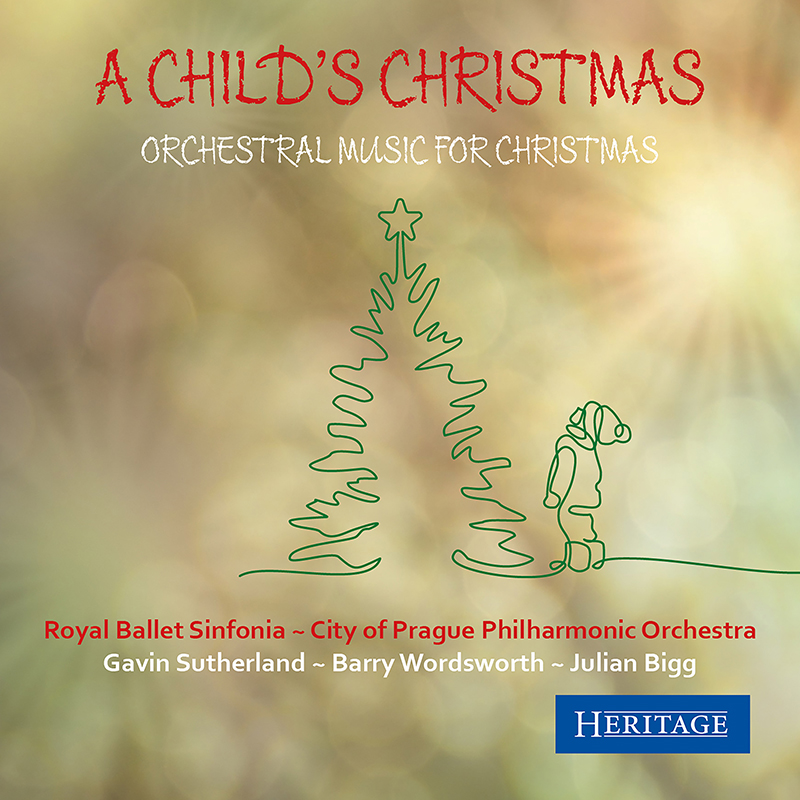
On Record: A Child’s Christmas – Orchestral Music For Christmas (Heritage)

Hely-Hutchinson Overture to a Pantomime (1946)
Hewitt Jones Christmas Party (2016)a; Overture: The Age of Optimism (2023)
Kelly Sing a Song of Sixpence (2020)
Lanchbery Tales of Beatrix Potter – excerpts (1971)
Lane/Nicholls Suite: The Adventures of Captain Pugwash (1999)b
Moore Santa’s Sleigh Ride (2019)
Saunders A Magical Kingdom (2003)a; Journey to Lapland (2020)
Thornett A Child’s Christmas (2016)a

Royal Ballet Sinfonia / Barry Wordsworth, aGavin Sutherland; bCity of Prague Philharmonic Orchestra / Julian Bigg

Heritage HTGCD139 [66’03’’]

written by Richard Whitehouse

What’s the story?

Heritage adds to the festive cheer with this latest anthology of music for, about or appropriate to Christmas as heard from a child’s perspective, expertly realized by this brace of orchestras and three conductors, in what should prove the ideal addition to anyone’s Yuletide listening.

What’s the music like?

The effervescence of Victor Hely-Hutchinson’s Overture to a Pantomime sets the ball rolling ideally, replete with Sullivan-like melodiousness whatever its lack of seasonal tunes, then into the title-track by Gordon Thornett – an appealing concocted medley with more than a hint of Tijuana to the brass (anyone recall the Torero Band’s 1968 masterpiece Tijuana Christmas?) and winsome writing for the woodwind. Adam Saunders displays his light-music credentials in the catchiness of A Magical Kingdom, then a deftly evocative touch in Journey to Lapland.

The youngest composer here, Thomas Hewitt Jones contributes two of the most substantial pieces in the cinematic Christmas Party, unashamedly old-style (not just musically) and with brother Simon the animated violinist, while The Age of Optimism makes for a stirring curtain -raiser. Roy Moore duly adds to what has become a notable Christmas sub-genre with Santa’s Sleigh Ride, while Bryan Kelly proves to be the present-day Roger Quilter with Six a Song of Sixpence – an extensive and resourceful fantasia on children’s songs both witty and amusing.

Prolific conductor and arranger for ballet, John Lanchbery (whose centenary fell this May) is well remembered for Tales of Beatrix Potter, drawing judiciously on a range of 19th-century light music – hence the graceful ‘Introduction’ and whimsical ‘Tale of Jemima Puddleduck’, before those lively goings-on of ‘The Picnic’ head straight into the jauntiness of the ‘Finale’. Launched with its indelible signature-tune, The Adventures of Captain Pugwash finds Philip Lane and Ian Nicholls in absolute accord for this saunter through the world of the sea-shanty.

Does it all work?

Yes, given that this is a miscellany only loosely unified by its Christmas theme – most of the pieces being ideal for listening at any other time of the year. The playing of the Royal Ballet Sinfonia is finely attuned under the direction of such ballet stalwarts as Barry Wordsworth or Gavin Sutherland, and the City of Prague Philharmonic Orchestra evidently enjoyed making acquaintance with Captain Pugwash (was the cartoon shown in the former Czechoslovakia?). Nor do these recording sessions suggest anything like a 24-year timespan in terms of sound.

Is it recommended?

Indeed, given this is a worthwhile addition to the Christmas music discography and features a succinctly informative note from Philip Lane. Those who get the seasonal bug should look no further then Heritage’s volume The Spirit of Christmas [HTGCD299] for a follow-up release.

Listen & Buy

You can explore purchase options at the Heritage Records website

Published post no.1,983 – Thursday 19 October 2023

On Record: Richard Deering – William Wordsworth: Piano Music; Wilson & McGuire (Heritage)

Wordsworth
Piano Sonata in D minor Op.13 (1939)
Cheesecombe Suite Op.27 (1945)
Ballade Op.41 (1949)
Valediction Op.82 (1967)
Wilson
Incanabula (1983)
McGuire
Prelude 7 (1983)
Six Small Pieces in C (1971)

Richard Deering (piano)

Heritage HTGCD142 [77’42’’]
Producer/Engineer Paul Arden-Taylor (Piano Sonata), Robert Matthew-Walker
Recorded 1985 at University of Wales, Cardiff, 2023 at Wyastone Concert Hall, Wyastone Leys, Monmouth

written by Richard Whitehouse

What’s the story?

Heritage here continues its extensive coverage of British music with a release of piano music primarily by William Wordsworth, complemented with short pieces by Thomas Wilson and Edward McGuire, all of them heard in idiomatic and insightful readings by Richard Deering.

What’s the music like?

Although his music is now relatively well covered in terms of recording (thanks to Lyrita and, more recently, Toccata Classics), Wordsworth remains a difficult composer to pin down – not least because this understated and often taciturn idiom does not lend itself to casual listening.

Piano music features prominently in his earlier output, notably a Piano Sonata that can rank with the finest such works from the inter-war period. Its initial movement is introduced by a Maestoso whose baleful tone informs the impetuous and expressively volatile Allegro that follows. The central Largamente probes more equivocal and ambivalent emotions before it leads directly into a final Allegro whose declamatory and often martial character is briefly offset by an aching recall of previous material, prior to a conclusion of inexorable power.

His status as conscientious objector saw Wordsworth engaged in farm-work during wartime, the experiences and friendships of this time being commemorated in the Cheesecombe Suite whose lilting Prelude and lively Fughetta frame a quizzical Scherzo then a Nocturne of affecting pathos. Written for Clifford Curzon, Ballade is a methodical study in contrasts that makes for an ideal encore; as, too, might Valediction, but here emotions run deeper and more elusively as befits this memorial to a lifelong friend written later in the composer’s maturity.

As with Wordsworth, Thomas Wilson was an incomer to Scotland (albeit from the United States rather than England), and Incanabula typifies the searching though accessible quality of his later music – the six sections unfolding as if variants on each other before concluding in a mood whose calmness does not preclude a degree of restiveness. Scottish by birth and among the most wide-ranging composers of his generation (not least through a half-century association with traditional group The Whistlebinkies), Edward McGuire has written widely for piano – notably a series of Preludes, of which the seventh integrates minimalist and folk elements into its fluid and cumulative overall design. Simpler as to form and expression, Six Small Pieces in C Major evoke Satie and Cage in their lucid textures and disarming naivete.

Does it all work?

It does, and not least when Deering is so evidently attuned to this music – having premiered the Wilson piece and MacGuire Prelude. Margaret Kitchin recorded those three earlier pieces by Wordsworth in the 1960s (Lyrita), and Christopher Guild recently set down all four items with various miniatures in his complete survey (Toccata), but those wanting the major works cannot go wrong with this anthology. Other than McGuire, booklet notes are by John Dodd – a tireless advocate of British music with whom this reviewer was fortunate to be acquainted.

Is it recommended?

Indeed. The sound has a clarity and focus such as belies the almost four decades between the two sessions, and this makes a worthwhile follow-up to Deering’s recent collection of piano music by Parry [HTGCD140-141]. Hopefully there will be further releases from this source.

Listen & Buy

You can explore purchase options at the Heritage Records website, and find out more about Richard Deering here. Meanwhile for more on the composers, click on the names William Wordsworth, Thomas Wilson and Edward McGuire.

Published post no.1,983 – Thursday 19 October 2023