On record – Livia Teodorescu-Ciocănea: Le rouge et le noir (Romanian National Opera / Răsven Cernat) (Toccata Classics)


TOCC_0595

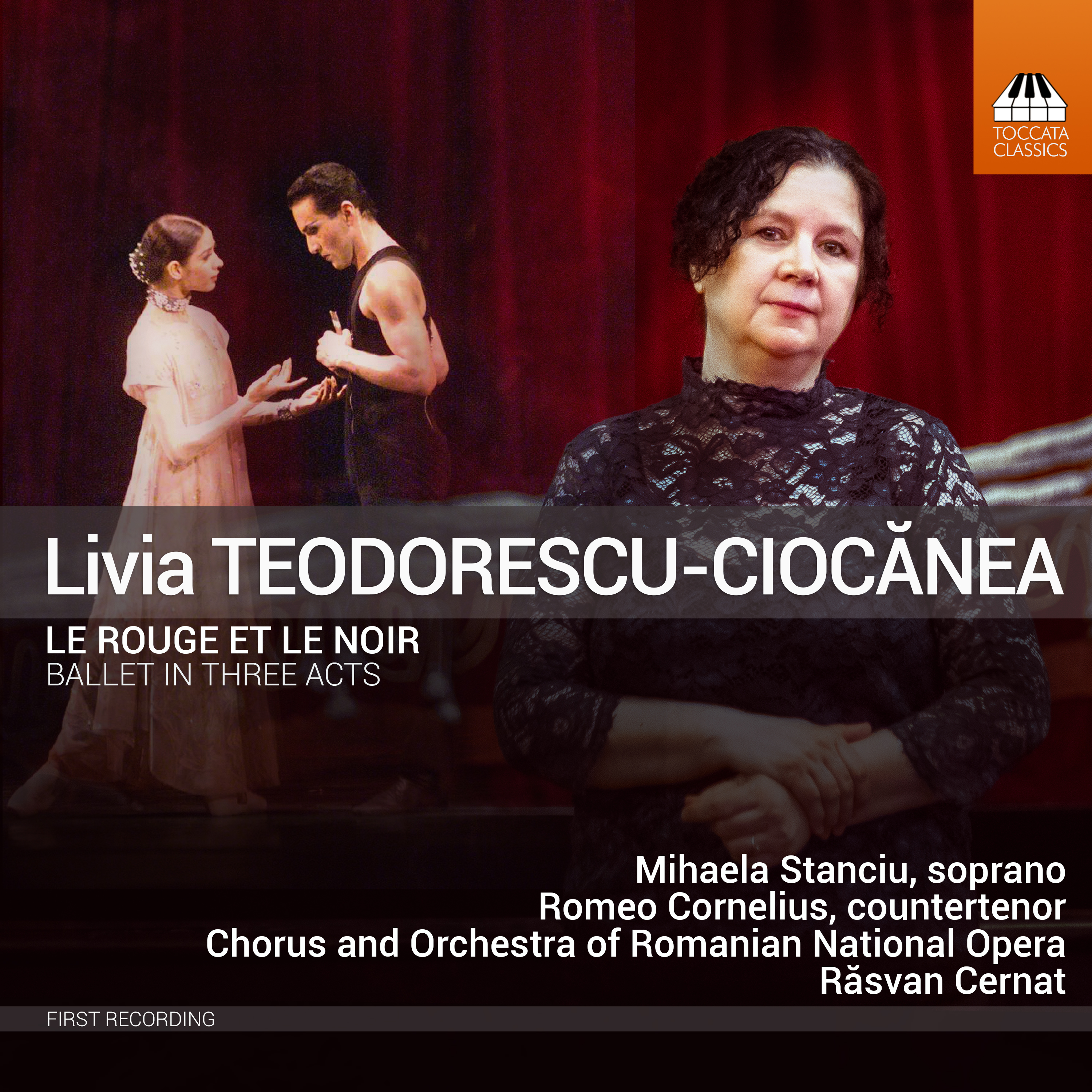
Teodorescu-Ciocănea
Le rouge et le noir (1999-2000)

Mihaela Stanciu (soprano), Romeo Cornelius (countertenor), Chorus and Orchestra of Romanian National Opera / Răsven Cernat

Toccata Classics TOCC0595 [75’25”] Synopsis included

Producers Florentina Herghelegiu, Erika Nemescu
Engineer Alexandru Părlea

Recorded 11-15 June 2000 at studios of Romanian Radio Broadcasting Corporation, Bucharest

Written by Richard Whitehouse

What’s the story?

Toccata Classics here continues its coverage of Livia Teodorescu-Ciocănea (b1959) with the ballet Le rouge et le noir, whose frequently lurid scenario allows her orchestral prowess and range of invention full rein – making for a musical experience cohesive almost despite itself.

What’s the music like?

Alongside a distinguished academic career (her PhD in composition was undertaken at the University of Huddersfield), Teodorescu-Ciocănea has amassed a sizable output that ranges across all the main genres. Her music has been compared to that of Horaţiu Rădulescu and Ştefan Niculescu in its usage of ‘spectral’ elements, but its expressive character is arguably closet to that of Pascal Bentoiu with its pivoting around post-romantic and modernist traits. Appropriate, then, for a ballet score complementing its subject-matter in no uncertain terms.

In her introductory essay, the composer describes Stendhal’s novel upon which this ballet is based as a ‘‘powerful and romantic one’’; which might almost be thought euphemisms for a scenario in which histrionics are emphasized to the point of – and even beyond – overkill. All is revealed in her track-by-track synopsis, but maybe this is a score best tackled – at least on first hearing – minus the distractions of Stendhal’s narrative with its cumbersome symbolism or mostly unsympathetic protagonists; one that culminates in a disingenuously tragic outcome.

Appreciating this ballet ‘in the abstract’ is facilitated, moreover, by the theatrical immediacy of its music. Structured in three acts, framed by a prologue and epilogue, it draws the listener through the story with no inherent longueurs (the ballet initially lasted for around 95 minutes, which Teodorescu-Ciocănea has reduced to its present 75 through withdrawing the numbers ‘‘that seemed to me redundant or transitional’’). Highlights are the second half of Act Two’s first scene – a propulsive passacaglia set in the mayor’s house; the subsequent scene, with its plangent and evocative love-duet set at Vergy; the brief while potent Passion Tango in Act Three’s second scene; and the Epilogue which brings about the denouement with a fervour and a dramatic inexorability that comprehensively transcends the narrative which inspired it.

Does it all work?

For the most part, yes. Listeners might well be advised to tackle the music straight off, rather than study the scenario beforehand. In the (understandable) absence of the visual component, this is a piece best evaluated on its own terms; without the cringing element of melodrama as derived from Stendhal, yet another of those ‘classics’ novels which has rightly been relegated to an academic footnote in history. The present performance surely presents this work to best advantage – vocalists Mihaela Stanciu and Romeo Cornelius eloquent in their contributions, and Răsven Cernat securing a visceral response from the forces of Romanian National Opera. The track-listing gives immediate access to each scene in the three acts, while Joel Crotty’s biographical outline is invaluable given the almost complete absence of material in English.

Is it recommended?

Yes, in the hope Toccata will go on to release examples of Teodorescu-Ciocănea’s orchestral and choral music – not least the oratorio Poppy Fields, her ‘in memoriam’ for those who fell in the First World War and on a scale as was largely ignored by major composers in the UK.

Listen

Buy

You can discover more about this release at the Toccata Classics website, where you can also purchase the recording. To read more about Toccata’s exploration of Teodorescu-Ciocănea’s piano music, click here

On record – Mihalovici: Piano Music (Matthew Rubinstein) (Toccata Classics)

TOCC-0376-Mihalovici-piano-music-cover

Mihalovici
Sonatine, Op. 11 (1922-3). Quatre Caprices, Op. 29 (1928). Ricercari, Op. 46 (1941). Quatre Pastorales, Op. 46 (1950). Sonate, Op. 90 (1964). Passacaille (pour la main gauche), Op. 105 (1975)

Matthew Rubinstein (piano)

Toccata Classics TOCC0376 [73’52”]

Producer Boris Hofmann
Engineer Henri Thaon

Recorded 5 & 6 June, 30 & 31 July 2018 at Jesus-Christus-Kirche, Berlin

Written by Richard Whitehouse

What’s the story?

Toccata Classics turns to the Romanian émigré Marcel Mihalovici (1898-1985) whose music has been poorly served by recording but whose works for piano, most often premiered by his wife Monique Haas, affords (in this selection) a representative overview of his sizable output.

What’s the music like?

Among the shorter pieces, the Sonatine typifies the neo-classical objectivity of the composer’s earlier music with the nimble fluidity of its outer movements framing an Andante of winsome delicacy. More testing pianistically, the Quatre Caprices recall Mihalovici’s slightly younger (and similarly Paris-based) contemporary Alexander Tcherepnin in their oblique poise along with that stealthily accumulating energy made manifest in the motoric Allegro – its ‘furioso’ marking subtly underlined here – though not before an Andantino of ruminative elegance. If the Quatre Pastorales strikes a deeper note, this is likely through the deft folk inflections as are manifest across the alternate whimsy and exuberance of these miniatures – culminating with a final Allegro reminiscent of Enescu in its ringing sonorities and cascading harmonies.

A breakthrough in several respects, Ricercari proceeds less as a set of variations than of free variants on a discursive theme whose indebtedness to a passacaglia – not merely for its tempo – is explored intensively during what follows. Surprisingly, perhaps, most of the ‘variations’ are rapid or at least flowing in manner – the propulsive ninth of these heading into a fugue as revisits the theme with renewed impetus in a gradual accumulation of energy; culminating in a notably equivocal restatement of the theme, itself making way for the tenuous final gesture.

The latter two works come from Mihalovici’s high maturity – the Sonate outwardly evoking Classical precepts with its clearly defined three movements. Less so the opening Allegretto’s nonchalant overriding of expected formal divisions, the central Lento’s freewheeling play on gesture and phrase (with its tangible recourse to the ‘doina’ crucial to Romanian traditional music), then the final Allegro’s capricious yet purposeful unfolding towards a conclusion of no mean agility in which the composer’s pianism is at its most combative and declamatory.

The left-hand Passacaille is a fair definition of ‘late masterpiece’, its gnomic theme made the basis of 18 variations whose diversity of motion and consistent brevity belie the formal focus with which the composer builds towards the lengthier closing brace. Hence the 17th with its plaintive demeanour and probing introspection, then the 18th – a ‘quasi una cadenza’ – that steers a determined course through to its unexpectedly stark close: mastery of means allied to that of technique in this undoubted enhancement of a distinctive if often intractable medium.

Does it all work?

It does, not least because Mihalovici is clearly a master at combining different stylistic facets that are more than the sum of their influences. Matthew Rubinstein evidently appreciates this with interpretations of methodical attention to detail, allied to playing of undoubted panache.

Is it recommended?

It is, given that only two pieces had been earlier recorded with only Ricercari easily available. Spaciously defined sound from the fabled Jesus-Christus-Kirche, and detailed notes by Lukas Näf. Hopefully, recordings of Mihalovici’s orchestral and chamber music will prove feasible.

Listen

Buy

You can discover more about this release at the Toccata Classics website, where you can also purchase the recording.

On record – Simon Bainbridge: Chamber Music (Kreutzer Quartet, Linda Merrick) (Toccata Classics)

TOCC_0573

Simon Bainbridge
String Quartet no.1 (1972)
String Quartet no.2 (2014-16)
Clarinet Quintet (1993)
Cheltenham Fragments (2004)

Linda Merrick (clarinet), Kreutzer Quartet [Peter Sheppard Skaerved, Mihailo Trandafilovski (violins), Clifton Harrison (viola), Neil Heyde (cello)

Toccata Classics TOCC0573 [56’14”]

Producer Peter Sheppard Skaerved
Engineer Jonathan Haskell

Recorded 5 July, 30 October 2019, 3 March 2020 at St. Michael’s, Highgate, London

Written by Richard Whitehouse

What’s the story?

Toccata Classics issues only the third release to be devoted to the music of Simon Banbridge (1952-2021), whose recent and untimely death at the age of 68 has made this an unintended if pertinent memorial to one of the more underestimated British composers of his generation.

What’s the music like?

Bainbridge’s two string quartets effectively frame his output. Commissioned by André Previn for the South Bank Summer Music, the First Quartet finds a composer barely into his twenties taking on board then recent innovations emanating from Eastern Europe (notably the Second Quartet by Ligeti) and fashioning these into a tense single movement whose juxtaposition of timbre and texture are integrated so that the music feels inevitable in its unfolding. What was heard ‘in passing’ proves to have had a decisive implication when encountered in retrospect.

By the time of his Clarinet Quintet, Bainbridge was creating music as distinctive in idiom as it was virtuosic in its technical demands. Analogies with the ‘classic’ works for this medium by Mozart, Brahms and Reger may be elusive, but the piece likewise evinces an introspection (whether – or not – ‘autumnal’) that offsets an inner world teeming with formal subtleties and expressive nuances. Once again, it is the slightest gestures and pithiest motifs which prove to be crucial in the elaboration of what is one of the composer’s most seamless overall concepts.

In contrast, Cheltenham Fragments proceeds as a sequence of ideas such as takes in various combinations of the ensemble as it assembles a design certain to be perceived differently by each listener, if not the element of high-flown lyricism which comes momentarily to the fore.

Moving to the Second Quartet is to find Bainbridge engaged in a distillation of compositional practice, underpinned by the direct influence of visual art – namely Ethopian-born American artist Julie Mehretu, images of whose canvasses were projected to the rear of the ensemble at the first performance. Not that a visual component should be necessary for appreciating what, unlike the preceding pieces, is music whose rapidity of gesture is abetted by that of tempo in this audibly fast-moving work – any passing sense of slowness occasioned by context rather than actuality. Moments of intense eloquence do emerge over the course of these 21 minutes, their short-lived repose acting as points of orientation during what is otherwise a propulsive journey toward a conclusion which, if it indeed brings oblivion, does so with exquisite poise.

Does it all work?

It does, not least through the commitment of the Kreutzer Quartet and, in the Clarinet Quintet, Linda Merrick in teasing out cohesion and imagination from music that possesses both these qualities in abundance, but which might easily be overlooked given its underlying reticence or unwillingness to ‘force the issue’. Along with its contribution to Toccata’s disc of Jeremy Dale Roberts (TOCC0487), this finds the Kreuzer at its considerable best – aided by commendably natural sound and thoughtful annotations by Peter Shepperd Skaerved and David Wordsworth.

Is it recommended?

Indeed, and listeners are encouraged to investigate two NMC releases devoted to Bainbridge – one with his breakthrough work, the Viola Concerto (NMCD126), the other his Grawemeyer Award-winning song-cycle Ad ora incerta (NMCD059). More recordings will surely follow.

Listen

Buy

You can discover more about this release at the Toccata Classics website, where you can also purchase the recording.

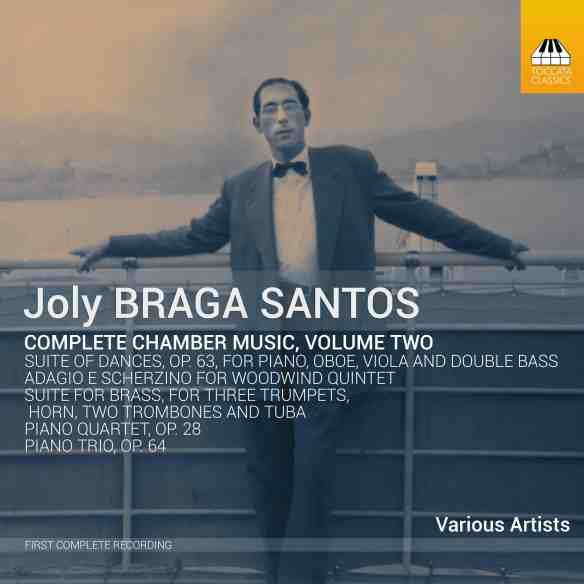
On record – Joly Braga Santos: Chamber Music Volume Two (Toccata Classics)

Joly Braga Santos
Piano Quartet Op.28 (1957)
Suite de Danças Op.63 (1984)
Piano Trio Op.64 (1985)
Adagio e Scherzino (1956)
Suite para intrumentos de metal (1985)

Piano Quartet, Piano Trio: Jill Lawson (piano), Eliot Lawson (violin), Natalia Tchitch (viola), Catherine Strynckx (cello)
Suite of Dances: Jill Lawson (piano), Ricardo Lobes (oboe), Natalia Tchitch (viola), Adriano Aguiar (double bass)
Adagio e scherzino: Nuno Ivo Cruz (flute), Ricardo Lopes (oboe), António Saiote (clarinet), Paulo Guerreiro (horn), Carolino Carreira (bassoon)
Suite for brass: Jorge Almeida, António Quítalo, Pedro Monteiro (trumpets), Paulo Guerreiro (horn), Jarrett Butler, Vitor Faria (trombones), Ilídio Massacote (tuba)

Toccata Classics TOCC0428 [71’20”]

Producers Brian MacKay, Romain Zémiri
Engineer Romain Zémiri

Recorded 5-8 December 2017, 6-8 June 2018 at Centro Cultural de Belém, Lisbon, Portugal

Written by Richard Whitehouse

What’s the story?

Toccata Classics issues the second instalment devoted to the chamber output of Joly Braga Santos (1924-88), one which ranges widely in terms of its instrumental media and features one of the undoubted high points from over the Portuguese composer’s extensive catalogue.

What’s the music like?

To describe three of these pieces as ‘occasional’ is not to deny their musical attraction. The Suite of Dances makes the most of its unlikely combination of oboe, viola, double bass and piano – the astringent harmonies of its Prelũdio commuted into more plaintive expression by the Sarabanda, before the Tarantella rounds off the sequence with heady insouciance. In its follow-through of wistful song then whimsical dance, the Adagio and Scherzino is an unassuming gift to the repertoire for woodwind quintet that all such ensembles should seize upon. Although a combination of horn, three trumpets, two trombones and tuba might prove awkward, the Suite for Brass is no less diverting – whether in the soulful pathos of its initial Moderato, incisive fanfares of its central Allegro or insinuating resolve of its final Andante.

Highly appealing as these all are, the remaining works more completely affirm Braga Santos as a composer of substance. Cast in a single movement lasting almost 15 minutes, the Piano Quartet unfolds as the interplay between tensile and rhapsodic main themes such that neither mode of expression ever quite gets the upper hand. Moreover, the writing for the four players is of an integrated ensemble with any solo expression secondary to that of the collective; not least in the final pages as the music regains its initial impetus on the way to a forthright close.

Undoubtedly the main achievement here, the Piano Trio can rank alongside the Third String Quartet (included on the previous volume) among Braga Santos’s finest achievements. The opening Largo elides between distanced and ominous expression, its unforced synthesis of modal and non-tonal facets accorded greater resolve by the ensuing Allegro with its tensely intertwined strings and repeated-note piano writing that, between them, reach an impetuous climax. More than twice the length of its predecessors, the closing Lento is also one of this composer’s most potent inspirations – the sheer remoteness of its initial gestures underlying the speculative discourse which follows, and while the later stages afford greater emotional variety, the destination of this music towards its ethereal final repose can never be doubted.

Does it all work?

It does, allowing for the fact that some of the pieces here are modest in scope but written most felicitously as to the ensemble required. The performances of the main two pieces –    by violinist Eliot Lawson, cellist Catherine Strynckx, pianist Jill Lawson and (in the Piano Quartet) violist Natalia Tchitch – make a strong case for these works to form part of their respective repertoire. The other items mainly feature woodwind and brass players from the leading Portuguese orchestras and bring similar combinations of insight and commitment.

Is it recommended?

Indeed. The sound avoids that slightly out-of-focus perspective of the first volume, even if breaks between works could have been lengthier. The booklet has an affectionate memoir by Santos’s pupil Alexandre Delgado, with detailed notes on each work by Bernardo Mariano.

Listen

Buy

You can discover more about this release at the Toccata Classics website, where you can also purchase the recording. For our review of volume one in this series, click here

On record – Peter Dickinson: Chamber & Instrumental Music (Toccata Classics)

Peter Dickinson
Violin Sonata (1961)
Air for solo violin (1959)
Metamorphosis for solo violin (1955, rev 1971)
String Quartet no. 1 (1958)
Fantasia for solo violin (1959)
Lullaby for violin and piano (1967)
String Quartet No. 2 (1976)
Quintet Melody for solo violin (1956)
Tranquillo for violin and piano (1986, rev. 2018)

*Peter Sheppard Skaerved (violin); **Roderick Chadwick (piano); ***Kreutzer Quartet [Peter Sheppard Skaerved, Mihailo Trandafilovski (violins), Clifton Harrison (viola), Neil Heyde (cello)]

Toccata Classics TOCC0538 [71’26”]

Producer Peter Sheppard Skaerved
Engineer Jonathan Haskell

Recorded 27 July & 29 November 2017, 16 January & 26 March 2019

Written by Richard Whitehouse

What’s the story?

Toccata Classics turns its attention to Peter Dickinson (b.1934), whose impeccably crafted and stylistically wide-ranging music has enhanced British music over almost seven decades – not least these chamber and instrumental works that are all recorded here for the first time.

What’s the music like?

Dickinson might consider the Violin Sonata to be among his more challenging works, but its serial technique is subtly embedded into outer Fast movements whose rhythmic tensility has an engagingly Bartókian impetus, while the central Slow movement alludes to Greensleeves near the start of its spare yet eloquent and at times impassioned course. At the other end of the scale, Lullaby is one of several warmly attractive and immediately accessible pieces derived from the abandoned opera The Unicorns, while Tranquillo is a recasting of part of the central section from the Violin Concerto (recorded on Heritage HTGCD276 along with concertos for organ and piano) Dickinson wrote as an In memoriam to Ralph Holmes – with whom he often gave recitals, not least of Beethoven’s Spring Sonata which makes a belated appearance here.

Dickinson’s output for solo violin is hardly less significant – whether with the folk-inflected plaintiveness of Air or the deftly accruing velocity of Metamorphosis (that both were initially conceived for flute makes this idiomatic new guise the more striking). More ambitious is the Fantasia with its grandly (but never wantonly) rhetorical gestures and vaunting passagework that aptly evokes the skyline of New York – in which city the composer studied during 1958-61, a time of considerable social and cultural upheaval. No less affecting despite (or perhaps because of?) its brevity, Quintet Melody is all that has survived from a quintet written when a Cambridge undergraduate. Dickinson has composed music for solo instruments throughout his composing career, of which those featured here constitute some of the most appealing.

Surprising that Dickinson’s string quartets have only now received their first recordings. The First Quartet opens with an intensively argued Allegro whose energy is the more palpable for its formal concentration, then the haunting ‘night music’ overtones of the central Lento – not least its quietly ecstatic solos and trenchant rhythmic ostinatos – carry over to a final Allegro whose ‘misterioso’ marking denotes its speculative progress to an eruptive climax and highly equivocal close. Unfolding as an eventful and often ingenious single movement, the Second Quartet evokes Ives in the way strings wend their leisurely yet methodical way to a rendition of the ‘rag’ that piano – heard on tape – has been sounding fragmentarily all the while. That this arrival is anything but decisive only makes the process of getting there more intriguing.

Does it all work?

It does, not least as Dickinson is a master of ‘less is more’. The longest of these pieces is little over 15 minutes in length, but this does not detract from the variety of incident and expression that the composer has invested into their content – not to mention their technical challenges.

Is it recommended?

It is, given the all-round excellence of the performances and the ideal ambience in which they have been recorded. A fluent author, Dickinson’s own observations on each piece are nothing if not apposite, and it is to be hoped that a follow-up disc might yet emerge from this source.

Listen

Buy

You can discover more about this release at the Toccata Classics website, where you can also purchase the recording.

Read

You can read about Peter Dickinson at his website