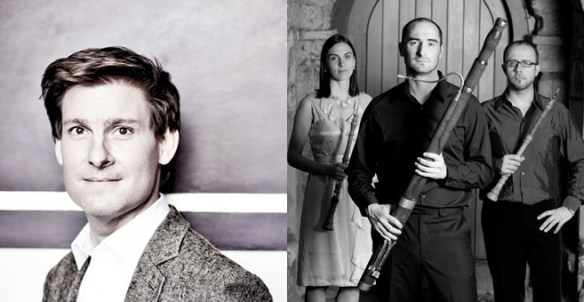
Wigmore Mondays – Nicholas Angelich plays Chopin & Liszt

nicholas-angelich

Nicholas Angelich

Chopin 2 Nocturnes, Op.55 (1842-4) (12 minutes)

Chopin 3 Mazurkas, Op.59 (1845)

Liszt Piano Sonata (1854)

Listen to the BBC Radio 3 broadcast here, until 9 November

Arcana’s commentary

A very satisfying blend of poetic 19th century piano music from Nicholas Angelich. By beginning with a well-chosen selection of Chopin he set the scene perfectly for the drama that is Liszt’s Piano Sonata, one of the great works for the instrument and a real test of any pianist’s clout.

First, though, the Chopin – and two contrasting works that bear the title Nocturne. This was a form of music that was more or less invented by the composer John Field and taken up by Chopin, who found it an expressive means with a relatively free form. The first of the two (from 1:46 on the broadcast) was distracted in mood and more than a little downcast. Thoughtfully played, it gradually became more animated before calm was restored with the theme at 5:58. The second nocturne (7:43) had a more open sound, with an almost constant ripple of watery accompaniment.

Angelich’s performances of the Mazurkas showed just how different Chopin’s interpretation of this dance could be.

The last of the three (22:10) was the most dramatic, shifting tellingly from major to minor key at 23:08, and ending there from 25:31.

You could say that Liszt’s Piano Sonata is a one-act play in four scenes – or you could equally say that it is a four-act play. Such is its formal design that both approaches work across the course of half an hour, and it really is one of those pieces the listener can be totally absorbed in.

For that you need the right performance of course, and this one from Nicholas Angelich fitted the bill in every way. The drama should begin even before the first soft, low notes are sounded, and here the period of silence beforehand built the anticipation nicely.

Then once we were under way at 27:30 Angelich set out the musical arguments, allowing the first movement to build its tension through to the start of the faster music at 28:20. After this the music really got going, though it was around the 36:27 where the tempo was really flying, leading up to a grand statement of the slow theme from Angelich at 38:05, a great demonstration of both power and grace at the piano.

This performance really came into its own in the slow movement however (from 41:00), setting a restful and uncommonly sublime mood, until a warning at 48:05 where the music from the start revealed itself again. Other points of note to look out for in the recording are at 48:43 where the fugue begins.

Angelich made a real and clear sense of this tricky passage, beginning with the theme and continuing at 48:55 with the ‘answer’ – as fugues are wont to do. Then the pyrotechnics ensued, a showy movement but one that Angelich kept under control, especially at 52:13 and a triumphant return of the big, slow theme. The coda, from 57:38, was exquisitely paced, and the end, when it came, was soft and petered out to the silence with which the Sonata began.

A performance as impressive for its quiet moments as its loud ones – and a Liszt sonata packed full of incident, drama and romance the whole way through.

Further listening

Angelich has very helpfully recorded something of a ‘concept’ album that begins with the Liszt Sonata. This work was dedicated to Schumann, so we also get that composer’s set of eight fantasy pieces Kreisleriana, one of his very best piano works. Completing the album are two Etudes by Chopin, the subject of Schumann’s dedication.

by Ben Hogwood
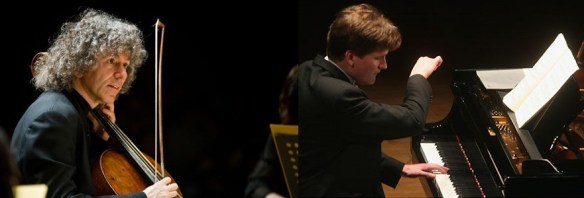
Wigmore Mondays – Steven Isserlis & Olli Mustonen in Prokofiev, Schumann and Mustonen

steven-isserlis-olli-mustonen

Steven Isserlis (cello), Olli Mustonen (piano) (both above)

Schumann 3 Romances, Op 94 (1849) (11 minutes); 3 pieces from Album für die Jugend, Op 68: Sheherazade; Winterszeit I & II (1848) (9 minutes)

Olli Mustonen Frei, aber einsam (UK premiere) (2014) (4 minutes)

Schumann arr. Isserlis Intermezzo from F.A.E sonata (1853) (3 minutes)

Prokofiev Cello Sonata in C, Op 119 (1949) (23 minutes)

Listen to the BBC Radio 3 broadcast here, until 2 November

Arcana’s commentary

Schumann is arguably Steven Isserlis‘ favourite composer. The clues are there in the enthusiasm with which the cellist talks about his music, the affection he gives to each of the melodic lines, and in this concert the construction of an imaginative suite of works for cello and piano, where his natural and extremely intimate lyrical side was to the fore.

Schumann did not write a fully-fledged sonata for cello and piano, but he did complete a number of pieces either directly for the combination or in a form that could be naturally arranged. Such is the case with the 3 Romances, published for oboe and piano as Schumann’s Op.94 but making a seamless transition to the cello.

In this performance the first Romance (from 1:47 on the BBC iPlayer) is a little doleful, the second (from 5:22) is notable for a relatively stormy central section, while the third (9:13) brings the instruments together in thoughtful unison.

After this Isserlis sat head bowed, listening intently as Olli Mustonen performed pieces from Album for the Young as though he and the listener were the only two people in the room. The first piece is Sheherazade (from 13:19), finding the level of intimacy that Schumann’s pieces for the young so consistently achieve, then from 17:10 we hear Winterszeit I and then the changing moods of Winterszeit II (19:01)

Mustonen himself then turns composer, with Frei, aber einsam (from 22:06), a piece for Isserlis alone written with the grace and intimacy of Schumann. It also has a bit of his childlike mischief when it gathers confidence – rather like a bird emerging from the nest – and starts flying along.

Mustonen uses the notes F-A-E as his starting point – which offers a strong like to the next work, heard from 26:46 we hear a tender performance of an arrangement of Schumann’s Romance for the collaborative FAE Sonata, a work written in tandem with Brahms (who contributed the famous Scherzo) and Albert Dietrich. It uses the notes ‘F-A-E’ in the simplest possible way – but also the most personal.

Following this attractive suite is the Cello Sonata of Prokofiev. Typically for the Russian composer this is full of good tunes, and in this performance (from 32:26) Isserlis and Mustonen bring them all to life in a vivacious performance. Isserlis had his way with the audience in the hall, too, with a few glances that sent up the more humourous moments of the second movement perfectly (from 42:46). There is music of romantic power, too, whether in the powerful climax of the first movement (at 41:11) or in the big finale (from 47:27) which sweeps impressively through its return to the main tune at 51:47.

A wonderfully affirming concert ends on a sad note with a tribute to the late conductor and violinist Sir Neville Marriner, the face of the Academy of St Martin-in-the-Fields, who passed away the day before at the age of 92. Isserlis chose the second of Schumann’s Five Pieces in Folk Style (from 56:42), and with Mustonen proceeded to give a touching and affectionate encore.

Further listening

For more music related to this concert, try the Schumann and the FAE playlist on Spotify below. This includes the whole of the collaborative FAE Sonata, the oboe and piano version of the 3 Fantasy Pieces in a wonderful recording from Heinz Holliger and Alfred Brendel and, to finish with, a rare recording of the Cello Sonata no.1 by Myaskovsky. He was the composer who raved about Prokofiev‘s Cello Sonata after its early performances – so here is his own moment in the sun:

by Ben Hogwood

Wigmore Mondays – Doric String Quartet play Debussy and Bartók

doric-string-quartet

Doric String Quartet [Alex Redington & Jonathan Stone (violins), Hélène Clément (viola), John Myerscough (cello)]

Bartók String Quartet no.4 (1928) (26 minutes)

Debussy String Quartet in G minor (1893) (27 minutes)

Wigmore Hall, London; Monday 26 September

Listen to the BBC Radio 3 broadcast here, until 26 October

Arcana’s commentary

An intriguing clash of two of the twentieth century’s biggest composers, glimpsed at very different stages in their development. It was perhaps a surprise that the Doric Quartet chose to begin with the Bartók, with its more abrasive tones, rhythms and harmonic language, but it received an extremely fine performance here.

Bartók wrote the piece at a point where his use of ‘cyclical’ and ‘arch’ forms was prevalent in his work. The String Quartet no.4 works as an arch, its first and fifth movements big-boned compositions, while the second and fourth are flighty and elusive. The third is a typical example of the composer’s night music, supremely evocative and more than a little wary of the shadows.

If not perhaps as ‘rustic’ as some of the Hungarian quartets in performance, it was played with precision accuracy, the rhythms making themselves clear with plenty of cut and thrust. The rocking motion of the second idea in the first movement (from 3:50 on the broadcast) offered a nice contrast.

It was perhaps in the middle movements however where the Doric were strongest. The second movement, played with mutes (from 8:11) offered shadowy contours and elusive, silvery sounds – not forgetting the odd outburst – while the third, a slow movement (from 12:02), has lovely shady contours at the end (from 17:28). Best of all was the fourth movement (17:58), played pizzicato (plucked) and with some especially good snappy effects.

Bartók’s moments of simplicity were surprisingly moving, while the gritty determination on show elsewhere was very convincing – nowhere more so than the start of the last movement, a big ensemble section of terrific drive (21:08).

Debussy’s only String Quartet comes towards the start of his composing career, just as he was shaking off the overbearing influence of Wagner. It signals a conscious move towards the more ‘impressionist’ language he started using with orchestral works such as Prélude à l’apres-midi d’un faune, but remains packed with extremely catchy tunes, enjoyable humour and rich textures.

The Doric performance was a very good one but did on occasion lapse towards a bit of fussiness with tempo variations. It certainly started rather smoothly (30:31), blunting the edges of Debussy’s humour a bit, but lovingly played. The less witty approach could also be felt in the second movement (from 37:10) – which, incidentally, is receiving a lot of exposure at the moment thanks to the Apple advertisement below:

The slow movement (from 41:21) was a beauty, notable for some lovely, elegiac sounds from the viola of Hélène Clément (at 44:22) and a beautifully judged climax. The finale felt a bit episodic, and it was difficult to always hear Alex Redington’s line at the very top of the texture where I was sat at the end of the hall. That said, its exuberance (from 49:47) could hardly be faulted.

Further listening

If you like the music in this concert, Ravel’s only String Quartet is a logical piece to hear next. It bears many similarities to the Debussy but is if anything even more exquisitely formed. For something a bit fuller for strings from Bartók, the Music for strings, percussion and celesta is a terrific orchestral piece, full of atmosphere and drama – so much so that Stanley Kubrick turned to it as part of his horror film The Shining. The playlist can be found here on Spotify, together with the music from this concert:

Wigmore Mondays – Ensemble Marsyas and Kristian Bezuidenhout

Ensemble Marsyas, Kristian Bezuidenhout (left)

Ensemble Marsyas (Josep Domènech Lafont (oboe), Nicola Boud (clarinet), Alec Frank-Gemmill (horn), Peter Whelan (bassoon), Kristian Bezuidenhout (fortepiano)

Wigmore Hall, London, 11 July 2016

written by Ben Hogwood

Audio (open in a new window)

http://www.bbc.co.uk/programmes/b07jhwk7

Available until 10 August

What’s the music?

Mozart Quintet for piano and wind in E flat major, K451 (1784) (23 minutes)

Beethoven Quintet for piano and wind in E flat major, Op.16 (1796) (24 minutes)

Spotify

Kristian Bezuidenhout and the Ensemble Marsyas have not recorded this music, but in case the broadcast link does not work the Spotify playlist below gives alternative versions from pianist Stephen Hough and the Berlin Philharmonic Wind Quintet, available on BIS:

About the music

Mozart held his quintet in extremely high regard in comparison with the rest of his output. Its first performance was part of a marathon concert that also featured the Linz and Haffner symphonies, but all the composer could talk about was his satisfaction with the new quintet. It does mark something of a departure, being the first work for the combination of piano and wind quartet, and the writing for both is superb.

In some of his early works Beethoven was consciously using instrumental combinations already mastered by Mozart, and applying his own stamp to them. The early string trios, piano trios and this quintet for piano and wind are all examples. Typically he does things his way in all of them, and in the quintet the piano really does take the lead, perhaps betraying the fact that Beethoven was about to publish his first two piano concertos.

It is an ambitious work, with a particularly sizeable first movement, and in the second Beethoven allows each of the wind instruments a chance to shine in a solo capacity.

Performance verdict

There is something about the sonic combination of piano and wind that is enormously comforting, either as late night / early morning listening or in a concert experience. To say it was invented by Mozart may be stretching things a little far, but it is seemingly the earliest work to put the combined forces together, followed by Beethoven in his early ‘if you can’t beat them, join them’ mode.

The two make a good concert coupling, especially when the performances are as good as these. Kristian Bezuidenhout is a musician who easily dispels the fears among some concert goers that the fortepiano is a tinny instrument of little sound quality. He gets his phrases to really sing, especially in quiet moments, and throughout the more graceful parts of both pieces he played several melting passages of music.

The wind players were every bit as good, led more obviously in the Mozart by oboist dfgd or in the Beethoven by the bright timbre of clarinettist Nicola Loud. Alec Frank-Gemmill wrestled manfully with the difficulties of natural horn to produce a lovely sound, while on occasion the bassoon of Peter Whelan had a timbre resembling a baritone saxophone. When all four played together it was a beautiful sound, sometimes rough around the edges in a most appealing way, reminding us that there is such a thing as over-polished performance!

One of the most enjoyable Wigmore concerts of the 2015-16 season, closing the series with a flourish and well worth hearing. As a postscript, it is worth noting Ensemble Marsyas were formed as a result of relationships formed in the European Union Baroque Orchestra. Would such a thing be possible after the UK leaves the union? Very unlikely!

What should I listen out for?

Mozart

2:02 – a slow introduction, where the tonality of E flat is established – but where the sonorities of the wind instruments are also made clear, as though Mozart were introducing the new idea to his audience. Then at 4:08 we hear the start of the allegro, introduced by the piano then passed over to the winds. This is a genial piece of music, like listening to a conversation between musical friends, and Mozart develops his ideas comprehensively, a good example occurring at 8:44.

12:05 the slow movement, a beautifully restrained introduction followed by solos for clarinet, oboe and then horn, Mozart giving each of the treble instruments their chance to shine. The fortepiano – reclaiming melody at 13:28 – is very much part of the ensemble. The horn gets a bigger solo at 16:08, part of a central section deeper on feeling.

19:37 – the fortepiano begins the finale with a detached and relatively simple theme that gains more colour when the woodwind repeat it. This tune becomes more of an earworm as the piece progresses.

Beethoven

28:15 – a subdued fanfare signals the beginning of the quintet from the wind, answered by a profound statement on the piano. This is a slow introduction, and a grand one at that, before the fast movement proper gets underway at 30:51, with some lively exchanges between the instruments and a number of tricky runs on the piano.

41:02 – a gentle start to the first movement, the fortepiano playing a figure that sounds like a lullaby. The sonorous tones of the wind instruments are soon in play with the same material, before solos from all four. The piano returns to the lullaby material at 45:12.

47:17 – the finale starts with a tune on the piano that you know is going to be whistled by the end of the concert! It is a perky and optimistic melody, often assigned to the bright clarinet timbre. When piecked up by the wind its dance character comes through, and for the rest of the movement it is developed and repeated.

Further listening

Not too long after the pieces in this concert were composed and performed, Rossini wrote six sonatas for string ensemble, published in 1804. Around twenty years later, Frédéric Berr thought these would be suitable when arranged for wind quartet – and so it proved. They make a very enjoyable hour’s music, making absolutely no demands on the listener!

Wigmore Mondays – Florian Boesch & Malcolm Martineau in Schumann & Wolf

boesch-martineau

Florian Boesch (baritone), Malcolm Martineau (piano)

Wigmore Hall, London, 4 July 2016

written by Ben Hogwood

Audio (open in a new window)

http://www.bbc.co.uk/programmes/b07j3vm5

Available until 3 August

What’s the music?

Schumann Die beiden Grenadiere Op.49/1; Abends am Strand Op.45/3; Die feindlichen Brüder Op.49/2

Märzveilchen Op.40/1; Muttertraum Op.40/2; Der Soldat Op.40/3; Der Spielmann Op.40/4 (all 1840) (20 minutes)

Wolf Goethe Lieder: Der Schäfer; Phänomen; Wandrers Nachtlied; Anakreons Grab; Harfenspieler I – III (18 minutes)

Schumann Belsatzar Op.57 (1840) (5 minutes)

Spotify

Florian Boesch has recorded a disc of Schumann but only one of the songs in this concert (Belsatzar). Here is a playlist containing all of the songs, using recordings made by the great baritone Dietrich Fischer-Dieskau:

About the music

1840 was an extraordinary year for Robert Schumann’s musical productivity. His so-called ‘year of song’, it saw him write 138 songs in total – including the eight in this recital program. Among the choice are four settings of Heine, which certainly preyed on the composer’s dark side.

In a similar vein, the year 1888 was a hugely productive one for the song composer Hugo Wolf. The tenor Ian Bostridge wrote this very fine introduction to the songs of Wolf for the Guardian in 2006. He wrote a whole songbook setting some of Goethe’s poetry, collected in 22 songs through 1888 and 1889, in the composer’s late twenties. The seven we hear are illustrations of the composer’s ability to combine melodic originality and a piano part that helps set the words in context, including the three songs of the downtrodden harpist.

Performance verdict

Florian Boesch’s baritone is an extraordinary instrument, and it is perfectly suited to the darker recesses of these Schumann settings, especially the Heine songs. Here is some of the composer’s most descriptive vocal music, and it is incredibly effective in this performance, not just for Boesch’s insights but for Malcolm Martineau’s ever colourful piano pictures. Here the colours are predominantly grey and black, but the steely edge to his lower register tone is crucial to the impact of the text and makes the moments of lighter relief – for there are a few! – ever more telling.

Similar forces are at work in the music of Wolf, which Boesch brings to thoughtful life. He is particularly effective in the slower songs such as Wandrers Nachtlied, where he and Martineau exhibit wonderful control of the drawn out phrases.

What should I listen out for?

Schumann

1:48 Die beiden Grenadiere (The two grenadiers) text

The piano’s terse introduction is quickly picked up by the baritone, who sings of the battle in dark tones. At 4:18 the song breaks into the melody of La Marseillaise, as the French grenadier expresses his wish to be buried on home soil should he die.

5:13 Abends am Strand text

A chilling song.

8:47 Die feindlichen Brüder (The hostile brothers) text

The singer and piano are closely aligned here. Initially the mood is a brooding one in preparation for the brothers’ fight, but then hostilities break out and the tempo quickens considerably, the piano stooping ever lower, well below the range of the singer.

11:20 Märzveilchen Op.40/1 (March violets) text

The mood lightens a little for Schumann’s celebration of the flowers, described by the poet as ‘a pair of laughing blue eyes’.

12:54 Muttertraum Op.40/2 (A Mother’s Dream) (Adelbert von Chamisso) text

The piano part is characteristically intimate for this soft reverie – but the peace does not last long, for there is a dark side in the form of a raven outside the window (from 14:10) at which point the singer’s tone gets progressively darker, to the depths of the end.

15:26 Der Soldat Op.40/3 (The Soldier) (Adelbert von Chamisso) text

There is a military air from the start of the piano introduction, with fanfares and ceremony, but again the mood is steely dark, right through to the drama of the bullets fired in the last verse, where the poet ‘shot him through the heart’.

18:20 Der Spielmann Op.40/4 (The Fiddler) (Adelbert von Chamisso) text

There are bright festivities at the start of this song, but again it is not long until darker thoughts emerge, the baritone sinking lower in his range as he sings of the bride of the story, who ‘looks like whitewashed death’.

Wolf

23:29 Der Schäfer (The Shephard) text

A darkly humourous song about a lazy shepherd, set by Wolf with some far-reaching harmonies and lazily decorated piano lines.

24:57 Phänomen (Phenomenon) text

A slow song, offering consolation at its end.

26:52 Wandrers Nachtlied (Wanderer’s Night Song) text

A slow and deeply sorrowful song, with long, drawn-out phrases – completed by Martineau’s soft postlude, lost in thought.

30:06 Anakreons Grab (Anakreon’s Grave) text

The contemplation at Anacreon’s Grave is not as sorrowful as one might think, ‘beautifully graced with verdant life’ in Goethe’s words. The song speaks of rest rather than torment.

32:45 Harfenspieler I text

Not surprisingly the piano imitates the harp beautifully at the start, though the vocal line that follows is quite stern, the singer imploring ‘leave me to my torment’!

36:25 Harfenspieler II text

Another predominantly slow setting, portraying a wretched man with dark tone in the singer’s voice and a reserved piano part.

38:49 Harfenspieler III text

The most dramatic of the three Harfenspieler settings, a tormented singer, in ringing tones, lamenting how the heavenly powers ‘let the wretched man feel guilt’.

Schumann

43:26 Belsatzar (Belshazzar) text

This extraordinary song runs through a whole gamut of moods and emotions. It begins with the Babylonian king singing with great bravado, his boasting and the piano’s tumbling figures adding to the sense of giddiness. At 45:24 he proclaims, ‘I am the king of Babylon!’ After this the song turns, the king fearful, until the famous writing on the wall passage, which sends a chill through the spine from 46:17. There is no coming back from here for the king, murdered by the end.

Encore

49:45 Described as ‘Twitter of the nineteenth century’ by Florian Boesch, this is Schumann’s Verratene Liebe Op 40/5 – another von Chamisso text – and it’s over in 45 seconds!

Further listening

Florian Boesch is a remarkable talent – and has forged a formidable partnership with Malcolm Martineau. Here they are in a complete album of Schumann, including the first of the composer’s Liederkreis cycles: