Wigmore Mondays – Esther Yoo & Zhang Zuo play Mendelssohn & Sibelius

esther-yoo

Esther Yoo (violin), Zhang Zuo (piano)

Wigmore Hall, London, 21 March 2016

written by Ben Hogwood

Audio (open in a new window)

http://www.bbc.co.uk/programmes/b07457qx

Available until 20 April

What’s the music?

Bach – Chaconne from the Solo Violin Partita no.2 in D minor, BWV 1004 (c1720) (15 minutes)

Sibelius – Sonatina for violin and piano in E major, Op.80 (1915) (12 minutes)

Glazunov – Grand Adagio from Raymonda (Act 1) (1898) (4 minutes)

Mendelssohn – Violin Sonata in F major (1838) (21 minutes)

Spotify

In case you are not able to hear the radio broadcast, here is a link to a playlist of the music played. Esther Yoo has not recorded any of it in violin and piano form, so substitute versions have been used:

About the music

Sibelius wrote a great deal of music for the violin but other than the famous Violin Concerto, very little of it is heard regularly these days. It is therefore a refreshing change to see the E major Sonatina listed. A relatively short work, it helped Sibelius through a particularly testing time with his finances.

Mendelssohn has a number of parallels with Sibelius where the violin is concerned, writing a famous Violin Concerto that gets played at the expense of pretty much everything else. Once again in this case there are works for violin and piano, and the Violin Sonata chosen for this concert is the most substantial, completed in 1838. For some unexplained reason it was not published in Mendelssohn’s lifetime, and was resurrected by Yehudi Menuhin in the 1950s.

Esther Yoo begins the concert alone, with Bach’s famous Chaconne – taken from his Solo Violin Partita no.2. It is a landmark in solo instrument writing, a tour de force of 64 different versions of the same sequence of chords that Bach develops with ever greater virtuosity.

She complements the Sibelius, meanwhile, with a short piece – an excerpt of a love scene from Glazunov’s ballet Raymonda.

Performance verdict

A refreshing program from Esther Yoo, who has just recorded a very well-received disc of Sibelius and Glazunov with Vladimir Ashkenazy.

It was particularly good to report a rare outing for the Sibelius Sonatina, a piece with energy and fresh invention that definitely sweeps away the cobwebs! Yoo and her musical partner Zhang Zuo (known as ‘Zee-Zee’) gave a performance full of enthusiasm and energy, giving Sibelius’ melodies a real shot in the arm. Prior to this Yoo had greatly impressed with her account of the Bach Chaconne, a deliberately slow and careful start gathering in pace and intensity, taking the fearsome technical challenges in her stride.

Glazunov’s Grand Adagio made a fitting complement to the Sibelius, invested with suitable passion, but the real discovery was the Mendelssohn, a piece of great craftsmanship and, in the slow movement, a depth of feeling unusual even for him. The two performers had great chemistry here and clearly enjoyed their interactions through the faster music, taking time in the slow movement to let the hymn-like passage sing.

An excellent concert concluded with a Korean folksong arranged for violin and piano, played with delicacy and then great gusto!

What should I listen out for?

Bach

1:28 – the violin begins with a grand statement of a chord sequence which it then proceeds to spin out over 64 variations, reaching great intensity in the string crossing around 7:30. The variations are set mostly in the minor key but move to the major at 9:15. Bach gives an enormous variety of colour, speed, attack, repose and musicality, starting relatively slowly but moving to passages of increasing difficulty and intensity, notably the string-crossing passage mentioned above, but this is also one of his most profound pieces of music when interpreted well. The music turns back to the minor key with impressive dramatic effect.

Bach often asks for the violin to employ ‘multiple stopping’; that is, playing more than one note at a time – which means the music can sound as though it is in many parts, despite still being played on the one instrument.

Sibelius

18:49 – a bold start from Sibelius, with the colour from the piano recognisably his. The grand introduction cuts to a quicker theme at 19:30 which suggests the outdoors. The music trips along at quite a pace – as so often Sibelius suggesting quick movement in his music. It also ends with a typical lack of fuss.

22:25 – the thoughtful second movement starts to spread its wings with the emergence of a rather beautiful melody from the violin.

27:03 – a broad melody on the lower register of the violin restores a grand air to the piece, though soon the violin twists upwards. The music gets faster again, returning us to the spirit of the first movement, with energy and grace in equal measure. Up to the end it becomes increasingly breathless, Sibelius throwing in a surprisingly light finish.

Glazunov

31:05 – as you might expect from a declaration of love in a Russian ballet, this is deeply passionate music, with a melody tailor made for the violin. With long phrases and sweeping gestures the music swoons. The violin reaches for the heights around 34:35, before sinking gracefully into a soft coda.

Mendelssohn

36:47 – it is difficult to understand why Mendelssohn did not publish his Violin Sonata when it starts as brightly as it does in this performance. A distinctive theme leads to close interplay between violin and piano. This being Mendelssohn there is a typically busy piano part, but there is a particularly nice, spring-like passage around 40:00 where the music slows and the composer’s lyrical side comes out.

45:38 – the slow movement is an unexpected treat, one of Mendelssohn’s most searching emotionally. It begins with a solemn statement on the piano, joined by the violin in

52:40 – a typically brisk Mendelssohn finale, the violin scampering off with the piano in hot pursuit. Initially there is barely room for breath, right up until a contrasting slower section.

Further listening

Yoo’s new disc would seem the ideal place to go next, containing Glazunov’s Violin Concerto as well as the one by Sibelius. It has been very well received and can be heard here:

Meanwhile you can watch a preview of the disc here:

Wigmore Mondays – Maxim Rysanov & Ashley Wass: Schubert plus

rysanov-wass

Maxim Rysanov (viola), Ashley Wass (piano)

Wigmore Hall, London, 14 March 2016

written by Ben Hogwood

Audio (open in a new window)

http://www.bbc.co.uk/programmes/b0739t8r

Available until 13 April

What’s the music?

Schubert – Sonatina for violin and piano in G minor (arr. Rysanov) (1816) (20 minutes)

Leonid Desyatnikov Wie der Alte Leiermann (1997) (14 minutes)

Sergey Akhunov – Erlkönig (2015) (5 minutes)

Dobrinka Tabakova – Suite in Jazz Style (2008) (15 minutes)

Spotify

Unfortunately most of the music in this concert is not available to stream…but there is a violin version of the Schubert that you can hear on the below playlist – which also contains some recommended listening and the originals of the Schubert songs inspiring the pieces by Desyatnikov and Akhunov:

About the music

This is a concert rather cleverly themed on the music of Schubert. Maxim Rysanov, though still a relatively new performer, has already contributed much to the available repertoire for the viola – and some of these contributions are in the forms of original compositions by Brahms and Schubert.

Schubert wrote three attractive Sonatinas for violin and piano, but their titles are misleading as they were applied posthumously. They are actually quite in depth pieces deserving of a bigger audience, and as Rysanov shows the G minor work transcribes nicely for viola and piano.

Russian composer Leonid Desyatnikov works predominantly in film, but wrote Wie der Alte Leiermann, his take on a song from Schubert’s song cycle Winterreise, for viola and piano. Likewise fellow Russian Sergey Akhunov expanded on Erlkönig, one of the composer’s darkest songs, to create a minimalist spectacular.

Finally Bulgarian composer Donbrinka Tabakova, with whom Rysanov has worked closely on an arrangement of a Schubert sonata for viola and orchestra, contributes a freely formed Suite in Jazz Style, where she looks to combine classical and jazz in a way successfully achieved by the likes of Stravinsky, Milhaud and Duke Ellington to name just a few.

Performance verdict

Maxim Rysanov is without doubt one of the finest viola players around, and he cemented that reputation with a series of powerful and passionate performances at the Wigmore Hall.

He has also gained a reputation for imaginative programming, and that was also in evidence, taking the music of Schubert and projecting it into much newer music and influences. This was a more guarded success, for the piece by Desyatnikov felt too long, despite its dramatic profile, and was rather relentless in its cold and downbeat mood. This does imply it was a successful recasting of the Winterreise song, which is hardly sweetness and light itself, but a little more light amongst the shade would have been welcome.

Akhunov’s Erlkönig was more effective as it had more momentum and rhythmic interest, though this too was starting to test the ear and run thinner on inspiration by the time its five minutes came to a close.

Far more involving was Bulgarian composer Dobrinka Tabakova’s Jazz Suite, for it was more obviously fun, as well as being more immediately emotional. There were some clever syncopations and use of the viola to get some truly unusual sounds, and Rysanov clearly warmed to this, in the company of Ashley Wass’s clear but nicely swung rhythms.

The Schubert with which the two began was very well played and carried an urgent dialogue throughout, reminding us that the three pieces in this form are not trifles, as the Sonatina name implies they should be – they are actually really substantial and memorable works.

What should I listen out for?

Schubert

1:28 – a call to arms to begin (marked Allegro giusto by the composer, which becomes a bit more furtive as the piano takes the lead. This is repeated (2:51) and then developed from 4:14 – before a reprise back in the ‘home’ key at 5:12. Mostly the two instruments are equal partners, though they both become obsessed with the three-note figure that dominates Schubert’s thinking. Rysanov’s arrangement for viola lies relatively comfortably under the fingers.

6:55 – a relaxed Andante forms the slow movement, with a nice and simple theme from the viola. Schubert gives it plenty of space, and the whole movement – though relatively short – has a nice airy profile.

12:57 – the influence of Mozart can be more clearly felt in this brisk Menuetto. You would have to look pretty lively if you were dancing three in a bar! The viola is effective when Rysanov drops down an octave to exploit the lower range (e.g.13:48). A trio section (from 13:59) is nicely poised, before the main theme comes back at 14:54.

15:42 – this sounds more like one of Schubert’s songs, with an offbeat piano accompaniment to the main viola tune. There is a lively secondary tune though, which comes through to dominate – especially when Schubert brings it back in the main key at 19:05, to close what had initially been an uncertain piece in emphatic fashion…or so we thought! He then swings back to the minor key, but ultimately this tune wins through.

Desyatnikov

The inspiration for Desyatnikov’s piece is Schubert’s Der Leiermann, which can be heard here:

23:02 – the harsh tones of the viola’s opening strings evoke the hurdy-gurdy in coarse style. In response the piano line feels very cold, and the two exchange their ideas. Then there is a slow statement from the viola using harmonics () before things get very fraught between the instruments. At 28:43 a new, faster section starts with urgent sounds and a swing to the melody that sounds almost American. In the long closing section, from 33:30, the music’s frosty tone becomes almost devoid of feeling, though some outbursts (34:08) draw vivid parallels with the music of Janáček.

Akhunov

Akhunov’s inspiration is Schubert’s Erlkönig, which can be heard here:

38:48 – a twisted introduction, with plenty of discords, gives way almost immediately to an intriguing development, a pulsating tonal base from the piano and a melodic cell that grows steadily from the viola.

Tabakov

45:35 – this first movement, marked ‘Confident’, starts out with a walking bass in the piano deliberately written to imitate the sound of a plucked bass instrument. Over the top is an airy, improvisatory piece of work from the piano. The pair spar playfully until the viola literally dies away.

49:54 – the second movement is marked ‘Nocturnal’, and treats the viola as though it were a solo jazz singer. After a sultry introduction from the piano the viola comes in with a bluesy tune, moving between the major and minor keys with ease. Tabakova uses some intriguing techniques to vary the sound of the instrument.

56:12 – the third movement has a simple marking – ‘Rhythmic’. It starts almost inaudibly, scratching on the viola, but then the two instruments start trading a syncopated figure. The music has a happy disposition, and both viola and piano dance around each other, the viola becoming ever more expansive in its language. The two are restless bodies right until the end.

Further listening

There is plenty of good music for viola and piano if you look hard enough. Maxim Rysanov has recorded a fair bit of it already – and in a link with the music of this concert, here is an album begun by the Arpeggione Sonata arranged by Dobrinka Tabakova for viola and string orchestra:

Meanwhile you can watch her Suite in Old Style – again with Rysanov – below:

Wigmore Mondays – Brentano String Quartet play Haydn and Britten

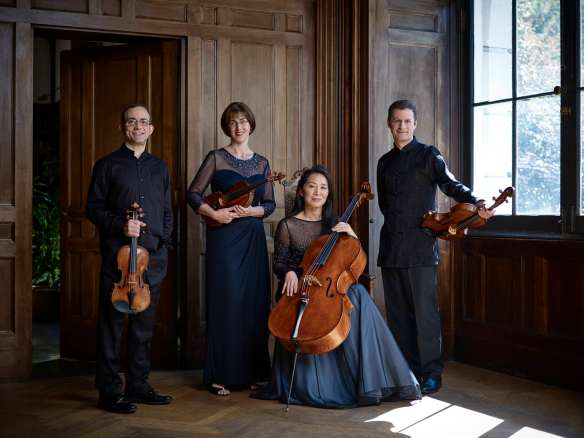
BRENTANO QUARTET - Misha Amory/ viola, Serena Canin/violin (glasses), Nina Lee/cello, Mark Steinberg/violin (glasses) www.http://brentanoquartet.com/

BRENTANO QUARTET – Misha Amory/ viola, Serena Canin/violin (glasses), Nina Lee/cello, Mark Steinberg/violin (glasses) www.http://brentanoquartet.com/

Wigmore Hall, London, 7 March 2016

written by Ben Hogwood

Audio (open in a new window)

http://www.bbc.co.uk/programmes/b072hw4q

Available until 6 April

What’s the music?

Haydn – String Quartet in F sharp minor, Op.50/4 (1787) (20 minutes)

Britten – String Quartet no.3, Op.94 (1975) (27 minutes)

Spotify

The Brentano String Quartet have not yet recorded this music, but other versions can be accessed via the playlist below, in case you can’t get to the broadcast:

About the music

Haydn wrote nearly 70 string quartets, but he was one of those composers incapable of writing the same thing twice. He also had a bit of a penchant for exploring relatively rare keys, and so this quartet, the only one he wrote in F sharp minor, occupies a special place.

It was part of a present for King Frederick William II of Prussia, to whom he had already sent his ‘Paris’ symphonies (nos.82-87) – receiving a ring in return. Haydn decided to send six string quartets, known as the ‘Prussian’ quartets – which continue to show his development as a composer in this relatively new form. The F sharp minor example is not as dark as some of the works in this key, though it does have some idiosyncratic moments described below.

Britten’s third numbered string quartet – his fifth and last to be published in the medium – is a direct product of the composer’s ailing health in 1975. With his capacity for work dwindling but not unbowed, it was suggested to him – in all seriousness by his friend Hans Keller – that if he wrote for less staves on the manuscript score he would be able to write more music.

He therefore completed a dedication for his friend, but as Keller recounts in his recent book, Britten: Essays, Letters and Opera Guides, the thought had been in his mind for some while. After a protracted discussion on form and sonata structure, Britten said to his friend, ‘One day, I’ll write a string quartet for you’. What he completed is something of a Divertimento – a wide ranging term that can apply from a short multi-movement piece to something as substantial as Mozart’s Divertimento for string trio, K563. The implication is that Britten wanted the freedom the form gave him.

With the Amadeus Quartet already enthusiastic exponents of his work, Britten took up the challenge with the help of the group and his assistant, composer Colin Matthews, who helped write much of the music from the piano. Although the Amadeus and Britten ran through the piece in private, he did not live to hear the public’s thoughts on the piece, for the premiere took place just over two weeks after his death.

The last movement of the quartet was written in its entirety in Venice, where Britten was still well enough to go on holiday, and perhaps inevitably it takes its lead from Death in Venice for its musical material. These are thought to be a present in musical form for Peter Pears. The final chord was a matter of some conjecture, and Britten changed it – for in the words of Colin Matthews, he wanted the work to ‘end on a question’.

For more thoughts on Britten’s last full work, visit the Good Morning Britten blog entry

Performance verdict

The Brentano Quartet were notable for their accuracy of tuning and ensemble in this concert but at times some of the raw emotional elements of the music were not necessarily close at hand.

The Haydn was extremely well played but did not have a freshness or spontaneity of the best Haydn performances. It was however impressive for the way they found the inherent darkness in the music, especially the finale, which had a grim determination. The slow theme and variations that make up the second movement could perhaps have enjoyed more variety between each one.

The Britten reached further emotionally, and the beautifully played last movement was a fitting finale. The Brentano were also very effective in the two faster movements, finding the right level of aggression. The rippling textures of the outer movements were beautiful too, recognising the very unusual colours Britten achieves in this music. Britten’s quartets travel internationally now – they were very much confined to this country for a while – and it is intriguing to hear them played from afar. This performance did the Third Quartet justice.

What should I listen out for?

Haydn

1:21 – the first four notes are key in the first movement of this quartet, for they form the basis of everything that follows – a bit like the repeated note motif in Beethoven’s Symphony no.5 but in a very different mood. Here the outlook is quite sombre, though the violin is positive. The first section is repeated (2:55), then at 4:25 the four note theme moves into development mode, before Haydn brings it back in original form at 5:37. Then he shifts the key to F sharp major at 6:22, and there is a notable upturn in mood.

7:31 – after the relative strife of the first movement the second begins in a pure and rather lovely form. A simple theme is presented before Haydn subjects it to several variations, but the peace doesn’t last and things take a darker turn at 9:30, the cello moving into its lowest register. At 10:55 the sunshine returns but is still affected by the music prior to it, and sure enough the minor key returns (12:34) – before Haydn moves once again to the major key for the next variation (13:16). The movement ends in a sudden full stop.

15:14 – the third movement, as is tradition, is a Minuet­ – but this one is a bit different as Haydn sets it in F sharp major, the most difficult of all keys for string players. It has a strange air about it, and some sudden loud bits do not help the mood of anxiety. At 16:45 a trio section starts, slipping into the minor key and feeling more vulnerable as a result. The Minuet music returns at 18:06, but doesn’t fully ease the tension.

19:10 – the mood of the quartet gets even darker for its finale, an austere fugue – which is where each part comes in at regular intervals playing slightly altered versions of the same tune. It makes a busy sounding texture, which Haydn works ingeniously until a sudden end, the finale only two minutes long.

Britten

23:54 – immediately in this work there is a sense of otherworldly mystery. In the third quartet Britten picks up where Death in Venice left off, the first violin using the same conversational style that Britten assigned to Aschenbach,(e.g. 25:14) the other instruments painting pictures of the undulating waters of the city’s canals. There is an intense period of contemplation that runs through this movement, subtitled Duets – because Britten tends to divide the quartet equally as the music unfolds

30:34 – the second movement (Ostinato) arrives with a jolt, and though its statements often end on a chord built on C – one of Britten’s favourite tonalities – it often sounds dissonant and unfeeling. There is a central section where brief respite is found, but it does not last long.

33:56 – when the violin takes the lead in this movement, marked Solo, it does so as a leader in prayer and meditation, and the other three instruments stand considerately in the sidelines. As the movement closes Britten reaches a radiant calm.

38:40 – either side of this moving section are two gruff, defiant scherzos, Britten writing closer to the style of Shostakovich but seeming also to shake his fist at the approach of Death. This second scherzo emphatically bursts the bubble created by the violin in the middle movement.

41:09 – the final movement – subtitled Recitative and Passacaglia – has perhaps the strongest sense of inevitability in late Britten. It begins with thoughts from the solo instruments, using the conversational style of the first movement. Then the Passacaglia takes hold (44:05). It is both sure footed and sublime, every repetition of the gently rising phrase feeling like a slow but sure step towards another world. That it ends on a question is something of a masterstroke, for after the serenity of the E major chord is realised in harmonics (50:33), Britten still has questions in his life and beliefs that remain unanswered. Ending on the ambiguous chord speaks volumes.

Encore

53:03 – a difficult call to make, doing an encore – but the Brentano chose nicely, opting for the first fugue from J.S.Bach’s The Art of Fugue (3 minutes). This is also reproduced on the Spotify playlist.

Further listening

Where to go after Britten’s final thoughts? It’s a very tricky question to answer, so how about some late or final thoughts from other composers? Included at the bottom of the playlist are Beethoven’s Piano Sonata no.32, Schubert’s last String Quartet and the Adagio from Mahler’s Symphony no.10:

Wigmore Mondays – Nicola Benedetti & Alexei Grynyuk in late sonatas by Beethoven & Brahms

nicola-benedetti
Nicola Benedetti (violin, above), Alexei Grynyuk (piano, below)

Wigmore Hall, London

Monday, 29 February 2016

Audio (open in a new window)

http://www.bbc.co.uk/programmes/b071cl1c

Available until 29 March

alexei-grynyuk

What’s the music?

Beethoven – Violin Sonata in G major, Op.96 (1812) (28 minutes)

Brahms – Violin Sonata no.2 in A major, Op.100 (1886) (23 minutes)

Spotify

Nicola Benedetti and Alexei Grynyuk have not yet recorded this music, but other versions can be accessed via the playlist below, in case you can’t get to the broadcast:

About the music

Beethoven’s tenth and last published violin sonata sits on its own in his output, a decade after than the composer’s previous work in the form. It is dedicated to the same ‘Archduke’ (Rudolph of Austria) for whom Beethoven wrote his famous B flat major piano trio, also published in 1812. Beethoven supposedly wrote it in a slightly easier style, as the violinist Pierre Rode – who was performing the piece with the Archduke playing piano – was not as skilful as he once was. The G major piece makes allowances, then – but not in a way that you would ever know from listening! It is unusually tranquil, and has instances of the timeless music Beethoven was to find in the slower movements of his late works.

There are no such concessions to technical ability from Brahms, who wrote the second of his three violin sonatas while on holiday by Lake Thun, Switzerland. This is however a relatively late work, and although Brahms has found and established his style the piece still carries some of the pressures of writing for Joseph Joachim. Its lyrical and tuneful nature have helped make it one of the composer’s most popular pieces of chamber music – and like the Beethoven it has a largely sunny outlook.

Performance verdict

A nice combination of two violin sonatas that seemed ideally suited to a bright Spring lunchtime – and how refreshing to hear young artists such as Benedetti and Grynyuk take on two later works like this.

The Beethoven was lovely, performed in a spirit of enjoyment where the violin and piano really were equals. Benedetti’s tone, slightly sweet, was ideal, while Grynyuk proved a very sensitive pianist, with some lightly brushed contributions that made sense of Beethoven’s unusual contentment.

The same mood infused the Brahms sonata, though here there was a greater sense of purpose, as the first movement, having begun relatively slowly, surged through to a much more animated development section. The finale was also notable for revealing some of the shadows that became a greater part of Brahms’s late works – but overall the feeling was one of positivity, celebrating the composer’s good spirits and warm lyricism in this work.

What should I listen out for?

Beethoven

1:58 – as the piece begins there is an immediate feeling of contentment, and although the opening idea is quite innocuous it is distinctive, with its use of the trill ornament. The piano introduces an airy second theme at 3:10, which the violin soon takes up. The mood is summery, and even a bit drowsy. The first section is repeated again at 4:40. Beethoven then develops his ideas fluently before we hear the main tune once again at 8:31, shared this time by the violin and piano. The balmy warmth continues until the end.

13:12 – the second movement is slow, marked Adagio espressivo, and has that kind of heavenly timelessness often found in later period Beethoven. It has a spacious introduction from the piano and is if anything even more relaxed than the first movement. It operates at a similar tempo and mood to the slow movement from the Emperor piano concerto. From around 14:35 the violin lines become quiet and bare, Benedetti using little vibrato, but the warmth does not take long to return.

19: 19 – the third movement, a Scherzo, is short, and if you blink you’ll miss it! Its first idea is once again light of touch, and though there is a heavier trio section it is not at all long before the minor key asserts itself again.

21:48 – the final movement also has a light touch, with a Haydn simplicity, and is particularly rich in the lower register and strong in the continuous, lower runs. The slower music is a delight, still airy and relatively carefree. There is then a quicker, invigorating run to the end.

Brahms

32:37 – one of Brahms’s most celebrated tunes opens this piece, a lovely outpouring of good feeling. It is quite slow and quiet to begin with but grows into a full blooded interpretation as the theme is developed further. There is greater affection here than in much of Brahms’s output.

42:07 – this is definitely the lighter side of Brahms, with a tender slow movement that segues into a more jaunty Scherzo section (43:32), marked by tumbling triplets in the piano part. The slow movement music follows again at a safe distance (44:38) – and then once again the scherzo music trips along (46:43), this time with plucking from the violin.

49:28 – in the last movement we get the warmth of the violin’s lower register, taking the ‘grazioso’ marking in to account. There are though some shadows that the listener might sense occasionally, the odd harmonic turn towards the dark side that never lasts too long but is there nonetheless.

Encore

54:35 – a substantial encore from Benedetti and Grynyuk, and a very different mood in the exotic and intense Myth no.3 by Polish composer Szymanowski.

Further listening

At the bottom of the playlist you will find some further suggestions for violin and piano in the form of sonatas by Schumann – Brahms’ friend, of course – with his Violin Sonata no.1 – and César Franck, whose own Violin Sonata shares the same key and mood as Brahms’s Second. Finally some shorter pieces by Schumann for solo instrument and piano – the joyous Adagio and Allegro and the 5 Pieces in Folk Style, arranged here for cello and piano. Each will put you in a good mood!

Meanwhile if the Szymanowski appeals, Nicola Benedetti has recorded his Violin Concerto no.1:

Wigmore Mondays – Denis Kozhukhin – Out of Doors

denis-kozhukhin
Denis Kozhukhin (piano)

Wigmore Hall, London

Monday, 22 February 2016

Audio (open in a new window)

http://www.bbc.co.uk/programmes/b071774c

Available until 24 March

What’s the music?

Haydn – Piano Sonata in D major, HXVI:24 (1773) (10 minutes)

Brahms – Theme and Variations in D minor (1860) (10 minutes)

Liszt – Benediction du Dieu dans la solitude (1847) (16 minutes)

Bartók – Out of Doors (1926) (14 minutes)

Spotify

Denis Kozhukhin has recorded the Haydn sonata but not any of the other works in this repertoire. In case you are unable to hear the radio broadcast the below playlist contains legendary recordings of the Brahms (Radu Lupu), the Liszt (Claudio Arrau) and Andreas Haefliger’s account of the Bartók:

About the music

Haydn is acknowledged as the godfather of so many forms that became the norm in classical music from the late 1700s onwards. As well as the symphony and the string quartet, he left a great body of piano sonatas that are fresh, original and ground breaking. Later examples from Beethoven and Schubert would surely not have been written were it not for works such as the D major example here.

The Brahms Theme and Variations is actually an arrangement of the second movement of his String Sextet no.1 – and transcribes for piano effortlessly, so much so that the listener would think it was a piano original. This was in order for it to be played by Clara Schumann, who received the score as a forty-first birthday present in 1860.

Liszt wrote his Benediction as part of a cycle of ten pieces for piano called Harmonies poétiques et religeuses in 1847. It is a relatively long, single span of contemplation, and in it the composer writes music that could be seen as an early pointer towards the so-called ‘impressionism’ of Debussy and Ravel. So often known for writing barnstorming piano pieces, Liszt takes his foot off that particular pedal for once.

Liszt’s fellow Hungarian Béla Bartók wrote his short set of five pieces, Out of Doors, in 1926. As its name suggests it is a celebration of the Hungarian countryside, by raucous day – pipes, drums and chases – and by atmospheric night, where the sounds of amphibious creatures can be heard in some of his exquisite nocturnal picture painting.

Performance verdict

From this concert it is very clear that Denis Kozhukhin is a special talent. The well-designed hour of music moved almost seamlessly from the simplicity of Haydn to the brazen antics of the Bartók with almost no join.

Kozhukin’s Haydn was lovely, the D major sonata receiving an airy performance with plenty of rubato – which means a stylish way of letting the music breathe – so that the rhythms were not too rigid.

The Brahms was similarly magical in the quieter passages, allowing Kozhukhin to use an imposing tone when the music returned to the minor key. This was a performance flying in the face of the obvious technical difficulties presented by the composer – and the same could be said for the Liszt, reaching moments of hypnotic beauty in its outer sections.

Kozhukhin took his time here, creating and maintaining the mood of contemplation, holding the atmosphere while easily managing the fiendishly difficult writing for the right hand. In the Bartók he found a good balance between percussive power and the primitive, folksy material that the composer brings to the surface. As a result Out of Doors felt like a celebration, entertaining and energetic, but with an added chill to the night pieces.

What should I listen out for?

Haydn

1:10 – the piece starts with a flourish in the right hand, one that recalls the sonatas of Scarlatti – as BBC Radio 3 announcer Fiona Talkington points out. It is a fresh tune that twinkles with the accompaniment that Haydn chooses, with very little bass. As is customary the first section is repeated (2:14) before at 3:20 Haydn starts to develop his main idea, moving it around harmonically. This is brief – as at 4:25 we hear the main idea again.

5:47 – the slow movement, which is immediately quite sombre and preoccupied. It is in the style of an aria, as though an imaginary singer were taking the line Haydn gives to the right hand. It is a brief but poignant movement, lost in thought towards the end. Haydn emerges from the quiet mood, leading straight into…

8:54 – the last movement, a short structure bright in tone and with an amicable tune. The end is rather nicely done.

Brahms

11:44 – Brahms begins with a grand statement. The first statement of the tune is given to the right hand, while the left plays arpeggiated chords. It is a big tune – and the first of six variations starts at 13:09, still in the minor key. By 15:38 the music is worked up and full of darkly coloured passion, but then Brahms slips effortlessly into the major key and a lighter outlook (16:54), from where Kozhukhin leads to a radiant variation. At 20:04 the austere minor key returns, but Brahms still finished in the major key, settling the strife experienced earlier.

Liszt

22:35 – Benediction du Dieu dans la solitude (God’s blessing of solitude) is a radiant performance of a piece that begins with a very long melodic phrase. It is quite unusual for Liszt in having very few moments of fire and brimstone, and instead achieves a kind of ecstasy of contemplation. The key – F sharp major – is key to this, the black keys somehow much more mystical than the white on this occasion! There are two central sections – both calming influences (28:39 and 30:58) before the original material returns (32:28). We hear all three tunes before the piece closes softly.

Bartók

39:03 – With Drums and Pipes – an exuberant if heavy start, low on the piano. This is almost an early precedent of rock music with its pounding rhythms!

40:40 – Barcarolla – a slower dance that flows nicely but which sounds uneasy, as though the direction of the boat on the water is uncertain.

43:10 – Musettes – this is rustic, dance-based material, where a lot of the tunes sound as though they are packed with wrong notes (they aren’t!) It makes them strangely charming.

46:05 – The Night’s Music – a classic example of a Bartók night setting. The music closes in on itself, and in the distance some animal / insect noises can be heard, disturbing the night’s piece when they get closer or make sudden noises, such as when Kozhukhin slams the upper end of the piano. It is an atmospheric and highly descriptive piece of music, and more than a little eerie as the sounds persist, seemingly stopping any chance of sleep.

51:11 – The Chase – a bruising encounter with the hands seemingly all over the place on the keyboard. The rhythms are deliberately inconsistent as the music hurries along, with great dissonance and surprises in both parts.

Encore

54:35 – the first encore is a sonata from Domenico Scarlatti – a relatively slow one that makes much of a trill in the right hand. It was published as Kk247 and lasts four minutes…after which point (at 59:01) we hear another sonata, this time from the Spanish composer Antonio Soler – a brighter example in D major – just the two minutes.

Further listening

At the bottom of the playlist you can hear the original Brahms Theme and Variations, written as the second movement in his String Sextet no.1. You can then hear another set of variations – on a theme of Haydn – as well as trying to second guess where Liszt was heading, in the direction of Ravel’s Jeux d’eau! Finally some more Bartók – his three movement Piano Sonata, just as raucous and unhinged as Out of Doors. Listen below: