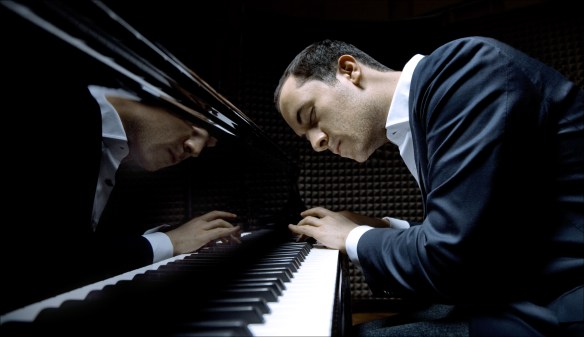
Igor Levit at the Wigmore Hall

igor-levit
Igor Levit

Richard Whitehouse on another enterprising program from the Wigmore Hall
Wigmore Hall, London Thursday 5 November

Muffat: Passacaglia in G minor (pub 1690)

Shostakovich: Piano Sonata no.2 in B minor (1943)

Beethoven: Diabelli Variations (1819-23)

Igor Levit (piano)

Make no mistake, Igor Levit is among the most questing and (executively speaking) creative of younger pianists and it was an astute move by Wigmore Hall to make him a featured artist this coming season – Igor Levit Perspectives taking in a range of solo and chamber projects.

Levit’s latest recording comprises no less than three variation cycles by Bach, Beethoven and Rzewski (about which you can learn more by watching the video below). Avoiding any temptation to programme them as a single ‘marathon’ recital, tonight’s recital placed the Beethoven within a stimulating context. This opened with the Passacaglia from Georg Muffat’s Apparatus musico-organisticus, whose five variations on a deceptively functional theme were a blueprint for increasingly elaborate such sequences over the next two centuries. Levit’s account did not want for expressive depth or technical finesse.

A conceptual link between this piece and the finale of Shostakovich’s Piano Sonata no.2 was not hard to discern. Despite advocacy from such pianists as Emil Gilels, this latter work remains neglected compared to the composer’s orchestral and chamber music; its essentially introspective manner evident in an initial Allegretto whose respectively furtive and sardonic themes were delineated with simmering volatility. Nor was the central Largo lacking in that anguished restraint which Shostakovich was to mine extensively in his later string quartets; the (11) variations of the final Moderato unfolding with a cumulative intensity capped by the penultimate one in which Levit’s daringly slow tempo was justified by the desolation thereby conveyed, its successor then bringing this work full-circle to a decisive yet fatalistic degree.

After the interval, Beethoven’s Diabelli Variations and a performance that underlined the breathtaking imagination of a piece whose overall cohesion is afforded precisely through its sheer unpredictability. Not that Levit shied away from such disjunctiveness – witness the frequent and often lengthy pauses between groups of variations (which, interestingly enough, were by no means the customary or expected ones) – yet there was rarely, if ever, any feeling that this follow-through was governed other than by deep-seated formal logic and expressive conviction. Qualities equally true of the 10 additional variations that Beethoven inserted late in the work’s gestation, and which between them further point up the audacity of the overall concept as one in which Diabelli’s jejune theme is respected for all its intensive dismantling.

The biggest change came (as most often) with the modulation into C minor for variations 29-31, and a sequence that occupies a similar emotional domain to that of the ‘Arietta’ from the final piano sonata – though here the outcome is not transfiguration but the careering velocity of a double fugue in E flat; its progress finely articulated by Levit, who was nonetheless at pains to ensure its apex came with that credential interlude into the final variation – a minuet whose lucid poise brings with it a measure of calm then, at the close, bestows a benediction.

A pity the audience betrayed frequent signs of restlessness as the performance unfolded, but. Levit made no concessions to his listeners; any more than does Beethoven to his exponents – between them confirming a level of artistic integrity that should never be taken for granted.

Wigmore Mondays – Sabine Meyer, Daniel Hope and Sebastian Knauer

meyer-hope-knauer

Sabine Meyer (clarinet), Daniel Hope (violin), Sebastian Knauer (piano) – Wigmore Hall, London, live on BBC Radio 3, 2 November 2015

Listening link (open in a new window):

http://www.bbc.co.uk/programmes/b06mc8lk

on the iPlayer until 2 December

Spotify

In case you cannot hear the broadcast, here is a Spotify playlist of the music in this concert, from available versions on Spotify:

What’s the music?

Stravinsky: Suite from ‘The Soldier’s Tale’ (1918-1919) (15 minutes)

Milhaud: Scaramouche (clarinet and piano) (1937) (9 minutes)

Satie: Gnossiennes nos. 1 & 4 (piano solo) (1890, 1891) (8 minutes)

Bartók: Contrasts (17 minutes)

What about the music?

There is not much repertoire for the combination of clarinet, violin and piano, but what there is available more than makes up for the dearth of material.

Stravinsky wrote The Soldier’s Tale for three speakers and a carefully chosen small group of instruments. The story tells of a soldier who trades his fiddle to the devil in return for prosperity – and in this condensed suite, arranged for clarinet, violin and piano, Stravinsky works some of the key numbers together in a combination that brings forward the raw elements of the story. All three instruments work together in punchy rhythms, or apart in virtuosic writing.

Milhaud’s Scaramouche is one of his most popular pieces, a short work that has proved flexible in arrangements for two pianos, saxophone and orchestra, or clarinet and orchestra. The clarinet and piano arrangement is the fourth version of the work he made – with a riotous first movement and a finale that brings forward his fascination with Brazilian dance forms.

Erik Satie wrote a lot of piano music, its appeal lying in a combination of suitability for amateurs and a direct emotional expression. The Gnossiennes are inspired by encounters with Romanian folk musicians, and are reactions to the music rather than an attempt to recapture it.

Bartók wrote his Contrasts for the unusual trio combination in response to a commission from the jazz clarinettist Benny Goodman and Bartók’s friend Joseph Szigeti. Originally called Rhapsodies, Bartók changed the title of the piece because of its very different moods and musical figures. After the curiously named Recruiting Dance there is a second movement that typically goes through a wide range of moods and speeds, before a helter-skelter beginning to the last movement finds the violinist using a detuned instrument.

Performance verdict

A quite outstanding concert from three soloists right at the top of their game who clearly work well in an ensemble capacity. It was a clever move to start with the Stravinsky – the dry humour, hummable tunes and tap-inducing marches worked very well in the Wigmore Hall acoustic, and with Daniel Hope effortlessly evoking the scratchy fiddle of the Soldier in this particular Tale, it was a performance that charmed and dazzled with its easy virtuosity.

Scaramouche fared much the same way, though Sabine Meyer’s playing in the first of the three movements was so exceptional – and fast – that it earned applause on its own. This lovable piece could brighten up any day, though even in this quickstep performance there was time for a little reflection in the second movement. The third showed off Milhaud’s aptitude for writing in Brazilian dance forms, and swung with a persuasive manner.

Two of Satie’s Gnossiennes provided a short cooling off period, simplicity themselves but also strangely moving with their modal folk writing.

Finally there were more fireworks, this time in the form of Bartók’s Contrasts, brilliantly played and with a keen sense of ensemble that implied these players meet up to play a lot more than they actually do! Meyer’s cadenza in the first movement took the breath clean away, but Hope and Knauer were not exactly slouches either! Hope gave a superb cadenza himself in the last movement, while Knauer was the glue for the performance, powerful in the fast music but finding the gamelan-like sonorities of the second movement with disarming ease.

The encore – Shostakovich’s Polka arranged for the original for two violins and piano – was invested with the same humour and enjoyment that kept the audience spellbound throughout the previous hour.

What should I listen out for?

Stravinsky

1:21 The Soldier’s March – Immediately the dry wit of Stravinsky’s music makes itself known, with little to no sustain in the violin or piano parts.

2:56 The Soldier’s Violin – the violin writing is deliberately scratchy, while the piano plays a typical Stravinsky ‘ostinato’, a repeated four note motif in the left hand that sounds awkward yet somehow completely right!

5:32 The Little Concert – some bold unison writing for the three instruments here, with bright colours as they show off in concert. However it’s not long before the piano ostinato comes back in the left hand – much quicker this time. The players work energetically throughout here.

8:20 Tango-Waltz-Ragtime – an exaggerated yet very persuasive tango from the violin, with what sounds like ‘wrong’ notes in the piano. Then the violin leads us through a waltz, exaggerating its gestures all the time in an attempt to rouse a sick princess.

14:46 The Devil’s Dance – in this whirlwind dance the soldier’s aim is to get the devil to play so fast he falls asleep. This is ideal for Stravinsky, who presents a brilliant sequence of syncopated rhythms and ensemble playing. When the end comes at 16:01 the devil falls down exhausted.

Milhaud

18:49 – Taken at an incredibly fast pace, this illustrates everything appealing about Milhaud’s music – the melodic invention, the humour and the snappy rhythms. The second theme, given out in octaves on the piano (19:45) sounds rather like Stravinsky, before the main idea makes a reappearance at 21:00. Huge fun!

21:50 – a doleful slower movement that brings out the mellow qualities of the clarinet’s lower range in its opening phrases.

25:44 – if you count each beat quickly at the start of this dance you’ll get the 3-3-2 that is characteristic of this particular Brazilian-infused dance. Once again the music is in high spirits, particularly the clanging piano octaves for the second idea (starting at 26:25). The shrill end is brilliantly done by Meyer.

Satie

29:46 – Gnossienne no.1 – time slows down almost immediately with this piece, which has a forlorn expression but also carries its listener off to another world. This is partly due to the folk melodies it uses, but also the variation of dynamics between loud and extremely quiet.

33:51 – Gnossienne no.4 – again the simplicity of this piece is a notable feature, with a stepwise movement to the melody and arpeggios in the left hand that point all the way forward to the music of Philip Glass and Ludovico Einaudi. The plaintive quality of the music remains.

Bartók

39:18 – the first movement has the curious title of a Recruiting Dance (dfgd) It starts with the violin plucking (pizzicato) before the clarinet and piano join. The music seems to turn in a circular fashion initially. The music continues to feel agitated, with extended trills from around 41:10 sowing the seeds of unease. Then from around 43:40 we have an extended solo (cadenza) for the clarinet.

44:42 – a soft but very uneasy slow movement begins with the clarinet and violin in slow unison, to which the piano responds with a soft, rumbling sound. Throughout this movement it evokes the sound of the gamelan, while the other two instruments make slow intonations above. This mood changes to a more fractious outlook around 47:07, where each of the instruments deals with extended trills, creating a vision of flying night music.

49:17 – the last of three movements begins with Daniel Hope on a cheap, detuned violin (apparently one he bought from E-bay!) Soon he casts this aside for the normal instrument and a typically frenetic Bartók fast movement plays out its arguments. At 51:40 the mood lightens with a slower but piercing violin solo, before the harmonies get more remote. Then the faster music starts to show itself, with shrill calls from the clarinet before the violin gets its moment at 54:05. The music then moves to a thoroughly convincing conclusion at 56:16.

Encore

58:00 – the well-chosen encore is a quick but funny Shostakovich Polka, subtly arranged from the original which is for two violins and piano.

Further listening

For some more repertoire featuring the clarinet, violin and piano, this album from Supraphon features not just the works heard here from Stravinsky and Bartok, but also works for the combination by Khachaturian and Milhaud.

One of Milhaud’s best-loved pieces is La Création du monde, and this can be heard as part of an album from Martha Argerich and friends:


Wigmore Mondays – Elizabeth Watts and Julius Drake

Elizabeth Watts, Photo : Marco Borggreve

Elizabeth Watts, Photo : Marco Borggreve

Elizabeth Watts (soprano), Julius Drake (piano) – Wigmore Hall, London, live on BBC Radio 3, 26 October 2015

Listening link (open in a new window):

http://www.bbc.co.uk/programmes/b06kb0f0

on the iPlayer until 25 November

Spotify

In case you cannot hear the broadcast, here is a Spotify playlist of the music in this concert, from available versions on Spotify (which do not include the Liszt song Quand tu chantes bercée).

What’s the music?

Liszt: 6 settings of poetry by Victor Hugo (dates are for first versions only): Enfant, si j’étais roi (1849); S’il est un charmant gazon (1844); Comment, disaient-ils (1842); La tombe et la rose (1844); Quand tu chantes bercée (c1844-45); Oh! quand je dors (1842) (21 minutes)

Debussy: Ariettes oubliées (1885-1887) (17 minutes)

Hahn: 4 Hugo settings: Rêverie (1888); Si mes vers avaient des ailes (1888); L’Incrédule (1893); Fêtes galantes (1892) (9 minutes)

What about the music?

A recital bringing together some richly varied settings of two French poets, Victor Hugo and Paul Verlaine.

It also gives us the opportunity to listen to some of the large output of Franz Liszt, who is best known for his piano music but whose songs have enjoyed greater prominence in recent years. He and the poet Victor Hugo were friends, meeting in Paris in the 1830s, and Liszt went on to set a number of his poems to music.

Debussy’s Ariettes oubliées (Forgotten Songs) is a cycle of six songs for voice and piano, based on a poem written by Paul Verlaine, who the composer knew and whose verse was a profound influence throughout the composer’s career.

We return to Victor Hugo for several settings by the Venezuelan-born French composer Reynaldo Hahn, who is best known for his song settings. This group of four includes Si mes vers avaient des ailes, the song that really brought Hahn to public attention and which, in the words of Graham Johnson, ‘has become his motto song’.

Performance verdict

A note first of all to say Arcana did not attend this concert, so the review is directly from the radio performance.

What is abundantly clear is that Elizabeth Watts is becoming a soloist of real repute, and one who has a very impressive and diverse repertoire. It was especially gratifying to hear her accounts of the Hugo settings by Liszt, not heard much in the concert hall but invested with real passion here, Watts floating effortlessly through the high notes as Julius Drake set the scene. Drake is an experienced pianist in Liszt songs, and is in the process of recording his output for Hyperion – and his ability to find the detail to point up alongside the vocal line was a real asset.

The Debussy had an essential mystique that Drake was quick to create in his piano part, Watts controlling her voice wonderfully well in the tricky melodic intervals. Meanwhile the Hahn selection sparkled, showing off this composer’s flair for word setting as well as the natural chemistry between Watts and Drake.

What should I listen out for?

Liszt

1:57 Enfant, si j’étais roi (Child, if I were king) translation here – a typically grand setting from Liszt, with a big piano part, while the soprano sings boldly above. A brave piece with which to start a recital! In the second verse the piano adopts a more threatening bass line as the soprano extols the virtue of a kiss from her lover.

5:13 S’il est un charmant gazon (If there’s a lovely grassy plot) translation here – a more gentle and loving song, this, with a similar mood to the opening of Brahms’ Violin Sonata no.2. The music flows with a mood of relative contentment.

7:41 Comment, disaient-ils (How then, asked he) translation here a nervy piano accompaniment immediately puts this song on each, though the floated higher vocal counters that somewhat. This is a short song but the high note at the end from the soprano carries a lasting impact.

9:49 La tombe et la rose (The tomb says to the rose) translation here This time we hear the soprano in a much lower range and with a fuller voice as Liszt takes on the much heavier text. There is weight in the piano part, too, though here as with a couple of the other songs it feels like Liszt has a short attention span.

13:44 Quand tu chantes bercée (When you sing in the evening) translation here This song has much softer contours, with a restful piano part and a relatively smooth vocal line for the soprano. That is not to say passion is lacking though, especially when the soprano sings ‘Chantez, ma belle’ (‘Sing, my pretty one’)

16:17 Oh! quand je dors (Oh! When I sleep) translation here As the title suggests here is a lullaby, though this one doubles as a love song. Again the soprano has to sing high, especially given the passion of Hugo’s text. The piano immediately sets the scene of rapture.

Debussy

The words for Ariettes oubliées are here

24:12 – C’est l’extase langoureuse (It is ecstasy) A heady song as you might expect from the title, which hangs on the air heavily. This whole impression is helped by Debussy’s chromatic writing, with soprano and piano right hand often in unison. The rich harmonies and melodies might sound awkward in isolation but, in a performance such as this, they are totally natural.

27:28 – Il pleure dans mon cœur…(It weeps in my heart) One of Debussy’s most celebrated early songs, delighting – or finding sorrow, rather – in the sound of the rain ‘on the ground and on the roofs’. A wide range is called for on the part of the soprano, not to mention the restless yet easily flowing piano part.

30:28 – L’ombre de arbres (The shadow of the trees) ‘The shadow of the trees, in the mist-covered river’ find the soprano beginning in a lower range, the air thick with humidity. This is a more sorrowful lament, the piano essentially standing by while the singer emotes – nowhere more so than the high note of 32:06.

33:14 – Chevaux de bois (Merry-go-round) A brilliant evocation of the fairground, the merry-go-round burling around dizzily on the piano, over which the soprano sings of the hurrying horses. Debussy’s quick moving harmonies are ideally suited to this sort of setting. The song ends quietly.

36:31 – Green A love song. The soprano has to travel quite a way in the course of this song, from low asides to higher outpourings of intense feeling. The twinkling of the piano’s right hand provides an effective counterpoint.

38:36 – Spleen A downcast song, reflecting on how ‘all my despair is reborn’. This does still take place over some exotic harmony on the part of the composer, the song moving far and wide in its melodic and harmonic reach.

Hahn

43:09 – Rêverie – translation here A halting figure on the piano feels like an offbeat waltz, accompanying the soprano as she sings, lingering on the word ‘kiss’. The song is relatively conventional in its structure.

45:11 – Si mes vers avaient des ailes (If my verses had wings) – translation here – a bright and positive love song, the singer clearly lost in thoughts of her beloved – and reaching some beautifully spun high notes along the way, with twinkling piano account. The last notes need particularly impressive control as the music slows.

47:52 L’Incrédule (The Sceptic) – translation here – a softly coloured but rather moving song, which has its conviction in the last lines, where the singer declares ‘And my faith is so deep in all that I believe in that I live for you alone’

50:11 Fêtes galantes – translation here – one of Hahn’s most endearing songs to close, the sparkling piano introduction keeping a detached feel as the singer spins higher notes above. The ‘shivering breeze’ is brilliantly evoked in the piano.

Encores

53:32 An encore of a Victor Hugo setting, L’Attente, (1840) from Richard Wagner. As Elizabeth Watts says to the audience, it’s not exactly easy – whether it’s the full bodied, high register vocal or the heavily congested piano part!


Further listening

Something completely different to complement Elizabeth Watts’ artistry, and also to show just how versatile she is. This is a recently released album of vocal works by the Baroque composer Alessandro Scarlatti, given with The English Concert and Laurence Cummings:

https://open.spotify.com/album/1Crx7DHWHCAqV7za0K80oX



Stephen Kovacevich 75th birthday concert with Martha Argerich

kovacevich

Stephen Kovacevich 75th birthday concert, Wigmore Hall, London Monday 2 November

How to review a concert where two genuine piano legends quite literally collide on stage? Well since this was a celebration, it seems only right to celebrate the main protagonist first.

Stephen Kovacevich, who has recently celebrated his 75th birthday, was honoured with this concert by the Wigmore Hall, where he made his debut over fifty years ago. He chose to include two-piano works with Martha Argerich, herself a celebrated pianist whose public appearances, if on occasion irregular, are as greatly revered as ever – and with whom he has a daughter. For the two to be together in a musical sense, performing relatively unfamiliar repertoire – for the birthday boy at least – made an opportunity too good to miss.

It was perhaps just a bridge too far in the case of Debussy’s En blanc et noir, however. Not because the performance was bad, but because the necessarily short rehearsal time meant the use of two page turners. This unfortunately relegated the modest Kovacevich to the back of the stage, rendering him only partly visible. The musical chemistry was pronounced between the two, especially in the second movement where Debussy hauntingly evokes the sounds of First World War bugle calls and gunfire against the slow, stately movement of a Bach chorale, which Argerich solemnly intoned. Yet the outer movements were tense, partly because of page turning quirks (no fault of the turners themselves) and the sense of two players not yet fully in gear.

They were emphatically in the zone for Rachmaninov’s Symphonic Dances, a terrific performance of the two-piano arrangement by the composer who is currently Kovacevich’s first love. The first movement punched at a considerable weight, with sharp ensemble and crisp rhythms, the speed a little slower than orchestras tend to take. Kovacevich himself clearly enjoyed the great second theme, usually assigned to the saxophone but beautifully phrased here.

The second movement was similarly fine, Argerich closely watching her partner, who was now nearest to the audience. This was his first public performance of a piece she has been performing for decades with friends, so it was natural she would want to ‘drive’ – but Kovacevich was very much her equal here and in the last dance, where rhythmic precision was key, they cut through the complexity of Rachmaninov’s writing to secure a powerful finish.

The second half of the concert immediately felt more relaxed, without the tension of page turning or multiple pianos to worry about. Instead Kovacevich gave from memory a lovely performance of Schubert’s final Piano Sonata in B flat, D960, one that flew in the face of the approach many pianists bring to this work. Rather than make it a final dying breath, he seemed to be saying this was music with plenty of life still to give. He made it so with faster tempo choices, a lack of repeats and phrasing that was at times unfussy but always affectionate.

Because of this the fabled slow movement was lovely, like a slow motion dance of contentment, coming after the first movement and its serenity – compromised by the rumblings of the lower left hand, though here they did not present too much threat. Kovacevich was keen to press on, each movement running into the next, and while there were a couple of choppy moments in the third movement, the intensity never let up. The feeling was of each of us being allowed into his own private recital room.

For an encore there was more Rachmaninov, Kovacevich beckoning the violinist Alina Ibragimova to join him from the audience for the Vocalise. This was a special moment, the pianist still discovering new music to perform even in his 76th year. He has made an incredibly good recovery from the stroke that threatened to end his career a few years back, and his disposition on stage is inspiring – modest but also affectionate. He is a musical treasure we should continue to nurture.

Wigmore Mondays – Alexei Ogrintchouk and friends play music for oboe and string trio

Picalexei-ogrintchouk

Picture used courtesy of the BBC

Alexei Ogrintchouk (oboe), Boris Brovtsyn (violin), Maxim Rysanov (viola) and Kristina Blaumane (cello) – Wigmore Hall, London, live on BBC Radio 3, 12 October 2015

Listening link (open in a new window):

http://www.bbc.co.uk/programmes/b06hjxlv

on the iPlayer until 18 November

Spotify

In case you cannot hear the broadcast, here is a Spotify playlist of the music in this concert, from available versions on Spotify. Alexei Ogrintchouk has recorded the Mozart, while available versions of the Haydn, Britten and Schubert pieces are also included.

What’s the music?

Attributed to Haydn: Divertissement in B flat, HII:B4 (not known) (10 minutes)

Britten: Phantasy Quartet, Op 2 (1932) (13 minutes)

Schubert: String Trio in B flat, D471 (1816) (8 minutes)

Mozart: Oboe Quartet in F, K370 (1781) (14 minutes)

What about the music?

Often in chamber music the strings get a lot of the glory, so it is good to report on a concert where the oboe is invited to take centre stage. The instrument is on occasion associated with sad music (Midsomer Murders use it a lot!) and it is perfect for autumnal listening, but it should be remembered that the oboe is also responsible for a lot of happy music too, as Mozart’s Oboe Quartet testifies.

This piece is a beauty, seemingly free of any constraints in its outer fast movements, while the inner slow movement is short yet poignant, set in the minor key. Mozart wrote it for the virtuoso Friedrich Ramm, and composed the oboe line to sit above that of the violin, thus using the higher register of the instrument a lot.

Britten uses a wider range of colour in his Phantasy, written as a competition piece when he was at the Royal College of Music. Thanks partly to the advocacy of the legendary oboist Leon Goossens, but also to his musical craft, the piece won its competition in Paris. Set over nearly 15 minutes, it has a dramatic profile, beginning as a march that seems to process in from nothing – started by the cello – until the sweep of lyrical oboe and punchy strings together is striking.

The first piece in the concert is a two movement Divertissement attributed to Haydn but, it is not wholly certain who actually wrote it. To my slightly untrained ears it sounds like it could be earlier than Haydn, but regardless of who the composer is the music is polite and attractive, the four instruments set in close dialogue.

Schubert’s single movement for String Trio is in the same key – B flat major – and has a similar profile, though does make the most of a striking descending motif throughout. Originally Schubert wanted this to be the first movement of a bigger piece, but after sketching some bars of the slow movement he stopped writing.

Performance verdict

Over the last few years Alexei Ogrintchouk has developed from a very promising musician to an oboist right at the top of his game – and that was evident throughout a highly enjoyable concert.

The peak was undoubtedly reached in the Mozart, where he met the virtuosic demands of the piece head on but without losing the airy, lyrical approach that makes the Oboe Quartet such a charmer. The performance of the Britten dug in much more firmly, the strings encouraged to project outwards, and this they did with impressive power when the march took hold. Britten’s genius in working with small forms was evident even at this point, and not a note was wasted in the performance.

Both the Haydn and Schubert performances charmed, the Schubert nicely placed so that the strings had a brief moment in the sun – which they enjoyed, with lightness and dexterity, clearly listening to each other.

What should I listen out for?

Attrib.Haydn

2:01 – this light hearted piece begins with an oboe-led melody, while the cello supplies a chugging pulse. The music is polite and attractive. At 5:13 a central section begins, based on the melody from the start.

7:50 – a slightly slower second movement, a courtly dance – in the form of a rondo, which essentially means the same theme recurs at regular intervals. The violin and viola assume greater importance in this movement. The theme itself makes a final appearance at 11:02.

Britten

14:25 – the beginning is almost imperceptible, a little phrase from the cello which is gradually joined by the other two stringed instruments. When the oboe joins at 15:07 the tone is songful, though the spiky accompaniment continues, leaving some tension until a firm statement of the main tune at 16:12. Then a different section takes over, with heavier string writing.

20:25 – the writing now has a softer, hazy hue, as the strings enjoy a slower and more obviously lyrical section. At 22:30 a higher melody from the oboe floats above the texture.

24:52 – the main march idea makes a reappearance, striding forward purposefully – until the music fades, as though it were walking over the horizon and out of earshot.

You can read more about the Britten Phantasy on a blog entry I made two years ago here

Schubert

29:52 – the Schubert String Trio, set in one movement, begins with an attractive melody led by the violin. There is a distinctive downward sweep that is heard from 30:40, and which becomes an important part of the piece. The three instruments stay closely aligned throughout. After developing his main tune, Schubert restates it at 35:22.

Mozart

40:04 – the oboe is already high in its register when the distinctive tune of the first movement is heard, top of an extremely light texture. The strings are busy in their accompaniment. Mozart then proceeds to manipulate his memorable tune through different methods of presentation, until a slight lull at 43:53 – and the return of the main tune at 44:57.

46:44 – A slight shadow falls over the music for the second movement Adagio, where the strings are softer and the oboe a little mournful if still beautiful in its first melody. At around 48:57 the oboe is left exposed in a kind of cadenza, leading up to the thoughtful end.

49:57 – once again the brightness in this music is evident as a light hearted theme sways between oboe and strings. The oboe enjoys the recurrences of its tune, with Mozart subtly varying the accompaniment each time before finishing on the high ‘F’ of the oboe at 54:00.

Further listening

If you enjoyed the sound of the oboe, then a logical next step is a couple of orchestral pieces, added to the bottom of the playlist, that use the instrument to its fullest capabilities:

First of all is Ravel’s subtle but gorgeous Le tombeau de Couperin, the oboe taking up the first theme in the Prélude and also enjoying prominence in the slow Menuet.

Then we have Vaughan Williams’ beautiful, autumnal Oboe Concerto, heard here in a new recording from the oboist Nicholas Daniel. The wistful quality perhaps gives away the fact this piece was written in the Second World War. Daniel’s disc is reviewed on Arcana here