In concert – Sarah Beth Briggs, English Symphony Orchestra / Kenneth Woods: Mozart in Cheltenham

sarah-beth-briggs

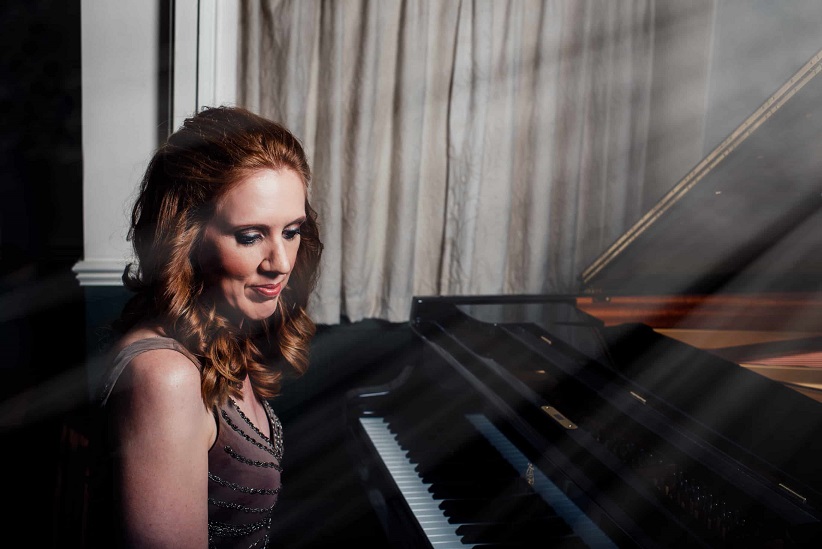
Sarah Beth Briggs (piano, above), English Symphony Orchestra / Kenneth Woods

Sawyers The Valley of Vision (2017)
Mozart
Piano Concerto no.22 in E flat major K482 (1785)
Beethoven
Symphony no.6 in F major Op.68 ‘Pastoral’ (1808)

Town Hall, Cheltenham
Monday 25 October 2021

Written by Richard Whitehouse; picture of Sarah Beth Briggs by Carolyn Mendelsohn

Tonight’s concert found the English Symphony Orchestra at the Town Hall in Cheltenham, a building of Victorian opulence with an expansive while (surprisingly?) immediate acoustic to match, in a programme featuring classics of their respective media by Mozart and Beethoven.

First, though, a welcome revival for The Valley of Vision – the tone poem by Philip Sawyers that surveys the environs around Shoreham, Kent as were immortalized in the visionary early landscapes of Samuel Palmer. Although the composer had identified five continuous sections, the probing intensity of this music makes for a seamless unfolding which was to the fore in a superbly focussed account as directed by Kenneth Woods (who recently premiered Sawyers’ Fifth Symphony at the Colorado Mahler Festival). No less tangible was the control over this music’s momentum, extending through to a climactic faster section before soon regaining its initial pensiveness. In its subtly evocative aura and persuasive handling of tonality, moreover, this piece can rank with the most significant British orchestral works of the past two decades.

From the six piano concertos that Mozart wrote for his subscription concerts during the mid-1780s, the Twenty-Second is likely the least often heard. A pity, when its relatively expansive form and unpredictability of content are striking even in the context of this most exploratory phase from the composer’s output. Certainly, it is a piece of which Sarah Beth Briggs had the measure – whether in the forceful impetus of its opening Allegro, winsome interplay between soloist and woodwind in the central Andante (arguably the most eloquent among Mozart’s sets of variations) or blithe unfolding of a final Rondo afforded greater pathos by the ‘harmonien’ episode whose interposing was an inspired departure. Nor were Dennis Matthews’s succinct and artfully integrated cadenzas other than an enhancement of what was a fine performance.

Not that there was there anything routine about Beethoven’s Pastoral following the interval, a worthy successor to those performances of the Fifth and Seventh Symphonies that Woods and the ESO have given in recent concerts. Thus, a purposeful though never inflexible take on the opening movement left sufficient room to characterize its reflective asides, with the ‘Scene by the brook’ even more engrossing through its homogeneity of texture and seamless continuity; the closing bird-calls elegantly phrased and enticingly integrated into the whole.

Too rapid a tempo for the scherzo left Woods with insufficient room to point up contrasts in motion with its trio sections, but the Thunderstorm was finely rendered as an extended introduction into the finale – this Shepherd’s Song emerging as the formal and emotional culmination in all respects. Not the least of these strengths was an inevitability of progress – here maintained right through to a coda of serene poise and, in the process, underlining the degree to which any vestige of self has been sublimated into the enveloping cosmic dance.

An absorbing performance as made one look forward to further Beethoven symphonies from this source. Woods and ESO are in Worcester at the weekend with two concerts as part of the Autumn Elgar Festival, the first featuring the masterly Elegy for Strings by Harold Truscott.

Further information on the ESO’s current season can be found at their website. For more on composer Philip Sawyers, visit his website here, while more on pianist Sarah Beth Briggs can be found at her website

In concert – Baiba Skride, CBSO / Andrew Gourlay: Rossini, Mozart, Berlioz & Prokofiev

Rossini Guillaume Tell – Overture (1829)
Mozart
Violin Concerto no.5 in A major K219 (1775)
Berlioz
Le carnaval romain, Op.9 (1844)
Prokofiev
Romeo and Juliet – Suite no.2 Op.64ter (1936)

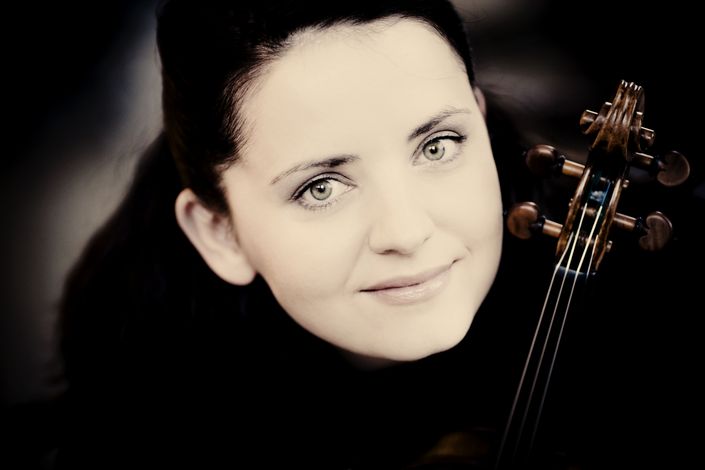
Baiba Skride (violin, below), City of Birmingham Symphony Orchestra / Andrew Gourlay (above)

Symphony Hall, Birmingham
Wednesday 13 October 2021, 2pm

Written by Richard Whitehouse; Picture of Andrew Gourlay (c) Kaupo Kikkas, Baiba Skride (c) Marco Borggreve

This afternoon’s concert by the City of Birmingham Symphony Orchestra saw an unexpected but welcome return from Andrew Gourlay (replacing an indisposed François Leleux) for this diverse programme as worked much better as a concert than it might have appeared on paper.

Its fame as a novelty item in cartoons et al can easily obscure the innovative qualities of the Overture to William Tell, last and most ambitious of Rossini’s operas, in terms of its eliding between curtain-raiser and symphonic poem; which latter aspect Gourlay emphasized in this evocative but cohesive account – whether in the ruminative calm of its opening section with the CBSO cellos eloquently fronted by Eduardo Vassallo, a scrupulously controlled ‘storm’ episode, a not unduly mawkish ‘lullaby’ then a closing galop free from Hollywood overkill.

Mozart was barely out of his teens on writing his Fifth Violin Concerto, if not the finest then certainly the most eventful of his cycle through such as the soloist’s alluring first entry in the opening Allegro with music not directly related to either of the main themes and rendered by Baiba Skride with real finesse. Equally successful was her succinct yet ideally proportioned cadenza prior to its close; after which, the Adagio had elegance without excessive sweetness. In the final Rondeau, others may have made more of that contrast between graceful lyricism and the robust humour of its central section’s stylized Turkishness, but Skride brought these into complete accord and, with Gourlay securing limpid playing from a scaled-down CBSO, this was a persuasive performance of music whose felicities can easily be taken for granted.

Formerly ubiquitous as a concert-opener, Berlioz’s Roman Carnival – the inspired recycling of music from his opera Benvenuto Cellini – launched the second half to striking effect. If the soulful introduction took a little time to settle (doubtless occasioned by a soon extinguished onstage rebellion before Gourlay’s return), what ensued was not lacking rhythmic elan or that scintillating interplay of orchestral timbres as was Berlioz’s gift to the orchestra. Effecting a tangible crescendo into the blazing peroration, Gourlay undoubtedly saved the best until last.

Ad hoc selections from Prokofiev’s Romeo and Juliet rarely provide a satisfying second half, making one of three suites the composer extracted from his ballet the more viable option. Of these the Second Suite is the best overview, and this account quickly found its stride with a visceral take on the music which opens Act Three, the grinding progress of Montagues and Capulets proving no less forceful. Juliet as a young girl exuded the right insouciance and pathos, as did Friar Laurence that of earnest authority. The lithe Dance made a telling foil to Romeo and Juliet before parting, its fraught rapture potently conveyed here, then Dance of the girls with lilies made for an appealingly wistful entrée into Romeo at Juliet’s grave with its searing anguish that only gradually subsides into expectant calm towards the close.

Gourlay had previously directed a fine account of Rachmaninov’s Third Symphony with this orchestra and the Prokofiev confirmed his prowess in Russian music. The CBSO, meanwhile, returns next Wednesday for a varied American programme with the saxophonist Jess Gillam.

Further information on the CBSO’s current season can be found at the orchestra’s website. For more on Baiba Skride, click here – and for more information on Andrew Gourlay, head to the conductor’s website

Playlist – World Mental Health Day: Music To Grow To

Today – Sunday 10 October – is World Mental Health Day.

Rather than post the latest concert review on Arcana, I decided to take some time out to come up with a simple playlist of music I have found helpful to listen to in busy or fraught times.

I have called it Music To Grow To, as it begins with one player (Ravel‘s Menuet antique for piano) and grows to music for two people (Messiaen‘s timeless Louange à l’Éternité de Jesus from his Quatuor pour le fin du temps), then three (Mozart‘s sublime Divertimento for string trio).

Philip Glass‘s restful Company is next, for string quartet, then we switch to wind instruments for the 12-player Serenade by Dvořák, a lovely piece.

Finally a long, contemplative piece that should be experienced live whenever you get the chance! John Luther AdamsBecome Ocean performs the function of being incredibly immersive, ambient music and it uses the whole orchestra from small beginnings to slow, steady growth.

Give the playlist a try on Spotify below:

Writer appreciation: Daniel Heartz

written by Ben Hogwood

This is the first in an occasional series of posts where I would like to draw attention to writers on music, classical or pop, whose work I love and respect.

Yesterday Arcana’s Listening to Beethoven series reached the Second Symphony – the last work discussed by Daniel Heartz in the third volume of an epic series looking at music of the 18th century.

I wanted to draw attention to Daniel’s writing because this series of books is quite simply invaluable. When I first considered purchasing it I baulked at the price per instalment (roughly £45, even at second hand) but I can honestly say it has provided me with incredible value for money.

Heartz’s strengths are many, but his ability to talk through technical aspects of music without losing the reader in jargon is unusually strong. However even that quality is second to his knack of placing the music in historical context, which he does so throughout the books. I warmed to this quality in the third volume (Haydn, Mozart and early Beethoven 1781-1802) just as much in the second (Haydn, Mozart and the Viennese School: 1740-1780). Going back further, the equally sizable volume of Music In European Capitals: The Galant Style, 1720-1780 ensures lesser-known and appreciated composers such as Boccherini, J.C. Bach and Stamitz get the detail and respect they fully deserve.

Heartz is great at telling a story, applying the same detailed and pictorial approach to each composer or historical figure, and at every turn it is clear that a remarkable depth of research has been applied to his work. There is very little speculation needed, but where it is made he is never fanciful or exaggerated.

Very sadly Professor Heartz died in 2019. I must admit, rather selfishly, that I was hoping his exploration of Beethoven would continue beyond the year 1802, but on learning the sad news I can only say I am very grateful to him for illuminating the classical period of music history with such high quality, informed writing. His books will give pleasure and more information, no doubt, for many years to come.

A tribute to Daniel can be found here on the University of California website. The three books referred to above are published by W.W. Norton.

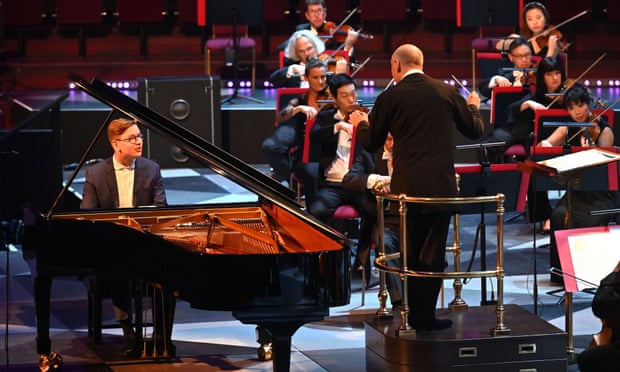
BBC Proms – Víkingur Ólafsson, Philharmonia / Paavo Järvi: Bach, Mozart, Prokofiev & Shostakovich

olafsson-jarvi

Víkingur Ólafsson (piano), Philharmonia Orchestra / Paavo Järvi

Prokofiev Symphony no.1 in D major Op.25 ‘Classical’ (1916-17)
J.S. Bach Keyboard Concerto in F minor BWV1056 (c1738-9)
Mozart Piano Concerto no.24 in C minor K491 (1786)
Shostakovich Symphony no. 9 in E flat major Op.70 (1945)

Royal Albert Hall, London
Saturday 14 August 2021

Written by Richard Whitehouse

Tonight’s Prom brought change of conductor, the always reliable Paavo Järvi stepping in for Santtu-Matias Rouvali in what would have been the latter’s Proms debut, but not of soloist – Icelandic pianist Víkingur Ólafsson duly making his first appearance at these concerts with concertos which, for the most part, played to his strengths.

The number of times that Bach’s keyboard concertos have been heard here on piano in recent decades can be counted on the fingers on one hand (Tatiana Nikolayeva’s D minor resonates in the memory), but that in F minor was a good choice in terms of its succinctness – the outer movements pitting soloist and (sizable body of) strings against each other with a trenchancy as was vividly conveyed here, with the central Andante an oasis of serenity that was not without its plangent asides.

Placing this piece before the interval, however, made for a distinctly short first half – given the relative length of Mozart’s C minor Concerto after the interval. There were many good things in this latter, Ólafsson keeping the first movement on a tight yet never inflexible rein so that its inclination to pathos – if not always its portentous undertones – came through in ample measure; not least in a coda that had been cannily prepared by the soloist’s cadenza. The central Larghetto was none the less the highlight – Ólafsson varying his tone such that piano melded into the woodwind for an early and defining instance of timbral colouration, with its limpid elegance never undersold. Maybe the finale was a little staid in the overall unfolding of its variations, but the coda’s strangely ambiguous poise was tangibly realized.

An auspicious debut, then, for Ólafsson, who underlined his prowess with affecting readings of the slow movement of Bach’s Fourth Organ Sonata (BWV526) in August Stradal’s chaste transcription and Liszt’s not unduly mawkish version of Mozart’s Ave Verum Corpus (K617). These further extended the disparity between each half – the first of which had commenced with Prokofiev’s ‘Classical’ Symphony, not in the least small of scale or mimsyish as Järvi heard it; witness his acerbic and impetuous take on the initial Allegro, trumpets and timpani to the fore, then a Larghetto whose swift underlying tempo left little room for any harmonic piquancy to emerge. The Gavotte was slightly marred by several mannered agogics which tended to impede its rhythmic profile, but the Finale lacked little in sparkle or insouciance.

Among the most travelled and recorded conductors of today, Järvi can seem detached or even aloof in manner – but there was no such reticence evident in Shostakovich’s Ninth Symphony as ended this programme. After a tensile and assertive Allegro, which audibly benefitted from the sizable forces onstage, the Moderato recalled Efrem Kurtz’s classic recording as to overall restraint and a dark-hued introspection rising to anguish in its twin climaxes. Playing without pause, the other movements were of a piece with the foregoing – a driving and almost manic Presto subsiding into a Largo, whose ruminative bassoon soliloquys were eloquently taken by Emily Hultmark, then an Allegretto whose capriciousness was acutely gauged through to its bitingly sardonic climax and breathless final payoff. Undoubtedly a performance to savour.

You can find more information on the BBC Proms at the festival’s homepage