In concert – Ruby Hughes, Natalie Clein & Julius Drake: Schubert and Other Folksongs @ Queen Elizabeth Hall

Ruby Hughes (soprano), Natalie Clein (cello), Julius Drake (piano)

Schubert arr. Jones Der Hirt auf dem Felsen (The Shepherd on the Rock) D965 (1828)
Kodály Sonatina for cello & piano (1922)
Tavener Akhmatova Songs: Dante, Boris Pasternak, Dvustishie (Couplet) (1993)
Brahms 2 Songs Op.91 (1884)
Trad arr. Britten I wonder as I wander (1940-41), At the mid hour of night (Molly, my dear), How sweet the answer (The Wren) (both 1957)
Deborah Pritchard Storm Song (2017)
Janáček Pohádka (Fairy tale) (1910, revised 1923)
Ravel Kaddisch from 2 Mélodies hébraïques (1914)
Bloch From Jewish Life (1924)
Schubert Auf dem Strom (On the river) D943 (1828)
(Encore) Berlioz La Captive

Queen Elizabeth Hall, London, 27 June 2025

by John Earls. Photo credits (c) Philip Sharp (above), John Earls (below)

Two of the most affecting sections of Ruby Hughes’ excellent 2024 album with the Manchester Collective End of My Days are three of John Tavener’s Akhmatova Songs (Dante, Boris Pasternak and  Couplet) and Maurice Ravel’s Kaddish (from 2 Mélodies hébraïques).

These also featured to dramatic effect in this fascinating concert programme of Schubert and Other Folksongs spanning two centuries, where Hughes was joined by Natalie Clein (cello) and Julius Drake (piano).

In this performance the Tavener song miniatures were performed for voice and cello and were at turns powerful, beautiful and urgent across their nine-minute duration. The prolonged silence from the audience afterwards was noticeable. Ravel’s lament-like Kaddish, this time for voice and (sparse) piano, was similarly respectfully performed and observed.

There were non-vocal pieces for cello and piano where Clein and Drake displayed what a well matched duo they are. Zoltán Kodály’s Sonatina was luminescent, Leoš Janáček’s Pohádka absorbing (not least the cello bowing and pizzicato) and Ernest Bloch’s From Jewish Life was both lovely and mournful.
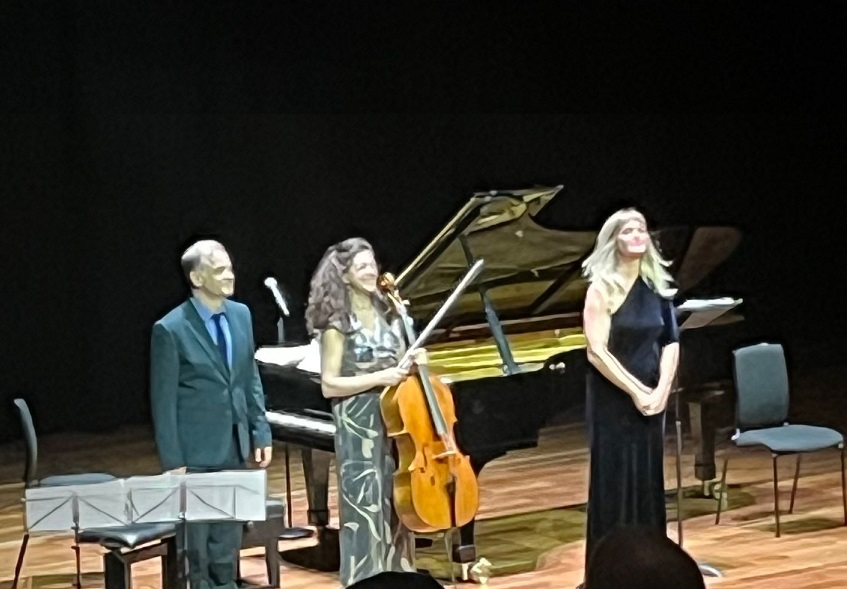
But this was a concert where Ruby Hughes’ amazing voice was to the fore but often in an understated, but no less impactful way. The captivating trio of Benjamin Britten folksong arrangements with their minimal piano trills were a case in point.

The trio performances were also impressive in their delivery and range. Brahms2 Songs (Op.91) were both gorgeous, while Deborah Pritchard’s Storm Song (from 2017, the most recently written piece) was powerfully unnerving between its haunting start and end (the composer was in the audience to take a well deserved bow).

The concert was bookended by two songs written by Franz Schubert shortly before his death in 1828 at the age of just 31. As David Kettle remarks in his excellent programme notes, to call them simply songs is to do them a disservice. Der Hirt auf dem Felsen (The Shepherd on the rock), arranged by Peter Jones for voice, cello (replacing the clarinet) and piano, traversed a journey of yearning and joy that was both delicate and impassioned. The closing Auf dem Strom (On the river) saw Hughes capturing the drama convincingly throughout.

An encore of Berlioz’s La Captive concluded this concert that combined fascinating and thoughtful programming with performances of beautifully judged expression.

John Earls is Director of Research at Unite the Union and posts at @johnearls.bsky.social on Bluesky and @john_earls on X. You can subscribe (free) to his Hanging Out a Window Substack column here: https://johnearls.substack.com/

Published post no.2,579 – Sunday 29 June 2025

On Record – Soloists, Transylvania State Philharmonic Choir & Orchestra / Lawrence Foster – Kodály: Te Deum & Psalmus Hungaricus; Bartók: Cantata Profana & Transylvanian Dances (Pentatone)

Kodály
Budavári Te Deum (1936)
Psalmus Hungaricus Op.13 (1923)
Bartók
Transylvanian Dances (Erdély táncok) Sz. 96 (1931)
Cantata Profana Sz. 94 (1930)

Luiza Fatyol (soprano, Te Deum), Roxana Constantinescu (mezzo-soprano, Te Deum), Marius Vlad (tenor, Te Deum and Psalmus Hungaricus), Ioan Hotea (tenor, Cantata Profana), Bogdan Baciu (baritone, Te Deum and Cantata Profana), Junior VIP, Children’s Choir (Psalmus Hungaricus), Transylvanian State Philharmonic Choir & Orchestra / Lawrence Foster

Pentatone PTC 5187071 [64’14”] Texts and English translations included

Executive & Recording Producer Job Maarse Balance Engineer & Editing Erdo Groot Engineer Lauran Jurrius
Recorded May 2022, Radio Studio of Radio Cluj, Romania

Written by Ben Hogwood

What’s the story?

Here is a chance to gain an insight into the choral music of two 20th century Hungarian composers known predominantly for their orchestral works. Bartók and Kodály were born just a year apart, and while their music is fiercely proud of their heritage their musical trajectories extend well beyond Hungary. Kodály stayed largely within Europe but brought back influences from Paris, while Bartók reluctantly emigrated to the US in late 1940.

Psalmus Hungaricus was Kodály’s first major post-war composition, in 1923. It is a landmark in his output, using for its text a Hungarian paraphrase of Psalm 55. Kodály uses a tenor soloist for the central dramatic role, the choir taking up their position as commentators. The Budavári Te Deum, completed 13 years later, marks the 250th anniversary of the liberation of Buda Castle from the Turks. While referencing Gregorian chant, Kodály incorporates references to Hungarian melodies and ornamentations in a dramatic setting.

In 1930 Bartók completed his first major work for chorus and orchestra. Cantata profana has Transylvanian roots, and Oana Andreica’s booklet note gives the context of its libretto, starting from two Romanian ‘colinde’ – ballads sung during the Christmas season but with a wide range of subjects well beyond the birth of Christ. Such is the case here, Bartók dramatising a myth of nine sons turned into stags. The cantata charts their fate and their father’s conflicting emotions, expressed by a baritone soloists. The Transylvanian Dances are a complementary addition, a short trio of works for small orchestra containing five traditional songs.

What’s the music like?

The Budavári Te Deum is a thrilling start to the album. This is red-blooded choral writing, Kodály diving in headlong to a high octane first section. He challenges choir’s higher sections, who respond admirably to the loud dynamic, retaining impressive clarity in the part writing. The work’s climactic points are notable for their power and passion.

This performance of the Psalmus Hungaricus has the authentic inflections to the melody, its bracing start turning to contemplation. Tenor soloist Marius Vlad inhabits the full tone and strong line demanded by Kodály, and sung so memorably by Ernst Haefliger in the legendary recording with Ferenc Fricsay. This makes for a fine digital alternative, with the choral response both full-bodied and unified. The meaningful counterpoint between Vlad and the Transylvanian woodwind in the middle section (Te azért lelkem) is especially memorable.

Bartók’s Cantata profana starts ominously, with an underlying menace that grows steadily as the hunt in the story progresses. Again the choral passages are well drilled, especially when in league with the percussion. The passionate tenor solo (Ioan Hotea) and fulsome bass (Bogdan Baciu) prove to be ideal foils, alighting on some spicy chords. There is little consolation at the end, in spite of the relative calm this performance leaves.

The Transylvanian Dances are over in a flash but leave a charming impression, with rustic themes. The recording is much closer, taking the action indoors to the tavern rather than outside in the wilds.

Does it all work?

Very much so. There is an adjustment to be made for the Transylvanian Dances, with the smaller ensemble and closer recording, but the performances justify the means. The choral works are a resounding success, brilliantly performed and with electric singing from the Transylvania State Philharmonic Choir, especially in the high passages. The orchestra match them under Lawrence Foster, who secures incisive rhythms and impressive clarity from such large forces.

Is it recommended?

It certainly is. This is an enterprising and very accessible coupling of three thrilling choral works, revealing fresh insights into the Hungarian composers.

Listen

Buy

For more information on this release and for purchase options, visit the Pentatone website

In concert – Laura van der Heijden & Jâms Coleman @ Wigmore Hall – Pohádka: Tales from Prague to Budapest

Laura van der Heijden (cello), Jâms Coleman (piano)

Janáček Pohádka (1910, rev. 1912-23)
Dvořák Gypsy Songs Op. 55: Songs my mother taught me (1880)
Kaprálová Navždy from Navždy Op. 12 (1936-7)
Mihály Movement for cello and piano (1962)
Kodály 3 Songs to Poems by Bela Balazs Op. posth.: Why are you saying that you do not love me (1907-9); Énekszó Op. 1: Slender is a silk thread (1907-9)
Sonatina for cello and piano (1909)
Janáček Violin Sonata (1914-15, rev.1916-22)

Wigmore Hall, London, 9 March 2022

reviewed by Ben Hogwood Pictures (c) Olivia Da Costa (Laura van der Heijden), Sim Canetty-Clarke (Jâms Coleman)

It bears repeating that times are tough for new artists in music. Competition is fierce, while opportunities for live performance and recording have been severely hampered over the last two years of lockdown and pandemic restrictions. How refreshing, then, to talk about two new artists, a long term agreement with Chandos and a chamber music album notable for its originality and depth of expression.

The new artists, cellist Laura van der Heijden and her musical partner, pianist Jâms Coleman, have been performing together since 2017. Their debut album, for which this concert was an official launch, looks at music from Central and Eastern Europe with its roots in folk, either written directly for cello and piano or falling naturally into a vocal range.

The album shares its title, Pohádka, with a three-part fairy tale for cello and piano by Janáček, based on a Russian tale. This began the concert, a picture book performance bringing the story to life with sharp characterisation and flair. Janacek used a good deal of his music to explore macabre storylines and this was no exception, though the lighter, more lyrical moments were good fun. van der Heijden’s tone was sonorous and projected easily to the back of the hall, while Coleman’s stylish playing was capped with limpid work in the second section.

We then heard arrangements of two songs from Dvořák and Vítězslava Kaprálová as an idea complement, the former transcribing beautifully from voice to cello, with tasteful ornamentation from the cello. It was good to hear more of Kaprálová, a talented Czech composer who tragically died from tuberculosis when she was just 25. Her music immediately cast a spell, Coleman’s mysterious chords matched by a remote but moving line from the cello in its higher register.

Different qualities were required for the music of Hungarian composer and conductor András Mihály. His Movement for cello and piano was a dramatic rollercoaster, and rather volatile at times – reflecting perhaps the differing styles at play in modern music when it was written in 1962. While there were undoubtedly elements of Bartók and even Webern in the music’s contours, which veered into atonality at times, there was a fierce expression suggesting Mihály’s music should be explored further. Both players responded with a terrific performance, mastering the technical demands.

Zoltán Kodály was also an influence on Mihály, and his music suits the cello hand in glove, whether in large-scale sonatas or shorter, folk-informed songs. We heard two songs here, the cello a doleful voice for Why are you saying that you do not love me, while Slender is a silk thread found Coleman beautifully spinning out the silvery tale. However the single-movement Sonatina for cello and piano, at just under 10 minutes, made a lasting impression with its passion, profound lyricism and subtle melancholy. The performers’ love for this piece was clear, and the high voltage account found them finishing each other’s musical sentences.

The same could be said for Janáček’s Violin Sonata, a pungent piece whose proximity to World War One is evident in the rapid fire of its phrases. The composer’s unusual musical language was once again wholly compelling, with broad lyrical statements countered by strange, abrupt full stops to his melodies. The parallels with the current situation in Ukraine were impossible to ignore, especially with the emotion both players brought to the second movement Ballada, its sweeping melodies reaching skyward. Ultimately the acidic third and fourth movements cast a cloud over the mood, the players vividly depicting the distant sound of gunfire alongside more thoughtful introspection. van der Heijden was commendably modest about her own arrangement of the Sonata, for cello and piano, an extremely successful version losing none of the intensity or fractious treble phrases. Both players were superb, their virtuosity and togetherness notable throughout.

This was an extremely rewarding concert, energetic and romantic in turn but also thought-provoking through its wartime undercurrents. Laura van der Heijden and Jâms Coleman deserve great credit for their refreshing take on a chamber music album, which bodes well for their ongoing relationship with one of Britain’s best classical independents. Theirs is a partnership to watch closely.

Watch and listen

In concert – Sunwook Kim, CBSO Youth Chorus, CBSO / Mihhail Gerts: Kodály, Rachmaninoff, Debussy & Stravinsky

Mihhail-Gerts

Kodály Dances of Galánta (1933)
Rachmaninoff
Rhapsody on a Theme of Paganini, Op. 43 (1934)
Debussy
Nocturnes – Sirènes (1899)
Stravinsky
The Firebird – Suite (1919)

Sunwook Kim (piano, below), CBSO Youth Chorus, City of Birmingham Symphony Orchestra / Mihhail Gerts

Symphony Hall, Birmingham
Thursday 17 February 2022

Written by Richard Whitehouse

As Mihhail Gerts (taking over at short notice from Lionel Bringuier) said in his initial remarks, all four pieces in this concert by the City of Birmingham Symphony Orchestra were written by composers born within 20 years of each other and made for some intriguing interconnections.

Youngest of these composers, Kodály’s piece was on one level the most traditional – Dances of Galánta looking back to the Hungarian Rhapsodies of Liszt with its bringing together folk melodies in a free flowing fantasia whose larger paragraphs were judiciously shaped by Gerts so that a cumulative overall structure was always evident. The CBSO responded with alacrity to Kodály’s vivid if sometimes workaday orchestration, Oliver Janes making the most of the clarinet solo as stealthily sets the course for all that follows through to a teasing final pay-off.

By the time of Rhapsody on a Theme of Paganini, Rachmaninoff’s music had all but shed its earlier opulence for a tensile, even sardonic quality pointing up expressive contrasts between the 24 variations which fall naturally while ingeniously into a three-movement continuity. It helped that Sunwook Kim constantly brought out those subtle changes of emphasis to which the theme is put, not least when combined with the Dies irae plainchant as if to underline the darker ambivalence at work in this music. That said, the 16th and 17th variations might have been probed even more deeply, so making the famous 18th more affecting in its catharsis, but the six variations of the ‘finale’ headed with unfailing panache to the suitably deadpan close – Kim responding to the enthusiastic applause with a limpid take on Brahms’s Intermezzo in A.

Whether or not it was the earliest piece to use wordless voices as a facet of the orchestration, Debussy’s Sirènes provided a template for numerous comparably innovative works across the next quarter-century and beyond. Gerts was scrupulous as to his enfolding of the textural strands into a cohesive and diaphanous whole; one to which the CBSO Youth Chorus made a suitably ethereal contribution. Nor was this too passive a reading as it moved with notably restive intent toward a culmination which brought a necessary measure of emotional repose.

But (and to misquote Ronald Reagan’s immortal words) ‘where was the rest of it’? Debussy’s Nocturnes being as integrated a triptych as his later La Mer or Ibéria, it seemed unfortunate to jettison Nuages and Fêtes – especially as they would have added no more than 15 minutes to a relatively short programme rounded off with Stravinsky’s The Firebird. This was heard in its 1919 suite, currently returning to favour given the over-exposure of the complete ballet over recent decades. Gerts duly encouraged the CBSO to give its all – whether in the sombre Introduction and a dextrous Dance of the Firebird, the affecting poise of The Princesses’ Khorovod or animated virtuosity of Kashchei’s Infernal Dance, then a Berceuse of real pathos as merged seamlessly into a Finale which conveyed the necessary emotional frisson.

A fine showing for Gerts who, as artistic director of the TubIN Festival, ought to be invited to schedule the Estonian’s Sixth Symphony on a future appearance. The CBSO returns next week in a concert featuring a UK premiere for R. Nathaniel Dett’s oratorio The Ordering of Moses.

For more information on the next CBSO concert, visit their website. Meanwhile click on the links for information on conductor Mihhail Gerts and Sunwook Kim.

In concert – CBSO Centre Stage: CBSO strings play Kodály & Korngold

CBSO-Strings

Kodály Serenade, Op. 12 (1919-20)
Korngold
String Sextet in D major, Op. 10 (1914-16)

CBSO Strings: Kate Suthers & Charlotte Skinner (violins), Adam Römer & Jessica Tickle (violas), Miguel Fernandes & Helen Edgar (cellos)

CBSO Centre, Birmingham
Thursday 27 January 2022 2pm

Written by Richard Whitehouse

Two unfamiliar while appealing works were featured in this afternoon’s Centre Stage recital given by string players from the City of Birmingham Symphony Orchestra, written during the early stages and in the aftermath of the First World War at a pivotal time in European culture.

The focus on choral and pedagogic music of Kodály’s later years makes his earlier chamber works the more valuable, and while the Serenade for two violins and viola is by no means the most imposing, its deftness and finesse of writing for this unusual line-up cannot be gainsaid. The lively outer movements abound in those allusions to and inflections of folk melodies that Kodály explored extensively in his maturity, with the central Lento touching upon a vein of ‘night music’ less inwardly intense than if equally evocative to that found in the music of his contemporary Bartók. Its relatively extended formal trajectory can make the final Vivo seem unduly prolix, yet in so buoyant and finely integrated a performance, there was no likelihood of this movement forgoing any sense of direction on its way to a decidedly nonchalant close.

Kodály was around 30 when writing this piece, whereas Korngold was barely out of his teens when he finished the Sextet as draws equally on very different (if by no means incompatible) stylistic traits evident in works for this medium by Tchaikovsky and Schoenberg. If the latter composer is to the fore in the lengthy initial Moderato with its intricate thematic interplay and frequent density of texture, the Adagio exudes a melodic eloquence denoting those operas or film-scores to come. The ensuing Intermezzo is arguably the most characteristic movement in its suavity and teasingly coy charm, while the Finale looks back to Brahms and even Dvořák (whose Sextet would be a welcome inclusion in these recitals) for its underlying vitality and easy-going humour as makes the coda’s rush to the finish the more unexpected and engaging.

Such was the impression left by a finely prepared reading by no means lacking in spontaneity or those flights of fancy such as denote the ‘confidence of youth’. Quintets are the order of the day for the next Centre Stage recital, which features contrasting works by Mozart and Brahms.

You can read more about that next Centre Stage recital, and book tickets, on the CBSO website