BBT – Wednesdays at Wilton’s

bbt-wednesdays-at-wiltons

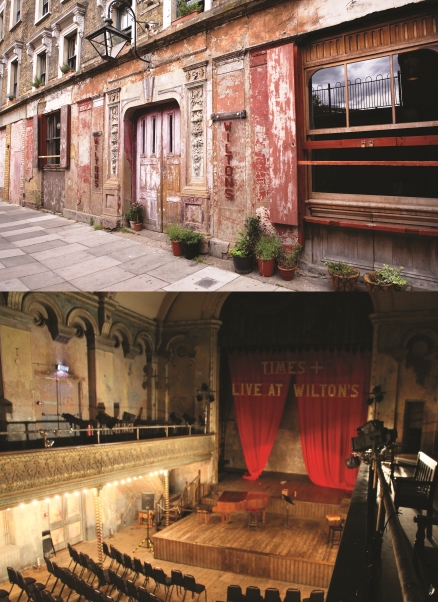
(Wilton’s front door photo James Perry; Wilton’s interior photo Mike Twigg)

The Borletti-Buitoni Trust and a new residency at one of London’s buried treasures

A week ago, Wilton’s Music Hall was home to an intimate Duran Duran charity gig. This week the grand old venue, one of East London’s little-known charms, looked down on young classical musicians starting out, recipients of a fellowship from the Borletti-Buitoni Trust given their chance to shine.

The hall is a wonderful performing space, a former 18th century ale house converted to a music room and concert hall, and now in the throes of a renovation that looks set to preserve its character while offering new, vibrant performance opportunities. The hall itself, with a high roof and balcony supported by what looks like parts from an old pile-driver, has acoustic properties ideal for piano or guitar – which was illustrated in an hour-long concert to launch the BBT‘s Wednesday’s at Wilton’s series.

Composer-pianist Kate Whitley made a strong impression – and as co-founder and artistic director of Multi-Story, which gave a performance of Stravinsky’s The Rite of Spring in a disused car park in Peckham, she is clearly an imaginative force. Whitley writes direct, unflinching music that can hit you between the eyes (two of her 5 Piano Pieces, for instance) or expose a melting heart (the song This is my love poem for you, from the poetry of Sabrina Mahfouz).

Her Three pieces for violin and piano, meanwhile, stood next to an equivalent set by the György Kurtág – a brave move that, it not entirely successful, illustrated the grand old Hungarian composer and his extraordinary musical compression, writing in one note what others could hardly manage with one hundred!

Performers and audience are treated as equals on these nights, and it was helpful that Whitley gave good context and musical examples to her pieces beforehand. We also had a sneak preview of the second concert in the series from guitarist Sean Shibe, who took on the tragic tale of Spanish composer Antonio José, executed by firing squad in his early thirties. Shibe played two movements, a winsome Pavane Triste and vigorous Finale from his Sonata for Guitar.

With concertgoers, performers and building ideally matched, this looks like the start of a meaningful friendship in East London – and you would be firmly advised to take the chance to see the musicians of the future in such a friendly and inspiring environment.

Under the surface – Dvořák middle period String Quartets

dvorak-zemlinsky-qt

Composer: Antonín Dvořák (1841-1904)

Nationality: Czech

What did he write? Dvořák is very well known as a writer of nine symphonies – of which no.9, From The New World, is extremely popular – and the Eighth is often performed too. He wrote in most disciplines, with a lot more orchestral music, string quartets, piano trios, songs and some seldom-explored music for the stage.

Why aren’t these works more popular? Concert programmers are lazy when it comes to Dvořák String Quartets, and often choose just the one work, which is admittedly a cracker – the American quartet of 1893, with its bountiful use of Negro and American spiritual melodies. Yet there are at least 15 other quartets in Dvořák’s armoury. Some of the latter ones do quite well in concert but this pair of works is often overlooked.

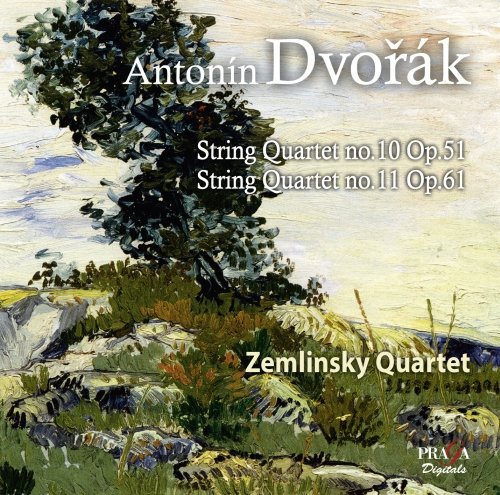
What are the works on this new recording? Two mid-period quartets – in E flat major (published as Op.51 and composed in 1879) – and in C major, published as Op.61 and finished in 1881. They are released on the Praga label, played by fellow-countrymen the Zemlinsky Quartet.

What is the music like? Very attractive. There always seems to be a tune about!

The E flat major quartet is especially likeable for its sheer positivity and abundance of good moments. Probably the two best tunes are given to the outer movements, those being the good humoured tune of the first and the outright happiness (with a bit of cheek!) in the fourth movement.

The C major quartet is a bit more serious in tone but is once again full of good tunes and extremely listenable musical dialogue. The first movement sounds a little like mid-period Beethoven with spicier harmonies and has a really nice main theme, while the slow movement is warm and comforting. Before everything comes together in the energetic fourth movement the third is probably the pick, one of Dvořák’s Czech based dance forms.

What’s the verdict? There is some lovely, spring-like music here, and both works receive very committed performances from the Zemlinsky Quartet. The authenticity of Czech players playing Dvořák – which we have here – should never be overlooked, because of their instinctive way with the rhythms and national dances, so this gives them the edge.

Give this a try if you like… any of Dvořák’s better known works listed above, or the composers Brahms and Schumann.

Spotify Playlist

The Zemlinsky Quartet recording is not available but this Playlist includes previous recordings from the Takács and Emerson Quartets, to give you an idea of the works. I’ve also added the composer’s Five Bagatelles for two violins, cello and harmonium as a bonus.

Louis Schwizgebel

BBC Radio 3’s New Generation artist Louis Schwizgebel gives a live recital of piano works by Haydn, Chopin and Liszt

Louis SchwitzgebelPhoto © Caroline Doutre

Louis Schwizgebel – Wigmore Hall, live on BBC Radio 3, 23 February 2015

Listening link (opens in a new window):

http://www.bbc.co.uk/programmes/b05302mn

on the iPlayer until 24 March

For non-UK listeners, this Spotify playlist is available:

For those unable to hear the broadcast I have put together a Spotify playlist. Louis has not recorded this repertoire, so I have chosen suitable available versions:

What’s the music?

HaydnPiano Sonata in E flat major (1789-90) (19 minutes)

ChopinBallade no.3 in A flat major (1841) (7 minutes)

ChopinÉtude in C# minor (1836) (5 minutes)

ChopinWaltz in C# minor (1847) (4 minutes)

ChopinFantaisie-impromptu in C# minor (c1834) (4 minutes)

LisztConsolation no.3 in D flat major (1849-50) (4 minutes)

LisztHungarian Rhapsody No. 6 in D flat major (c1863) (6 minutes)

What about the music?

This is a cleverly structured recital taking in three giants of the piano.

Schwizgebel begins with Haydn, godfather of so many musical forms – and one of the first composers to start writing what became known as the mature piano sonata, in three movements. His examples in the form – many written like this one for the palace of Esterházy in Hungary – show good humour and a delicate touch. This work, not often heard in concert, fits the bill nicely as an opening piece.

Schwizgebel’s Chopin selection is carefully structured so that the keys fit – moving from A flat major for the Ballade into C# minor for the three other works. The Ballade is a form in which Chopin made very personal expressions but which also allowed him the chance to experiment formally. The three works following are an unusually profound Etude (Study) – which sounds technical but is far from dry, shot through with characteristic Chopin melancholy. The Waltz is more playful, coming back to the same theme again and again, while the freeform Fantaisie-Impromptu makes the most of its freedom.

Liszt was a barnstorming virtuoso – the piano equivalent of Jimi Hendrix, you could say! – but he had his sensitive side too, as the Consolations show – and this one selected is a tribute to Chopin himself. It is a thoughtful example, leading to the fire and brimstone of the Hungarian Rhapsody no.6, given the natural inflections of the music of Liszt’s own country before a helter-skelter coda.

Performance verdict

Schwizgebel is a thoughtful Haydn pianist, and gives a rather touching performance of the slow movement in particular. He is commendably modest in performance, preferring not to go for the demonstrative approach, but instead letting his playing do the talking. The Chopin selection is excellent, very well played, losing a little rhythmic definition in the climax of the Étude but trumping that with a dazzling Fantaisie-impromptu.

The Liszt could perhaps have done with more of the reckless bravura you get in the Hungarian Rhapsodies, a sense of living right on the edge. That said, the closing pages are brilliantly played, the octaves written for the right hand immaculately delivered.

What should I listen out for?

Haydn

4:19 – a matter-of-fact start to the first movement, with a slightly gruff accompaniment to the tune. Yet Haydn’s easy charm is soon in evidence, despite the left hand having to work pretty hard in accompaniment!

11:14 – the second movement begins, headed by a graceful melody, as if assigned to a singer. Then, later on, it nearly stops as the right hand melody gets lost in thought before ambling to an easy close.

19:46 – a typically perky Haydn finale, nicely proportioned and sensitively played here.

Chopin

24:36 – the Ballade no.3 – beginning with an attractive introductory theme before the music assumes the profile of a waltz (from 26:27). Schwizgebel takes this slower than a lot of pianists, with a delicate approach – allowing greater contrast for then the music appears again, much more forcefully, at 27:20. At 29:35 a shadow falls over the music and it becomes more fraught as it moves into a minor key – C sharp minor, which is the key for the next three works in the recital. The Ballade’s main theme comes back at 30:57 before the closing passage.

31:52 – the Étude in C# minor, numbered 7 in the second book of studies Chopin published as his Op.25. The left hand takes the lead with a rising theme, and sets the melody throughout in what is a deeply intense piece, the longest of Chopin’s Études.

37:25 – the more playful Waltz in C# minor, published as Op.64/2, characterised by a sparkling theme high up in the piano’s register. This returns frequently to trump the underlying melancholy in the music, and the player has the chance to play around with the speed to give the music more ebb and flow. A contrasting section (38:28) brings a ray of light in the middle.

40:35 – the Fantaisie-Impromptu, a freeform piece where the floodgates just open! A torrent of notes form the main theme, wheeling up and down the keyboard, before taking the foot off the gas for a sweetly toned second theme (41:31)…which segues neatly back to the river of notes again (43:24)

Liszt

46:02 – the Consolation in D flat major, one of a set of six. Intimate and romantic, especially in this performance.

50:07 – the Hungarian Rhapsody no.6 begins with a drone and a rustic tune, very controlled in this performance, which takes some nice liberties with the tempo, holding back where necessary. There is some dazzling virtuosity as the piano then unfurls a variation on that melody before a solemn second theme (51:50) makes itself known. At 54:01 the final section starts with a melody played in octaves, which soon works to a thunderous climax (55:33).

Encore

57:36 – Moszkowski’s Étincelles (1886) – a showpiece from the Polish composer, with some brilliant runs up and down the keyboard as well as some sharply pointed notes. Schwizgebel dispatches it very impressively, with a wonderful throw-away finish!

Want to hear more?

Haydn’s humour makes for lovely music to work to – and a personal favourite is his C major sonata.
Chopin’s Ballades reward repeated listening – so after the intimate Third I would recommend the stormier Fourth – with the calm of an A minor Waltz and the famous Raindrop prelude completing a very attractive selection.

For Liszt with real depth the Vallée d’Obermann can be strongly recommended as a powerful utterance.

All these are collected on a Spotify playlist, below the repertoire played by Schwizgebel:

For more concerts click here

John Tejada

john-tejada

John Tejada is a well established and highly respected techno musician – but his roots lie in an upbringing full of classical music. Arcana called him on a break from work in his California studio, where he wrote his tenth album Signs Under Test, released on Kompakt this month.

He spoke about the benefits of a musically open family, how that led him to hone his own approach to music, and why he loves the music of Steve Reich. But first, after a quick listen…

Can you remember your first encounter with classical music?

My first memories were from my parents, with my mother being an opera singer and my father a clarinettist and conductor. I would often get dragged around to gigs! One of my first memories was seeing them practice, and that made it very real. I think that probably that programmed me into the routine of how you get up, have breakfast and then practice, and that has stuck with me right through to this day. It was a big influence in what I do now.

There are often moments in your music where you are subtly very inventive, using unusual rhythms and less conventional harmonic patterns. Does that stem from your upbringing do you think?

I suppose it does, but I couldn’t properly explain it. It’s one of the different ways I got to where I am now. My focus is not on getting played out by DJs but it is an enjoyment of listening to what feels interesting. Getting the fuzzy feeling, that’s what I’m after!

What does classical music mean to you?

I wouldn’t say that ‘classical’ music means a great deal to me, as I tend towards the stuff that the more modern composers did, I would go with my mum to see Steve Reich concerts; we’d go to see that stuff together. I don’t actively listen to the classic stuff, but because opera was always on at full blast in the house I got to hear a lot of it. It gave me an interesting perspective on what music is and what it can do. It has stuck with me the whole way through.

The categorisation of what is classical music has always puzzled me. The early works of Stockhausen are classical but today sound like something like that could be released on Torch Records! Looking back, it’s pretty wild what was going on in the 1950s and 1960s compared to what people do today.

Is Steve Reich a big influence on your work?

Absolutely. One of the biggest goose bumps I have ever had was going to see the Music for 18 Musicians live for the first time:

You start to see that live, and you say “Holy shit, it’s real!” It flared up a real love of the music in me. No-one bothered to notice that on my last album The Predicting Machine there is a strong nod to Reich on the fourth track, Winter Skies:

Reich was so revolutionary in the way he showed people could have ideas of just using tape loops. He was a massive influence on digital music today with the loops and the phase experiments – he laid the fundamentals to what people are still doing now. I would love to see Music for 18 Musicians performed on synths, I think that would be really successful.

What would you say classical music – as you listen to it – and techno have in common?

I think a lot of stuff! I really enjoy making those connections. I think classical music – and the music of Reich – refers to looped and non-looped music that is beatless. The question for techno is ‘Can you do that with a beat?’ For me though the fundamentals of techno and drone are laid down without a beat. Terry Riley and Steve Reich discovered that. It is an interesting connection there, but I find a lot of people won’t give it a chance. It’s like eating a vegetable. There are times when I won’t explore because I just don’t know.

What do you know and like at the moment?

I am a big fan of Terry Riley, because he is one of those great composers who cross into other areas. In his album A Rainbow in Curved Air he used music in a way that would give Autechre a run for their money:

I also think early Art of Noise records are really interesting, you have people trying stuff out – because why not? I remember when I was listening to some of this stuff at home, and being nearly asleep but being scared silly at the same time! We had some really interesting radio in the mid-1980s, and I was absorbing some crazy stuff.

I remember one time when one of my friends came round who was writing some particularly experimental stuff. He was playing that new stuff for me, which was a real risk for him playing it at full blast. Mum came in and said, “What are you playing, it’s really interesting – it sounds like…” and then she named three different composers. It wasn’t the standard request to turn it down at all!

Would you like to try writing more classically based music?

I have done some more experimental things on labels like Plug Research, but yes – I do have an idea to do something that is modern classical. We’ll see how that develops!

John Tejada’s new album Signs Under Test is out now on Kompakt – and you can listen to it on the label’s website here. For more about the artist himself, visit his Facebook page

The Inextinguishable Fire

The Inextinguishable Fire – The BBC Symphony Orchestra and Sakari Oramo reach the Fourth Symphony in their Nielsen cycle, adding Sibelius, Ravel and Zemlinsky for good measure

sakari-oramo
Anne Sofie von Otter (mezzo-soprano), BBC Symphony Orchestra / Sakari Oramo (pictured) – Barbican Hall, 19 February 2015

Listening link (opens in a new window):

http://www.bbc.co.uk/programmes/b052lpjh

on the iPlayer until 19 March

Spotify

Those unable to get the BBC concert can follow the same pieces here in appropriate recordings:

What’s the music?

Sibelius – The Oceanides (1914) (9 minutes)

Zemlinsky – 6 Maeterlinck Lieder, Op.13 (1913, orchestrated 1921) (19 minutes)

Ravel – Le Tombeau de Couperin (1914-17, orchestrated 1919) (18 minutes)

Nielsen – Symphony no.4, ‘Inextinguishable’ (1914-16) (34 minutes)

What about the music?

nielsenThe composer Carl Nielsen

This is a carefully picked program of intriguing opposites, part of the BBC Symphony Orchestra’s celebration of 150 years since the birth of Danish composer Carl Nielsen. All four pieces date from the same decade, and inevitably the First World War is an immovable presence, but these are four very different works that look to harness strength in adversity.

Sibelius, in his tone poem The Oceanides, looks abroad for its stimulus. He was on his only trip to America when he wrote the work at Yale University, taking an Ancient Greek legend as his inspiration. The ‘Oceanides’ are daughters of the water that circles the earth – water in all of its forms – and in this piece Sibelius describes the water as ‘a single breaker growing in force’. The version played here is the Yale version, rather than the later (and longer) revision.

Zemlinsky wrote his Six Maeterlinck Lieder while digesting the news that Alma Schindler, a long time obsession, had decided to marry the composer Gustav Mahler. This news upset and angered him, for he was preoccupied with Alma for many years – yet in these elusive and often unresolved songs he found the ideal vehicle for his response. As Anne-Sofie von Otter said in an interview broadcast on BBC Radio 3, the cycle of six songs is ‘not easy to get the balance right’ between voice and orchestra.

The work is ‘elusive and enigmatic. The stories aren’t straightforward!’

Le Tombeau de Couperin worked for Ravel on a couple of levels; firstly it helped him to observe the passing of several close friends in the First World War, while secondly it gave him chance to pay homage to the great composers of the French Baroque (from the 1700s) such as Couperin, held up as a national treasure and regarded as superior to the German equivalents, especially in time of war! It is an elegant piece, revelling in its role as a pastiche composition – using dance forms of the Baroque – but never resorting to imitation. Instead Ravel uses some cheeky and quite spicy harmonies to keep the hint of a smile on the face of the music.

Finally we have the Inextinguishable symphony, Nielsen’s Fourth and best known example in the form. This is a hugely affirmative piece of music, ‘that which is life’. David Fanning describes it as a ‘midlife crisis’ piece, as Nielsen’s life was undergoing a number of changes. It runs without a break, from searing melodies to small evocations of a village band – truly embracing the many forms and sizes of life itself.

Performance verdict

A fascinating and stimulating concert. Sakari Oramo has already gained a reputation for his prowess in Scandinavian music, and he brought Sibelius’ brief tone poem to life with a succession of watery colours. This was in direct contrast to the Nielsen, which was taut and thrilling, the strings producing some piercing lines while the real glory went to the drums, rolling like thunder in the background.

The Ravel, meanwhile, was notable for its glassy clarity, each melodic line clear to the ear and lovingly turned by the conductor. Oboist Richard Simpson was superb throughout, each of his leading tunes beautifully phrased and voiced. In some ways it was the Zemlinsky, the least known piece of the four, that made the greatest impact. Anne Sofie von Otter, ideally dressed in a long burgundy gown, got right to the heart of these poems – as much as you can with verse such as Maeterlinck’s, at any rate!

What should I listen out for?

Sibelius

3:47 – a murky start with very quiet strings and murmuring timpani. The two harps are prominent at this stage. As the music grows louder you can almost feel the water with every swirl of the harps!

6:09 – a trademark figure for woodwinds which falls back to the murky depths of the soft strings.

8:11 – the big wave grows and swells, powered by timpani, strings and woodwind

9:54 – the music settles on a home note and immediately takes on a happier air

12:09 – the big spray of a ‘breaker’ – and a typically concise finish to the piece, courtesy of a single clarinet – whose note resolves right at the end.

Zemlinsky

16:39 – Die drei Schwestern (The Three Sisters). The music moves with deliberate tread, as though walking carefully. The music moves through a succession of harmonies without stopping, and the singer too is tense – until a brief but meaningful climax which cuts off suddenly.

20:34 – Die Mädchen mit den verbundenen Augen (The Maidens with Bound Eyes). Silvery strings introduce the singer, who initially shadows the cor anglais. Zemlinsky uses the orchestra very deftly, with lots of light and shade, though eventually this song becomes darker and sorrowful.

23:41 Lied der Jungfrau (The Song of the Virgin) The otherworldly sound of the harmonium can be heard at the start of this song in conjunction with a solo violin. Zemlinsky reduces the string section to eight players and there is some truly odd but rather enchanting music here!

26:21 – Als ihr Geliebter schied (When her lover went away) Richly coloured but once again strangely elusive. This is one of the songs Zemlinsky wrote as Alma Mahler, the long-time object of his affections, had a ‘dalliance’ with another man, a year after her husband’s death

28:25 – Und kehrt er einst heim (And should he return one day)­ – the golden ring of the song glints in Zemlinsky’s orchestration for harp and celesta.

31:23 – Sie kam zum Schloss gegangen (She came towards the castle) – this song to me sounded more like Mahler than any of the other five. The oboe and cello paint a ghostly picture to begin with, and as the mysterious story unfolds there is a curious fascination on the part of the listener.

Ravel

1:03:11 – Prélude – a graceful and slightly furtive solo, beautifully played here by Richard Simpson. The strings offer a silvery melody as a complement

1:06:43 – Forlane – a French dance form that Ravel wanted to make like the tango. In the event he is quite restrained here, but the use of ‘wrong’ notes in the melody makes the dance more exotic. At 1:11:37 the clarinet introduces another section, then at 1:12:12 the melodies become awkward and twisted.

1:13:09 – Menuet – the emotional centre of the work, with a polite if slightly sad melody from the oboe, then a minor key section (1:15:08) where the shadows cast over the work get longer. Again this is beautifully phrased by the BBC woodwind, with harmonics on the strings in the background.

1:18:28 – Rigaudon – here is music of greater hope, a quick and high spirited dance that skips along.

Nielsen

1:25:24 – with a massive heave the symphony gets underway, unleashing a seemingly unstoppable force through the whole orchestra.

1:26:56 – the clarinets duet in what becomes the great theme of the symphony, heard softly at first but then in an affirmation from the whole orchestra at 1:29:31

1:35:15 – the affirmative second theme returns to close off the first movement in joyous spirits, at which point we lead to…

1:36:37 – a small village wind band pipe up with a thoughtful melody. The sound is small compared to the first movement and not rhythmically consistent.

1:40:01 – the village band returns, but the music still feels a little distracted

1:41:29 – the third movement, a tense exchange that begins with piercing high notes on the violins.

1:50:41 – strings hurry around at the start of the fourth movement, exerting a sheer primal force

1:52:35 – rolling timpani, one set of drums each side of the orchestra, dominate the sound

1:56:48 – rolling timpani return, driving forward to a thoroughly affirmative finish where the big theme from the first movement comes back in its crowning glory

Want to hear more?

The Spotify playlist link above also contains some extra items for each composer. These are the short but tuneful Karelia Suite of Sibelius, then the two other movements from Le Tombeau de Couperin that Ravel did not orchestrate, a Fugue and a Toccata. There is Zemlinsky’s highly regarded three movement Sinfonietta, a major work, and to finish the suite written by Nielsen for Aladdin.

For more concerts click here