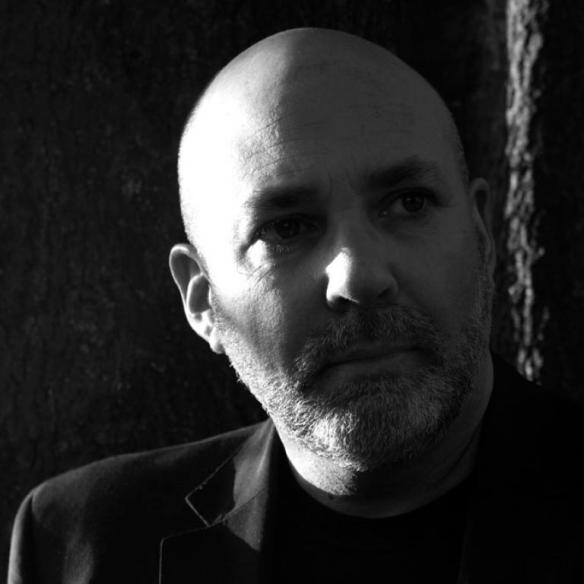
Matt Dunkley – Discovering new worlds

Matt-DunkleyMatt Dunkley’s debut album as a solo artist is long overdue – because until now he has spent his time working with other people.

The list of artists for whom he has produced is an impressive one, including Massive Attack, Patti Smith, Nick Cave and the Kronos Quartet – while within the discipline of the film soundtrack, Dunkley’s principal form of work, he has worked on The Dark Knight, Inception and Black Swan. This prestigious CV only heightens the anticipation for Six Cycles, shortly to be released on Village Green and recorded with the Babelsburg Film Orchestra.

Dunkley spent some time with Arcana to talk about his past, studying with the renowned composer Christopher Palmer, and his present – while also recommending some music for us to enjoy.

Can you remember your first encounters with classical music?

MD: I can remember my first encounter very clearly. It was a junior school trip to a Saturday morning children’s concert at the Fairfield Halls in Croydon, South London. The orchestra played, amongst other pieces, Tchaikovsky‘s 1812 Overture. I think it was the Royal Philharmonic Orchestra, an orchestra I’ve since conducted many times. I was transfixed, particularly by the brass section – and soon afterwards I started learning the trumpet.

What are your memories of studying trumpet and piano at college? Did they push you in the direction of composing?

Music College was a wonderful experience. I was pretty focused on being a professional trumpet player back then, but I did start writing and arranging for small college ensembles. Learning the classical repertoire and having the discipline to spend long hours practising and performing day in and day out was an excellent training for my future career. After a few years as a freelance professional trumpet player, I began to move towards arranging and composing more seriously.

What did you learn from studying with Christopher Palmer?

Chris taught me everything. He was an amazing orchestrator and arranger, a brilliant producer, and a gifted writer and academic. I learnt so much from him. He had worked with Maurice Jarre and Dimitri Tiomkin in Hollywood. He was an expert on William Walton and many of the post war English composers, such as Britten, Delius and Tippett. Just looking over his shoulder and absorbing that depth of learning was inspirational for me. He taught me how to orchestrate, and he taught me how to listen. Really listen.

I remember the first recording session I attended with him. The Academy of St Martin-in-the-Fields were recording some Walton film music that Chris had reconstructed. After the first take (which to my ears was perfection) he went on the talkback and proceeded to rip the performance to shreds, albeit with great charm and politeness. He showed me, in that moment, how high the quality bar should be set. He wanted perfection – and on take four he got it!

Is it beneficial to conduct your own material, and does the composition process continue if you do that?

I love conducting my own material, and for this album, which I conducted in Berlin with the Babelsberg Film Orchestra, I made many small changes on the floor of the studio, making adjustments in phrasing and volume, changes in the voicing of chords, and even altering the notes of a melody at one point. When you have the orchestra playing live in front of you, you hear things that inspire you to adjust your writing, to make the living, breathing being that is an orchestra really come to life.

What do you love about writing for orchestra, and strings in particular?

The orchestra is such a wonderful instrument, capable of so many colours and moods and effects. Once you know how to harness the power of this instrument the possibilities are endless.

Strings are the basis of it all, and for this album I chose to just use a string orchestra, with piano, violin and cello solos. There is something so organic and visceral about a string orchestra. The textures, the colours, the power, the beauty.

Are there any particular circumstances behind ‘Six Cycles’? You have mentioned a painting, poetry and a personal loss, but are there specific examples?

Each one of the six ‘cycles’ was inspired by something very personal to me, but I decided to give each piece an enigmatic title as I wanted the listener to have their own emotional responses to the music, and not to be led by me. I can tell you, for example, that Cycle 6 was inspired by a beautiful love poem by Brian Patten, Simple Lyric, which means a lot to me. But the listener might feel something entirely different when hearing that piece. That’s the wonderful thing about music. It’s so subjective.

Are you composing to imaginary pictures with some of this music?

I’ve done that in the past, certainly. But for Six Cycles each piece had a very clear inspiration. I wrote these pieces separately over a two year period, whenever inspiration struck. It was only when I began to collect them together that I thought of them as one work, or cycle.

There is some very powerful writing for string orchestra here, and a subtle but constant movement of colour. Was that your aim with the music?

Thank you, and yes. I try to achieve the feeling of ebb and flow in my string writing, with the music always in motion, whether externally with climactic loud driving rhythms or internally with subtle quiet movement between the inner voices. Even the moments of stillness have shifting sands beneath the surface.

What has been your most satisfying piece of pop work to date – either in composition or musical direction?

I’ve been very lucky to work with some wonderful artists throughout my career. Working with Tom Jones (on his duets album Reload) was pretty special, as was working on albums with the Pet Shop Boys, Catatonia, Massive Attack, U2 and Badly Drawn Boy.

Who was most rewarding to work with…and if you’re able to mention names, who was least?

Well I tend to find that the most talented artists are the easiest and most rewarding to work with. Any of those mentioned above fall into that category. It’s the less talented that cause all the problems…..but I’m too discreet to name names!

What does classical music mean to you?

Classical music was my first love and it still means everything to me. I grew up in the 1970s / 80s and my older brother and younger sister were all over the pop music of the era. Classical music was mine and it still is. It’s my go-to place in good times and bad.

What piece or piece(s) for the cinema would you recommend to Arcana readers? Both obvious and less obvious would be great!

I’ve been lucky enough to work on many, many movies in my career, and I have a great love of music for the cinema. Here’s a list of some of my favourite scores – some obvious, some less so…
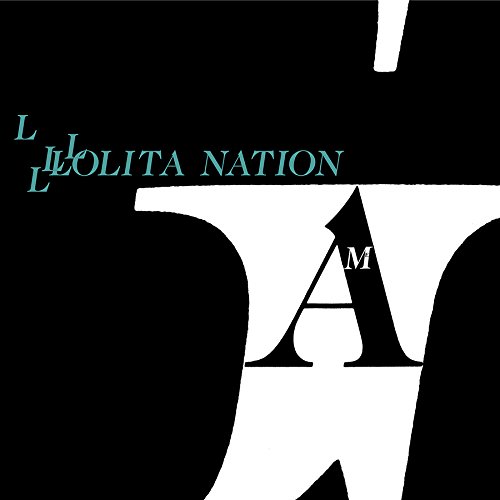
On record: Game Theory – Lolita Nation reissue (Omnivore Recordings)

game-theory

Richard Whitehouse writes about the long-awaited re-release of a landmark album.

2016 is unlikely to see any more significant reissue than this. For two decades, Lolita Nation has been more talked about than heard – an album which bridged the perceived divide between power pop and college rock, transcending genres for one of the seminal albums of the decade.

How did it come about?

By 1987, Game Theory was a seasoned outfit whose two previous releases – the edgy pop of Real Nighttime and the versatile rock of The Big Shot Chronicles – paved the way for what its leader Scott Miller intended to be both an ambitious summation and reckless leap in the dark. At nearly 75 minutes and spread over two LPs, Lolita Nation was that most unfashionable of 1980s prospects: a concept album as varied as Physical Graffiti and as single-minded as The Wall – with the ‘devil may care’ attitude of The White Album thrown in for good measure. A panoply of songs interspersed with concrete and electronic music, it is best heard as being in four parts – reflecting, despite having appearing at an early peak of the CD era, an allegiance to the LP format: one whose giddying diversity never detracts from its underlying cohesion.

What’s the music like?

Part One is launched with the splintered reportage of Kenneth – What’s The Frequency?, a preamble into the heady surge of Not Because You Can; the pause for breath of Shard and limpidity of Go Ahead You’re Dying To cancelled out by the combative squall of Dripping With Looks then assuaged by the jauntiness of Exactly What We Don’t Want to Hear. With its tensile mashing of keyboards and guitars over off-kilter percussion, We Love You Carol and Alison is a highlight, as also the near-descent into anarchy of The Waist and the Knees.

Part Two eases in with the stately opulence of Nothing New, a likely candidate for Miller’s greatest song – to which the barbed nonchalance of The World’s Easiest Job is an admirable foil. Guitarist Donnette Thayer’s Look Away engagingly verges on Survivor territory, then Slip injects a welcome measure of skedaddling humour before two of the album’s defining songs – the pertness and poignancy of The Real Sheila, another of this band’s ‘hit singles’ in a parallel universe, and the pathos of Andy in Ten Years with its poised world-weariness.

Part Three kicks in with the layered collage of Watch Who You’re Calling Space Garbage Meteor Mouth – Pretty Green Card Shark, proceeding via the incisive workout of drummer Gil Ray’s Where They Have To Let You In and breathlessness of Turn Me On Dead Man to the inviting singalong of Thayer’s Mammoth Gardens. This slams into the glinting irony of Little Ivory, before the mock-drama of Museum of Hopelessness and the shimmering, ethereal Toby Ornette, from the pen of keyboardist Shelley LaFreniere, makes way for the free-form montage of track 22, whose incredibly lengthy title does not bear repeating here! This does not pre-empt the impact of One More For Saint Michael, with its drily sardonic manner and Star Trek allusion, or keyboard-driven fizz of Choose Between Two Sons that rounds off this most unpredictable sequence.

Part Four reverts to first principles with three of Miller’s choicest cuts – thus the irresistible sassiness of Chardonnay, then the ambivalence of Last Day That We’re Young distils the essence of an album which plays out to the wistful elegance of Together Now, Very Minor.

What’s with the second disc?

Its double-album length has necessitated this second disc of sundry tracks which Omnivore has used productively – kicking off with the legendary full-length version of Chardonnay, transformed from the lacklustre bootleg on You-tube. That said, the album version is much superior in context – the narrative as it unfolds over the original’s six verses not quite sharp enough, nor the instrumental backing sufficiently varied, to sustain this song’s duration as Miller conceived it: excision of its almost unaccompanied final verse is the only real loss.

Dripping with Looks is heard in a tentative rough mix, while One More For Saint Michael appears both as an engagingly ragged live version and as in an almost fully realized (i.e. not so rough) mix. The Waist and the Knees similarly evolved between its solo rehearsal demo (with an aborted Pink Floyd intro) and rough mix complete in almost all essentials, and if the rough mix of Andy in Ten Years sounds a little too sluggish for its pathos fully to register, the band rehearsal demo of ‘Little Ivory’ has a glinting irony in advance of the finished cut.

Of the radio sessions, We Love You Carol and Alison works fine as a solo number, as does Together Now, Very Minor. Miller’s versatility comes over in a vividly barbed take on Elvis Costello’s Tiny Steps and almost too musical rendition of Iggy Pop’s Gimme Danger. His eloquence in The SmithsThese Things Take Time will delight those partial to Morrissey’s lyrics if not his voice, and a memory lapse in the Sex PistolsGod Save the Queen points up this cover’s verve as surely as do any passing over-emphases in David Bowie’s Drive-In Saturday.

Live covers feature a pertly ambivalent take on The HolliesCarrie Ann, together with one on Joy Division’s Love Will Tear Us Apart whose uncannily authentic instrumental backing highlights the mismatch with Miller’s vocal. If desultory versions of Bowie’s Candidate and Jonathan Richman’s Roadrunner are of little import, the stark sarcasm of Public Image Ltd’s Public Image triumphs over the sub-fuse sound. The test demo of Miller’s Choose between Two Sons, of which only the title made it onto the album, duly makes for a touching epitaph.

Is it recommended?

This is an impressive resurrection of an album which will hopefully secure a wider and more responsive audience today. The remastered sound retains all the clarity but not the brittleness of its original release, with CD presentation in keeping with Omnivore’s high standards – not least a lavishly illustrated booklet which includes detailed reminiscences from band members and friends.

Whether or not Lolita Nation is Miller’s greatest achievement, it is assuredly his most all-encompassing and its return to active service could not be more timely or welcome.

Listen on Spotify

On record: David Gordon Trio – Alexander Scriabin’s Ragtime Band (Mister Sam Records)

david-gordon-trio

Reviewed by Richard Whitehouse

Alexander Scriabin died in Moscow at Easter 1915 – unaware that, over the Atlantic, Israel Baline (Irving Berlin) had hit pay-dirt with Alexander’s Ragtime Band. The David Gordon Trio here ventures into that potent realm in which ‘musics’ meet in place as so often in time.

What’s the music like?

Praeludium Mysterium evokes Scriabin’s unrealized Himalayan extravaganza in pensive yet probing terms. Integrating his ‘mystic chord’ within the harmonic trajectory of Berlin’s hit in Alexander Scriabin’s Ragtime Band would have given both pause for thought, and Scriabin would surely have been disconcerted by transforming a prelude he never played in public into the incisive modality of Scriabin’s Depressed.

Light relief comes with the Debussian high-jinx of Cakewalk, then the engaging Prelude for Both Hands suggests  Scriabin could profitably have deployed jazz and dance idioms. Famous Etude unashamedly transforms his most famous piece into a rumba, with Antonio María Romeu’s danzón Tres Lindas Cubanas a trailblazing number that was hardly less influential on both its listening and dancing public.

Onward to the bluesy sequences of Nuances that suggest Bill Evans as a future acolyte, then the tensile Choro Mazurka gives a Brazilian twist to this most favoured dance of Scriabin’s output. Francisco Canaro’s tango El Pollito vividly overcomes the musical distance between Moscow and Buenos Aires, with the ethereal Rootless Sonata delving further into a putative Scriabin/Evans union.

Comparable possibilities are pursued with the hard-bopping rhythms of Improbable Hip, followed by the limpid piano study that is Pixinguinha’s Passínha and which opened-up the potential of choro music for non-Brazilian audiences. The programme closes with the diffusion of a mazurka into the caressing harmonies of River, most notable for those myriad timbral shades of which the synatheist Scriabin would surely have approved.

Does it all work?

Yes, because the David Gordon Trio is unafraid to stick out its collective neck in pursuit of a singular fusion. Hopefully it will further investigate the bringing together of artists diverse in aim yet kindred in spirit: maybe a Boulez/Bowie synthesis as a fitting double ‘in memoriam’?

Is it recommended?

Absolutely, as those who missed the trio’s memorable recent gig at London’s 606 Club can judge for themselves. Check out the David Gordon Trio website and also Mister Sam Records for previous releases from this thought-provoking jazz outfit.

Listen on Spotify

Wigmore Mondays – Brentano String Quartet play Haydn and Britten

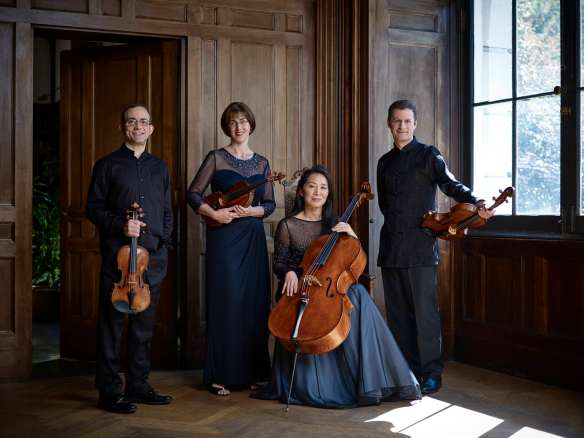
BRENTANO QUARTET - Misha Amory/ viola, Serena Canin/violin (glasses), Nina Lee/cello, Mark Steinberg/violin (glasses) www.http://brentanoquartet.com/

BRENTANO QUARTET – Misha Amory/ viola, Serena Canin/violin (glasses), Nina Lee/cello, Mark Steinberg/violin (glasses) www.http://brentanoquartet.com/

Wigmore Hall, London, 7 March 2016

written by Ben Hogwood

Audio (open in a new window)

http://www.bbc.co.uk/programmes/b072hw4q

Available until 6 April

What’s the music?

Haydn – String Quartet in F sharp minor, Op.50/4 (1787) (20 minutes)

Britten – String Quartet no.3, Op.94 (1975) (27 minutes)

Spotify

The Brentano String Quartet have not yet recorded this music, but other versions can be accessed via the playlist below, in case you can’t get to the broadcast:

About the music

Haydn wrote nearly 70 string quartets, but he was one of those composers incapable of writing the same thing twice. He also had a bit of a penchant for exploring relatively rare keys, and so this quartet, the only one he wrote in F sharp minor, occupies a special place.

It was part of a present for King Frederick William II of Prussia, to whom he had already sent his ‘Paris’ symphonies (nos.82-87) – receiving a ring in return. Haydn decided to send six string quartets, known as the ‘Prussian’ quartets – which continue to show his development as a composer in this relatively new form. The F sharp minor example is not as dark as some of the works in this key, though it does have some idiosyncratic moments described below.

Britten’s third numbered string quartet – his fifth and last to be published in the medium – is a direct product of the composer’s ailing health in 1975. With his capacity for work dwindling but not unbowed, it was suggested to him – in all seriousness by his friend Hans Keller – that if he wrote for less staves on the manuscript score he would be able to write more music.

He therefore completed a dedication for his friend, but as Keller recounts in his recent book, Britten: Essays, Letters and Opera Guides, the thought had been in his mind for some while. After a protracted discussion on form and sonata structure, Britten said to his friend, ‘One day, I’ll write a string quartet for you’. What he completed is something of a Divertimento – a wide ranging term that can apply from a short multi-movement piece to something as substantial as Mozart’s Divertimento for string trio, K563. The implication is that Britten wanted the freedom the form gave him.

With the Amadeus Quartet already enthusiastic exponents of his work, Britten took up the challenge with the help of the group and his assistant, composer Colin Matthews, who helped write much of the music from the piano. Although the Amadeus and Britten ran through the piece in private, he did not live to hear the public’s thoughts on the piece, for the premiere took place just over two weeks after his death.

The last movement of the quartet was written in its entirety in Venice, where Britten was still well enough to go on holiday, and perhaps inevitably it takes its lead from Death in Venice for its musical material. These are thought to be a present in musical form for Peter Pears. The final chord was a matter of some conjecture, and Britten changed it – for in the words of Colin Matthews, he wanted the work to ‘end on a question’.

For more thoughts on Britten’s last full work, visit the Good Morning Britten blog entry

Performance verdict

The Brentano Quartet were notable for their accuracy of tuning and ensemble in this concert but at times some of the raw emotional elements of the music were not necessarily close at hand.

The Haydn was extremely well played but did not have a freshness or spontaneity of the best Haydn performances. It was however impressive for the way they found the inherent darkness in the music, especially the finale, which had a grim determination. The slow theme and variations that make up the second movement could perhaps have enjoyed more variety between each one.

The Britten reached further emotionally, and the beautifully played last movement was a fitting finale. The Brentano were also very effective in the two faster movements, finding the right level of aggression. The rippling textures of the outer movements were beautiful too, recognising the very unusual colours Britten achieves in this music. Britten’s quartets travel internationally now – they were very much confined to this country for a while – and it is intriguing to hear them played from afar. This performance did the Third Quartet justice.

What should I listen out for?

Haydn

1:21 – the first four notes are key in the first movement of this quartet, for they form the basis of everything that follows – a bit like the repeated note motif in Beethoven’s Symphony no.5 but in a very different mood. Here the outlook is quite sombre, though the violin is positive. The first section is repeated (2:55), then at 4:25 the four note theme moves into development mode, before Haydn brings it back in original form at 5:37. Then he shifts the key to F sharp major at 6:22, and there is a notable upturn in mood.

7:31 – after the relative strife of the first movement the second begins in a pure and rather lovely form. A simple theme is presented before Haydn subjects it to several variations, but the peace doesn’t last and things take a darker turn at 9:30, the cello moving into its lowest register. At 10:55 the sunshine returns but is still affected by the music prior to it, and sure enough the minor key returns (12:34) – before Haydn moves once again to the major key for the next variation (13:16). The movement ends in a sudden full stop.

15:14 – the third movement, as is tradition, is a Minuet­ – but this one is a bit different as Haydn sets it in F sharp major, the most difficult of all keys for string players. It has a strange air about it, and some sudden loud bits do not help the mood of anxiety. At 16:45 a trio section starts, slipping into the minor key and feeling more vulnerable as a result. The Minuet music returns at 18:06, but doesn’t fully ease the tension.

19:10 – the mood of the quartet gets even darker for its finale, an austere fugue – which is where each part comes in at regular intervals playing slightly altered versions of the same tune. It makes a busy sounding texture, which Haydn works ingeniously until a sudden end, the finale only two minutes long.

Britten

23:54 – immediately in this work there is a sense of otherworldly mystery. In the third quartet Britten picks up where Death in Venice left off, the first violin using the same conversational style that Britten assigned to Aschenbach,(e.g. 25:14) the other instruments painting pictures of the undulating waters of the city’s canals. There is an intense period of contemplation that runs through this movement, subtitled Duets – because Britten tends to divide the quartet equally as the music unfolds

30:34 – the second movement (Ostinato) arrives with a jolt, and though its statements often end on a chord built on C – one of Britten’s favourite tonalities – it often sounds dissonant and unfeeling. There is a central section where brief respite is found, but it does not last long.

33:56 – when the violin takes the lead in this movement, marked Solo, it does so as a leader in prayer and meditation, and the other three instruments stand considerately in the sidelines. As the movement closes Britten reaches a radiant calm.

38:40 – either side of this moving section are two gruff, defiant scherzos, Britten writing closer to the style of Shostakovich but seeming also to shake his fist at the approach of Death. This second scherzo emphatically bursts the bubble created by the violin in the middle movement.

41:09 – the final movement – subtitled Recitative and Passacaglia – has perhaps the strongest sense of inevitability in late Britten. It begins with thoughts from the solo instruments, using the conversational style of the first movement. Then the Passacaglia takes hold (44:05). It is both sure footed and sublime, every repetition of the gently rising phrase feeling like a slow but sure step towards another world. That it ends on a question is something of a masterstroke, for after the serenity of the E major chord is realised in harmonics (50:33), Britten still has questions in his life and beliefs that remain unanswered. Ending on the ambiguous chord speaks volumes.

Encore

53:03 – a difficult call to make, doing an encore – but the Brentano chose nicely, opting for the first fugue from J.S.Bach’s The Art of Fugue (3 minutes). This is also reproduced on the Spotify playlist.

Further listening

Where to go after Britten’s final thoughts? It’s a very tricky question to answer, so how about some late or final thoughts from other composers? Included at the bottom of the playlist are Beethoven’s Piano Sonata no.32, Schubert’s last String Quartet and the Adagio from Mahler’s Symphony no.10:

In concert – Ryan Wigglesworth and the BBC Symphony Chorus and Orchestra at the Barbican

ryan-wigglesworth

Picture (c) Benjamin Ealovega

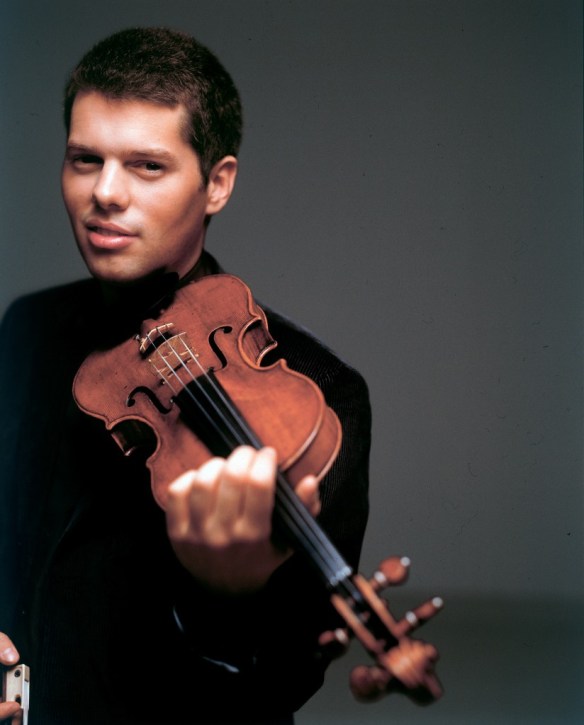
Barnabás Kelemen (violin), BBC Symphony Orchestra / Ryan Wigglesworth (above)

Barbican Hall, London / Wednesday 2 March

This typically well-planned BBC Symphony Orchestra concert had a surprise or two in store. Bookending the quartet of works on display were two pieces by Stravinsky – the Agon ballet from 1957 and the Symphony of Psalms.

They provided a good illustration of how Stravinsky changed styles as a composer, and how in spite of that he retained a fascination with older polyphonic styles. Some of the sound worlds in Agon, a set of twelve tableaux for twelve dancers, frequently alighted on melodic figures or chords that felt ‘old’, holding dissonances and deliberately leaving chords unresolved.

Agon is viewed as the work where Stravinsky starts to take his leave from a more obviously tonal approach to composition. In this performance it was lean yet colourful, with excellent solos from leader Stephanie Gonley, mandolin player Nigel Woodhouse, harpist Sioned Williams and Christian Geldsetzer and Richard Alsop, the two BBC SO lead double bass players, who nailed their otherworldly harmonics on each appearance.

The Symphony of Psalms was more obviously outgoing but saved its greatest emotional impact for the quieter music, the closing pages of ‘Omnis spiritus laudet Dominum’ (‘Let everything that hath breath praise the Lord’) from the BBC Symphony Chorus given out with softly oscillating orchestral figures.

Stravinsky uses the lower end of the orchestra in this piece, with no violins or violas, adding extra percussive punch from two pianos – all aspects that Wigglesworth brought forward in a taut performance. Great credit should however go to chorus master Hilary Campbell, who was unfortunately not mentioned in the concert programme. She is clearly popular with the singers, and helped secure that extra degree of accuracy and emotional involvement. One of Stravinsky’s most cinematic scores, it was in this performance a powerful statement of affirmation.

Wigglesworth positioned his own Violin Concerto modestly after the interval – I say modestly as in its five years of existence the piece has already ramped up an impressive number of performances. On this evidence its status is well-deserved, for it is a tightly structured unit of no little tension, the soloist searching for his ultimate melody while the reduced, ‘classical’ orchestra try and find their ultimate tonality.

barnabas-kelemen

Soloist Barnabás Kelemen (above) was a macho presence, with a little too much testosterone at times when the violin was surging forward, but he balanced that with some incredibly sensitive playing at the quietest moments of the piece, where the audience strained on his every note. Both melody and tonality were resolved in moments that confirmed Wigglesworth as a composer of impressive style and instinct.

The one dud in the program was Britten’s Four Sea Interludes and Passacaglia from the opera Peter Grimes, seen through the visual projections of Tal Rosner. This was a commission from four American orchestras in Britten’s centenary year 2013, with each interlude was set to the images of the city from which the commission came. For its UK premiere Rosner added a portrait of London to go with the other orchestral excerpt from the opera, the Passacaglia. This was centrally placed, keeping the order in which the scenes appear in the opera.

Although well played by the orchestra, the idea sadly fell flat on several levels. Although Britten spent time in America – and indeed began Peter Grimes there – the work’s roots are so entrenched in Suffolk that to suggest anything other than the Aldeburgh coastline through the music feels completely wrong. Rosner’s constructions were skilled, and had a few fine moments where close-up images of the Golden Gate Bridge rotated in technicolour.

Sunday Morning, with its bright building blocks of orchestral colour, was revealed to be a minimalist precursor of the music of John Adams through the clever constructions of its visuals. However despite Britten’s more universal appeal as a composer these days, Peter Grimes surely belongs wholeheartedly in Suffolk – and any suggestion to the contrary, however well intended, feels wrong.