
Live review – Viktoria Mullova, Matthew Barley & LPO / Orozco-Estrada: Dusapin premiere

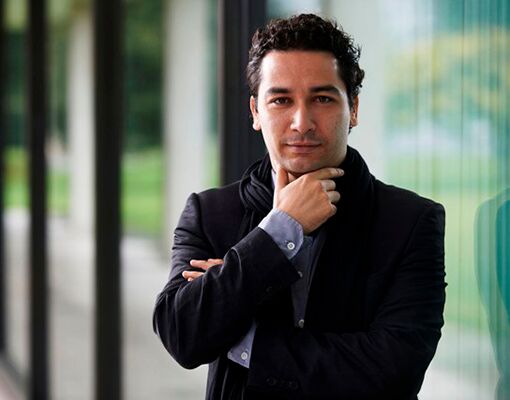
Viktoria Mullova (violin, below), Matthew Barley (cello, below), London Philharmonic Orchestra / Andrés Orozco-Estrada (above)

Royal Festival Hall, London
Wednesday 28 November 2018

Enescu Romanian Rhapsody No. 1 in A, Op. 11 No. 1 (1901)
Dusapin At Swim-Two-Birds (LPO co-commission: UK premiere) (2017)
Martinů Symphony No. 4, H305 (1945)
Ravel La Valse (1920)

Written by Richard Whitehouse

This centenary year of the establishing of a greater Romanian state (aka the National Day of Romania) brought tonight’s varied programme from the London Philharmonic under Andres Orozco-Estrada, now into his third season as the orchestra’s principal guest conductor.

Enescu‘s First Romanian Rhapsody might have seemed almost too obvious a choice, but this sophisticated piece suffused with the ‘confidence of youth’ is hardly a populist crowd-pleaser, so making Orozco-Estrada’s rather superficial approach the more disappointing. The opening exchanges were prosaic, the ensuing episodes lacking in wit and (to quote Richard Bratby’s note) insouciance and the heady climactic stages rather jog-trotted their way forward without much hint of that deftness and effervescence as can still excite audiences nearly 120 years on.

The first UK hearing of a major work from Pascal Dusapin is never to be passed over, with At Swim-Two-Birds continuing the series of concertante pieces running through his creative maturity. The title is that of Flann O’Brien’s 1939 novel, which considers Irish culture from a decidedly post-Joycean perspective, but Dusapin’s concerto hardly reflects this beyond its being a double concerto in two movements – both interweaving incisive passages with those that float suspended above their recurring key-notes. Viktoria Mullova (above) and Matthew Barley (below) were fully responsive to their solo and duet writing, whether in the intricate dialogue of the first movement or emerging cadenza-like writing of its successor; during which Dusapin’s predilection for ricocheting percussion and translucent textures came enticingly to the fore.

Such qualities are no less central, albeit put to very different ends, in the Fourth Symphony that Martinů wrote towards the end of the Second World War – when a victorious outcome could openly be expressed. The result is its composer’s most affirmative such piece, though there are many instances of ambivalence and Orozco-Estrada was attentive to such as those moments of stasis in the first movement’s subtly curtailed sonata design, offbeat accents that impede forward motion in the scherzo (its folk-tinged trio enchantingly evoking Dvorak), or sudden and teasing shifts in perspective which rein-in the emotional fervency of the Lento. The finale, too, has glimpses of doubt but Orozco-Estrada marshalled momentum unerringly through to a peroration that caps what should now be a repertoire work in outright jubilation.

An impressive reading, then, which found the partnership between orchestra and conductor at its finest. After this, was La Valse (or anything else for that matter) really necessary? Not that this performance was without its merits, Orozco-Estrada mindful to avoid letting an endlessly fascinating and always unnerving work descend to the level of mindless showpiece, but the music’s reserves of irony and violence sounded merely hectoring when heard in this context. That said, the visceral close was finely navigated by an LPO intent on projecting every bar.

This enterprising and often exhilarating concert was enthusiastically received by all those present. Hopefully Orozco-Estrada will tackle further Enescu and Martinu in future, while a too little known piece as Prokofiev’s Russian Overture fairly cries out for his advocacy.

Wigmore Mondays: Tai Murray & Silke Avenhaus play Grieg, Philip Glass & Saint-Saëns

Tai Murray (violin, above); Silke Avenhaus (piano, below)

Grieg Violin Sonata no.2 in G major Op.13 (1867)
Glass Pendulum (2010)
Saint-Saëns Violin Sonata no.1 in D minor Op.75 (1885)

Wigmore Hall, London; Monday 26 November 2018

You can listen to the BBC Radio 3 broadcast by clicking here

Written by Ben Hogwood

This was an imaginative and invigorating recital from two instrumentalists at the very top of their game. It also brought forward two of the lesser lights in the violin and piano repertoire, giving exposure to composers for whom melody came naturally.

Edvard Grieg’s three sonatas for violin and piano are consistently rewarding. Three weeks previously at the Wigmore Hall we heard Aleksey Semenenko and Inna Firsova in the Violin Sonata no.3; now Murray and Avenhaus gave a passionate performance of its predecessor.

Of a largely sunny disposition, the Violin Sonata no.2 in G major is one of the first works to introduce home-grown folksong into the Norwegian composer’s output. Tai Murray seized the opportunity for drama with an assertive introduction, countering Silke Avenhaus’s thoughtful opening in the minor key (1:49). From 3:17 they moved to the first movement proper, enjoying the attractive, dance-like melodies in a bright exchange, though this was countered by a more reflective, minor-key theme (heard again at 8:19).

Grieg used this key for the slow movement, which began in dreamy, reflective mood (11:09). Soon however the violin was soaring higher and faster, before subsiding to a beautiful, airy second theme, back in the major key (12:47). The third movement once again suggested the outdoors with the piano drone (16:55) and another folksy melody, the violin stepping in exuberantly – and another dreamy episode from 19:02. After a recapitulation of the drone material at 20:18 Murray and Avenhaus led us to a grand coda, a passionate finish in a similar vein to the soon to be published Piano Concerto.

Philip Glass’s Pendulum, originally written for piano trio, appeared here in a duo version sanctioned by the composer. Even when Glass is at his most delicate, great demands are placed on the performers, especially when set the kind of athletic arpeggio figures Murray and Avenhaus had here (from 24:30). They responded with an energetic performance but also took great care with the subtleties of Glass’s writing at the start of the piece, with a steady tread on the lower notes of the piano. The nervous energy was never far from the surface, growing as the oscillations became ever wider, leading to a sweeping finish at 31:47.

The mystery that Saint-SaënsViolin Sonata no.1 is not more often performed is solved by its fiendishly difficult but utterly exhilarating finale. Until then, the work – completed in 1885 – had already made a strong impact, thanks to the composer’s clever grouping of the four movements into pairs of two, and the irregular but strangely effective phrasing of the melodies.

From the start of the first movement (34:02) Murray and Avenhaus set a tense, nervy atmosphere, the violin and piano shadowboxing each other. The second theme (35:37) was equally nervy, despite the flowing piano’s suggestions of the Organ symphony. The recapitulation in this dramatic movement reached a climax at 39:55 with some concerto-esque playing from the piano before the flowing theme returned, Saint-Saëns moving us seamlessly into the second movement (from 43:25)

This respite, a rather beautiful reverie, was broken by the third movement Scherzo (from 48:00), a throwback to the composer’s Danse macabre, with irregular phrases and the instruments mirroring each other again. There was a flowing trio section (from 49:58) but before long we were back to the Scherzo (50:58). Another seamless transition set up the finale (from 52:05), scampering out of the blocks with some remarkable playing from both players, responding to the technical demands with apparent ease and bringing back the second theme from the first movement in a beautiful passage of playing from 56:08. Then the music built for the final time, surging into the major key where a cascade of bells rang out from the piano (57:03), before the emphatic finish.

A terrific concert, this, with no need for an encore. At its best Saint-Saëns’ music can be breathtaking, and this was one such wholly enjoyable occasion!

Further listening

Tai Murray has yet to record any of the music played in this concert, but the playlist below contains some of the best available versions:

If you particularly enjoyed the Grieg, I wholeheartedly recommend a disc bringing together all three of the composer’s sonatas for violin and piano, played by Augustin Dumay and Maria-João Pires:

It remains a mystery as to why the Saint-Saëns sonatas are not performed more often. If you listen to the collection below you will find some persuasive accounts of the Second Violin Sonata, the Cello Sonatas and works for clarinet, oboe and bassoon: