American pianist Bruce Brubaker is one of those artists whose every move is worth monitoring, for his musical quests bring many rewards.
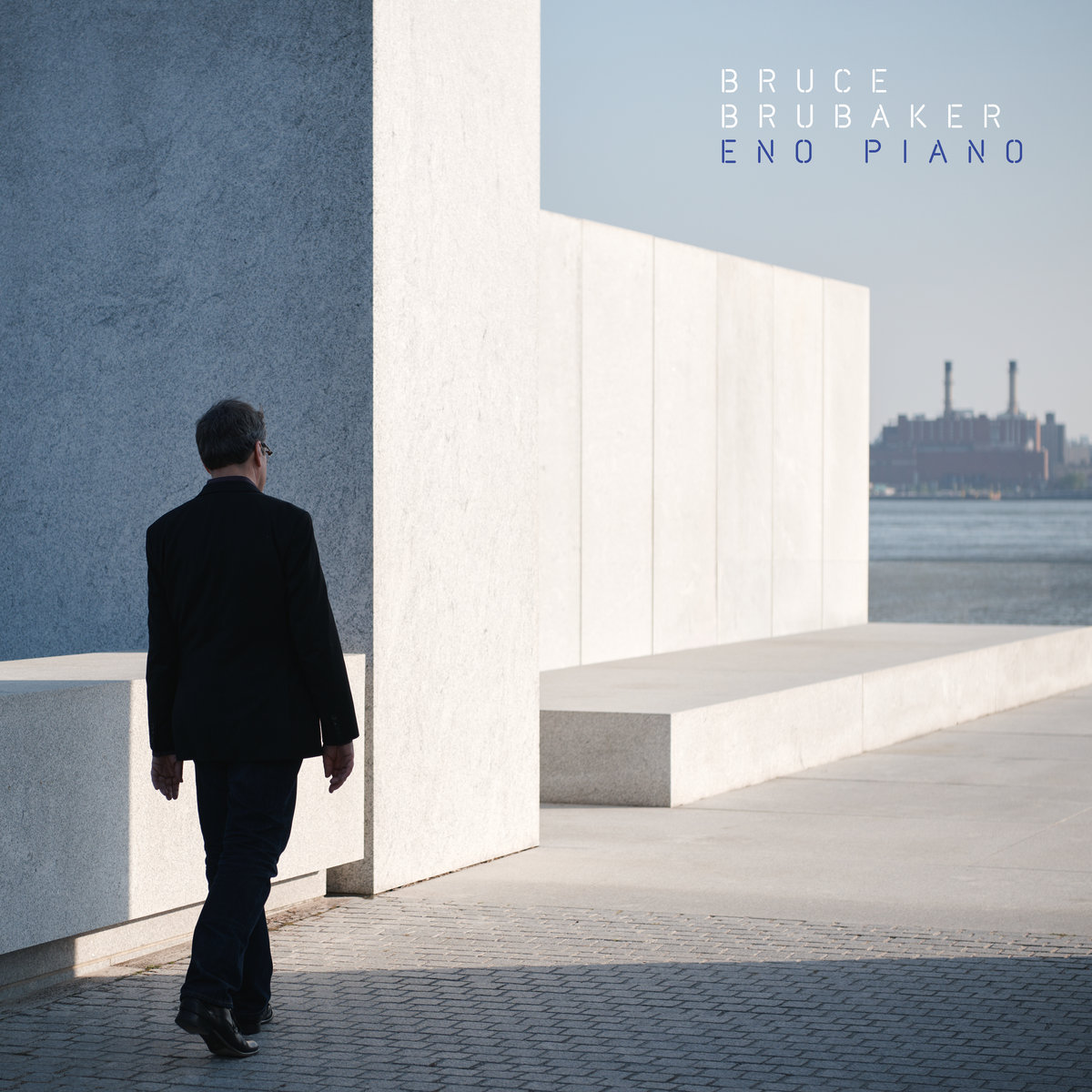
Brubaker is perhaps best known for his work with the music of Philip Glass, John Cage and Meredith Monk, but now he makes a very intriguing turn in the direction of Brian Eno, creating an album for the InFiné label that will include a selection of ambient music, including Music for Airports.
The press release asks a question: “Can a single instrument convey ambient music originally made through studio techniques and tape loops? Eno Piano is a companion to Bruce Brubaker’s acclaimed album Glass Piano (2015) — even the two album covers are companions. Named by Pitchfork “one of the most exciting pianists in the contemporary American classical scene,” Brubaker, in Eno Piano, shows that just as the studio can be a musical instrument, a single musical instrument can be a studio.”
Umdrehen is a word that denotes a twist, a turning around, a reverse – and the name of Thomas Fehlmann’s new album.
It is effectively a title that gives Fehlmann free musical rein on a 40-minute set of musical experimentation. He refers to his approach as ‘generative music’, with the element of chance playing a role in his choices.
What’sthemusiclike?
Not as playful as the above description might suggest. In fact some of this album operates under a dark cloud, wrapped in an ambience that can be cloying.
That said, there is a good deal of invention here that makes its best impression on headphones. Having established the dark, brooding textures, Fehlmann adds a shuffling beat and semi-industrial field recordings to Gelbe Kurve. There are some unnerving moments, such as Steinwurf, while Doppelherz opens out to a much wider expanse, offering a halo of light around the music. By contrast Feuchter uses mottled chimes, which prove to be comforting yet weirdly eerie. The delicate exchanges of Gehupft suggest the chance elements more, with a cold intimacy, while the soft hues of Prenzlau an sich are complemented with foreground chatter.
Does it all work?
Largely – though the feeling does persist that Fehlmann is in search mode, never quite pinning down a style of music to settle on. Because of that Umdrehen has a fleeting, fitful ambience.
Is it recommended?
It is – and Umdrehen is certainly an interesting addition to Fehlmann’s impressive discography, if not perhaps the most successful.
Recent audience figures released by the BBC suggest the Proms have had a very big impact on new concertgoers this year. Here are some outtakes from the press release:
A record-breaking season online, with more than double the number of signed-in accounts accessing BBC Proms content on iPlayer and BBC Sounds compared to last year
Nearly 1 million people watched the First Night of the Proms on BBC Two, its strongest overnight TV audience since 2009
Proms content reached 3.2 million on TV during the opening weekend
A peak audience of 3.5 million people watched the Last Night of the Proms on BBC One
Well over half the Proms at the Royal Albert Hall have been total sell-outs
Average main evening attendance at the Hall was 93%, building on 85% in 2019
With Arcana’s blueprint being to bring classical music to those who might not normally listen to it (as well as sending electronic and pop music the other way!) this can only be described as fantastic news. The Director of the Proms is an incredibly difficult job to do – and having observed the juggling acts that previous incumbents have had to undertake to satisfy every different audience demand, I think it is fair to say David Pickard – and Roger Wright before him – have managed the changing habits of the last decade very impressively, not to mention the pandemic.
I have to admit that for me personally, the Proms are not as rewarding as they used to be. Yet this statement comes with a huge qualification, for I am 30 years into my classical music journey and first attended the festival in 1997. There have still been concerts that I have enjoyed immensely; I just attend less often than I used to.
The Proms should not be looking to satisfy my musical needs on a nightly basis. Instead it absolutely needs to be looking at the next generation of concertgoers, those who want to start out and get to know this wonderful area of music.
In order to bring them along, the festival needs to reach beyond the core classical at times, and that is why the range of artists – from The English Concert to Self Esteem to the premiere of Kurtág‘s End Game – is so important. Add in Anna Lapwood, Mariza, tributes to Northern Soul, Bollywood and Stevie Wonder, and one concert that I attended – the Jon Hopkins / BBC Symphony Orchestra collaboration – and you have greater inclusion than ever before.
Stood in the arena, I was aware that many around me were unfamiliar with the Proms or the Royal Albert Hall. What a memorable first visit they had! This is where a great opportunity exists, to give new concertgoers new memories that they will treasure. If their first visit is a success, it is fair to assume another one will follow – then another, and another…
Listening habits are changing in the era of streaming, and – like it or not – festivals like the Proms have a pressure (and even an obligation) to respond with concerts that their audiences will want to attend. To that end it is so important that seasoned classical concertgoers – while not being made to feel outcast – recognise that the make-up of some concerts in the season simply has to change, that it may well be the case that people applaud between movements, and that there may be a lot of distractions during the concert. Such things happen at pop gigs – and certainly did back in Beethoven’s day – and should be accommodated where possible.
I guess the point of this slightly rambling blog is to say that we have a duty (and hopefully a wish!) to pass on the love of classical music to other concertgoers – just as we do with our favourite bands. Let’s do that as much as we can!
Anthony Wilson has a most impressive musical CV. While big band jazz played a pivotal role in his musical upbringing, he also has a great deal of experience in pop music, playing with Paul McCartney, Leon Russell, Randy Crawford and Willie Nelson among many others. To an extent, that is the ‘day’ job – for as a composer Wilson has an experimental and exploratory approach, looking for new sounds and collaborators.
To that end his new album Collidon finds him trying out new sounds and instruments in the company of fellow Colorfield luminaries Anna Butterss, Daniel Rotem, Mark Giuliana and Rob Moose. The producer is Pete Min – and Wilson helpfully lists all the instruments used in the recording (including the keyboards) on the album’s Bandcamp page.
For those wondering, as I was, what ‘collodion’ is, it is a highly flammable solution used in the manufacture of photographic film, or in medicine for sealing wounds.
What’sthemusiclike?
Open minded – but Wilson is not a composer to lose his focus or indulge himself by seeing how many genres he can tick off for the sake of it.
Instead, we are treated to an album that is an exploration for the performers and the listener. Much of it has an instinctive feel, but this is the environment in which Wilson is most effective, with a sixth sense that tells him when to stick and when to twist.
The balance of kinetic energy and contemplation is finely achieved, allowing Wilson time out on Heart Whispering but bringing urgent dialogue to The Daughters Of Night, an atmospheric compilation of nocturnal noises and melodic snippets.
The piano often acts as the fulcrum in his music, whether in the stately chords of Keeping, complemented by more mysterious gamelan sounds, or by providing the harmony for Arrival At Kanazawa, which develops above an urgent drum track to express profound thoughts on the guitar. Dream Oracle adds a breathy tenor saxophone (Daniel Rotem) to its explorations, while the title track features a beautiful, silvery string arrangement executed by Rob Moose.
Does it all work?
Yes – though the feeling persists that Wilson could have enhanced the smaller tracks further, such as the glittering textures of Divine One.
Is it recommended?
It is, enthusiastically. An engaging and sonically rewarding piece of work.
In 1983, Cybotron made one of dance music’s landmark records. The single ‘Clear’ became a calling card for techno, a futuristic piece that still sounds new today. Now they are returning as a duo, original founder Juan Atkins teaming up with producer Laurens von Oswald but not Rik Davis.
A two-part EP, Maintain The Golden Ratio, is scheduled for release on the Tresor label on 13 October – and for now we can enjoy its lead track Maintain. Described as ‘a studied engagement with what techno was and should be, it is an atmospheric machine piece with strong breakbeat, busy electronics and moody backdrop. In other words, as the vocal goes, “We will maintain”…with the elements that made Clear such a lasting track largely present and correct. While not quite on that exalted level, it is still a fine piece of work. Now to see if there are more plans afoot!



 Arcana.fm