Back in July 2015, Arcana posed the question ‘Is there a less fashionable British composer than Delius?
The thought was a response to the lack of Proms performances for his music over the years, a trend that continues to this day.
The piece played on that balmy July evening, however, made a winsome impression on this particular author, even though it is not one of his best known works. To quote from the review, “Delius’ mastery lies in his orchestration and harmony, with sultry added notes and hazy, impressionistic textures that evoke the laziness of a summer day.”
Since a good deal of Europe has been basking in hot weather this weekend, it is the ideal time to revisit this dreamy piece. Listen (and hopefully enjoy!) below:
British producer and composer Roger Eno has hit a rich vein of form in recent years – and his prolific writing period continues with the The skies, they shift like chords…, due to be released on Deutsche Grammophon on 13 October.
On the press release for The skies, they shift like chords… Eno describes the world in a dozen musical watercolours based on spontaneous sketches, tracing an evocative and thought-provoking path through sound and silence. “I think of music in visual terms. Perhaps here the chords could be the earth, the melody the trees rising above ground, and the atmosphere of floating guitar could be the sky. These three elements are different but interconnected.” He adds, “Most of my pieces are snapshots of things that were experienced in the moment,” says Eno. “How do you describe the world unless it’s in an instant? You can’t fix anything because everything is in flux, it’s changing and mutable.”
Here is the first excerpt from the album, Tidescape, in the form of a visualizer:
Yesterday Vince Clarke, founding member of Depeche Mode, Erasure and Yazoo, and all-round electronic maestro, announced a new album.
Due on 17 November on Mute, Songs of Silence is described as an ‘ambient instrumental album’. Its first single, The Lamentations of Jeremiah, represents a striking musical structure. A haunting solo cello line takes the lead, a true lament set against a drone accompaniment. It is certainly dark, but has at its heart an outpouring of emotion that is ultimately positive. Listen below:
The end of summer brings one of those reassuring points in the Kompakt calendar, the annual release of their Total compilation. Once again it draws a line in the sand to bring us a snapshot of the music the Cologne label’s artists have been making over the last year, while throwing in the gratefully accepted new versions and rarities that we collectors treasure.
What’sthemusiclike?
Very good indeed. While techno is the broad area where the 13 tracks lie, the range of the music runs from soulful introspection to peak time euphoria (aka Rex The Dog)
The collection begins with the subtle shades of Kollmorgen‘s Muddy. After that, Argia’sNo Concept is quite stark but movingly so, before the confident poise of Jürgen Paape makes itself known. Talmi is a cracker, brooding and bristling over a strong four to the floor beat. The cinematic dance is suitably nocturnal. Four Down is classy, while Jon Tejada offers a lovely heat soaked number on Wild Ride. Rex tge Dog an excellent vocal number with its hook take away my sorrow and this pain. Hardt Antoine’s All We See sends tracers out into the night
Does it all work?
It does. Kompakt are well-versed in compilations of this sort, so there is no reason the 23rd instalment should be any different! It has a very satisfying ebb and flow, played out to a nocturnal background.
Is it recommended?
It is – a consistently good guide to where the label is at musically right now.
It is – typically thought provoking work from one of Britain’s finest electronicmusic makers.
Bruckner Symphony no.8 in C minor WAB108 (1884-7, rev. 1889-90 [ed. Nowak])
Royal Albert Hall, London Monday 4 September 2023
by Richard Whitehouse photos by Chris Christodoulou / BBC
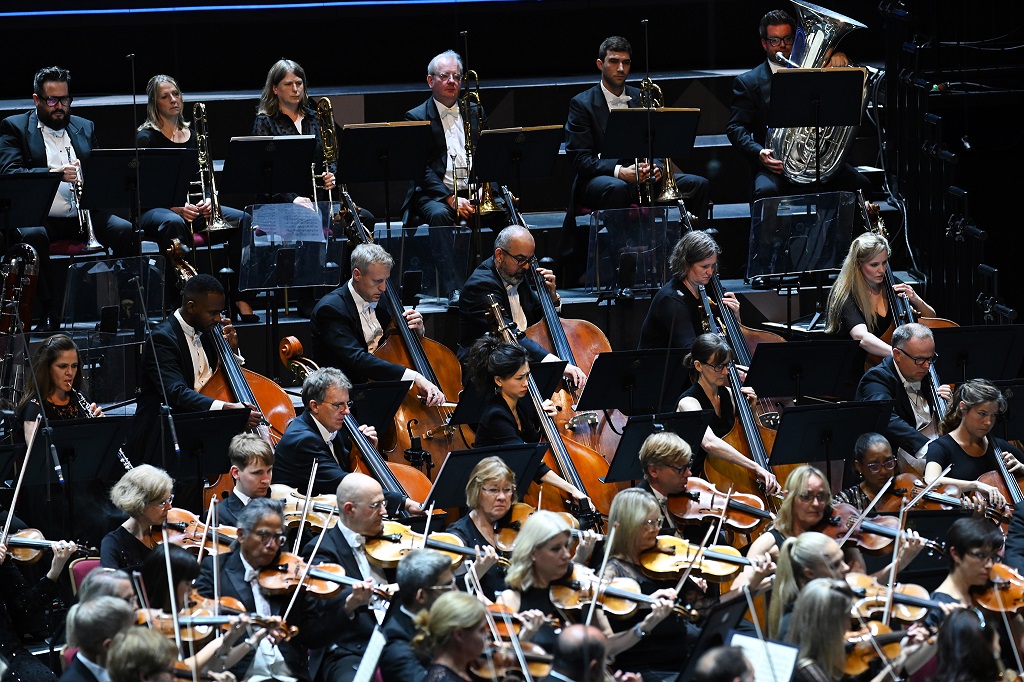
It may have taken 70 years for its Proms premiere but the Eighth has since become the second most often played of Bruckner’s symphonies (this being its 21st hearing), and a near capacity house greeted tonight’s performance by the BBC Symphony Orchestra with Semyon Bychkov.
At home across a broad repertoire, Bychkov has of yet directed relatively little Bruckner, and the first movement took its time to settle. Fugitive rather than speculative in their emotional import, those distinct motivic elements lacked a final degree of definition and only began to take on greater cumulative focus during a development whose unfolding drama was matched but not exceeded by the climax of the coda – after which, that inexorable winding down into silence was precisely controlled while curiously unevocative in its sense of time running out.
With the outer sections taken at a swift but never headlong tempo that enabled its underlying ostinato pattern to be perceived throughout, the Scherzo exuded energy while also mystery in what remains Bruckner’s most powerful instance of a genre he made his own. The brass was at its most assured, and Bychkov duly avoided any temptation to make the lengthy trio a self-contained episode. Its unforced progress brought winsome contributions from woodwind and harps, the reprise then having audibly greater impetus as it surged towards its decisive close.
As so often in this symphony, the Adagio found the interpretation and its realization in most potent accord. Mindful to draw its continual thematic restatements into a consistent process of developing variation, Bychkov conveyed the music’s expressive but also spatial grandeur with an assurance hardly less evident in its unfolding tonal trajectory. Nor did the excising of material in revision impede its course, even if the sudden appearance of cymbals and triangle at its climax sounded more than usually redundant. A pity, moreover, that momentary failings of intonation among Wagner tubas affected what was otherwise his near perfect rendering of the coda – Bruckner’s distilling of main motifs, underpinned by the halting accompaniment, finding closure only at that point where everything stops as the movement comes full circle.
From here the Finale set out with due purposefulness, even though the occasional rhythmic hesitancy gave notice of an approach in which the whole did not quite match the sum of its admittedly impressive parts. Strategically coinciding with those divisions of the movement overall, the chorale-like main theme brought a resplendent response as left its eloquent then ominous successors sounding incidental within the ongoing formal scheme, and though the extensive development did not lack for variety of content, its discursiveness made for a less than perfect unity. Any remaining tentativeness was none the less dispelled in a coda whose gradual emergence made for an apotheosis of unusual clarity – the superimposing of themes not just ingenious in its technical skill but cathartic in its conveying of a journey completed.
The illustrious rollcall of conductors who have tackled this work at the Proms speaks for itself, and while Bychkov might not yet have joined the ranks of Wand, Haitink and Mehta et al, his belief in and commitment to Bruckner’s Eighth was amply communicated to all those present.





 Arcana.fm