
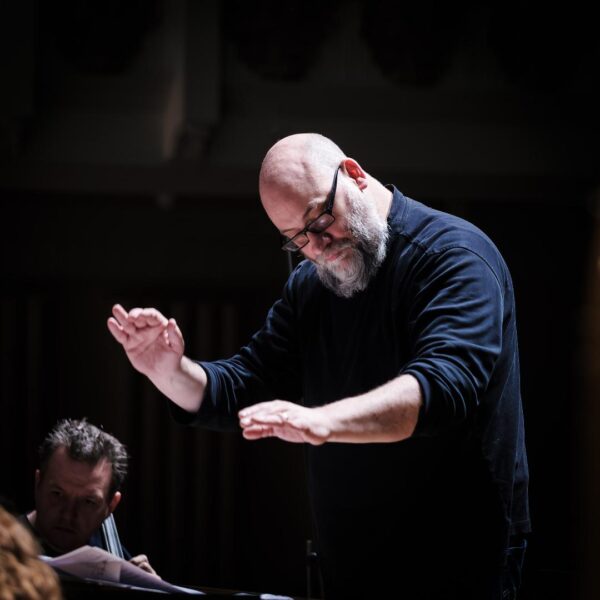
interview by Richard Whitehouse Picture (c) Julie Andrews
You do not move forward by standing still. That is evidently the maxim of the English Symphony Orchestra, whose first release on its new in-house label has just been issued. Apropos of this and other matters, Arcana spoke recently to Kenneth Woods, the principal conductor and artistic director of the ESO, about his plans for this audacious undertaking.
It made sense to begin with the motivation behind the establishing of ESO Records. ‘‘It’s something I’ve wanted to do for a long time. Being able to release whatever we want, and whenever we want, to is hugely empowering for us as an orchestra. It gives us a chance to align our concert work with our online presence and recording programme more strategically’’.
As to whether these releases will be mainly studio or live recordings, ‘‘It’ll be a combination of both. I think that over the course of the next couple of years, listeners will start to discern a number of threads within the ESO Records portfolio. Our first release is an Elgar Festival disc with Elgar’s First Symphony and his concert overture In the South. This is a great way for us to spread the word about the festival internationally and also to share the exceptional quality of Elgar Festival events. And, with the festival doing so many new or lesser-known works, we can share that music with a world-wide audience.
‘‘As a result of the COVID pandemic, we’ve an enormous amount of material ‘in the can’ that we recorded for ESO Digital (our online video portal). ESO Records gives us a chance to share that body of work, also to highlight and complement our future concerts. For instance, we’ll be releasing our one-per-part version of Mahler’s Ninth Symphony to coincide with a run of performances in December. And there are studio projects such as the Sibelius cycle which have continued as we tie-in the recording of its future instalments to public concerts’’.
Woods is keen to point out that ESO Digital release will complement the orchestra’s ongoing schedule of releases for other labels. ‘‘Since we released the first disc of my tenure in 2015, we’ve worked with Nimbus, Lyrita, Signum, Avie, Toccata and Somm among others. While I hope that many of those partnerships will continue, the economic climate for labels is very difficult. They’ve a lot of fixed costs and declining revenue streams which means that, for a group like us, finding release slots and agreeing repertoire or projects has become more complicated. Something like the Sibelius cycle which, while it is very important to us as an orchestra, is not the kind of repertoire many labels do anymore.
‘‘One can also be hampered through labels having other versions of the same repertoire in the pipeline or in their back catalogue. That said, I’d contend the world does need recordings of pieces which emerge out of shared sympathy and enthusiasm for the music among players, conductor and production team. There’s always more to be said about the greatest music, and if we feel we’ve something meaningful to contribute, then we’re going to say it’’.
Given the varying economic and logistical factors, ESO Records might not always be issued both as CDs and Downloads. ‘‘This will vary according to the release. It makes to put the Elgar Festival Live stuff makes out on CD because they make a great souvenir for attendees. But with most projects today, physical sales are so small it isn’t worth the cost or complexity of maintaining an inventory and shipping it all over the world. Moreover, the argument used to be that CDs sounded better, but the quality now at 24-bit and 96-kHz sampling contains between three and ten times as much detail and information. We want our listeners to hear our work in the best possible quality, and these days that means streaming or hi-res downloads’’.
With this in mind, listeners can look forward to no mean diversity in terms of future issues. ‘‘I mentioned we were looking to create coherent and ongoing threads among our releases. Elgar Festival Live has several more releases ready and we’ll be recording our performances at this year’s and all future festivals. The orchestra’s long-term commitment to contemporary music will be a big part of our future work, and I expect this to feature many of the amazing composers that listeners have come to associate with ESO such as Philip Sawyers, Adrian Williams, Emily Doolittle, David Matthews and Steve Elcock. We’re also keen to draw on the ESO’s extensive archive of performances by composers such as Ireland, McCabe, Maw, Simpson and Arnold, along with performances conducted by the likes of Michael Tippett and Yehudi Menuhin, with a wider public.”
‘‘The Sibelius and Mahler projects are indicative of our desire to put our stamp on so-called standard repertoire or, as I prefer to call it, the greatest music ever written. One of the best things about streaming is that not every release needs to be a 70-minute album. Archival recordings might well come out as singles or EPs to align with composer anniversaries or birthdays, historic occasions and upcoming concerts – so there’ll be releases of Beethoven, Mozart, Brahms, Strauss, Bartók and Shostakovich. I’m also very proud of our track record of championing historically suppressed music, so listeners can expect further issues of Gál, Schulhoff, Kapralova, Krenek and Weinberg.”
‘‘Finally, ESO Records will give us greater freedom to develop collaborative projects with artistic partners including composers, soloists and directors. We’ve just recorded a fantastic disc of organ concertos by Poulenc, Hindemith and Daniel Pinkham with organist Iain Quinn for release next year, and I’m hopeful there’ll be many opportunities in the future to work collaboratively so as to bring worthwhile music to the public’s attention’’.
Much to look forward to, then, from a label whose artists have never shied away in pushing the envelope when it comes to imaginative programming and innovative presentation. Qualities, indeed, that will no doubt prove synonymous with whatever releases emerge from the ever-enterprising English Symphony Orchestra.
You can read Richard’s review of the first instalment in the English Symphony Orchestra’s Sibelius cycle on Arcana, with the Sixth and Seventh Symphonies and Tapiola
Published post no.2,623 – Monday 10 August 2025
 Arcana.fm