
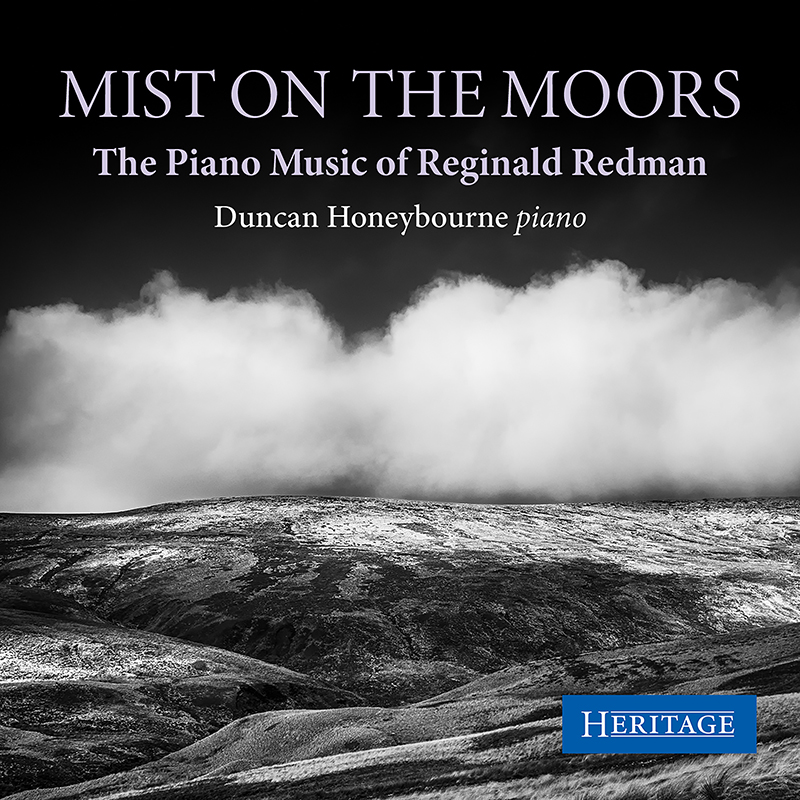
Duncan Honeybourne (piano)
Reginald Redman
Mist on the Moors (1926); A Cornish Legend (1922); Arabesque (1923); La Nuit; Lyric Piece; The Mystic Garden; Graceful Dance; Cradle Song; On the Cornish Coast (all 1924), The Lonely Faun (1926); Gossamer (1922); Lullaby for a Kitten; Deep in the Woods (c1923); Children at Play; In Changing Moods; In a Gondola; Venetian Barcarolle (all 1924); Prelude I Vent a travers les Roseaux (Wind through the Reeds), Prelude II Dans la Clairiere des Esprits Follets (In the Glade of the Will-o’-the-Wisps), Prelude III Le Desert au Point du Jour (The Desert at Dawn) (1918); Song of the Fountain (1924); Humoreske (1927); All Through the Night (earlier version, c1927); All Through the Night (later version, c1970)
Heritage Records HTGCD121 [78’24”]
Producer / Engineer Paul Arden-Taylor
Recorded 24 September 2025 at Wyastone Concert Hall, Wyastone Leys, Monmouth
Reviewed by Richard Whitehouse
What’s the story?
Heritage continues its coverage of unfamiliar British music with an album of piano music by Reginald Redman (1892-1972), fastidiously realized by Duncan Honeybourne who himself has been a doughty champion of composers from the UK throughout his professional career.
What’s the music like?
Although active as a musician from his early years, composition frequently took a back seat in Redman’s activities; particularly during 1926-52 when he worked for the BBC in Cardiff then Bristol – eventually becoming its Director of West of England music. A skilled organist and pianist, he was latterly in demand as a conductor of amateur or professional orchestras. His own output comprises operas and ballets, chamber music, and songs including over 60 settings (albeit in translation) of Chinese poetry, on which subject he was a noted authority.
The highlight of this piano collection is the set of Three Preludes written near the end of the First World War and languishing in the archive at Bristol University until the present pianist rediscovered them in 2024. Complementary as a set, their sound-world is brought into focus by the descriptive titles (in French) appended to each one. Hence the simmering agitation of Vent à travers les Rousseaux, capricious agility of Dans la Clairière des Espirits or spatial immensity of Le Désert au Pont du Jour – which latter piece leaves a powerful impression.
If the miniatures that Redman wrote in the early 1920s, mainly for his wife Evelyn Amey, fail to recapture the individuality of those earlier pieces, they are never less than expertly written and evocative of their actual titles. Whether in the disarming whimsy of Lullaby for a Kitten, restrained poignancy of The Lonely Faun, the ominous aura of Mist on the Moor or harmonic subtlety of The Mystic Garden, these are consistently attractive items such as make for ideal encores and they would be worth taking up by other pianists for inclusion in their own recitals.
One of the latest pieces from this time is an appealing arrangement of the Welsh folksong Ar Hyd y Nos, duly heard in counterpoint with the West Country song Admiral Benbow for what became the signature-tune for the BBC’s Western station when it served both regions up until 1936. How revealing Redman should have revisited the Welsh melody in an arrangement just two years before his death; more austere yet no less affecting, while enhanced with a prelude and postlude in music that lingers in the memory long after these three minutes have ceased.
Does it all work?
Pretty much always. Redman was first and foremost one for whom practicality was the key as composer as much as a musician though, that said, the finest of these pieces inhabit a domain never less than personal and which should readily be appreciated as such. Those who respond to their charm can enjoy more of this music via digital downloads available from the Heritage website: the entertaining vignettes of At the Opera and poetic evocations of In Amberley Vale, both of which find the composer writing educational music that feels not in the least didactic.
Is it recommended?
It is. These recordings are as attentive to the letter and spirit of this music as expected from a musician of Honeybourne’s calibre, enhanced by spacious and well-defined Wyastone sound, along with typically informed and informative notes by the pianist. Well worth investigating.
Listen / Buy
You can explore purchase options at the Heritage Records website. Click on the name to read more about composer Reginald Redman and pianist Duncan Honeybourne
Published post no.2,893 – Thursday 21 May 2026
 Arcana.fm