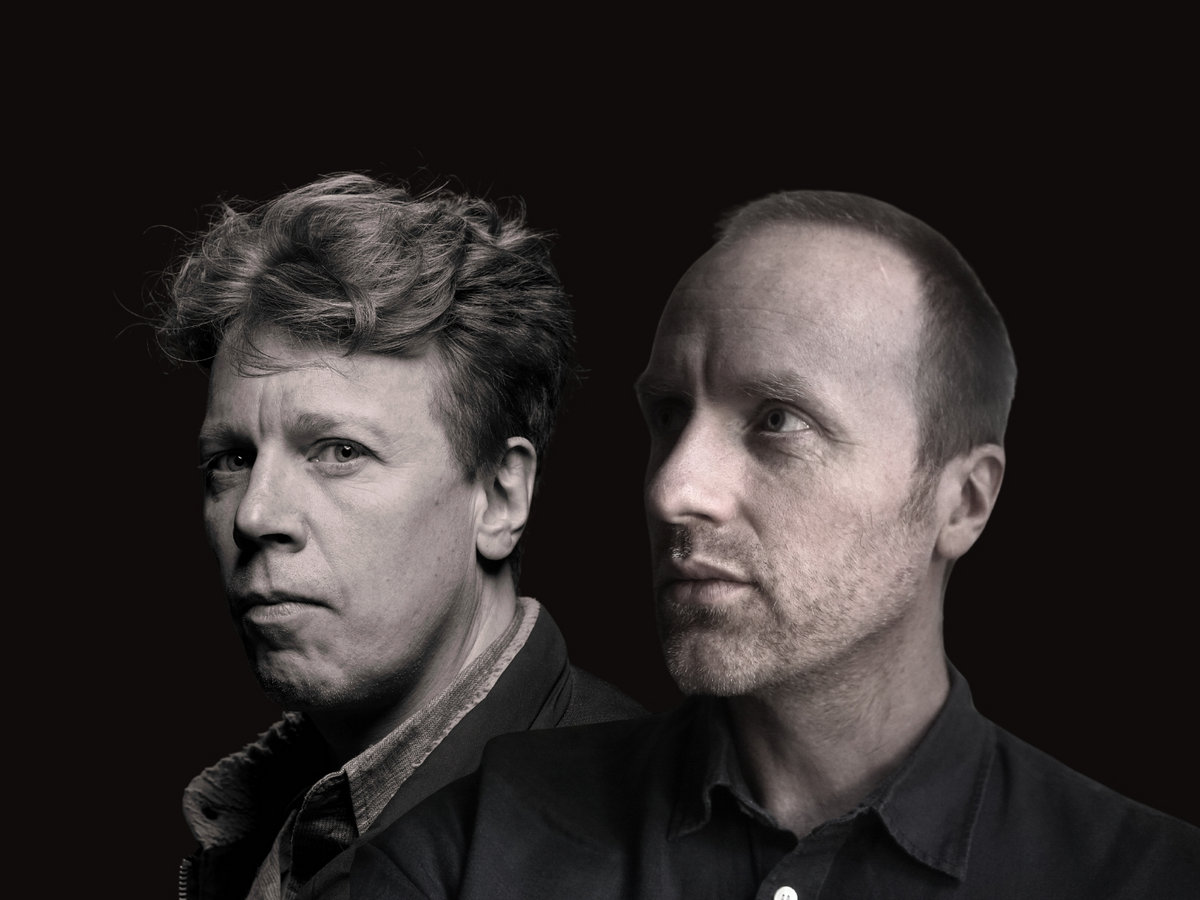
It gives us great pleasure to welcome Krononaut‘s Leo Abrahams (above, front) for the latest Arcana playlist guest turn. The improvisatory duo release Krononaut II on Palomino on 9 August, and Abrahams has generously given us an insight into the working process behind the album. Here is the playlist – and you can read below the detail on his choices:
Schneider TMFirst Of May Ingenious sonic investigations of the guitar from a studio master.
Mazz SwiftHidden In Plain Sight I met Mazz playing in Anohni’s band recently. Their record absolutely blew me away with its sincerity and erudition.
Ovalhmmm So playful and so detailed, all these years on I still have no idea how he did it, but it’s firmly lodged in my subconscious.
Spin MarvelTuesday’s Blues The record that first brought Martin France to my attention. Astonishing drumming – melodic, refined and furious.
John Hassell, Brian EnoDelta Rain Dream One of those records that is responsible for a whole new genre, it is tremendously free.
Sulton NazarOmaded Mehmoni Mo Recorded by Lu Edmonds in the mountains of Tajikistan in the early 2000s, this master of maddoh opened my ears to a whole new culture.
KrononautConvocation This track from the first record gets closest to the till-but-not-static feeling that we were reaching for on the second.
Morton FeldmanPalais de Mari A relatively concise piece from one of my favourite composers, this is deep, concentrated and compelling music.
Our very grateful thanks to Leo for his selection.
Orchestre National de France / Cristian Măcelaru with Choeur de Radio France (Symphony no.3)
Enescu 2 Romanian Rhapsodies Op.11: no.1 in A major, no.2 in D major (1901) Symphony no.1 in E flat major Op. 13 (1905) Symphony no.2 in A major Op. 17 (1912-14) Symphony no.3 in C major Op. 21 (1916-18, rev. 1920)
DG 4865505 [three discs, 2h42m24s] Producer Vincent Villetard Engineer Yves Baudry Recorded September 2022 (Symphony no.1, Rhapsody no.2) June (Symphony no.2, Rhapsody no.1) and July 2023 (Symphony no.3) in Auditorium de Radio France, Paris
Reviewed by Richard Whitehouse
What’s the story?
Deutsche Grammophon continues its survey of those symphonic cycles ‘less well trod’ with this collection of the three numbered symphonies which Enescu completed, performed by the Orchestre National de France and its music director these past four seasons Cristian Măcelaru.
What’s the music like?
Although symphonies were a preoccupation of Enescu over almost 50 years, his reputation in the genre rests on those written during the earlier phase of his maturity. Numerous cycles have appeared that feature Romanian forces, but only three from elsewhere – Lawrence Foster with orchestras in Monte Carlo and Lyon (EMI / Warner), Gennady Rozhdestvensky with the BBC Philharmonic Orchestra (Chandos) and Hannu Lintu with the Tampere Philharmonic (Ondine). Măcelaru thus enters a select but not uncompetitive field where his recordings generally hold their own.
Relatively compact as to its formal dimensions, the First Symphony gives a good overview of the relative strengths and weaknesses in Măcelaru’s approach. The initial movement is vividly launched with its proclamatory summons, but an increasing loss of focus means the climactic lead-in to the reprise is undersold and the coda lacks decisiveness. The slow movement finds the ONF woodwind at its most felicitous, though the beatific central span is more persuasively realized than the inward ambiguity on either side, while the finale seems more convincing in its purposeful opening than towards its close – when what should be among the most thrilling perorations in the symphonic literature of this period sounds almost offhand. Often performed in its early years, this is a work that could yet find its way back into the orchestral repertoire.
By contrast, the Second Symphony was a failure at its 1915 premiere then went unheard until six years after the composer’s death. Strauss replaces Berlioz as the primary influence, albeit with a fastidious instrumentation to which the ONF players do justice. That said, Măcelaru is no more successful than most others in maintaining momentum across the expansive opening Allegro, so that any impetus has dissipated well before the development unsuccessfully tries to regain it. Akin to a series of variations on a theme that the clarinet never quite defines, the central Andante is eloquently rendered while the finale’s martial introduction has the requisite stealthiness. Yet the Allegro fails to sustain itself to the most opulent of Enescu’s apotheoses, not least because orchestral sound lacks the weight and visceral force necessary in this music.
Composed during Romania’s torrid involvement in the First World War, the Third Symphony is among Enescu’s greatest achievements and the highlight of Măcelaru’s cycle. He paces the initial Moderato such that its questing and rhetorical elements are held in persuasive accord -building to a resplendent culmination from where the central Vivace surges forth; its alternate ebullience and ambivalence propelled intently towards a shattering climax which, as with the sinister coda, is seamlessly integrated into this movement overall. Never lacking for repose, the final Lento unfolds with intuitive if tangible poise – Choeur de Radio France effortlessly absorbed into a diaphanous music whose closing stages radiate an almost metaphysical aura. Whether or not Dante-esque as to its inspiration, this affords a transcendence rare in any era.
A pity no Enescu cycle has yet included the Fourth and Fifth Symphonies which, as realized in the 1990s by Pascal Bentoiu, make a logical and necessary continuation of his symphonic odyssey (they have been recorded by Peter Ruzicka for CPO). A pity too that, instead of the Third Orchestral Suite or the symphonic poem Vox Maris, Măcelaru opted for the ubiquitous Romanian Rhapsodies. The Second of these is more appealing here, for all that the fervency toward its centre and pathos at its close are under-projected, while the First is rushed early on and underwhelming thereafter. No match, then, for a host of previous readings – among these, Antal Doráti with the London Symphony (Mercury) and, especially, Constantin Silvestri with the Czech Philharmonic (Supraphon) retain their innate potency after more than six decades.
Does it all work?
Swings and roundabouts. In the context of those cycles mentioned earlier, Măcelaru’s take on the Third Symphony ranks with the best – but, in the First, Lintu or Foster and, in the Second, Foster are to be preferred. The quality of playing cannot be denied, and if the recording lacks a degree of definition and impact in more demonstrative passages, it presents this orchestra to advantage. Rob Cowan essays a personable booklet note, but to claim that these symphonies ‘‘…emerge more as extended tone poems clothed in symphonic dress’’ is simply not the case.
Is it recommended?
Yes, taken overall. Enescu’s symphonies are still on the periphery of the orchestral repertoire, so making the undoubted advocacy a high-profile conductor such as Măcelaru gives them the more admirable. Hopefully he will be continuing his exploration of a singular musical vision.
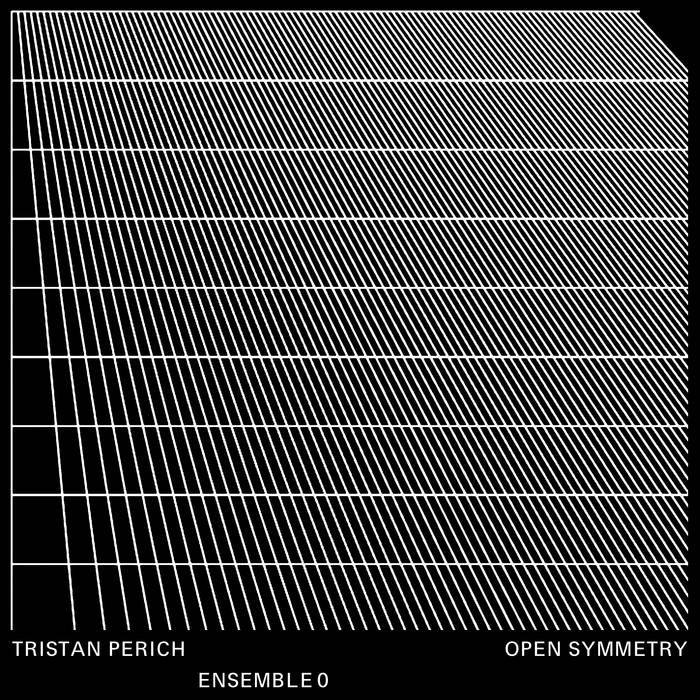
Open Symmetry is the first release on Erased Tapes from New York-based composer Tristan Perich.
As the commentary for the album describes, ‘Open Symmetry pares the ensemble down to just three musicians playing the resonant metal bars of three vibraphone accompanied with a glistening ensemble of 20 speakers, each playing their own separate musical part of the composition.”
Open Symmetry was the result of a meet-up in 2014 between Perich and Ensemble 0‘s Stéphane Garin, who commissioned the piece. Writing for three vibraphone and 1-bit electronics, Perich soon realised it would be a large-scale piece, and the piece occupied him until its premiere in 2019. This is the first recording.
What’s the music like?
Hypnotic is an oft-used word in musical descriptions, but it applies perfectly to the effect this epic piece has on its listener.
Perich’s treble-rich writing creates a rarefied atmosphere, and as the scope of the piece becomes clear there is a sense of assurance, the listener able to kick back and enjoy the piece on two levels.
The first and most immediate level is the short term, and the energetic loops Perich packs together for the vibraphones. Then, as the sections unfold, there is a long-term contentment, the music progressing naturally through each stage without losing any of its momentum.
After a bright introduction, Section 2 is where the pulsing qualities of the music really take hold, before Section 3 opens out beautifully into oscillating figures. Section 4 pulses with warmth and light, initially slow but ultimately powering through. Section 5 becomes like a shower of silvery rain, before Section 6 adopts a more percussive profile of chimes.
A buildup of energy ensues, emphatically released in Section 7 with a thrilling flurry of staccato chords that power to an ecstatic finish.
Does it all work?
It does. Perich writes with impressive conviction and creates vivid colours through motifs that dance in the half light.
Is it recommended?
Yes, enthusiastically. This is a highly impressive achievement, a substantial piece of minimalist music that is both original and effective. Like a long session of bell ringing, Open Symmetry will leave its listeners transfixed.
For fans of… Philip Glass, Steve Reich, Terry Riley
In the last week we heard the sad news of the death of the great Cornish baritone Benjamin Luxon, at the age of 87.
A much-loved singer, Luxon excelled in the opera house and the recital room – not to mention as a soloist in many important recordings of choral and vocal works. The playlist compiled below is packed with English music, with cycles from Vaughan Williams (Songs of Travel) and Stanford (Songs of the Sea).
Luxon took on the title role in the first recording of Benjamin Britten‘s TV opera Owen Wingrave in 1971, an excerpt of which you can also hear below:
You can also hear Benjamin Luxon’s Desert Island Discs on BBC Radio 4
CHERISE, Lucy-Anne Daniels, Marisha Wallace, Lizz Wright, Clarke Peters, BBC Concert Orchestra / Guy Barker
Royal Albert Hall, London Sunday 28 July 2024
reviewed by Richard Whitehouse Pictures (c) Andy Paradise
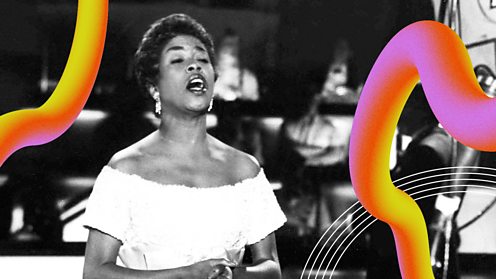
It has been customary in Proms seasons across the past decade to celebrate figures from those interconnected worlds of jazz, blues and soul. In this context, Sarah Vaughan (1924-90) was a natural choice as, though she rarely featured as a songwriter, her versatility across the musical spectrum meant she had few (if any) equals among her peers and even fewer successors. That tonight’s programme, and its four main singers, could do little more than touch on the relevant stylistic bases was itself tribute to one whose insisting ‘‘I am a singer’’ was not to be gainsaid.
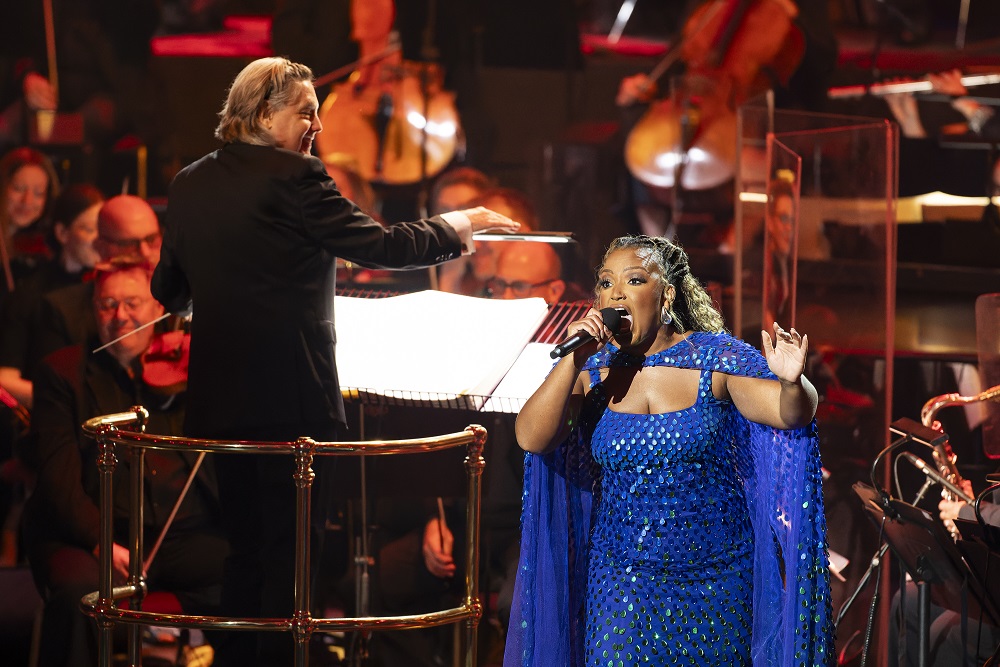
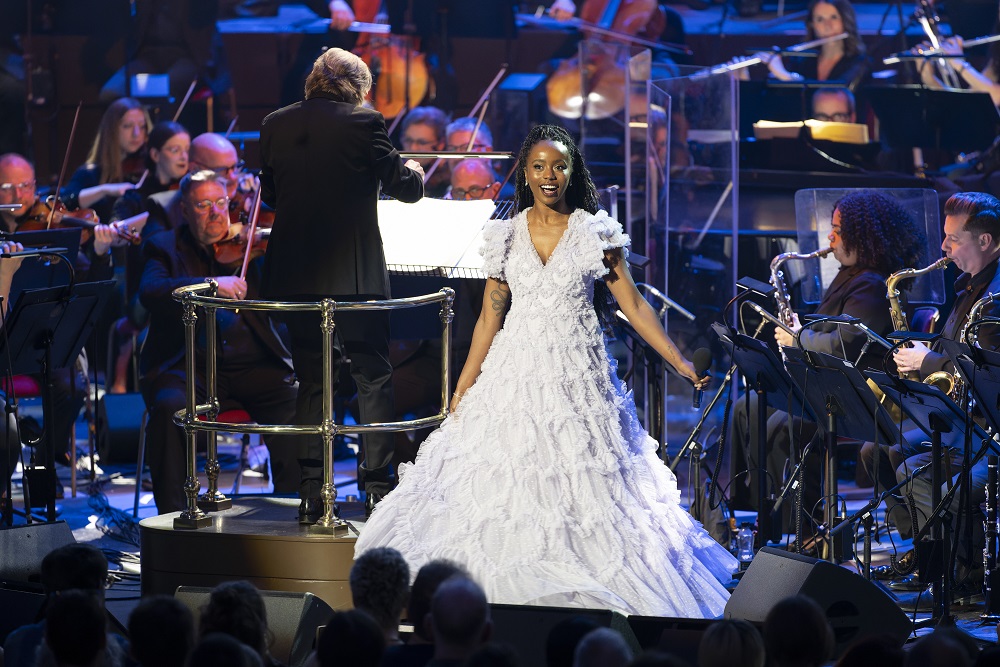
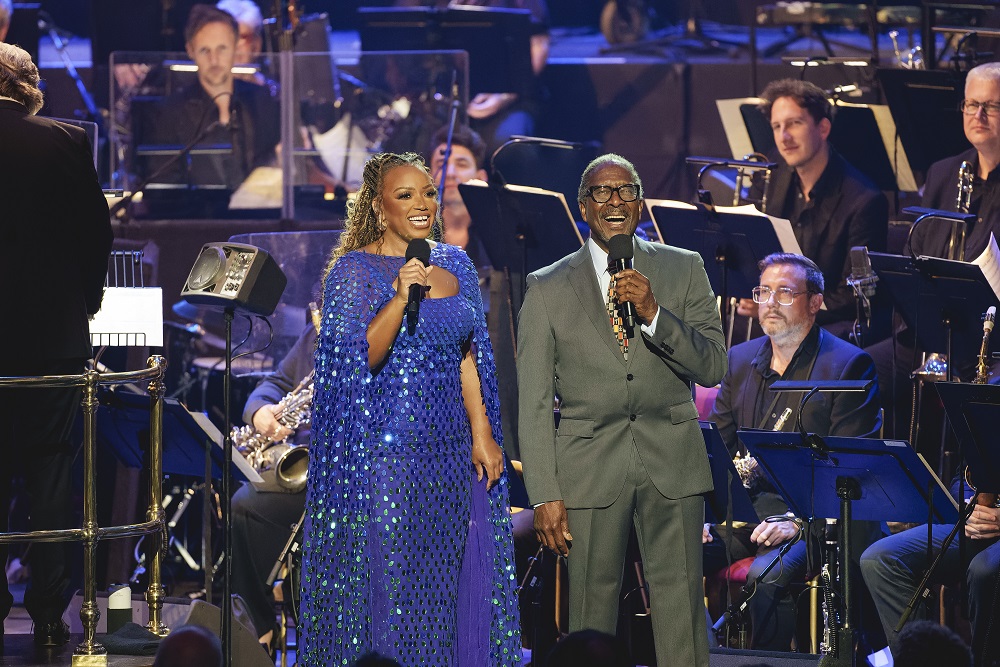
Marisha Wallace (above) pitched straight in with her no-holed-barred reading on I’m Gonna Live Till I Die, complemented by Lucy-Anne Daniels with an appropriately ‘sassy’ Nobody Else but Me then a soulful rendering of A Night in Tunisia (aka Interlude and surprisingly little heard as a vocal item). CHERISE (below) brought no mean pathos to I’ll Wait and Pray then no little wit to the catchy Mean to Me, while Clarke Peters made the most of his spotlight with a dextrous take on I Love the Rhythm in a Riff. Lizz Wright was eloquence itself in Tenderly, and despatched I Hadn’t Anyone Till You with a deft touch, then CHERISE gave a melting rendition of Misty (more affecting for the absence of affectation), but Daniels’s rather ‘by numbers’ scat rather undersold Sassy’s Blues – a pity given this was a rare Vaughan co-write. Wallace returned to round off the first half with a contrasting brace in which My Man, encompassing the wistful and dramatic in equal measure, proved a perfect foil to Great Day whose sheer vocal agility made for an undoubted showstopper with the BBC Concert Orchestra firing on all cylinders.
The orchestra came into its own at the start of the second half, its Bebop Instrumental Medley of standards by Thelonious Monk (‘Round Midnight, Little Rootie Tootie and Pannonica) and Dizzy Gillespie (A Night in Tunisia and Manteca) engaging reminder of the musical environs out of which Vaughan emerged. Daniels then sounded a plaintive tone in Body and Soul, with CHERISE’s insinuating take on Double Rainbow (whistling done to perfection) a reminder of Vaughan’s attraction to Brazilian music in later years. Wallace and Peters were a characterful double-act in Passing Strangers (without banishing memories of Kiki Dee and Scott Walker in their 1968 reading) while CHERISE was raunchiness incarnate in Don’t Be on the Outside, before Wright took the stage for a sequence comprising a moody Black Coffee, sultry Lullaby of Birdland then a confiding If You Could See Me Now which underlined just why this should have become a signature-tune for Vaughan.
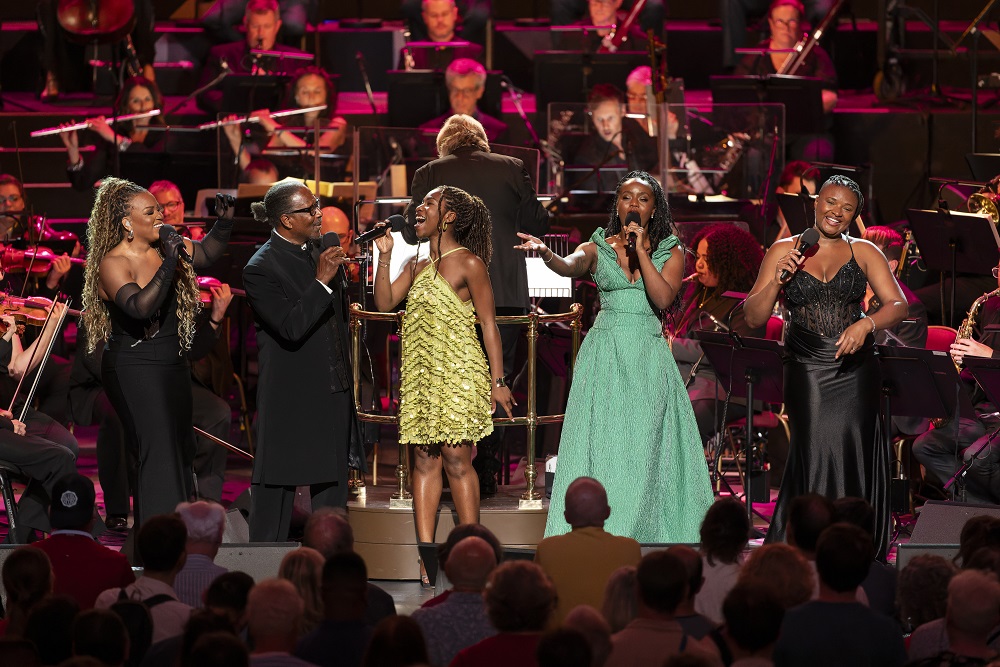
Daniels consequently upped the ante with a blithe I Cried for You, ideally complemented by Wallace with her genial take on Just a Little Lovin’. Although tonight was very much a showcase for vocal prowess, most of the items found space for at least one instrumental solo and rightly so, given the roster of ‘names’ in the BBCCO (a pity that woodwind and reeds were omitted from the personnel in the programme). As conductor (and arranger?), Guy Barker set his inimitable seal on proceedings which hopefully brought Sarah Vaughan a younger generation of admirers. All four vocalists (and Peters) returned for a send-off in the guise of an effervescent take on Perdido that assuredly brought the house down.
Prom 13: Sarah Vaughan – If You Could See Me Now. CHERISE
Lucy-Anne Daniels
Marisha Wallace
Lizz Wright
Clarke Peters presenter
BBC Concert Orchestra
Guy Barker conductor
The night’s program was as follows:
Curtis/Hoffman/Kent: I’m Gonna Till I Die Kern: Nobody Else but Me Gillespie: Interlude (A Night in Tunisia) Treadwell/Valentine: I’ll Wait and Pray Ahlert: Men to Me Eckstine: I Love the Rhythm in a Riff Gross: Tenderly Noble: I hadn’t Anyone Till You Garner: Misty Vaughan/Jones: Sassy’s Blues Yvain: My Man Youmans: Great Day Monk/Gillespie: Bebop Instrumental Medley Green: Body and Soul Jobim: Double Rainbow Mitchell/Applebaum/Mann: Passing Strangers Kelly/Watts/Wyche: Don’t Be on the Outside Burke: Black Coffee Shearing: Lullaby of Birdland Dameron: If You See Me Now Arnhelm/Lyman: I Cried for You Mann/Weil: Just a Little Lovin’ Martínez: Perdido




 Arcana.fm