
Unknown's avatar

About Arcana

My name is Ben Hogwood, editor of the Arcana music site (arcana.fm)

In concert – Simon Desbruslais, English Symphony Orchestra / Kenneth Woods: Sibelius, Sawyers, Dvořák, Fribbins & Elgar

Simon Desbruslais (trumpet), English Symphony Orchestra / Kenneth Woods

Sibelius Rakastava Op.14 (1893, arr. 1912)
Sawyers Concerto for Trumpet, Strings and Timpani (2015)
Dvořák Notturno in B major Op.40 (1870, arr. 1883)
Fribbins Soliloquies (2012, arr. 2017)
Elgar Introduction and Allegro for strings Op.47 (1905)

Hall One, Kings Place, London
Sunday 15 April 2024

Reviewed by Richard Whitehouse

Concerts by the English Symphony Orchestra in the London Chamber Music Society’s season are always a worthwhile fixture and this early-evening event, in its mixing established classics with contemporary pieces, demonstrated the stylistic range and sympathies of this ensemble.

A pity that Sibelius’s Rakastava has never been taken up by many British conductors – John Barbirolli and Sir Colin Davis excepted – as this extensive reworking for strings and timpani of an early choral work should be a staple of its repertoire. Kenneth Woods duly brought out the wistful poise of The Lover, and if the stealthiness which underpins The Way of the Lover seemed just a little tentative, the bittersweet pathos that permeates Good evening, Farewell then came through unabated in what is as moving a leave-taking as its composer ever penned.

The music of Philip Sawyers has been a constant feature of the ESO’s programming this past decade, and his Trumpet Concerto more than deserved revival. The outward Classicism of its formal trajectory should not belie the deftness by which Sawyers modifies the sonata design of its opening Allegro, the impetus and reflectiveness of its main themes finding accord prior to a trenchant cadenza with timpani at the fore, or a central Andante that exuded an emotional breadth and fervour in advance of the excellent recording by these artists. Among the leading trumpeters of his generation, Simon Desbruslais – placed high to the rear of the auditorium, to potent effect – was wholly unfazed by its demands; nor those of a final Allegro in which more reflective elements leaven the initial energy, only to be outdone in the virtuosic closing bars.

Next, a welcome hearing for the Notturno that Dvořák salvaged from an early (and reckless) quartet. Its relative swiftness here recalled its intermediate reworking as an intermezzo in the second of his string quintets, so emphasizing its appealing lilt over any more ethereal quality.

Desbrulais (above) returned after a brief hiatus for Soliloquies by Peter Fribbins. A composer as adept on a symphonic as on a miniature scale, these brief if affecting pieces draw on three earlier songs – the recasting of whose vocal line encourages the soloist to an eloquence that, after the relative restraint of the initial Adagio and central Tranquillo, comes to the fore in a final Adagio where evocation takes on an almost cinematic aura. With impressive concertos for piano and violin to his credit, Fribbins ought to consider a full-length work for trumpet.

Elgar’s Introduction and Allegro has not unexpectedly been key to the ESO’s repertoire since its founding some 45 years ago, and this performance did not disappoint. Most admirable was the variety and depth of string tone that Woods (a one-time professional cellist) secured from only 19 players, so ensuring a vitality and impact in the more animated sections together with the requisite delicacy in those passages where the composer’s ruminative mood is uppermost. Both aspects were brought into thrilling accord at the close of the powerfully projected coda.

Beforehand, Woods spoke of the changing nature of commissions and the current difficulties in securing the necessary funding. This season has not been easy for the ESO though, on the basis of this programme, these players are commendably taking it all in their collective stride.

Click on the link to read more on English Symphony Orchestra, and on the names for more on their conductor Kenneth Woods, and trumpeter Simon Desbruslais. Click on the names for more on the new composers featured, Philip Sawyers and Peter Fribbins

Published post no.2,150 – Tuesday 16 April 2024
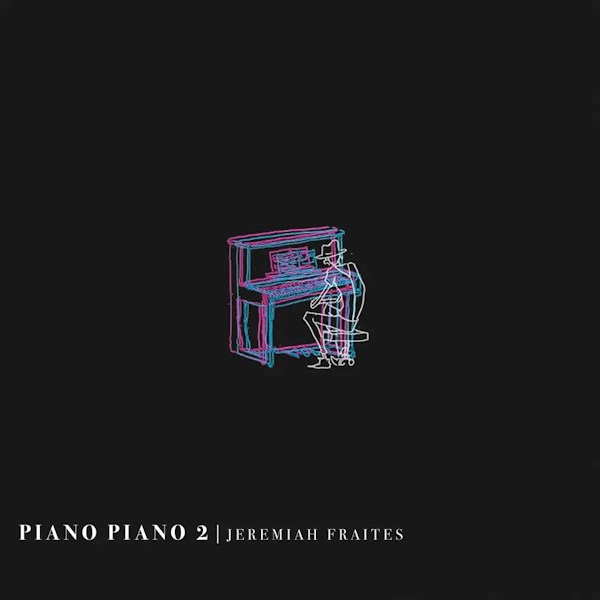
On Record – Jeremiah Fraites: Piano Piano 2 (Mercury KX / Dualtone Records)

by Ben Hogwood

What’s the story?

The Lumineers co-founder Jeremiah Fraites has poured a great deal of his soul into Piano Piano 2 – which, as its name suggests, is his second piano album. Whereas its predecessor was a set of relatively minimal compositions, the sequel has added textures, including strings, guitar, percussion and widescreen textural effects.

Extra Life, one of the single releases, was released in the wake of Fraites losing his father Joel, and has taken on a great deal of personal significance.

What’s the music like?

Fraites certainly keeps the music flowing on this album, using a number of different pianos as he strives for different colours and effects. Perhaps as a result of that Piano Piano 2 does have a greater reliance on texture rather than melody, and it is an outpouring of emotions, a stripping away of layers to get to the core.

Yet ironically it is when Fraites reduces the textures that the music has greatest impact. Pluck is an effective and thoughtful meditation, while the descriptive Snow Falling gives that lovely impression of being indoors, nose pressed up to the window pane, while the snow falls outside.

Extra Life is indeed a powerful track, with a beautiful viola solo to counter the piano work. The album finishes with a guest vocal from Gregory Alan Isakov, a version of Radiohead’s No Surprises that adds a good deal of extra music to the simple dressing of the original. The gospel-like harmonies at the end do rather swamp the vocal, though Isakov does hold his poise.

Does it all work?

Largely – though on occasion it does feel as though too much is going on, the listener swimming against a particularly strong current. Fraites, however, digs deep emotionally in his piano playing, and that comes across to the listener.

Is it recommended?

If you liked the soundtrack Michael Nyman wrote for The Piano, Fraites’s music is a logical next step – for he plays with similar energy and feeling. Yet it is when he takes a step back that the listener can feel closer to his true musical soul.

For fans of… Michael Nyman, Erik Satie, Ludovico Einaudi

Listen and Buy

Published post no.2,149 – Monday 15 April 2024

In concert – Seong-Jin Cho, London Philharmonic Orchestra / Edward Gardner: Wagner, Beethoven & Tippett

Seong-Jin Cho (piano), London Philharmonic Orchestra / Edward Gardner

Wagner Parsifal – Prelude to Act One (1878)
Beethoven Piano Concerto no.4 in G major Op.58 (1805-6)
Tippett Symphony no. 2 (1956-7)

Symphony Hall, Birmingham
Wednesday 10 April 2024

Reviewed by Richard Whitehouse

Although the London Philharmonic Orchestra’s ongoing season might not have been among its most enterprising, this evening’s concert confirmed how Edward Gardner is influencing both this orchestra’s programmes and its approach to standard repertoire as well as modern classics.

Beginning with the Prelude from Wagner’s Parsifal is certainly playing for high stakes and, while it afforded no revelations, this performance seemed nothing if not aware of the piece’s searching grandeur where the placing of motifs and those silences between them is crucial to its overall cohesion. A pity, perhaps, that Gardner opted for the ‘concert ending’ in which the close of the first act is laminated onto what went before instead of merely allowing the music to remain in expectancy, but this detracted only slightly from the majesty of what was heard.

Beethoven’s Fourth Piano Concerto then provided a perfect foil, not least in a performance so attentive to the interplay between soloist and orchestra. It helped that Seong-Jin Cho, winner of the Chopin International Competition in 2015, had an innate feeling for that ‘give and take’ necessary in this most integrated of the cycle; his fastidious while never uninvolving pianism heard to advantage over an initial movement where gradual evolution was uppermost, though his take on Beethoven’s earlier and less capricious cadenza was not lacking virtuosity. He and Gardner were at one in conveying the elemental call-and-response of the Andante, a brief but profound entry into a final Rondo whose vivacity was judiciously balanced with a ruminative poise, where lower woodwinds and strings emerged at the fore prior to the exhilarating close.

Some 66 years following its problematic premiere (restarted after a collapse of ensemble just minutes in), Tippett’s Second Symphony now enjoys regular revival though it could hardly be said to play itself. A keen advocate of this composer (witness his acclaimed recording of The Midsummer Marriage), Gardner paced the opening Allegro unerringly – pointing up contrast between its vigorous and yielding themes, while securing the requisite impetus in its lengthy development then a surging energy in its coda. Punctuated by Paul Beniston’s superb trumpet playing, the Adagio was almost as fine even if a slower underlying tempo might have brought even more depth to some of Tippett’s most evocative and spellbinding music; not least during its central build-up in the strings to a climax whose stark curtailing feels more than prescient.

Reservations as such centred on the Presto – undeniably well articulated in terms of rhythmic precision, while lacking the swiftness or velocity for its obsessive interplay and its Dionysiac culmination really to hit home. By contrast, the final Allegro was far from the anti-climax it can seem. Gardner had its measure from the jazzy introduction, via an inventive sequence of variations then sensuously descending melody on strings against shimmering woodwinds, to those cumulative ‘gestures of farewell’ that ended this performance in ecstatic ambivalence.

If not definitive, this was certainly an absorbing and memorable account as will hopefully be made available on the LPO’s own label (the concert having been broadcast live on Radio 3): one that rounded off what proved to be a judiciously planned and finely executed programme.

Click on the link to read more on the current LPO concert season, and on the names for more on pianist Seong-Jin Cho, conductor Edward Gardner and a website devoted to composer Sir Michael Tippett. The LPO’s new recording of The Midsummer Marriage can be found here

Published post no.2,148 – Sunday 14 April 2024

In appreciation – Edo de Waart

by Ben Hogwood

This week the Dutch conductor Edo de Waart announced his retirement, after six decades at the top of his game. On inspection of his discography, de Waart has conducted a number of important recordings – either in San Francisco, Minnesota or the Netherlands – and a selection of these are included in the playlist below, which begins with a classic recording of Steve Reich‘s Variations for winds, strings and keyboards and ends with the landmark Harmonium, by John Adams:

Published post no.2,147 – Saturday 13 April 2024

In concert – Sheku Kanneh-Mason, Soloists, Philharmonia Chorus, Royal Philharmonic Orchestra / Vasily Petrenko: Elgar, Weinberg & Rachmaninoff

Sheku Kanneh-Mason (cello), Mirjam Mesak (soprano), Pavel Petrov (tenor), Andrii Kymach (baritone), Philharmonia Chorus, Royal Philharmonic Orchestra / Vasily Petrenko

Elgar In The South (Alassio) Op.50 (1904)
Weinberg Cello Concerto Op.43 (1948/1956)
Rachmaninoff The Bells Op.35 (1913)

Royal Festival Hall, London
Thursday 11 April 2024

Reviewed by Ben Hogwood Pictures (c) Chris Christodoulou

The Royal Philharmonic Orchestra and Vasily Petrenko continued their dual focus on Rachmaninoff and Elgar this season with a deeply satisfying programme. They began with Elgar on holiday, music to match the Mediterranean climate of a rather humid Royal Festival Hall. This was In The South, Elgar’s extended postcard from Alassio, Italy, a sudden burst of inspiration that the composer finished in double quick time. Petrenko and his charges caught the instinctive writing, launching the overture in high spirits that brought the spring sunshine in from outside. Their interpretation grew in stature as it progressed, the central statements from brass given impressive heft. Yet it was the quieter asides that proved most telling, notably a fine viola solo from Abigail Fenna, whose depiction of the ‘canto popolare’ was appropriately reserved and beautifully phrased.

Sheku Kanneh-Mason joined for Weinberg’s Cello Concerto, a fine work sharing the same key (C minor) and elegiac mood of its now neglected equivalent by Nikolai Myaskovsky, completed three years earlier. Sheku’s credentials in Shostakovich (he won the BBC Young Musician prize with a standout account of the Cello Concerto no.1) served him well here, and he was an eloquent guide in the thoughtful first movement. Again this was an interpretation growing in stature, from a silvery first movement to the persuasive habanera of a Moderato that grew increasingly sour in tone, aided by standout solos from trumpeter Matthew Williams. By the third movement Allegro the gloves were well and truly off, incisive solo playing carrying through to an assertive and deeply felt cadenza, before the finale responded with doleful phrases turning us back to the material of the first movement, emotions not fully resolved. The main theme carried more weight second time around, while Kanneh-Mason’s choice of the same composer’s Prelude no.18 for solo cello was ideal as an encore, setting the seal on a fine interpretation. Hopefully his thoughts on the concerto will be set down in the studio by Decca before long.

Rachmaninoff’s four-part choral symphony The Bells formed a dramatic second half, led by an extremely well-drilled Philharmonia Chorus (prepared by Gavin Carr), whose diction and ensemble were most impressive. On first glance the men appeared outnumbered, but when the telling moments came in the third and fourth movements they rose to the occasion with great conviction.

In tenor Pavel Petrov, soprano Mirjam Mesak and baritone Andrii Kymach, Petrenko could call on three excellent soloists, Mesak in particular impressing with her sensitive phrasing and vibrato, passionately singing The Mellow Wedding Bells. Her glittering dress was an ideal match for Poe’s verse, too. Petrov’s ringing delivery set the ideal tone in The Silver Sleigh Bells, while Kymach’s declamation was pitched just right for The Mournful Iron Bells, right after the frenzied scherzo, The Loud Alarm Bells.

The Royal Philharmonic Orchestra gave memorable contributions, with incisive woodwind, plangent brass, strings united as one, and percussion that added punctuation to the choral thunderclaps of The Loud Alarm Bells, Rachmaninoff effectively slamming the door shut on his deepest fears. Following this dramatic high point, the cor anglais solo of Patrick Flanaghan was all the more poignant – and Petrenko made sense of the major key ending, a chink of light in the darkness.

You can find more information on further concerts at the Royal Philharmonic Orchestra website

Published post no.2,146 – Friday 12 April 2024