Unknown's avatar

About Arcana

My name is Ben Hogwood, editor of the Arcana music site (arcana.fm)

BBC Proms at Cadogan Hall – Marmen Quartet play Haydn & Robert Simpson

Marmen-Quartet

Marmen Quartet [Johannes Marmén & Ricky Gore (violins), Bryony Gibson-Cornish (viola), Sinéad O’Halloran (cello)]

Haydn String Quartet in D major Op.64/5 ‘Lark’ (1790)
Simpson String Quartet no.1 (1951-2)

Cadogan Hall, London
Monday 16 August 2021 (1pm)

Written by Richard Whitehouse

In his centenary, it was timely to include music by Robert Simpson (who spent three eventful decades at the BBC) at the Proms, and while one might have hoped for one of his symphonies in the evening concerts, his First Quartet at a Cadogan Hall recital was hardly less welcome.

Finished when Simpson was in his early thirties and dedicated to Enescu (who read through and commended the score during his last visit to the UK), the First Quartet fairly typifies the composer’s music at this time in its stealthy take on progressive tonality and methodical yet never pre-ordained design. Thus, the opening Allegro evolves seamlessly from wistful then animated main ideas through an inwardly probing development to a trenchant reprise then a headlong coda; the ensuing Andante unfolding a series of variations on a ruminative theme – structured as a palindrome – that grows in intensity towards a fervent culmination before it touches on the work’s opening theme on route to a limpid final repose. Simpson was to use   a two-movement format on subsequent occasions, but never so elegantly or lucidly as here.

In his introductory remarks, Johannes Marmén stated that the Marmen Quartet had not been familiar with Simpson’s music until asked to learn the First Quartet for this recital. Evidently played-in beforehand, this afternoon’s performance was impressive in its formal command and audible feel for a distinctive idiom of far-reaching consequences. Hopefully this group will tackle further Simpson – the Second and Third Quartets, which explore the potential of their predecessor in what effectively becomes a ‘meta-quartet’, are a good place to continue.

A passing allusion to Haydn’s Lark Quartet at the start of the Simpson made the former a natural pairing, of which the Marmen made a virtue with its attentive and insightful account. After an animated reading of the initial Allegro (second half repeat included to make it weightier), the Adagio was notable for its eloquent ensemble and a tentative wit made manifest in the lively Menuetto. Sparkling yet never skittish, the final Vivace rounded off this performance in appealing fashion – leaving little doubt of the Marmen Quartet as an outfit with a future.

You can find more information on the BBC Proms at the festival’s homepage
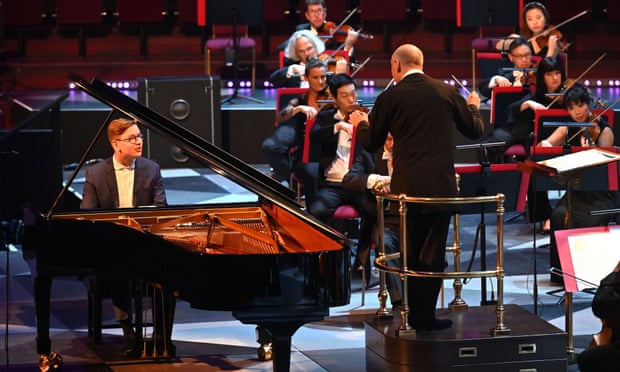
BBC Proms – Víkingur Ólafsson, Philharmonia / Paavo Järvi: Bach, Mozart, Prokofiev & Shostakovich

olafsson-jarvi

Víkingur Ólafsson (piano), Philharmonia Orchestra / Paavo Järvi

Prokofiev Symphony no.1 in D major Op.25 ‘Classical’ (1916-17)
J.S. Bach Keyboard Concerto in F minor BWV1056 (c1738-9)
Mozart Piano Concerto no.24 in C minor K491 (1786)
Shostakovich Symphony no. 9 in E flat major Op.70 (1945)

Royal Albert Hall, London
Saturday 14 August 2021

Written by Richard Whitehouse

Tonight’s Prom brought change of conductor, the always reliable Paavo Järvi stepping in for Santtu-Matias Rouvali in what would have been the latter’s Proms debut, but not of soloist – Icelandic pianist Víkingur Ólafsson duly making his first appearance at these concerts with concertos which, for the most part, played to his strengths.

The number of times that Bach’s keyboard concertos have been heard here on piano in recent decades can be counted on the fingers on one hand (Tatiana Nikolayeva’s D minor resonates in the memory), but that in F minor was a good choice in terms of its succinctness – the outer movements pitting soloist and (sizable body of) strings against each other with a trenchancy as was vividly conveyed here, with the central Andante an oasis of serenity that was not without its plangent asides.

Placing this piece before the interval, however, made for a distinctly short first half – given the relative length of Mozart’s C minor Concerto after the interval. There were many good things in this latter, Ólafsson keeping the first movement on a tight yet never inflexible rein so that its inclination to pathos – if not always its portentous undertones – came through in ample measure; not least in a coda that had been cannily prepared by the soloist’s cadenza. The central Larghetto was none the less the highlight – Ólafsson varying his tone such that piano melded into the woodwind for an early and defining instance of timbral colouration, with its limpid elegance never undersold. Maybe the finale was a little staid in the overall unfolding of its variations, but the coda’s strangely ambiguous poise was tangibly realized.

An auspicious debut, then, for Ólafsson, who underlined his prowess with affecting readings of the slow movement of Bach’s Fourth Organ Sonata (BWV526) in August Stradal’s chaste transcription and Liszt’s not unduly mawkish version of Mozart’s Ave Verum Corpus (K617). These further extended the disparity between each half – the first of which had commenced with Prokofiev’s ‘Classical’ Symphony, not in the least small of scale or mimsyish as Järvi heard it; witness his acerbic and impetuous take on the initial Allegro, trumpets and timpani to the fore, then a Larghetto whose swift underlying tempo left little room for any harmonic piquancy to emerge. The Gavotte was slightly marred by several mannered agogics which tended to impede its rhythmic profile, but the Finale lacked little in sparkle or insouciance.

Among the most travelled and recorded conductors of today, Järvi can seem detached or even aloof in manner – but there was no such reticence evident in Shostakovich’s Ninth Symphony as ended this programme. After a tensile and assertive Allegro, which audibly benefitted from the sizable forces onstage, the Moderato recalled Efrem Kurtz’s classic recording as to overall restraint and a dark-hued introspection rising to anguish in its twin climaxes. Playing without pause, the other movements were of a piece with the foregoing – a driving and almost manic Presto subsiding into a Largo, whose ruminative bassoon soliloquys were eloquently taken by Emily Hultmark, then an Allegretto whose capriciousness was acutely gauged through to its bitingly sardonic climax and breathless final payoff. Undoubtedly a performance to savour.

You can find more information on the BBC Proms at the festival’s homepage

On record: Wooden Elephant: Landscapes, Knives & Glue – Radiohead’s Kid A Recycled

wooden-elephant

Wooden Elephant [Aiofe Ní Bhriain, Hulda Jónsdóttir (violins), Ian Anderson (viola, arrangements), Stefan Hadjiev (cello), Nikolai Matthews (double bass)

Backlash Music [59’29”]

Reviewed by Richard Whitehouse

What’s the story?

The quintet Wooden Elephant releases its take on Radiohead’s seminal album Kid A, second in its reworking of game-changing albums that commenced in 2016 with Björk’s Homogenic then continued in 2018 with Beyoncé’s Lemonade, on the enterprising Backlash Music label.

What’s the music like?

When it appeared in autumn 2000, Kid A not only redefined what even as forward-thinking a rock band as Radiohead was capable of, but also topped the mainstream charts on both sides of the Atlantic. Thus, an album as artistically radical as it is commercially successful such as violist Ian Anderson has made it his mission to reassess. Each of the musicians plays a range of sundry instruments (what improviser Jamie Muir would have deemed ‘allsorts’), yet they are extensions to the already inclusive string sound on which these ‘arrangements’ are based.

After the gradual merging into focus then rhythmic and melodic clarifying of Everything in Its Right Place, the subdued moodiness of Kid A is afforded a ruminative treatment which reveals an unsuspected poise in the melodic line and whimsical twist to the accompaniment. The rhythmic obsessiveness of The National Anthem gives rise to an invigorating textural workout that spills over into mayhem towards the close (who needs an orchestra?) – and to which the video’s Jarmusch-like interplay of drink-stirrers with woodland inhabitants offers an intriguing complement. A siren-song reverb from wine glasses then segues into How to Disappear Completely whose brooding eloquence and lilting gait make it a highlight now as then, while Treefingers is no less arresting given its ethereal emergence and timbral finesse.

The propulsive syncopation of Optimistic effects a vibrant and soulful – if, in this context, relatively straightforward – response, with the hymnic preamble then stealthy integrating of rhythmic and melodic elements across the course of In Limbo satisfying in its immediacy. Nor is there anything predictable about Idioteque with its plaintive unfolding set against a pulsating undertow that drives towards a febrile close, out of which the lucid melodic profile of Morning Bell is maintained from its tentative arrival to its sudden disintegration. It duly remains for the aching pathos of Motion Picture Soundtrack to provide a heartfelt ending; here with its (unintended?) postlude, which is often tracked as Untitled on digital versions of the original album, serenely dissolving into a melange of ricocheting chordal patterns.

Does it all work?

Almost always. Something that was never quite a rock album has provided ideal material for an ensemble that is not quite a string quintet, Wooden Elephant taking full advantage of this stretching of musical and conceptual boundaries to come up with what is an absorbing listen in its own right. Just occasionally the ensemble’s interplay evokes those bluesy harmonies of Quintette de Hot Club de France, but this serves to throw the more experimental aspects of its approach into provocative relief. Nor does the vividly defined sound leave anything to chance.

Is it recommended?

It is. This is an ideal opportunity to reconsider a key album from the turn of the Millennium, finely interpreted by a sympathetic and resourceful ensemble. Wooden Elephant is giving a performance in Potsdam this November, with hopefully further hearings to follow in the UK.

Stream

Buy

Further information

For more on Wooden Elephant, click here, and for more on Backlash Music, click here

Listening to Beethoven #181 – 7 Bagatelles Op.33

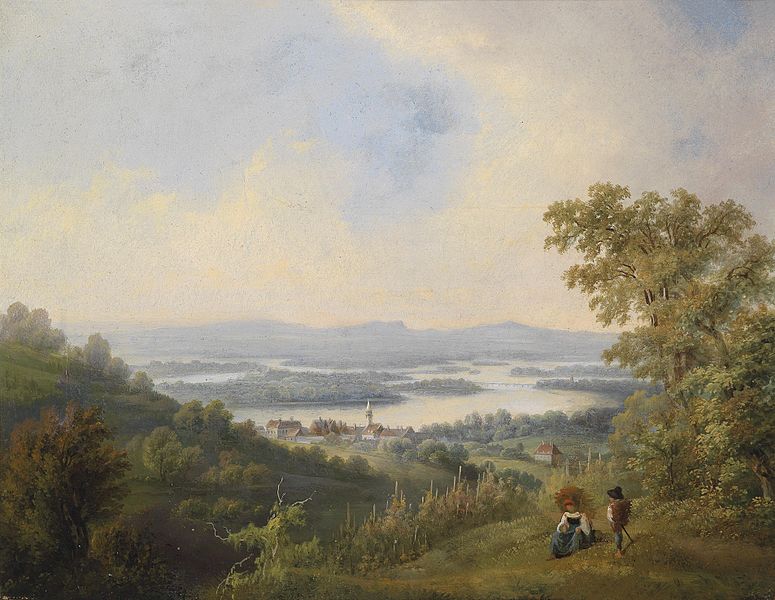
Heiligenstadt 19th century by Anon

7 Bagatelles Op.33 for piano (1802, Beethoven aged 31)

1. Andante grazioso quasi allegretto (E♭ major)
2. Scherzo – Allegro (C major)
3. Allegretto (F major)
4. Andante (A major)
5. Allegro ma non troppo (C major)
6. Allegretto quasi andante (D major)
7. Presto (A♭ major)

Dedication not known
Duration 20′

Listen

written by Ben Hogwood

Background and Critical Reception

1802 was a key year for Beethoven. Suffering from ill health and from the disintegration of his hearing, he was instructed by his doctor to leave Vienna for the nearby village of Heiligenstadt, to aid his convalescence.

Sadly his health did not improve, giving to the famous Heiligenstadt Testament, where the composer bared his soul in a letter to his brothers. The correspondence was sealed but not delivered or seen until after Beethoven’s death.

Despite (or in spite of) going through such a tragic time, Beethoven redoubled his efforts as a composer, focusing all his energies into new work. Around this time he turned to the Bagatelle, a short form of piano piece, collecting his first volume of seven miniatures in a folder and publishing them as Op.33 in 1803. Each lasts two or three minutes.

The collection consists of ideas going right back to the composer’s early music from Bonn, and may (writes Misha Donat for Hyperion) include music written as long ago as 1782, used for the first piece of the seven. ‘Perhaps the intricate, improvisatory runs that embellish the main theme (they become more elaborate with each appearance) were a later addition’, he says. Summing up, ‘the two jewels of the set are, perhaps, the much more relaxed and lyrical fourth and sixth numbers.’

Thoughts

The Bagatelles are great fun. The first piece enjoys leaning on its dissonances – a friendly, welcoming way in. It also hangs around in the listener’s head, its main tune being unexpectedly catchy. The second is lively too, firstly adopting the profile of an offbeat march, but then rumbling into A minor for a fulsome second idea. Beethoven is enjoying himself – and continues to do so more subtly in no.3. This is a popular student piece (which I have had the joy of playing) and is simple but wonderfully effective, springing a subtle surprise when the music suddenly but effortlessly turns the music from F major into D major.

The fourth bagatelle is indeed more relaxed, bringing reminders of Mozart with its graceful air, though clouds appear briefly in the minor key middle section. By contrast the fifth is a torrent of notes, asking questions when it pauses but emphatically answering them with a cascade down the keyboard. The sixth relaxes a bit more, an appealing conversational piece. Finally we get a sneak preview of the figuration Beethoven is to return to in the Waldstein sonata, the last bagatelle generating manic energy.

Recordings used and Spotify playlist

Alfred Brendel (Philips)
John Lill (Chandos)
Paul Lewis (Harmonia Mundi)
Glenn Gould (Sony Classical)
Ronald Brautigam (BIS)

A wide range of approaches here, from Ronald Brautigam’s crisp staccato on the fortepiano to Alfred Brendel’s peerless phrasing and poise. Outside of these lies Glenn Gould, a fascinating and engaging listen. His style sounds very prim and proper to begin with but once the ear adjusts it is actually very appealing, and he lingers lovingly over the dissonances of no.1. John Lill and Paul Lewis, last but certainly not least, enjoy the music greatly.

You can also hear clips of Steven Osborne’s recording at the Hyperion website

You can chart the Arcana Beethoven playlist as it grows, with one recommended version of each piece we listen to. Catch up here!

Also written in 1802 Titz 3 String Quartets

Next up Romance no.1 in G major Op.40

BBC Proms – Dame Sarah Connolly, BBC SO / Brabbins: Berlioz, Payne & Beethoven

sarah-connolly

Dame Sarah Connolly (mezzo-soprano, above), BBC Symphony Orchestra / Martyn Brabbins (below)

Payne Spring’s Shining Wake (1980-81) (Proms premiere)
Berlioz Les nuits d’été Op.7 (1840-41, orch. 1856)
Beethoven
Symphony no.6 in F major Op.68 ‘Pastoral’ (1808)

Royal Albert Hall, London
Friday 13 August 2021

Written by Richard Whitehouse

A family bereavement meant that Sir Andrew Davis was unable to conduct this Prom, the baton having been taken up by Martyn Brabbins – whose currently in-demand status is a reflection not least of his broad range of musical sympathies and an inherent ability to ‘get things done’.

Not too many conductors would have taken on at relatively short notice a long-unheard piece by the late lamented Anthony Payne then render it with the familiarity of a repertoire staple. Seemingly unheard for 15 years, Spring’s Shining Wake was a breakthrough piece in several respects: the composer fashioning a ‘contemporary’ yet never esoteric idiom, unencumbered by stylistic precedent, as reflected his love of an earlier generation of English music. Delius’s In a Summer Garden is a focal-point in several respects, but what comes over most strongly in its modest scoring (seven wind, one percussionist and strings) is a sense of organic growth from the overtly static formal framework; textures diversifying and intensifying, yet without changing as to their essential features, in music exemplifying the ‘same yet different’ maxim.

From there to the limpid Romanticism of Berlioz’s song-cycle Les nuits d’été is nearer than might be imagined, this latter being notable for its range of expressive nuance despite (even because of) its pervasive restraint. Certainly, there was no uniformity of response from Dame Sarah Connolly – whose whimsical response to Villanelle contrasting with the wide-eyed fantasy of Le spectre de la rose, and becalmed rapture of Sur les lagunes thrown into relief by the fervent heartache of Absence then the spectral imaginings of Au cimetière; itself finding purposeful response in the animated L’île inconnue with its vouchsafing new imaginative realms. Coordination between soloist and orchestra is paramount throughout, and there was no lack of that in a reading as conveyed this music’s potent sensibilities with acute insight.

Nor was there anything routine about Beethoven’s Pastoral after the interval. Readers may remember a cycle of all nine symphonies which Brabbins (above) gave with the Salomon Orchestra just over a decade ago, and his purposeful if never inflexible take on the opening movement left room for its reflective asides and heady flights of fancy. This was no less evident in the Scene by the brook, with its emphasis on seamlessness of transition and unity of content – not least in the way those bird-calls of the coda were integrated into their textural context.

Unfolding with consistency of pulse, the remaining three movements yielded few surprises but no failings. A touch of blandness in the scherzo was duly countered with the immediacy   of the Thunderstorm and its nexus of accrued emotion whose dispersal makes possible the Shepherd’s Song – less cumulative in its eloquence than others have made it, perhaps, but whose inevitability of progress was sustained through to a close of serene poise; underlining the degree to which any trace of ego has been sublimated in the enveloping cosmic dance.

Some elegant and characterful playing from the woodwind of the BBC Symphony Orchestra was a highlight of this performance, a reminder that even a work with a Proms tally running to several dozen never need sound routine when approached with such unaffected reverence.

For further information on the music of Anthony Payne, visit the composer’s website. You can find more information on the BBC Proms at the festival’s homepage